Key Takeaways
- A credible drinkware vendor should quote MOQ, lead time, and test reports up front, not after you place a deposit.
- For Europe and North America, ask for REACH, LFGB, ISO 9001, and AQL 2.5 final inspection data before you approve the order.
- A 304 stainless custom canteen is usually the safest default for cost, durability, and branding flexibility.
- In China and Zhejiang, strong factories can support 300,000 units per month, but only if you lock specs, artwork, and packaging early.
If you are buying custom drinkware for retail, promotion, or distribution, the wrong drinkware vendor costs you twice: once in samples, once in chargebacks, delays, and customer complaints. The real question is not who can print a logo. It is who can run a stable canteen custom program with tight welds, leak resistance, and export paperwork that clears customs on the first pass. On our floor, QC pulled the sample at the seam with a 0.2 mm gauge before anyone touched packing.
A serious canteen factory in Zhejiang or elsewhere in China should quote MOQ, lead time, packing method, and test data without hand-waving. A mature line may run 300,000 units per month, with 1,000 pcs MOQ for a standard stainless SKU and 20 to 35 days for production after sample approval. If the canteen manufacturer cannot give you those numbers, you are still screening suppliers, not sourcing. We saw a buyer flag a PO typo on carton count last month, and that kind of miss turns into a chargeback fast.
What A Vendor Must Prove
The first test is simple: can the drinkware vendor prove it is a real production partner, not a quoting desk. A canteen supplier or canteen vendor should show product photos that match the sample, a current capacity sheet with weekly output, and recent test reports from the lab bench. Ask whether they are a canteen factory, a canteen manufacturer, or a trading company, and the answer should come back in one sentence. We run this check before any price talk, because a polished catalog does not move a 3,000-piece order through the line.
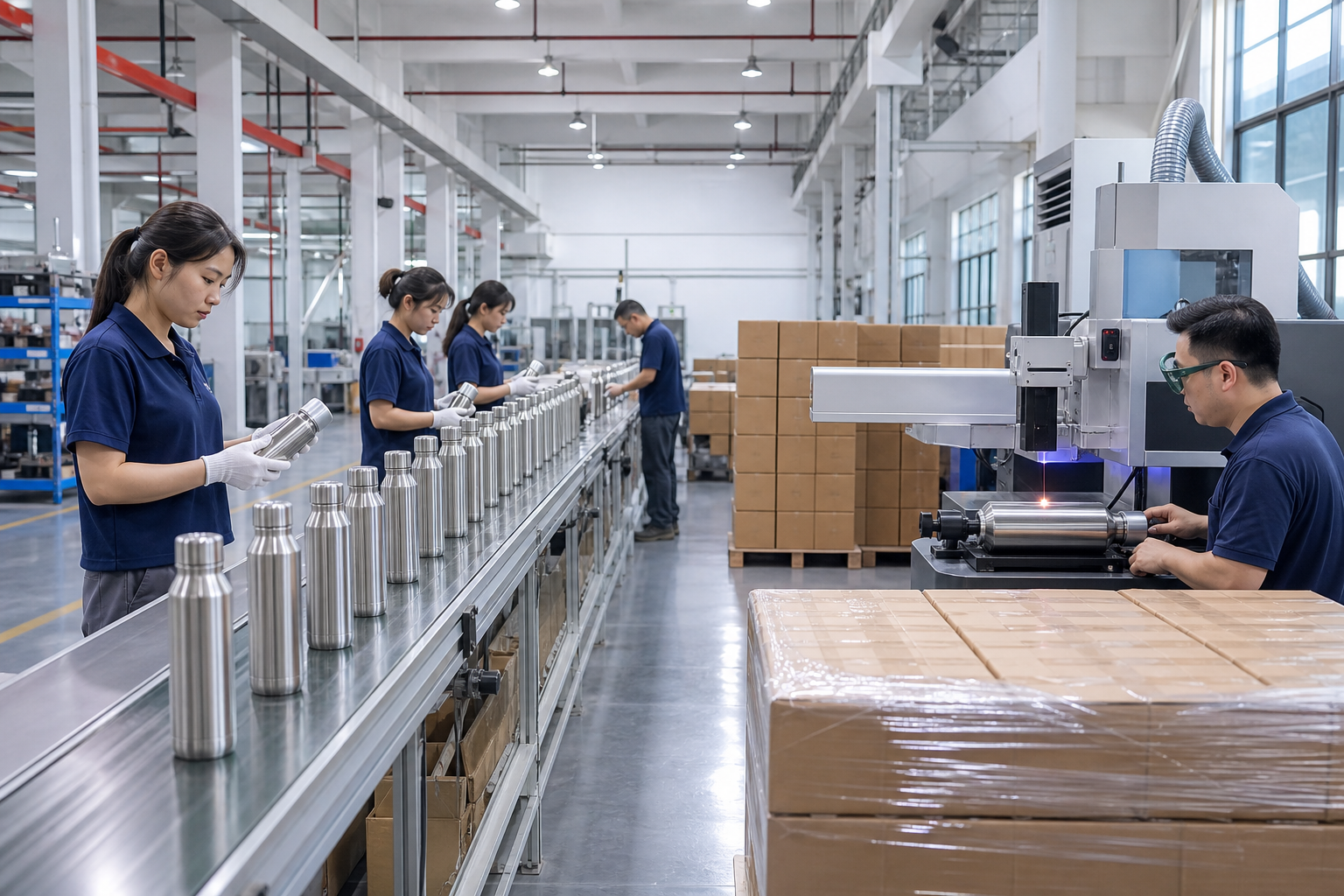
Look for evidence that the factory actually controls the process. That means in-house mold maintenance, incoming inspection with a caliper and go/no-go gauge, and a stable decoration line. A proper canteen manufacturer can tell you where the bottle body is formed, how the cap is assembled, and which step catches leaks before carton packing; on our side, QC pulled the sample at the 0.2 bar leak test, not after packing. If they also produce customized drinkware for retail chains or distributor drinkware programs, ask for references by market type, not by brand name. A canteen distributor serving Amazon needs different pack-out discipline than a canteen distributor serving a warehouse club. We've seen this go sideways when a buyer asked the wrong question.
For custom canteen projects, pay attention to how the vendor handles samples. A good workflow is design confirmation, pre-production sample, then gold sample approval. We run that sequence with a signed spec sheet, because a 1 mm change on the lid or a typo on the PO will turn into a missed carton label and a second round of photos. If the seller cannot describe that process, the risk stays with you.
Match Product To Channel
Not every bottle fits every channel. A 500 ml custom canteen for outdoor retail is not the same job as a canteen promo piece for a trade show, and a custom growler for a brewery chain is a third case altogether. Start with the channel, not the print file. Retail wants shelf presence, a solid lid, and low return risk. Promo buyers want quick sign-off, tight cost, and artwork that does not trigger three rounds of revisions. We ship these differently for a reason. A buyer once asked us to push a powder-coated canteen into a giveaway slot with a 2-color logo and 18-day lead time. The math does not work.
For mainstream programs, the cleanest mix is usually one stainless model, one sports bottle, and one tumbler. A 20 oz travel tumbler still moves in North America. A 750 ml sports bottle works for gyms and team packs. A 500 ml custom canteen is easier to carton and easier to price than oversized novelty shapes. On the line, each extra mold means more QC checks, more sample pull time, and more carton testing. If you are building a canteen custom line for a brand owner, keep the range tight. Three SKUs are enough for most programs. Six is where it starts to get messy.
The same rule applies to canteen manufacturers and canteen suppliers serving distributors across Europe. Pick SKUs that can share caps, inserts, or packing dimensions, even if the buyer pushes for a one-off shape. That is how you hold freight down and keep dead stock from eating margin. We have seen this go sideways when a PO typo changed the neck finish from 55 mm to 65 mm and QC pulled the sample before shipment. Customizable drinkware works best when the base product already matches the channel, not after you force it to fit.
Materials, Compliance, And Safety
Material choice is where a serious drinkware vendor earns the order. On stainless jobs, 304 is the starting point. If the bottle will see harsher use, or the buyer wants a better interior spec, we run 316, but the cost goes up fast. For plastic lids and sleeves, ask for BPA-free resins and colorants that do not drift after 500 cycles. For a custom growler or insulated bottle, the inner wall thickness, vacuum hold, and weld seam matter more than the brochure copy. I have seen buyers fixate on the print finish while the line was failing on a 0.3 mm weld gap. That is the wrong question to ask.
For Europe and North America, ask for REACH and, where relevant, LFGB evidence. If the product carries temperature claims, ask how the factory checks them. ISO 9001 tells you the plant runs a process, not that every unit passes. It still matters. If the factory is BSCI-audited, that helps when your buyer needs social compliance papers on file. Some canteen manufacturers will also hand over ASTM-based or internal tests for lid cycling, coating adhesion, or thermal retention, and we treat those as supporting evidence, not sales talk. QC pulled the sample at 50 cycles once and the hinge started whitening at 38. The buyer flagged it, and we changed the resin blend the same week.
China has a wide range of factories, and Zhejiang is full of them, but you still need the test report number and the issue date. A canteen supplier that cannot show current paperwork is asking you to carry risk you do not need. We ship enough PO's to know the typo on page two can hide the real problem, and a missing report date does the same thing. Ask for the actual document, not a screenshot. For custom drinkware, compliance is not optional. It is the price of admission.
Decoration That Survives Shipping
Artwork is where a lot of canteen promo orders slip. A logo can look fine on a mockup and still fail after 200 dishwasher cycles or two weeks of rubbing in transit. We ask the drinkware vendor which process fits the body: silk screen for one- to two-color art, laser engraving for stainless steel, UV print for complex graphics, and powder coating when the color shell has to take abuse. On our line, a 3M tape rub test on a curved wall shows the weak spot fast. The process follows the substrate, not the price sheet.
For custom logo work, we ask for Pantone references, vector files, and a proof that shows logo size, location, and color tolerance. A PO typo on one batch swapped 350 ml for 500 ml, so we now check the artwork sheet against the carton mark before the line runs. A canteen custom order also needs to say whether the print lands on a curved body, a flat panel, or a sleeve. That one call changes the result more than most buyers expect. If you are buying customized drinkware for a retailer, ask for a rub test or cross-hatch test before mass production. For a canteen distributor, that beats a full return cycle later.
Laser engraving is usually the safer call for stainless custom canteen and custom growler jobs because it does not peel. Silk screen costs less and works for promo volume if you accept normal wear. We ran one 304 stainless run last month where QC pulled the sample after the first pass because the engraving depth was 0.08 mm shallow at the handle side. A capable canteen factory will tell you where decoration helps and where it turns into a failure point. That honesty is worth more than a flashy effect, and we've seen the wrong choice come back in damaged cartons and unhappy buyers.
MOQ, Pricing, And Lead Times
Pricing only makes sense when you put it next to MOQ, tooling, and packing. In Zhejiang and across China, a mature canteen factory will usually quote 1,000 pcs MOQ for a standard stainless bottle, 500 pcs for a stock tumbler with logo, and 3,000 pcs if you want a custom color body or special lid. We ran this last week on the line: the buyer pushed back on a 3,000 pcs lid color, but the real cost was the Pantone spray setup and a second sample on the torque wrench. Those numbers are normal. A 200 pcs offer often means the factory is mixing your order with leftover stock, and that is the wrong question to ask if you want repeatable replenishment.
Lead time is just as hard a number. For a simple customized canteen, 20 to 35 days after sample approval is realistic. Add time for custom packaging, color matching, or a new mold. QC pulled the sample and found a 0.3 mm gap at the lid seal, so we held shipment two days and fixed it before mass run. FOB pricing should include product, standard packing, and export carton setup, not hidden artwork fees or surprise test charges. Ask for sample cost, sample freight, mass production price, and carton pack count in one line item. We had one PO with a typo on carton count, 24 pcs written as 42, and that sort of mistake blows up the math fast.
If you are a canteen distributor, push the vendor to quote in tiers. A 1,000 piece price, a 3,000 piece price, and a 10,000 piece price will tell you more than a single number. Good factories can scale; weak canteen vendors only look cheap at the first breakpoint. We ship this way because the line cost drops once tooling, labor, and carton setup are spread across volume. The best custom drinkware programs are built around repeatability, not one-off discounts.
Quality Control And Export Docs
Quality control should be written into the purchase order, not discussed only after a problem shows up. Ask the drinkware vendor what inspection plan it runs: incoming inspection, in-line checks, and final AQL inspection. For most consumer drinkware, AQL 2.5 for critical and major defects is a reasonable starting point, with 4.0 or similar thresholds on minor issues depending on your tolerance. If a canteen manufacturer cannot explain whether a 0.5 mm gap counts as a leak, which dent depth gets rejected, or why a print shift failed on the line, the inspection plan is too vague. We have seen buyers try to sort that out after the PO is signed. The math does not work.
Good export documentation is part of quality, not a separate admin task. Your supplier should be able to prepare commercial invoice, packing list, carton marks, and if needed a certificate of origin. If you sell through Amazon or a similar channel, ask in advance for FNSKU application, barcode placement, master carton dimensions, and pallet specs. That is not paperwork noise. A buyer once flagged a typo on the carton mark before shipment and saved a week of warehouse relabeling; that is the kind of problem that shows up when the vendor treats docs as an afterthought. A distributor drinkware buyer who ignores packout details often pays for it in labor.
When you work with a canteen vendor in China, ask for photos from the first 10 cartons, not only the final shipment. That gives you a chance to catch label mistakes, bagging errors, and color drift before the whole lot leaves the factory. QC pulled the sample from carton 3 and caught a 1 mm print offset before we shipped 5,000 units. A disciplined canteen supplier should welcome that request, because it is cheaper to fix a bad carton on the line than to handle a claim after export.
Request a quote with specs that matter
Send your target MOQ, artwork, market, and packing requirements. We will quote the right custom drinkware line, not a vague brochure price.
Frequently asked questions
What MOQ should I expect from a drinkware vendor?
For a standard stainless custom canteen or travel tumbler, 1,000 pcs per SKU is common in China, especially from a factory in Zhejiang with stable tooling. If you only need logo printing on a stock body, some canteen suppliers can go to 500 pcs, but the unit price will be higher. If you want a new color, special lid, or custom packaging, 3,000 pcs is more realistic. The key is to ask whether MOQ is tied to material, decoration, or carton packing. A serious drinkware vendor will break the number down instead of giving you one vague figure.
Which decoration method lasts longest on custom drinkware?
For stainless steel, laser engraving is usually the most durable because it does not peel or fade like surface ink. Silk screen is fine for simple canteen promotional orders if the customer accepts normal wear. UV print gives better graphic flexibility, but abrasion resistance depends on the coating system. Powder coating works well for full-body color and canteen custom branding, especially on bottles that will be handled every day. Ask the canteen manufacturer for a rub test, dishwasher guidance, and a sample proof before mass production. That small step prevents a lot of rejects later.
What compliance documents do I need for Europe or North America?
At minimum, ask for REACH for chemical compliance, and LFGB where your market or buyer requires it. ISO 9001 is useful because it shows the factory runs a process system, and BSCI helps when your customer asks for social audit evidence. If the product includes temperature claims, ask for the test method and report date. For custom drinkware, you should also confirm food-contact materials, especially for lids, seals, and coatings. A canteen vendor that works with Europe or North America should be able to send these documents without delay.
How long does a customized canteen order take?
For a standard custom canteen, expect 20 to 35 days after sample approval. If you need a new mold, custom color matching, or special packaging, add 10 to 15 days. Shipping time is separate and depends on route, but your factory lead time should be stated clearly in the PO. A canteen factory with 300,000 units per month can still miss deadlines if artwork approval is slow, so keep your logo files, Pantone references, and carton text ready before you confirm the order. Speed comes from preparation, not from pressure.
How do I compare two canteen suppliers fairly?
Compare them on the same five points: material grade, decoration method, MOQ, lead time, and inspection standard. Price alone is not enough. One canteen supplier may be cheaper because it uses thin steel, loose tolerances, or weak packing. Another may cost more because it offers tighter AQL control, better caps, and clearer export docs. Ask both vendors for the same artwork, the same carton count, and the same test requirements. If you are a distributor drinkware buyer, that gives you a real apples-to-apples comparison instead of a low-price trap.