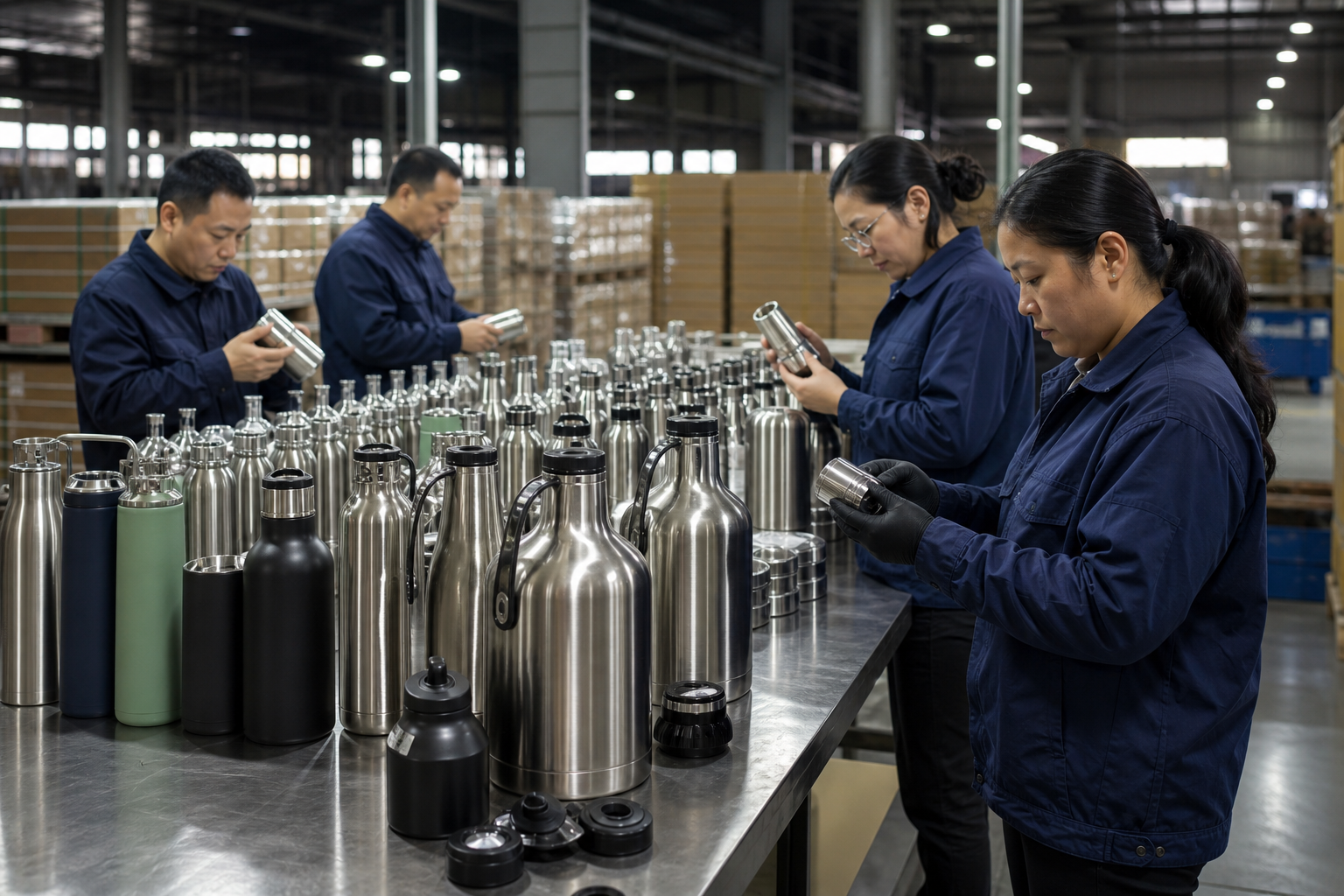
Key Takeaways
- Most drinkware wholesale programs land at 500 to 1,000 pcs MOQ per SKU; custom vacuum builds can start at 3,000 pcs.
- For stainless wholesale drinkware, 18/8 304 steel with 0.4 to 0.8 mm walls and REACH or LFGB support is the safest default.
- Standard production from Zhejiang or other China factories is usually 25 to 35 days after sample approval, with 5 to 7 days for samples.
- AQL 2.5 major and 4.0 minor, plus leak and carton-drop tests, catches the failures that damage repeat orders.
When you source drinkware wholesale, unit price is the wrong place to start. The real risk is picking the wrong build for the channel: a bulk canteen that sweats on a 2 mm wall, a bulk growler that starts weeping after one cold-chain run, or an alcohol flask wholesale bulk order that stalls at customs because the coating or steel grade never got tested. QC pulled the sample, the buyer flagged it, and the shipment stayed on the dock.
In Zhejiang and across China, good factories can run almost any shape, but the PO still has to spell out wall thickness, decoration method, carton pack, and compliance. On a 300,000-unit-per-month line, swapping cap tooling or moving print color by one Pantone step can add 7 to 10 days, and a typo in carton count has burned more than one booking. This is the wrong question to ask: what is the cheapest cup? Wholesale drinkware is a technical buy, not a catalog buy.
Buy By Use Case First
Start with the job the product has to do, not the shape on a spec sheet. This is the wrong question to ask if you are buying at volume. A bulk canteen for outdoor retail is a different buy from a bulk growler for breweries, and both are different from an alcohol flask in bulk for gifting or promotional packs. On the line, QC pulled the sample and checked the cap torque before we packed it back. If you treat them all as generic wholesale drinkware, you miss the parts that drive complaints: cap style, fill volume, wall gauge, carry loop, and whether the finish can take ice, carbonation, or pocket wear.
For a canteen wholesale program, the usual choices are 500 ml, 750 ml, and 1,000 ml single-wall stainless or double-wall insulated formats. For growler wholesale, the common retail sizes are 32 oz and 64 oz, with threaded lids or swing-top closures depending on the channel. Beer growler bulk orders should be specified for carbonation retention and seal durability, not just looks. We have seen a 64 oz swing-top pass on the sample bench and fail after warm-fill testing because the gasket sat 1 mm off center. Alcohol flask wholesale bulk orders often sit at 6 oz, 8 oz, or 12 oz, where compactness and edge finishing matter more than thermal performance.
If you want the best wholesale drink bottle for broad retail, the answer is usually not the cheapest SKU. The math does not work once you add one scratched coating, one cracked carton, and one rejected pallet. You want clean welds, a tested gasket, and packaging that holds up through ocean freight from China. A buyer once flagged a PO because one line said "matte" and the art file said "satin"; that kind of typo turns into a delay fast. In Zhejiang, experienced factories ask about your channel before they quote; if they do not, ask harder.
- Outdoor retail: bulk canteen, abrasion-resistant coating, carry-friendly shape
- Craft beverage: wholesale growler, tight seal, carbonation-safe lid
- Promotional gifting: alcohol flask wholesale bulk, compact profile, fast decoration
Specs That Prevent Returns
The fastest way to burn margin in drinkware wholesale is to under-spec the materials. For stainless steel, 18/8 304 is still the normal baseline for food-contact parts. If the cup will see sour juice, salt spray, or a higher-end shelf tag, 316 earns its keep, but it does not make sense on every SKU. On the line we check shell thickness with a micrometer, not a sales phrase. A practical spec is 0.4 to 0.5 mm on vacuum shells and around 0.6 mm for single-wall canteen styles, depending on shape and target price.
Gaskets are another hidden failure point. Silicone seals should be tested for compression set and smell, especially in beer growler wholesale programs where odor transfer kills repeat orders fast. For lids, PP, Tritan, and stainless all work, but the lid has to match the beverage. A growler lid that passes a water leak test can still fail under carbonation. We saw one 5,000-piece run where the thread pitch drifted by 0.3 mm and the buyer flagged it before packing; that is the wrong place to find the problem.
Ask for the exact material callout, not just stainless steel. The difference between 304, 201, and a poorly controlled blend shows up after the first customer complaint, not on the quote.
For coated products, powder coat thickness around 50 to 70 microns is a practical range. Too thin and it scratches in carton transit; too heavy and the cap fit can change. We ship cartons that sit 12 days on humid southern China routes, and thin coating comes back scuffed. QC pulled one sample last month at 82 microns and the lid skirt no longer seated cleanly. That is the sort of detail a serious China supplier should confirm without guessing.
Decoration Drives Margins
Decoration is not just branding. It changes yield, lead time, and how many SKUs we can run in one batch. On the line, one extra screen set-up means another jig, another inspection step, and another chance for a color shift. Silkscreen is still the workhorse for simple logos on wholesale drinkware because it stays economical at 500 to 1,000 pcs and keeps brand colors solid. Laser engraving looks cleaner on premium stainless products and usually holds up better against abrasion, but it only works when the material and shape give the beam enough contrast. Full-wrap UV print, pad print, and heat transfer all have a place. Every extra color adds a control point.
If you are sourcing bulk drinkware for retail or Amazon, ask the factory how decoration changes the production sequence. One extra logo color can add 3 to 5 days. A custom lid can add 7 to 10 days. A new mold for an alcohol flask wholesale bulk program can add several weeks before the first pilot run. We had a buyer flag a PO typo on the lid color code, and that one line cost a full rerun of the sampling sheet. Do not assume that a factory in Zhejiang can move every graphic onto every substrate at the same cost. The math does not work that way.
For long-term margin, the best wholesale drinkware is usually the one with a decoration method you can repeat cleanly on reorder. QC pulled the sample after 2,000 rub cycles, and the repeat order held because the method was fixed from the start. If you want a full comparison of print methods, pair this decision with a logo strategy that fits your channel and not just your design file.
- Silkscreen: best for simple logos and lower unit cost
- Laser engraving: best for premium stainless and durable branding
- UV print: best for complex artwork but more sensitive to abrasion
MOQ, Pricing, And Lead Times
Buyers often fixate on MOQ and miss the real cost driver: how many variables are moving at once. A stock shape with one-color print starts around 500 pcs. Add a custom color cap, wrapped logo, and a special insert, and the line moves to 1,000 pcs. For complex insulated builds, 3,000 pcs is normal if you want stable welding on 304 stainless and a clean FOB China price. In Zhejiang, the math is simple. If the spray booth and pad printer keep changing over, unit cost rises fast. This is the wrong question to ask if you only look at MOQ.
Sample lead time is 5 to 7 days for existing tooling. Mass production runs 25 to 35 days after sample approval for standard wholesale canteen and travel tumbler orders. Multi-step decoration, special packaging, or a custom lid adds 7 days. If you need repeat replenishment, ask whether the factory holds semi-finished stock. QC pulled the sample on the line twice, and that told us more than any sales pitch. A factory that can state a monthly capacity of 80,000 pcs is worth more than one that only throws out a low MOQ.
As a practical reference, a simple stainless canteen wholesale order sits around USD 1.80 to 3.20 FOB depending on size and finish. A beer growler wholesale item lands higher, around USD 4.50 to 8.00, because the body is larger and the closure has to seal better. An alcohol flask in bulk can use less material, but clean edging and leak control still matter, so the cheapest quote is not the cheapest landed result. We have seen a PO typo on “matte black” send a 2,000 pcs cap run back to spray. If a factory says it ships everything fast, ask for the production calendar and packing spec before you commit.
Compliance Is Not Paperwork
For Europe and North America, compliance sits on the product, not in a binder. If a tumbler or mug touches food or drink, we ask for food-contact test support for the exact stainless grade, ink, and coating. In Europe, REACH and LFGB are the usual gate checks. In the US, buyers ask for FDA food-contact support and a look at California Proposition 65 if pigments or silicone caps are in the build. We ship from China, so we also want lot-level traceability for steel coils, silicone parts, and print inks; if the factory cannot trace a bad batch back to a 1,000 kg coil, the math does not work.
QC has to be written in numbers. AQL 2.5 for major defects and 4.0 for minor defects is standard on consumer drinkware. Put that next to leak testing, finish inspection, and carton-drop checks. If the item is insulated, ask for temperature-retention data at a set ambient of 23 C instead of a marketing line. For a beer tumbler bulk run or beer growler wholesale bulk order, we also check lid torque and seal hold, because a cap that loosens after 12 days in transit turns into a return on arrival. On the line, we run a torque wrench and a 1 m drop test, not guesswork.
Factories in Zhejiang that sell to export buyers usually know BSCI, ISO 9001, and third-party audits. We still separate audit badges from product testing. A badge does not fix a lid with a 2 mm gap, and it does not excuse a PO typo that turns a black cap into a clear one. We ship the line based on the test report, then the audit file; that order keeps the buyer from chasing paperwork after a leak claim.
- Request LFGB, REACH, or FDA support for the exact SKU, ink, and coating
- Set AQL 2.5 major and 4.0 minor in the PO, with the carton count written in
- Ask for leak, torque, and carton-drop records before shipment, not after the truck leaves
Build For Reorders
The best drinkware wholesale programs are built for repeat orders, not one-off wins. The first PO should already line up with reordering, carton efficiency, and channel rules. If you are selling into Amazon FBA, ask for FNSKU labeling, carton barcode placement, and a packing plan that avoids repacking fees. On our line, we check whether a 24-pack inner carton still stays under 15 kg and fits the 600 x 400 x 300 mm master carton spec. This is the wrong question to ask if you only compare unit price. If you sell through distributors, standardize the inner carton so they can split cases without scuffing the finish. The difference between a dead-end shipment and a reorder account is usually packaging discipline, not design.
For a serious bulk drinkware program, ask the factory to freeze a golden sample. That sample should lock the approved print color, cap torque, gasket type, and carton layout. Then lock the change control process. QC pulled the sample with a torque wrench at 3.5 N·m and checked the logo position against a 0.2 mm register limit. A factory in China can still let small changes slip in when the production team thinks they are harmless. They are not harmless if your retail buyer spots a different gloss level or a cap that threads differently on the second shipment. We have seen a PO typo turn "matte black" into "black" and trigger a recheck at the dock.
If you want the best wholesale drink bottle for a broad assortment, keep the core spec steady and vary only the finish, logo, or accessory pack. That keeps the 18 g wall thickness, the lid fit, and the mold setup stable while you move between canteen bulk, growler wholesale, and beverage flask lines without starting over. We run the same body across three channels, then swap a brushed finish or a bamboo lid when the buyer asks for a new look. The math does not work if you redraw the core bottle for every account. A supplier with clear capabilities, repeatable QC, and enough monthly capacity to cover your growth will beat the cheaper quote that cannot hold spec on reorder.
Request a quote built around your channel
Send your target size, MOQ, and decoration method. We will map the right China production route, lead time, and compliance package.
Frequently asked questions
What is the best wholesale drink bottle for general retail?
For broad retail, the safest default is usually a 500 to 750 ml stainless bottle or tumbler with 18/8 304 steel, a dependable gasket, and powder coat around 50 to 70 microns. That spec works for outdoor, office, and gifting channels without overcomplicating the order. If your audience wants beverage storage rather than daily hydration, a growler wholesale model makes more sense. If you are targeting promotions or lifestyle gifting, an alcohol flask wholesale bulk product can be the right fit. The best choice is the one that matches your channel, not the one with the lowest unit price on the first quote.