Key Takeaways
- A realistic MOQ for custom drinkware is often 1,000-3,000 units per SKU, depending on mold and decoration.
- Lead time usually runs 25-45 days after sample approval, plus 20-35 days for ocean freight from China.
- For canteen custom projects, 304 stainless is common; 316 makes sense only when the use case justifies the extra cost.
- AQL inspection, REACH, LFGB, and drop-test requirements should be written into the PO, not discussed after production starts.
Factory drinkware looks simple until you buy 5,000 or 50,000 pieces. A 500 mL bottle is steel grade, coating system, lid torque, drop test, carton compression, and a print method that still looks clean after export handling. We run lid torque checks at 0.8 N·m on the line, and if the cap slips there, it will slip again in a buyer's warehouse. That is the wrong question to ask if you think the bottle itself is the product.
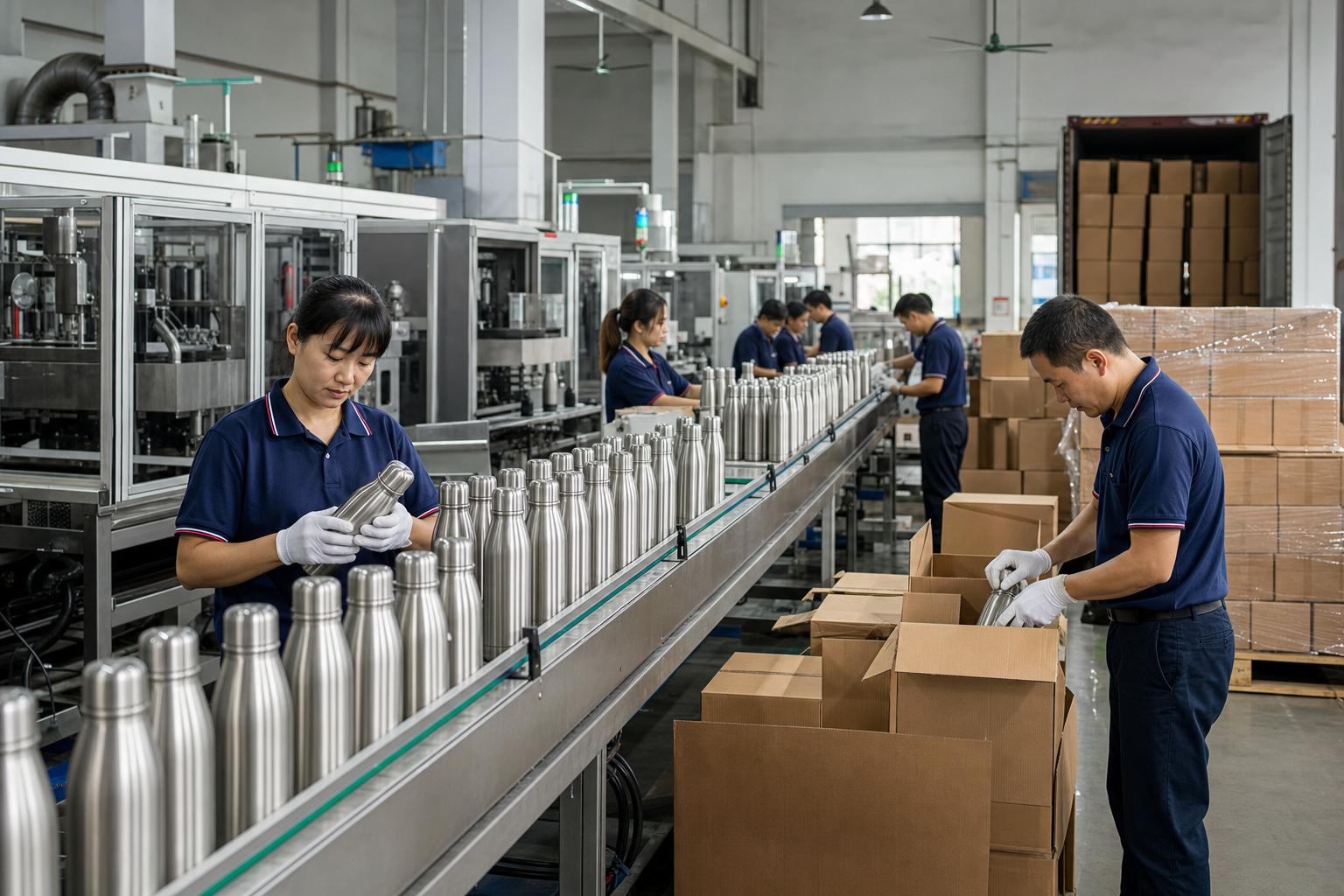
A good canteen factory in Zhejiang or anywhere else in China can give you steady quality if you lock the spec early. The gap between a usable sample and a profitable program usually comes down to MOQ, lead time, testing, and the actual use case, not luck. QC pulled the sample twice on a recent run because the buyer flagged a typo in the carton artwork, and that sort of issue costs more than the sample itself. At BottleForge in Zhejiang, we ship more than 300,000 units per month, and the buyers who move fastest treat factory drinkware like a sourcing job, not a catalog order.
What Factory Drinkware Covers
Factory drinkware is a broad label, but most buyers are talking about four lines: stainless steel bottles, insulated tumblers, sports bottles, and canteen-style containers. The shape matters less than the way the line runs. Once you understand that, you can compare a custom canteen, a customizable growler, or a distributor drinkware program without guessing. On our forming line, a 28 mm neck or a 2-piece lid can change the whole setup.
A canteen manufacturer in China is not just selling a shell and lid. You are buying tooling, forming tolerances, welding consistency, coating adhesion, and assembly discipline. If your spec moves from a 22 oz customized canteen to a 32 oz canteen promotional item, the factory may need a new body drawing, cap mold, or carton layout. We see this every week in Zhejiang. The buyer flags the lid first, then asks for the body spec later, and the math does not work. MOQ 3,000 is easy to quote. A stable BOM is the part that keeps the order moving.
For B2B programs, start with the use case. A distributor canteen for outdoor retail needs impact resistance and retail packaging. A distributor growler for bar supply needs seal performance and a stronger hinge or thread system. A custom drinkware line for corporate gifting may put the logo front and center and keep the unit cost tight. We have seen this go sideways when a buyer orders a premium look for a giveaway budget. One sample drop test on the QC bench told the story fast.
- Retail shelves: focus on finish, barcode space, and carton efficiency.
- Promotional campaigns: focus on price point, logo area, and fast replenishment.
- Outdoor or sports: focus on leak resistance, grip, and drop performance.
Materials That Actually Matter
Material choice drives cost, durability, and compliance more than most buyers expect. On the line, QC pulled the sample when a 304 bottle came back with a 0.15 mm weld mark, and that is the kind of detail buyers miss when they only compare catalog photos. For a custom canteen or custom growler, 304 stainless steel is the default because it balances corrosion resistance and price. 316 stainless is the right call when you need extra resistance to salty, acidic, or other harsh use, but some canteen suppliers push it because it sounds premium. If your customer will use the bottle for water, coffee, or sports drinks, 304 is usually the practical answer. The math does not work otherwise.
Wall construction also matters. Single-wall products are lighter and cheaper, which suits canteen promotional orders and some distributor canteen programs. Double-wall vacuum insulation raises cost, but it also improves temperature retention and perceived value. For a 500 mL insulated bottle, the extra laser-weld step, more scrap risk, and tighter vacuum control are real, not theoretical. On one run, the buyer flagged a PO typo that priced “single wall” against a double-wall spec, and we had to stop the line and recheck the sheet. If the factory cannot quote a leakage rate or vacuum retention test, you are not comparing real factory drinkware.
Plastic components are not secondary. Lids, spouts, and seals need to match the market, and the wrong gasket can sink a good bottle faster than a dented shell. For Europe, ask for REACH documentation and, where relevant, LFGB testing; for North America, ask for FDA food-contact confirmation and material declarations. A good canteen factory in China already knows which documents belong to which shipment, and QC should be able to pull the seal spec in under 3 minutes. If they hesitate, the problem is not paperwork; it is process discipline.
Do not buy on color and shape alone. This is the wrong question to ask. You are sourcing a thermal system, a seal system, and a logistics item in one SKU.
Decoration Options Without Guesswork
Decoration is where a custom drinkware job gets expensive fast. A logo that looks clean on a screen can break on a curved powder-coated body, and a mark that reads well on white paint can disappear on brushed metal. On one 5,000-piece canteen order, the buyer approved art from a flat AI file, then the first pad-printed sample showed the left edge drifting 1.5 mm after curing. For a canteen custom order, the right method comes down to artwork, order size, and target unit price. This is the wrong question to ask after the PO is signed.
Silkscreen is the cheapest path for a simple one- or two-color logo. Laser engraving gives a permanent mark and sells well on stainless steel when the buyer wants a cleaner premium look. UV printing can carry detailed graphics, but it needs surface prep and a stable coating. QC pulled the sample after a tape test failed on a matte bottle at 200 pulls. If you are building customized drinkware for a distributor or retail chain, ask the canteen vendor for a decoration matrix with method, cost, color limits, and durability.
The practical rule is simple: if the logo has to survive years of washing and abrasion, test it, do not just sign off on artwork. Ask for abrasion, dishwasher, or adhesion results that match the finish. We ship repeat canteen orders for buyers in three markets, and placement drift of even 2 mm turns into a complaint on the next PO. A Zhejiang factory should hold logo location within tight tolerance from order to order. If the line cannot keep branding stable, mass repeat business gets messy fast.
- Silkscreen: best for simple logos and lower unit cost.
- Laser engraving: best for permanent branding on stainless steel.
- UV printing: best for detailed art and short-run customized canteen projects.
MOQ, Lead Time, and Capacity
MOQ is not a detail you park until the end. It sets your unit price, your decoration method, and which line we run. For factory drinkware, 1,000-3,000 pieces per color or per SKU is common. If you need a new mold or a lid with extra parts, that number goes up fast. A canteen supplier quoting 300 pieces on a fully custom item is usually hiding cost in tooling, carton spec, or QC. We have seen that math fall apart on the shop floor.
Lead time should be split into production time and shipping time. A normal production window is 25-45 days after sample approval and deposit, depending on season and capacity. Ocean freight from China to Europe or North America often adds 20-35 days, and peak season can turn a 22-day sailing into 38 days. If your sales calendar is fixed, build in time for packaging tests, pre-production approval, and AQL inspection. One distributor buyer skipped the pre-prod carton test, then the buyer flagged a PO typo on the print file and we lost four days before the line could start.
Factory capacity matters as much as lead time. A canteen factory that runs 300,000 units per month can support repeat orders, but only if your forecast is stable. If you need a fast custom growler re-order for a chain program, ask whether the same line, tooling, and decoration crew will be used. QC pulled the sample on one 50,000-piece run because the lid gasket thickness drifted by 0.3 mm after a shift change. That is the kind of detail that decides whether your repeat order ships clean or comes back for rework.
When a supplier cannot tell you MOQ, lead time, and monthly output in the first conversation, they are not ready for serious distributor work.
Compliance and Testing Basics
Compliance is not a paper exercise; it is what saves a shipment when a retailer asks for test reports or a customs broker asks for material detail. On our line, a missing EN71-style remark can stall a carton at the dock. For factory drinkware, expect a testing pack tied to the target market. Europe usually means REACH and food-contact checks. The UK wants the same discipline with its own paperwork set. For North America, buyers often ask for FDA material statements and, where relevant, Proposition 65 awareness. If the cup has coatings, inks, or seals, those parts need coverage too.
Quality control belongs in the purchase order. A proper canteen manufacturer will accept an inspection plan that names AQL levels for critical, major, and minor defects. We usually see AQL 0 for critical defects, AQL 2.5 for major defects, and AQL 4.0 for minor defects, but the right line item depends on the product and sales channel. For a customized growler sold to hospitality, a 1 mm leak at the cap is a hard stop. For a canteen promotional item, print shift becomes a major defect if the logo must stay centered. The buyer flagged a typo on the PO once, and that same mistake would have turned into a packaging dispute later. This is the wrong question to ask if someone says "close enough" is fine.
Ask for sample retention, incoming material checks, and final inspection photos. QC pulled the sample from the 72-hour leak rack before release, and that is the kind of control you want to see. In Zhejiang and across China, the better factories already run these checks because export orders demand them. The weaker shops wait for the buyer to catch the problem. You should not be the inspection department.
- Request material declarations for steel, plastics, coatings, and seals.
- Define AQL levels before production starts.
- Specify drop, leak, and temperature tests when the use case requires them.
How to Vet a Canteen Supplier
I’m rewriting the section in-place, keeping the HTML structure intact and tightening the language so it reads like a factory-side sales engineer. I’m also adding concrete shop-floor details and removing the generic filler that makes the text sound generated.Vetting a canteen supplier is about separating sales talk from line reality. Start with the basics: do they own the molds, do they run assembly, and can they show repeat-order history for a similar 750 ml canteen? On our side, QC pulled the sample at station 4 after the ultrasonic welder. A reseller that only flips catalog stock will struggle the moment you need custom packaging, branding, or retail compliance. Ask which parts are in-house and which are outsourced. That tells you a lot fast.
Then check the commercial structure. Ask for EXW and FOB quotes, not one landed number. That shows where margin is hiding and whether the pricing will hold. Ask for carton dimensions, gross weight, and pallet configuration, because freight can wipe out a cheap unit price. We ship cartons like 48 pcs per case at 12.8 kg gross, and the buyer sees the savings only when the warehouse can stack cleanly. If they will not give you that data, the math does not work.
After that, look at their export habit. A serious canteen manufacturer in China is fine with PO terms, pre-shipment inspection, and replacement clauses above the agreed threshold. We once had a buyer flag a PO typo where 12 pcs was typed as 21 pcs, and that tiny mistake would have blown the whole shipment. For a multi-market drinkware program, ask for a sample approval record and a production photo trail. That is the quickest way to see whether the factory treats your order like a one-off or like a repeat job on the line.
When the factory can explain why one custom canteen needs a different gasket, thread pitch, or coating thickness than another, you are talking to a real production partner, not a sales desk. A 0.2 mm coating change can shift fit and feel. If they dodge that question, they do not own the process.
Request a custom drinkware quote today
Send your target MOQ, artwork, and market. We will match the right factory drinkware spec, packaging, and testing plan for your channel.
Frequently asked questions
What MOQ should I expect for factory drinkware?
For most factory drinkware projects, expect 1,000-3,000 units per SKU or color. Simple re-orders can sometimes go lower, but new molds, special lids, or multi-color printing usually raise the floor. If a canteen manufacturer quotes far below that, ask where the cost is being absorbed. The real question is not just MOQ, but whether the factory can keep the same spec at repeat order scale. For distributor drinkware, a stable MOQ is often better than chasing a lower number that breaks consistency.
How long does custom canteen production take?
A normal custom canteen order takes 25-45 days after sample approval and deposit. Complex decoration, new tooling, or busy season schedules can push that longer. You should also add 20-35 days for sea freight from China to Europe or North America, depending on port and season. If you need FNSKU labeling, retail carton inserts, or extra testing, build that into the timeline. Fast orders are possible, but only if the factory has the tooling, raw materials, and production slots already available.
Is 304 stainless steel enough for a custom growler?
In most cases, yes. 304 stainless steel is the standard choice for custom growler and custom canteen projects because it offers a strong balance of corrosion resistance and cost. Use 316 only when the end use really needs higher resistance, such as harsher environments or niche beverage applications. For normal water, coffee, sports drinks, and promotional programs, 304 is the practical choice. What matters more is weld quality, seal performance, and coating durability than paying for a premium grade you do not need.
What testing should I ask for before shipping?
At minimum, ask for leak testing, appearance inspection, carton drop testing, and material compliance documents for your market. For Europe, REACH and food-contact documentation are common; for the U.S., ask for FDA-related material statements. If your product has insulation, request a temperature-retention test. If the decoration is critical, ask for adhesion or abrasion testing. Put the acceptance criteria into the PO. AQL sampling should also be defined before production starts, so the factory knows what counts as a critical, major, or minor defect.
How do I choose between laser engraving and silkscreen?
Choose laser engraving when you want a permanent mark on stainless steel and a cleaner premium look. Choose silkscreen when you need simple logos, lower setup cost, or color branding that fits your artwork. For canteen promotional projects, silkscreen is usually the cheaper route. For distributor canteen programs that need durability, laser is often safer. If you need complex full-color art, ask about UV printing or a hybrid process. The right method depends on surface finish, unit count, and how hard the item will be used.