Key Takeaways
- A factory growler usually starts at 500-1,000 pcs MOQ, with 25-35 day lead time after sample approval.
- 304 stainless steel is standard; 316 is better for corrosive drinks, but it adds roughly 8-15% to cost.
- Ask for leak tests, AQL inspection, REACH documentation, and carton drop testing before you approve production.
- Decoration choice matters: laser engraving lasts longest, while screen print is cheaper for canteen promotional orders.
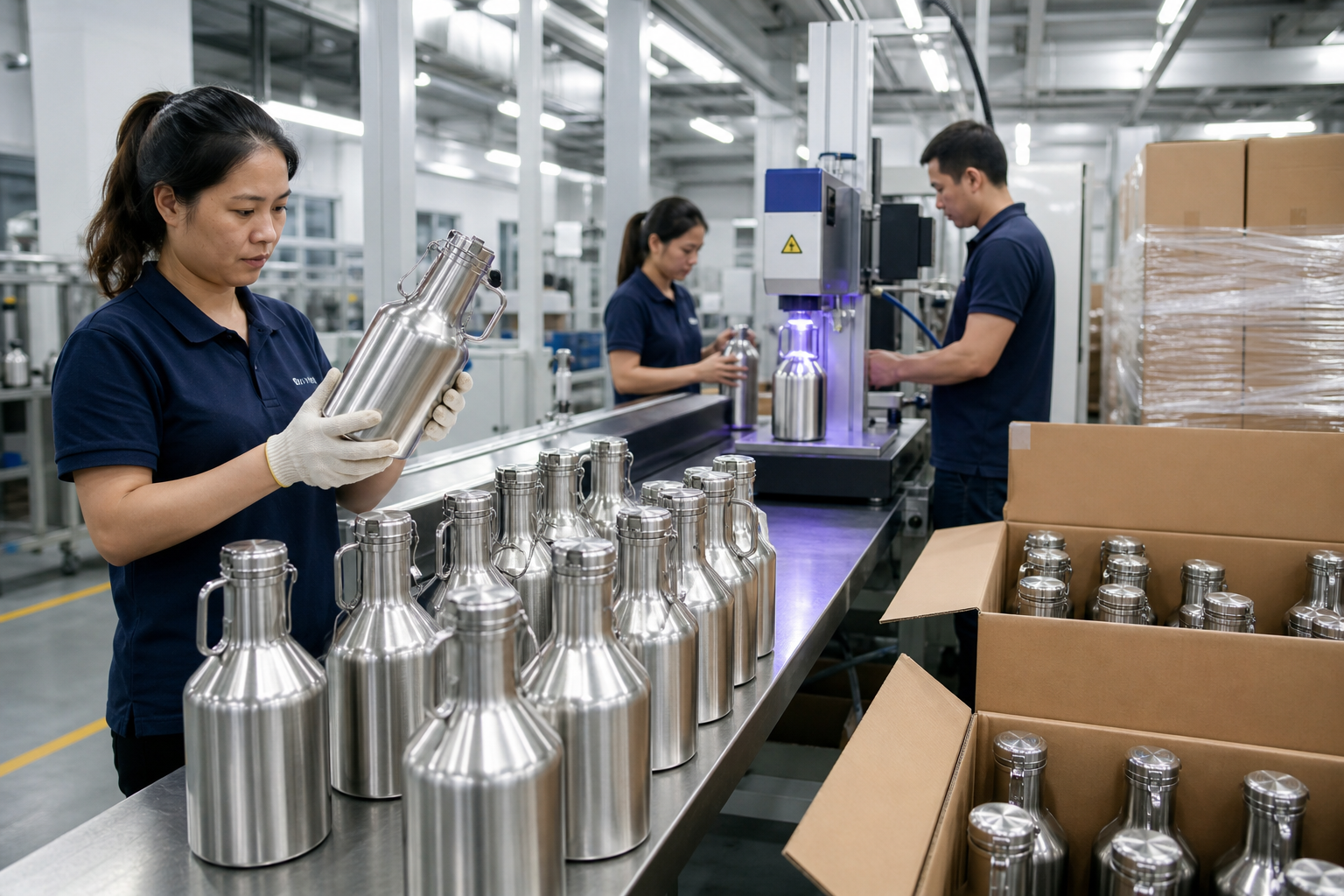
A factory growler is not just a bigger bottle with a handle. On the line, the difference shows up in the 0.8 mm wall, the TIG weld at the neck, the lid gasket, and whether QC can pull the same result from the first 500 units to the 5,000th. If you buy for retail, gifting, hospitality, or a distributor program, the spec sheet decides the job. We have seen buyers approve a nice catalog photo and then reject the first sample because the powder coat scratched after one clamp test. That is the wrong place to start.
If you are comparing custom canteens, customized drinkware, or a wider canteen supplier program, think like a buyer and like the line. Zhejiang has the factories, but a canteen factory that skips vacuum leak testing or export carton checks will cost you later. We run batch records, carton drop tests, and 24-hour water holds for a reason. The buyer flagged a PO typo once, and it saved a 2,000-piece reprint. Pick the partner that gives real production numbers, not sales talk, or your FOB margin will disappear fast.
What a Factory Growler Really Is
When buyers say factory growler, they usually mean a reusable stainless steel vessel for beer, cold brew, or any cold-fill drink that needs a clean retail look and steady thermal performance. On the floor, we treat it as a middle-spec item between a standard bottle and a premium canteen made for beverage service. The common sizes are 32 oz and 64 oz, though some canteen manufacturers in China will quote 20 oz, 750 ml, or 1 L if you want a shelf fit that matches mainstream retail packs. QC pulled the sample on a 32 oz run last month because the cap insert was 1.5 mm off and the buyer flagged it before packing.
The label matters less than the build. A proper growler should use a body wall around 0.5-0.8 mm for single-wall retail styles, or a double-wall vacuum build with an inner liner and outer shell when insulation is part of the brief. If you are sourcing from a canteen factory in Zhejiang, ask whether the line runs TIG welding, vacuum sealing, and nitrogen leak checks. We see this go sideways when a factory says "same spec" but the seam polish changes after 2,000 pieces, and the product starts looking like giveaway stock, not retail drinkware.
For B2B buyers, the commercial question is simple: can the factory hold the same diameter, neck finish, lid torque, and coating across 5,000 or 50,000 pieces? If not, your distributor canteen program breaks at replenishment. The right answer is a measurement sheet, not a glossy sample. We had one PO with a typo on the finish code, and the 304 stainless lids came in at the wrong torque spec, which forced a recheck on the torque tester before we shipped the lot.
Materials That Change Cost
Material choice sets both performance and landed cost. On the line, we start most custom growler jobs with 304 stainless steel because it holds up to forming, resists corrosion, and keeps the quote in range. For acidic or salty drinks, or stock that sits for 30 days on a shelf, 316 is the safer call, but the factory math usually adds 8-15% once nickel prices move. We had a buyer push back on a 316 upgrade last quarter; QC pulled the sample after a 24-hour salt spray test and the 304 panel showed early spotting. That premium only makes sense for a top-tier customized growler or a premium distributor drinkware line.
For lids and closures, vague wording causes trouble. Ask for food-contact grade PP, silicone gaskets, and one leak standard in writing, not a loose promise from sales. A lid that misses by 0.5 mm will ruin the carton, and we've seen one typo on a PO turn a screw cap order into flip-top parts. If the project is a custom canteen or customizable canteen rather than a niche growler, check whether the same body can take two cap systems. That gives you room to move from one SKU to a full canteen customizable range without reworking the mold.
- 304 stainless: the best balance for most orders.
- 316 stainless: better for premium applications and tougher liquids.
- Powder coat: durable, but verify adhesion and scratch resistance.
- Electropolish: useful for a cleaner interior finish on higher-end drinkware.
In China, the lowest quote is often the thinnest wall and the weakest coating. A 0.6 mm wall looks fine on paper and dents on the first drop from the packing table. The math doesn't work if the product reaches your warehouse with scuffs, leaks, or a coating that flakes after one week in transit.
Branding That Survives Shipping
I’m tightening the wording for a factory-side sales tone and keeping the HTML structure intact. The rewrite will keep the same tag layout, but the prose will be more specific and less generic.Decoration is where a lot of canteen vendors oversell and underdeliver. On a 12,000-piece factory growler run, the logo has to survive cartons, pallet wrap, and 45 days in storage. Laser engraving stays the cleanest choice for a premium custom drinkware program. It does not flake, it holds up on repeat runs, and it still looks sharp when QC pulls a sample after the line has packed 300 cartons. Screen print is cheaper for canteen promo jobs, but it needs proper curing and can wear down after heavy wash cycles. Pad print works for small marks or curved zones, though it should not be the default for a distributor canteen order.
If you want a premium finish, ask the factory for a decoration map that shows the printable area, seam position, and curvature limits. That matters more than most buyers expect. The wrong question is which logo looks best on screen; the real question is what survives a 3-meter carton drop and a 25 kg pallet stack. A sample can look fine, then the production batch shifts and the mark walks toward the seam. The same rule applies if you are making a customized canteen, customized drinkware, or a canteen customized for a chain customer: keep the mark simple, keep the contrast strong, and cut out tiny text. We saw a 1.2 mm stroke disappear after a 70 micron powder coat.
Practical rule: if your branding cannot be read from 1 meter away under warehouse light, it is too fragile for mass production.
For custom canteen programs sold through distributors, lock one logo format and one color code first. We ship faster when the PO says one vector file, one Pantone code, one placement. Extra versions turn into inventory noise and slow reorders. The buyer flagged a typo on a PO once, and the whole job stalled for two days while the team sorted which mark was the real one.
Testing Buyers Should Demand
Do not sign off on a factory growler until you see a real test pack. We run leak checks, coating adhesion, dishwasher runs if the spec calls for it, and migration or compliance papers for food-contact materials. For Europe, REACH matters. For North America, buyers usually ask for FDA food-contact statements and, depending on the channel, ASTM or a lab report for finish and wear. If the factory cannot show traceable paperwork for the raw material and the ink system, move on.
QC should not stop at one sample. A disciplined canteen manufacturer will talk in AQL terms, usually AQL 2.5 for major defects and AQL 4.0 for minor defects, though a tougher channel may need tighter limits. If you are importing a custom growler for retail, ask for pre-production samples, in-line checks, and final random inspection before shipment. Ask for torque testing on lids and vacuum retention on insulated units too. We have seen a 0.8 mm lid gap turn into a pallet of returns. That is the difference between a distributor line that ships clean and one that lands in complaints.
Buyers in Zhejiang and across China often hear that a certificate is enough. It is not. Certificates help, but process control protects margin. You want documented control over welding, coating thickness, gasket fit, and carton drop performance. QC pulled the sample, and if the weld bead is off by 1 mm or the carton fails a 76 cm drop, the line will tell on itself fast. If a canteen supplier cannot explain those points clearly, the production line is probably more hopeful than disciplined.
MOQ, Lead Time, and Pricing
Pricing for a factory growler starts at the source: material, forming, welding, coating, decoration, packaging, and freight terms. For a standard 32 oz stainless model, factory pricing usually starts around USD 2.40-4.20, and the spread is driven by wall thickness, lid type, and finish. A 0.5 mm shell with a basic lid sits on the low end; move to 0.6 mm, a powder coat, or laser engraving and the number climbs fast. A double-wall vacuum version can move into the USD 4.80-8.50 range without much drama. On our line, QC checks the weld seam before packing, and that is where a lot of cheap quotes start to break.
MOQ is usually the first commercial gate. This is the wrong question to ask if you only want the lowest number. Many canteen factories in Zhejiang will quote 500-1,000 pcs per color for standard tooling, while truly customized shapes can require 3,000 pcs or more. A factory running 180,000 units per month can usually hold a 25-35 day lead time after sample approval, but peak season pushes that out by 7-15 days. If your channel is a canteen distributor or distributor growler program, build a buffer stock plan early. One late shipment can wipe out a full reorder cycle, and we have seen a buyer get stuck because the PO said 500 pcs mixed color while the tooling was set for 1,000 per color.
FOB terms are common for China sourcing, but do not compare quotes unless the packing standard, test plan, and carton count are the same. A cheaper unit price with weak packing is usually more expensive once damage and chargebacks are added. We ship 24 pcs per master carton on one standard build, and the buyer flagged a carton spec typo that would have changed the drop result. That kind of mistake matters more than a 3-cent price gap.
Packaging for Retail and Distribution
Packaging is not an afterthought. It is part of the product. A custom growler for retail needs a different carton plan than a canteen promo order for a trade show. If you ship into Amazon or a similar channel, check barcode placement, carton size, pallet pattern, and whether FNSKU labels are required. If you sell through distributors, ask whether the factory can run master cartons with inner boxes, molded trays, or paper sleeves that protect the coating. On the packing line, we check the label window at 20 mm before sealing. Treat packaging as a last-minute add-on and the math stops working.
For export, a solid canteen vendor should offer drop-tested packaging with corner pads and enough compression strength to survive sea freight. We run a 1.2 m drop test and a 25 kg top-load check, and heavier stainless models show the weak point fast. A 64 oz growler packed badly will dent even when the bottle itself is fine. If your product line includes both distributor canteen and distributor drinkware SKUs, standardize the outer carton print so the warehouse can read size, color, and logo variant at a glance. The buyer flagged a PO once because the carton spec said 12 pcs and the label said 24. That kind of mismatch slows the line.
- Retail gift box: best for shelf display and a cleaner unboxing on 1,000-unit runs.
- Plain export box: the right call for bulk distributor orders and lower freight waste.
- Master carton labels: needed so the warehouse can sort size, color, and finish without opening boxes.
- Barcode and SKU mapping: required for Amazon, replenishment, and fewer PO mistakes.
The best factories in China treat packaging as a controlled process, not decoration. QC pulled a carton sample with a skewed barcode once, and that saved a full reprint before shipment. That discipline is what keeps a canteen distributor program profitable after the first carton lands.
Source your factory growler with fewer surprises
Tell us your size, finish, MOQ, and target market. We will quote a production-ready custom drinkware plan with clear specs and export terms.
Frequently asked questions
What MOQ should I expect for a custom growler?
For a standard factory growler, 500-1,000 pcs is common if you are using an existing body shape and a single logo color. If you need a new mold, a special lid, or a canteen customized with a unique profile, MOQ can move to 3,000 pcs or more. In Zhejiang and other parts of China, factories often quote lower sample MOQs, but that does not mean the line is truly set up for repeat production. Ask whether the MOQ is per color, per logo, or per packaging version. That detail changes your real entry cost. A serious canteen factory should also tell you the sample fee, production lead time, and whether the sample cost is refundable at order placement.
Is 304 stainless steel enough for a beer growler?
Yes, 304 stainless is enough for most beer, cold brew, and cold-fill drinkware programs. It is the standard starting point for a custom growler because it offers good corrosion resistance and keeps cost under control. If you are sourcing a premium customized growler for acidic drinks or harsher use, 316 stainless is stronger from a corrosion standpoint, but it adds cost. For most B2B buyers, the bigger issue is not grade alone; it is wall thickness, weld quality, and lid sealing. A thin 304 bottle with poor welding is worse than a properly built one. Ask the factory for material certificates and thickness data in millimeters, not just marketing language.
How do I check if the factory is reliable?
Start with process evidence. Ask for photos or video of welding, coating, leak testing, and packing lines, not just a polished sample photo. Then request a quality file with AQL targets, test reports, and export documentation such as REACH declarations if you ship to Europe. A real canteen manufacturer should be able to explain how they control defects, what their monthly output is, and how they handle rework. If they say they are a canteen supplier but cannot quote a realistic lead time or show carton drop testing, that is a risk. A factory in China that produces 150,000-180,000 units per month will usually have more stable controls than a trading-only seller.
Can I use the same growler for retail and distributor channels?
Often yes, but only if you standardize the core spec and then separate the packaging. The same factory growler can be sold as a retail unit with a printed gift box and also as distributor growler stock with plain export cartons. The body, lid, and decoration should stay consistent. What changes is the label strategy, carton count, and whether you need FNSKU, barcode, or case-pack mapping. This approach works well for canteen distributors and custom drinkware buyers because it simplifies reorders. If your distributor canteen customers need different languages, local compliance marks, or promo inserts, build those as packaging variants rather than changing the bottle itself.
What lead time should I plan for from China?
For a standard order from a canteen factory in China, plan on 25-35 days after sample approval. If the project needs a new mold, special coating, or a complex custom canteen shape, the timeline can stretch to 45-60 days. Add more time if you want third-party inspection, carton artwork approval, or peak-season shipping. Buyers in Zhejiang often have faster access to raw material and decoration capacity, but that does not remove the need for planning. If you need a launch date, lock artwork early, approve samples fast, and give the factory final carton specs before production starts. That is usually where delays are created.