Key Takeaways
- A practical factory thermos order usually starts at 500-1,000 units, with 35-45 days lead time after sample approval.
- 304 stainless is the common baseline; 316, copper coating, and powder coat change cost and performance.
- For bulk thermos orders, ask for AQL 2.5 inspection, leak tests, and temperature-retention data by size.
- A Zhejiang thermos manufacturer should quote FOB China, carton count, and monthly capacity, often 300,000+ units/month.
If you buy a factory thermos for outdoor retail or promotion, the real problem is not finding a supplier. It is separating a usable production partner from a polished brochure. The sample table lies. A stainless thermos that looks fine there can still fail on vacuum retention, lid sealing, coating durability, or carton packing once you scale to 5,000 units. On our line, QC pulled the sample after the vacuum tester held -0.08 MPa, and the rim still sweated.
For buyers in Europe and North America, the right move is plain: define the use case, lock the technical spec, and treat China sourcing like an engineering job, not a guess. A serious thermos factory in Zhejiang should tell you the steel grade, wall structure, MOQ, lead time, and test standards before you place the order. If they cannot, you are buying risk, not product. Ask for the 0.8 mm inner wall, the 304 stainless cert, and the carton drop test before you argue price; we run that check before a PO leaves the desk, and the math does not work any other way.
What factory thermos really means
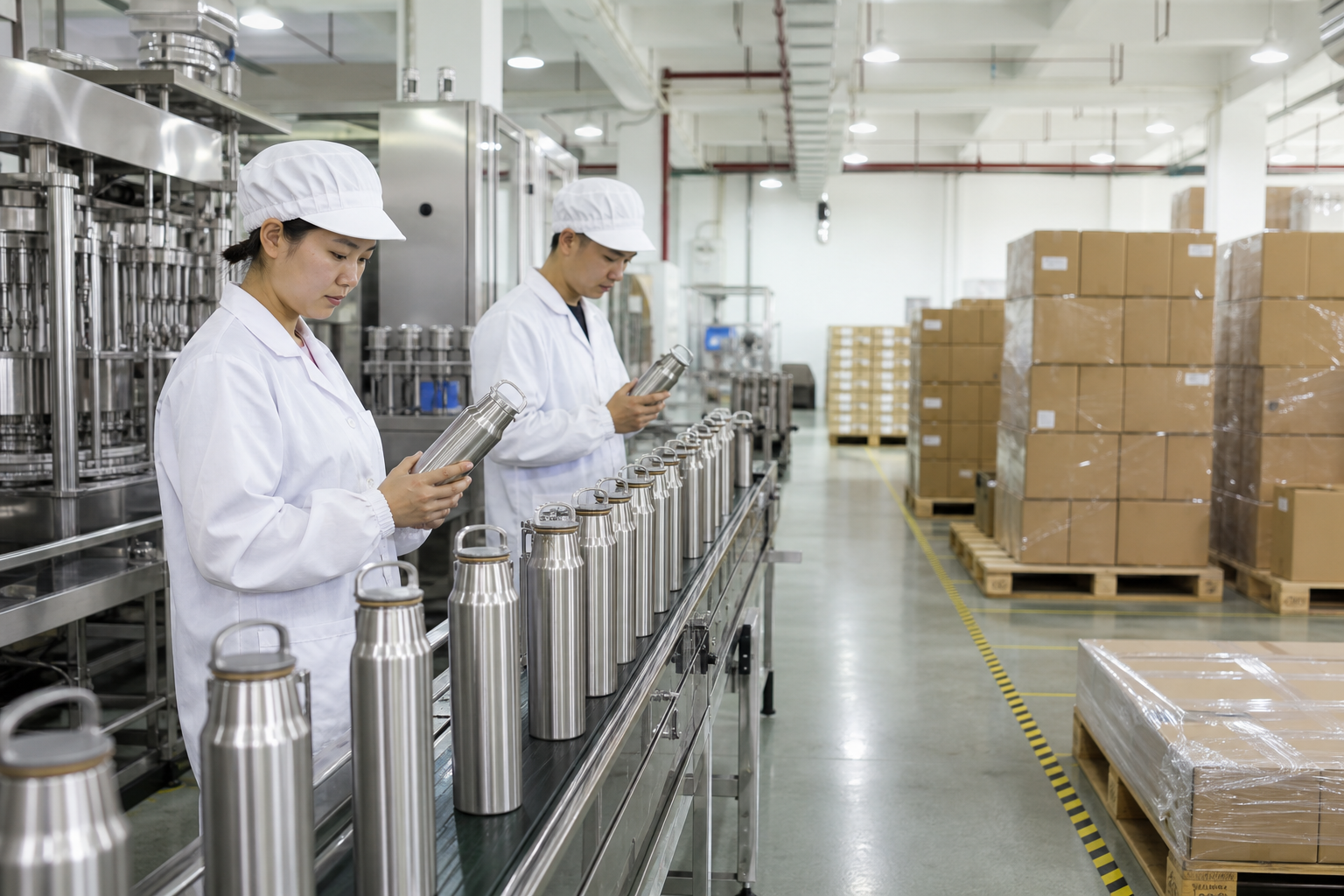
In sourcing terms, factory thermos means you buy from the manufacturer, not a trading desk that just puts a new label on stock. That changes the job on the floor. The shell, inner liner, vacuum gap, stopper, gasket, coating, print method, and carton spec all feed into performance and landed cost. On our line, a 304 inner can pass one spec and fail another if the neck tolerance drifts by 0.3 mm. If you want a custom thermos or customized thermos order that holds up in retail, you need to know which parts are standard and which parts are built for your program.
A serious thermos factory in China will tell you whether the body is 18/8 or 304 stainless, whether the cup base is laser-welded or seam-formed, and whether the lid uses silicone or TPE sealing. Ask one more question: is the quote for plain bulk thermos stock, thermos custom decoration, or full mold changes? The math changes fast. A promotional thermos with one-color print and a standard lid is a simple run; a distributor thermos with a color-matched exterior, gift box, and leakproof lock needs separate checks, and QC pulled the sample twice before we signed off.
Buyers in Zhejiang and other parts of China should push for straight answers on MOQ, sample time, and monthly output. If a factory says 20,000 units minimum for a simple print job, that usually points to a real setup limit on the screen-print table or the packing line. If they promise everything with no numbers, walk away. We have seen that go sideways. Ask for the production route, the vacuum test method, and the carton count per case, not just the sales pitch.
Choose the right steel and build
Material choice decides whether a thermos survives a 6 a.m. truck bed, a dishwasher, or a salty port warehouse. For most thermos bulk programs, 304 stainless is the default because it gives solid corrosion resistance, weldability, and cost control. We ran a 500-piece sample last month; the buyer flagged tea stain after a citrus fill, and that pushed the conversation to 316 stainless. Use 316 only when the margin supports it. Asking for the cheapest steel first is the wrong question. A proper supplier thermos quote should split material, decoration, and packaging line by line, or the math gets fuzzy fast.
Wall structure comes next. Double-wall vacuum construction is standard, but thickness and finish change weight, insulation, and hand feel. On our line, 0.5-0.6 mm outer wall gives a sturdier grip for outdoor retail, while lighter promo bottles go thinner to hit target price. The lid is where we see trouble. A wide-mouth bottle with a flip lid, straw lid, or screw cap each seals differently, and one loose gasket can sink the lot. Ask for boil-water leak tests, upside-down storage tests, and lid cycle counts. If the factory has no cycle data, you are buying hope.
Coating is not just decoration. Powder coat improves grip and scratch resistance, while glossy spray shows wear faster when warehouse staff stack cartons and drag them across the line. We had a PO last quarter where the buyer typed the Pantone code one digit off, and the fix cost a re-sample. For laser engraving, the mark is permanent, but it only looks clean if the surface prep is right. On China-sourced stainless drinkware, the best builds are usually boring and consistent. We have seen flashy specs go sideways. That is the build you want from a manufacturer, not a lab experiment.
- 304 stainless: best balance for most custom thermos orders.
- 316 stainless: better corrosion resistance for premium use cases.
- Powder coat: practical for grip and abrasion resistance.
- Vacuum seam check: non-negotiable on every production lot.
MOQ, price, and lead time
I’m rewriting the section in place, keeping the HTML tags and the existing numbers intact, and tightening the prose so it reads like a factory sales engineer wrote it.Buyers often start with price and work backward. That is the wrong order. For a factory thermos program, the real question is which build keeps your unit cost stable at the MOQ you can actually move. A plain 500 ml stainless thermos with single-color print starts at a lower unit price; once you add a molded lid, gift box, or special coating, the number climbs fast. On FOB China terms, tooling, print setup, and packaging upgrades are where the budget slips. We had one buyer flag a PO that said “gift box included” but left out the insert spec, and that turned into a cost fight on the line.
For Zhejiang suppliers, MOQ usually sits around 500-1,000 units per design for a standard body and 3,000-5,000 units if you want deeper customization or multiple colors. Lead time is usually 7-10 days for samples and 35-45 days after order confirmation, assuming no new mold work. On our side, QC pulled the sample off the vacuum leak tester before release, because that is where bad seals show up first. A serious thermos supplier should also tell you monthly capacity without dancing around it. A line with 2 shift coverage and clean packing flow may run 300,000 to 500,000 units per month across multiple models, which is the number that matters when you are planning a retailer launch or a seasonal promo. One buyer pushed for 1,000 units with 3 lid colors. The math did not work.
Do not ignore carton economics. A bulk thermos order that looks cheap per unit can turn expensive if the outer carton is oversized, the insert is weak, or the master carton fails drop testing at 1.2 m. Ask for carton dimensions, gross weight, and pallet count. We check those details on the packing table with a tape measure, not in theory. If you sell to distributors or into Amazon FBA, packaging discipline is part of the product. A distributor thermos order needs to land cleanly, not just leave the factory looking good.
Custom branding that survives use
Custom branding on a thermos is not about covering every millimeter. We run samples at 60 mm, 80 mm, and 100 mm logo width, then check what still looks clean after 500 hand cycles and a carton drop. Screen print is the low-cost choice for one- or two-color promo orders, and it holds up if the artwork stays simple. Laser engraving gives a sharper mark for premium work, and it does not peel. Heat-transfer or water-transfer can carry full graphics, but QC pulled the sample after an abrasion test left the edge scuffed. A factory thermos supplier should show you production samples from the real line, not a catalog piece made for show.
If you are building a thermos custom collection for retail, brand control matters more than packed-up artwork. Keep the logo size in proportion to the bottle body, and set the color limit with Pantone codes or a signed master sample, not a vague promise from sales. We had one buyer flag a PO because the navy print on the lid was off by 1.5 Delta E, and that was enough to slow the shipment. For a thermos customizable line sold through multiple distributors, a neutral body color with local sleeve or carton changes is the cleaner move. You get one base product, fewer tooling changes, and less confusion at packing. The math does not work any other way when three buyers want three SKUs from the same mold.
Personalization also has to match the substrate. Powder coat changes ink grip, and a curved bottle can warp small text at the shoulder by 2 to 3 mm. If the logo includes a legal claim, certification mark, or compliance mark, check placement against the market rules before we print. A supplier thermos with the wrong size or wrong position can trigger a customs hold or a retail rejection. Keep the art simple, test it on the actual steel, and sign off on the production sample. A PDF on a laptop is not enough.
Best practice: approve one pre-production sample with the exact print, lid, and carton. That unit becomes the reference for the full run.
Quality checks before shipment
I’m rewriting the section in place, keeping the HTML structure intact and tightening the language so it reads like it came from a factory-side sales engineer, not a generic content draft.Quality control on stainless drinkware should be dull and strict. On our line, QC starts with incoming 304 sheets and caps, then moves through weld seam checks, vacuum retention, finish, and final pack-out. For a thermos factory, the base set is leak testing, temperature-retention testing, visual inspection, and carton drop testing. We run this before the pallet leaves; if the inspector only says “all good,” ask for the report and the test values.
Many buyers use AQL 2.5 for major defects and AQL 4.0 for minor defects on consumer drinkware, but the channel decides the split. A 500 ml retail bottle gets judged on leaks, dents, print shift, and missing parts; an FBA carton gets judged on barcode placement and FNSKU readability. For Europe, ask for REACH declarations and any country-specific food-contact papers. For North America, request material declarations and, where relevant, ASTM or FDA evidence from your thermos manufacturer. A PO typo on the carton mark can sink the batch. “Food grade” on its own is not enough.
A practical supplier thermos audit should include at least these checks:
- Vacuum performance after 24 hours at a defined fill temperature, checked with a vacuum gauge.
- Leak test with the lid inverted and shaken, then held over a tray for 30 seconds.
- Coating adhesion and rub test on the printed area, especially around the shoulder and base.
- Carton drop test from 1.2 m, not a desk-height tap.
If the factory in Zhejiang or another part of China cannot document these checks, the risk moves to your warehouse. That is not a sourcing strategy. It is deferred failure.
Picking the right factory partner
The right thermos manufacturer is the one that can explain why its process stays steady, not the one with the loudest sales deck. Look for a factory thermos partner that owns the vacuum furnace, the leak test bench, and the packing line under one roof. If a plant outsources half the work, traceability gets messy and the bill shows up later in lead time and rework. In Zhejiang, a solid factory should support both OEM and ODM work and keep a clean PO record, down to the carton code.
Ask direct questions: how many lines do you run, what is your monthly output, what is your reject rate, and how do you hold color within the same batch? A serious thermos supplier answers in numbers, not adjectives. If they say they ship for Europe and North America, they should know pallet height, barcode placement, and whether the buyer wants retail-ready cartons or warehouse-only packs. We have seen this go sideways on a simple PO typo, where 500 pcs became 5,000 on paper. That is the wrong question to dodge. China has plenty of capable manufacturers, but capability is not fit. You want the one that matches your channel.
Before you place a larger order, ask for three things: a pre-production sample, a production checklist, and an agreed inspection standard. If the factory is confident, they will send them fast. If not, keep looking. QC pulled the sample on a 500 ml cup, checked the lid gap at 0.3 mm, and caught the problem before the line moved. The best custom thermos programs run on repeatable process, not one-time enthusiasm.
Source your factory thermos with real spec control
Send your target capacity, logo method, and MOQ. We can quote a custom thermos program with clear FOB terms and production timing.
Frequently asked questions
What MOQ should I expect for a factory thermos order?
For a standard stainless factory thermos with one-color print, MOQ is often 500 to 1,000 units per design. If you want custom lid parts, special coating, or multiple Pantone colors, 3,000 units is more realistic. Some Zhejiang factories can split SKUs only after 2,000 to 5,000 units because line setup and packaging changes add cost. For a promotional thermos run, always ask whether the MOQ includes printed cartons and insert cards. If you need fast replenishment, confirm whether the supplier can hold raw shells or packaging components for repeat orders.
How do I compare thermos bulk prices correctly?
Compare on the same basis: capacity, steel grade, lid type, print method, packaging, and FOB China terms. A 500 ml 304 stainless bulk thermos with screen print is not comparable to a powder-coated 316 model with laser engraving and gift box. Ask for a breakdown of body cost, decoration cost, carton cost, and any tooling or mold charges. A reliable thermos manufacturer should also tell you the sample fee and whether it is refundable against the first order. Without that detail, the quoted price is not meaningful for procurement.
What tests should a thermos supplier provide before shipment?
At minimum, ask for leak testing, temperature-retention testing, visual inspection, and carton drop testing. Many buyers use AQL 2.5 for major defects on a thermos supplier shipment, with special attention to dents, missing parts, and print defects. If the product is going to Europe, request REACH-related material declarations and food-contact documentation. For North America, ask for any relevant ASTM or FDA-related support documents your channel requires. Good suppliers in China can provide batch records and inspection photos without arguing.
Is custom logo printing or laser engraving better for distributor thermos programs?
Screen printing is usually lower cost and works well for promotional thermos campaigns with short lead times. Laser engraving is more durable and looks cleaner on premium distributor thermos programs, especially when the same product will be handled repeatedly. If you want a customized thermos for retail, laser is usually safer for long-term wear, but it depends on the coating. Powder coat and engraving pair well, while glossy finishes can show edge variation. The best choice is the one that matches your target price, not the one that looks busiest in a mockup.
How long does a thermos factory in China need to deliver?
For a standard custom thermos order, sample time is usually 7 to 10 days and mass production is 35 to 45 days after sample approval and deposit. If you need mold changes, new lids, or custom packaging, add 10 to 20 days. A thermos factory in Zhejiang with multiple lines may quote 300,000 units per month across products, but your specific model still depends on raw material availability and finishing capacity. For seasonal retail or promotional thermos programs, build in extra time for artwork approval, inspection, and export booking.