Key Takeaways
- FDA food-contact compliance is a materials issue, not a blanket product approval; ask for test reports, not marketing language.
- For kids’ thermoses, 304 stainless, LFGB-compliant silicone, and BPA-free PP lids are the practical baseline.
- Typical B2B MOQ in Zhejiang is 3,000 pcs for custom thermos bottles, with 35–45 day production lead time.
- For schools and hotels, insist on leak testing, dishwasher-cycle checks, and AQL 2.5/4.0 inspection limits.
If you are sourcing an fda approved thermos bottle for kids, start with the wording. In Zhejiang, factories often say “FDA approved” when they mean the materials can meet FDA food-contact rules. FDA does not pre-approve finished drinkware. That is the wrong question to ask. You need the stainless grade, lid resin, silicone seal, coating, and test report aligned before you place the order.
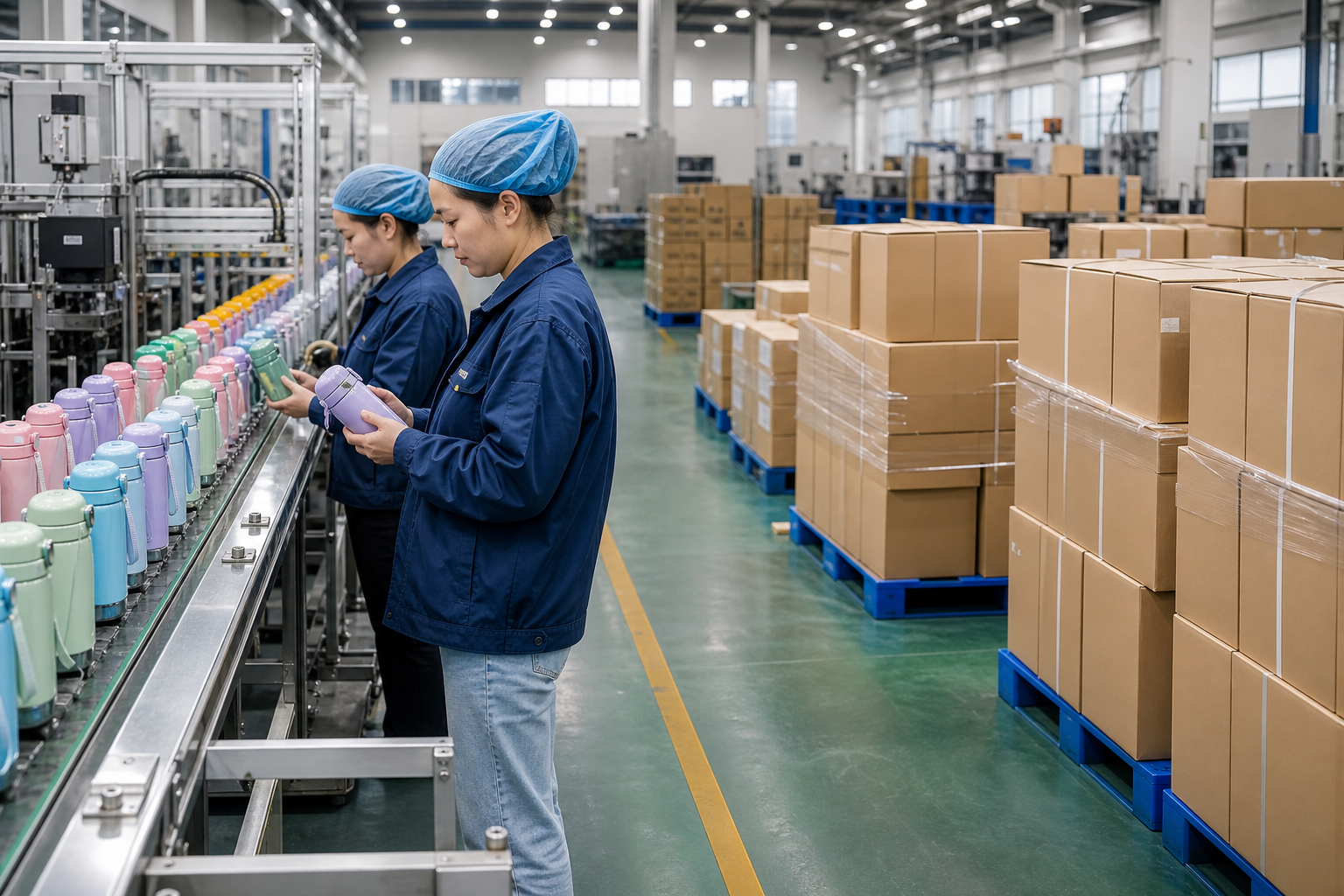
That matters because a kids’ thermos sold to schools, hotels, or outdoor retailers gets dropped, chewed, and twisted on the line. We run 304 or 316 stainless steel, then QC pulled the sample for a 12-hour leak test and found one cap torque issue at 0.8 N·m. The buyer flagged it before mass production, which saved us from a bad PO typo on the seal spec. At BottleForge in Hangzhou, Zhejiang, our stainless thermos line runs 120,000 units per month, with MOQ starting at 3,000 pcs for custom color projects and 35 to 45 days lead time after sample approval.
What FDA Approved Really Means
Buyers search for fda approved thermos for kids, but in sourcing terms that phrase needs a hard look. FDA is the U.S. food-contact regulator, not a sticker a factory can print on a carton and call compliant. We need material compliance, test records, and traceability from the mill to the finished bottle.
For a stainless thermos, the shell is usually 304 stainless steel, or 316 stainless steel if the buyer wants better corrosion resistance. The lid and sip parts should be BPA-free PP, Tritan, or another food-contact polymer. Seals are usually food-grade silicone, often 60 to 70 Shore A hardness. On our line, QC pulled the sample with a 0.1% citric acid migration test, and if the supplier cannot show material declarations and lot traceability, the math does not work.
From a China sourcing angle, this is standard work. In Zhejiang, plenty of factories can run FDA-oriented builds, but only the better ones can hand over a clean paper trail for retail, school tenders, or private label orders in North America. We have seen buyers flag PO notes like “FDA approved bottle” with no spec behind it, and that causes avoidable delays.
Materials That Actually Matter
The thermos lives or dies on materials. For a fda approved thermos bottle for schools, we run for clean contact, steady heat retention, and low complaint rates. The usual stack is this:
- Inner liner: 304 stainless steel, 0.35 to 0.5 mm wall thickness
- Outer shell: 201 or 304 stainless, depending on price target and durability
- Vacuum gap: double-wall vacuum, often below 5 x 10^-3 Pa in production targets
- Lid: BPA-free PP or Tritan, food-contact grade
- Seal: platinum-cured or food-grade silicone
For kids, I push matte powder coat or soft-touch only after the adhesion test and 100-rub abrasion check pass. The line gets dropped, washed, and stuffed into backpacks, and a weak coating starts peeling in week two. We saw one batch fail cross-hatch on the first QC pull; the buyer flagged it before packing, and that saved a pile of returns. Paying an extra $0.35 to $0.80 per unit at FOB China pricing is cheaper than reworking 5,000 pieces.
You will also see buyers ask for a fda approved thermos flask for schools or hotels. Same rule: materials first, then structure, then certification file. I have seen PO samples with the wrong lid code, and that one typo can sink the whole order. Do not buy on photos alone.
Kids Safety Features Buyers Should Specify
A kids thermos is not a shrunken adult bottle. The line sees this every week. The user is rougher, drops it on tile, and the cap gets chewed, bent, or lost in one term. For a proper fda approved thermos flask for kids, I would put a wide mouth for cleaning, a rounded spout, and a cap that cannot be swallowed or snapped into sharp pieces. If the build uses a straw lid, we check straw hardness and pull strength on the bench, not by guesswork.
Practical feature set for B2B buyers:
- Capacity: 320 ml, 350 ml, or 450 ml for school use; 500 ml is usually too heavy for younger kids
- Weight: keep under 280 g empty for younger children; we run a sample at 265 g and see if small hands can lift it without tipping
- Temperature retention: 6 to 12 hours hot, 12 to 24 hours cold depending on structure; ask for a 24-hour chart, not a sales claim
- Leakage: zero drip in inverted static test for 30 minutes; QC pulled the sample and held it upside down on the rack
- Opening force: cap should not be too stiff for small hands; if the buyer says the school wants “easy open,” we test the torque again
If you are supplying schools, ask for a finish that survives repeated dishwashing. We have seen matte paint fail after 40 wash cycles while the same bottle body was fine. The wrong question is “can it look premium?” For school distribution, the math says simplicity wins: fewer parts, fewer break points, fewer complaints from teachers.
Certification File You Need Before PO
Do not cut a PO until the factory sends a proper file. For an fda approved thermos bottle for restaurants or hotels, the paper trail matters almost as much as the sample. We usually want four things in hand: material specs, lab reports, factory QC profile, and the latest inspection record. On one order, the buyer flagged a typo in the stainless grade on the PO, and that small mistake turned into a week of back-and-forth. If you sell into the EU as well as North America, ask for REACH and LFGB support too. A shop that ships export goods every week should not blink at this request.
Useful documents include:
- FDA food-contact material declaration
- REACH SVHC screening, if required by your market
- LFGB or migration test report for lids, seals, and coatings
- RoHS only if electronic components are involved
- AQL inspection plan: 2.5 major, 4.0 minor is common
For private label buyers, ask for carton drop-test proof, barcode verification, and FNSKU label placement guidance if you sell on Amazon. We ship enough cartons to know the weak point is often not the bottle. It is the pack-out. QC pulled the sample on one 500-unit run and found the barcode scanned at 92% on the first pass, so we reprinted before cargo moved. If the compliance file is thin, the math does not work. Zhejiang suppliers used to export retail should hand this over in one set, no drama.
MOQ, Lead Time, and FOB Pricing
Let’s talk numbers. For a custom fda approved thermos for hotels or a kids retail line, the math is plain. In Zhejiang, a workable MOQ for custom logo or custom color stainless thermos bottles is usually 3,000 pcs. If you want a new mold, special lid geometry, or a unique carry handle, we run at 5,000 pcs or more. Sample lead time is 7 to 10 days. Mass production usually takes 35 to 45 days after sample sign-off and deposit. QC pulled the sample on a 0.2 mm lid gap once, and the buyer flagged it before we started the line.
FOB China pricing depends on capacity, finish, and packaging. For a 350 ml kids thermos with 304 inner liner, PP lid, and single-color logo, budget roughly USD 2.80 to 4.20 at 3,000 pcs. Add cost if you want a gift box, full-color print, or upgraded 316 stainless. For hotel and restaurant programs, the price can sit a bit lower when the structure is simpler and the packaging is bulk. One PO had a typo on the carton count, and that small mistake changed the freight quote by 12 days vs 18 days on the booking window.
One practical point: if a supplier promises a low MOQ of 500 pcs and a fully custom bottle, ask what they are cutting. Usually it is testing, packaging, or process control. The math does not work any other way. We have seen this go sideways on a 1,000 pcs order when the supplier skipped vacuum retention checks and the line failed after 48 hours.
How Schools, Hotels, and Restaurants Buy
The same bottle does not move the same way in every channel. A fda approved thermos bottle for schools has to clear safety checks, wash fast, and stay near a workable unit price. A fda approved thermos bottle for hotels usually needs tighter decoration, a softer lid sound, and cleaner carton presentation. A fda approved thermos bottle for restaurants is about table use, hygiene, and repeat branding, not cartoon art.
For schools, the buyer usually asks about spill resistance, name-label space, and whether it survives a 12-week term without dents. For hotels, the pushback is different: they care about the first look, sleeve print alignment, and whether the outer box looks gift-ready. For restaurants, the bottle may ride inside a kids’ meal or takeaway set, so stackability and wash test results matter. QC pulled the sample on a 304 stainless unit and found a lid torque issue at 1.8 N·m, which the buyer flagged right away. The search terms fda approved thermos for schools, fda approved thermos flask for hotels, and fda approved thermos flask for restaurants are not synonyms; they point to three different buying jobs.
Start with the channel, then lock the cap type, finish, and carton spec. That is the right order. We have seen this go sideways when a buyer tries to use one spec for a North America school contract and a Europe hotel gift run; the math does not work. A 500-unit MOQ with a plain white box can suit one order, while a foil-stamped sleeve at 18 days of packaging lead time fits another. Keep the use case clear, or the line ends up making the wrong bottle.
Quality Control in Zhejiang Factories
Source from Zhejiang, and process control beats the brochure every time. A real thermos line checks raw material certificates, vacuum seal integrity, paint adhesion, lid torque, and thermal retention on each batch. On our side, we run batch checks for leak rate, coating adhesion, and drop resistance before packing. The buyer once asked for a cheaper spec; the math did not work, and we showed him the failed drop test instead. If you want repeat orders, this is the job.
Ask your supplier these questions:
- What is your AQL standard for major and minor defects?
- Do you test 100% leak performance or only sample checks?
- Can you provide vacuum retention data for 24 hours?
- What is your coating thickness in microns?
- Do you keep material traceability by lot number?
For an export program, I also want to see secondary carton compression test results and a clear QC checklist. QC pulled the sample, and the carton held 12 kg before the side panel buckled at 18 mm; that tells you more than a sales sheet. If the factory cannot explain rejection rate, rework rate, and final inspection, the risk sits with you. We’ve seen this go sideways fast after the first container lands, then schools and distributors start flagging the same issue.
Request compliant thermos samples from Zhejiang
Send your target capacity, logo method, and channel. We will quote the right thermos spec, test file, and FOB price for your market.
Frequently asked questions
Is FDA approval required for a kids thermos bottle sold in the U.S.?
Not exactly. FDA does not issue a simple “approved” label for finished thermos bottles. What you need is food-contact compliant materials and documentation. For a kids thermos, ask for 304 stainless steel declarations, BPA-free lid material specs, silicone seal composition, and migration or food-contact test reports. If you also sell in Europe, request LFGB and REACH support. A proper factory file matters more than the phrase on the quote sheet.
What is a realistic MOQ for a custom thermos bottle in China?
For a standard custom-logo thermos from Zhejiang or other export hubs in China, 3,000 pcs is a realistic MOQ. If you want a new mold, special straw lid, or custom handle, 5,000 pcs is more common. Some factories quote 1,000 pcs, but usually the price is much higher, the packaging is basic, or they are using stock parts. For private label retail, 3,000 pcs is the sweet spot.
How do I check if a thermos is safe for schools or kids?
Start with the materials: 304 or 316 stainless, BPA-free lid parts, and food-grade silicone seals. Then check the cap design, leak performance, and ease of cleaning. For school use, I would ask for a 30-minute inverted leak test, 1-meter drop test, and dishwasher-cycle verification. Also confirm that any printed graphics use compliant inks and that the surface coating does not flake after abrasion testing.
What price should I expect FOB China for a kids stainless thermos?
For a 320 ml to 450 ml kids thermos with 304 inner liner and single-color logo, FOB China pricing usually lands around USD 2.80 to 4.20 at 3,000 pcs. If you add a premium lid, gift box, or upgraded 316 stainless, the price goes up. Bulk hotel or restaurant versions can be slightly lower if packaging is simpler. Always compare like-for-like specs, not just the bottle shape.
Can one thermos design work for hotels, restaurants, and schools?
Technically yes, but it is rarely the best choice. Schools need lighter weight, stronger leak resistance, and easy-clean lids. Hotels care about presentation, branding, and carton quality. Restaurants often want stackability and dishwasher durability. You can use one core body and adjust lid, finish, and packaging for each channel. That is a smarter way to control tooling cost while keeping channel-specific performance where it matters.