Key Takeaways
- A real FDA-compliant kids thermos usually starts with 304 stainless steel, food-grade PP lids, and silicone seals, not just a printed claim.
- For schools and outdoor retail, a 12 oz to 16 oz bottle is the sweet spot, with MOQs around 3,000 pcs and export lead times of 35–45 days.
- A factory that makes 300,000 units per month can still fail your order if it cannot pass AQL 2.5 inspection and migration testing.
- For hotels and restaurants, the same vacuum bottle platform can be customized into 500 ml to 750 ml formats with premium lids and packed at 4 pcs per master carton.
If you are sourcing an fda approved vacuum insulated bottle for kids, start with one hard truth: that phrase gets thrown around a lot, and the label alone means nothing. We look at the material on the food-contact side, the vacuum seal, and whether the bottle survives school bags, lunch breaks, and a drop test off a desk. Buyers in Europe and North America ask for migration results first. Then they ask whether it still holds 55–65°C hot after 6 hours or 6–10°C cold after 12 hours. That is the real check.
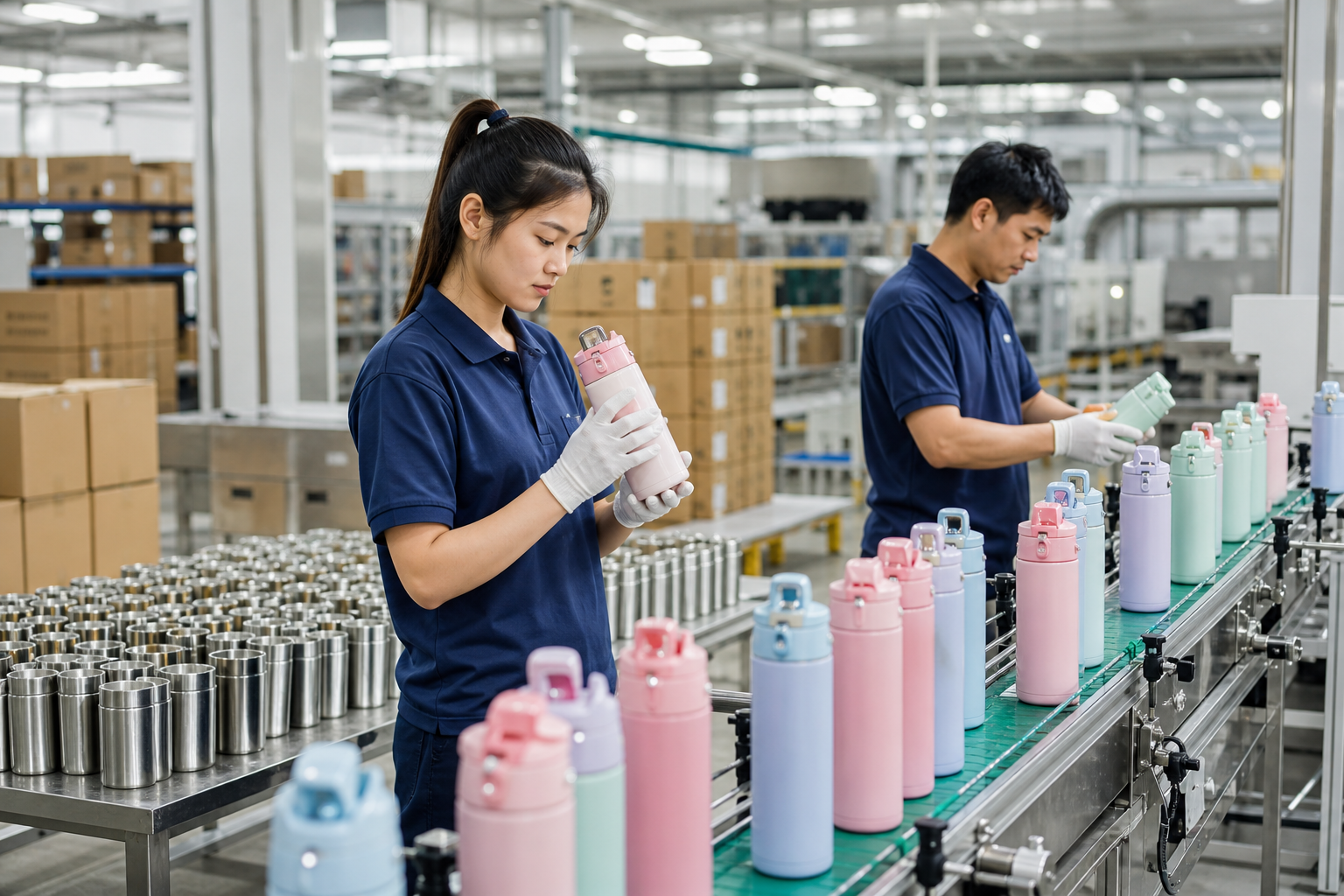
At BottleForge in Zhejiang, we run stainless vacuum bottles for export buyers who want clean paperwork, steady lead times, and a MOQ that matches their forecast. A school or kids model usually starts at 3,000 pcs per color, with a 35–45 day lead time after sample approval. QC pulled the sample on a torque tester at 1.2 N·m, and that is where weak lids show up. If you are building a private label line, you need to sort 304 versus 316 stainless, PP versus Tritan lids, and silicone sealing before you send the PO. FDA, REACH, and LFGB all sit in the same buying decision. Zhejiang has plenty of factories that can quote fast. Fewer can keep the same finish across a 20,000-unit order.
What FDA compliance really means
Buyers often search for fda approved vacuum bottle for kids, but the wording needs care. The U.S. FDA does not “approve” most consumer drinkware the way buyers expect; what you need is a bottle built from food-contact compliant materials that meet FDA rules for indirect food additives. For a stainless thermos, that usually means 304 stainless steel for the inner and outer wall, PP, Tritan, or ABS for lid parts that touch food, and silicone for gaskets and seals. We run into this on the line all the time. A buyer sends “FDA approved” in the PO, and the spec sheet says 304/0.4mm, but the lid resin is still a blank line.
If you are sourcing for North America, ask for material declarations, migration test reports, and the exact resin grades used in lids and straws. For Europe, you may also need LFGB and REACH, and a lot of brands ask for both because retailers do not want split compliance by region. The smarter move is to treat “FDA approved” as buyer shorthand, then check what the factory can prove on paper. In Zhejiang and across China, the gap is real: one factory sends a promise, another sends the test report the same day. QC pulled the sample last week and found a lid gasket typo on the carton, not the bottle itself. This is the wrong question to ask: not “Is it approved?” but “What documents match this exact model?”
What to request from your supplier
- Material spec sheets for stainless steel, PP, Tritan, and silicone
- Third-party migration test reports
- Production photos of lid assembly and welding
- Batch traceability and carton labeling details
Do not buy based on the phrase “FDA approved.” Buy based on documents, materials, and QC that repeats batch after batch.
Kid-sized thermos specs that work
A good fda approved vacuum insulated bottle for kids has to carry well, seal tight, and wash out fast. That is the spec sheet we run. For school-age children, 350 ml, 500 ml, and 600 ml fit the job best; under 300 ml runs short on a full school day, and 750 ml plus starts to feel heavy in a backpack. On retail shelves, 12 oz or 16 oz is the clean commercial range, and we have seen buyers reject 20 oz samples after one school run because the bottle was too bulky for small hands.
Wall thickness is not a side note. On a standard 304 stainless build, we usually hold the inner wall at 0.4–0.5 mm and the outer wall at 0.4 mm, with a vacuum gap that gives 6 to 12 hours of thermal retention, depending on the lid. QC pulled the sample on a caliper at 0.02 mm over spec once, and the buyer flagged the whole batch because the lid was leaking, not because the steel was wrong. A weak lid kills the performance. For kids, a push-button lid, straw lid, or simple flip-top sells better than a full screw cap because one hand is all they have at school.
When a buyer asks for an fda approved vacuum flask for kids, I point them to a wide mouth for cleaning, a soft-touch carry handle, and a base that still drops into standard lunch bags and cup holders. That is the right question. Keep the decoration practical: screen printing, laser engraving, or powder coating. We ship too many bottles to risk a fragile finish that chips after two weeks in a backpack, and a PO typo like “5000 ml” instead of “500 ml” can waste a full line setup.
Materials and construction details
The build decides whether your fda approved vacuum bottle for schools turns into a reorder or a headache. We run 304 stainless steel for the inner liner on most orders; it hits the right cost point and holds up well. If a buyer wants a premium spec or better corrosion resistance, 316 stainless is available, but it usually adds 8–15% to the bottle cost. For the outer shell, 304 is still the usual pick, especially with powder coating. The buyer once flagged a 0.3 mm wall mismatch on a PO, and that kind of miss shows up fast on the line.
Vacuum insulation is about welding, not just steel grade. On a decent Zhejiang line, you want automated seam welding, vacuum pumping, and leak testing that is actually done, not just written on the spec sheet. We check helium leak tests, or at least hot-water retention sampling for each lot. For lids, PP is the workhorse: light, stable, cheap. Tritan makes sense when the part needs a clearer look and stronger shelf appeal, but the unit price can rise by USD 0.20–0.60 depending on geometry. QC pulled the sample once and found a slow seep at the cap thread after 18 minutes in hot water. The math does not lie.
For schools, hotels, and restaurants, we ship the same bottle platform with different closures:
- Kids: straw lid or flip lid, leak-resistant carry handle
- Schools: durable screw lid, easy-clean wide mouth
- Hotels: matte finish, gift box, laser logo
- Restaurants: simpler build, stackable cartons, bulk packing
If you are checking an fda approved vacuum flask for schools, test dishwasher tolerance early. This is the wrong question to skip. Some decorative coatings fail after repeated washing, and some gaskets loosen after 200 cycles. We have seen that go sideways more than once, especially when a buyer assumes every finish is the same. A 200-cycle test with a 65°C wash is cheap insurance.
MOQ, pricing, and lead times
Let’s talk numbers, because that is where a sourcing deal lives or dies. For a private label fda approved vacuum insulated bottle for schools, the MOQ is usually 3,000 pcs per design or per color if you want a custom print. If you keep the bottle body standard and only change logo or packaging, some China factories will start at 1,500 pcs, but the unit price climbs. A realistic FOB China price for a 350–500 ml stainless kids thermos usually lands at USD 4.20–7.80, depending on 304 stainless, lid parts, coating, and whether you add a spoon or carry strap.
At BottleForge in Zhejiang, we run 300,000 units a month across stainless and insulated drinkware lines. That matters when a buyer wants repeat shipment dates, not a one-off. QC pulled the sample on a 1.5 mm gasket once because the lid torque felt loose by hand; that is the sort of issue you want found before bulk. Sampling usually takes 7–12 days. Mass production takes 35–45 days after sample sign-off and deposit, assuming the tooling stays standard. If you add custom mold work for a special lid or handle, budget another 18–25 days. A supplier who says “two weeks for everything” is skipping the part that protects your order.
For hotels and restaurants, the math changes. A fda approved vacuum bottle for hotels or fda approved vacuum flask for restaurants often ships in smaller runs of 1,000–2,000 pcs, but buyers tend to ask for heavier finishes, gift boxes, or engraved branding. That adds USD 0.35–1.20 per unit, depending on the print method and box style. We’ve seen this go sideways when the buyer flagged a PO typo on the carton quantity and expected the same unit cost anyway. It does not work like that.
Testing, quality control, and audits
Good sourcing starts with risk control before the container leaves China. For an fda approved vacuum insulated bottle for hotels or a retail kids line, we run a QC plan with hard limits. AQL 2.5 for major defects and AQL 4.0 for minor defects is a normal baseline, unless your buyer wants tighter numbers. Check leaks, cap torque, vacuum performance, paint adhesion, and logo accuracy. If the bottle has a straw or silicone spout, add bite-valve integrity and odor testing. We once caught a 0.8 mm cap mismatch on the line; the buyer flagged it before packing.
Ask for BSCI, ISO 9001, or another audit report the factory can actually show, not a promise in email. European distributors and North American brand owners usually want a paper trail. For compliance, request REACH, FDA material statements, and CA Prop 65 screening if the SKU goes that way. For thermal claims, get retention test data from the exact production spec, not a “similar model.” The math does not work any other way. Our lab uses a thermocouple probe and a 5,000 ml water bath for those checks.
A practical inspection flow looks like this:
- Pre-production sample approval
- First article check on the pilot run
- In-line inspection at 30% output
- Final random inspection before carton sealing
If you want an fda approved vacuum bottle for restaurants or hotels, ask about carton drop tests and pallet loading. We’ve seen this go sideways on sea freight. A 5-layer master carton and a 1.2 m drop test matter when the goods ship from Zhejiang to Los Angeles or Rotterdam and sit in a warehouse for six weeks. One PO we saw even had “Roterdam” typed wrong, which tells you how careful the buyer was being.
Branding and channel fit
Different channels need different bottle behavior. A kids retail line needs bright graphics, safety cues, and easy cleaning. A school program needs a 12-month drop test, low return rates, and a lid that survives 500 openings. A hotel amenity line needs a clean premium feel and fast replenishment. A restaurant procurement manager wants stackable cartons, reliable lids, and a replacement cost that stays flat. One fda approved vacuum flask for hotels should not be spec’d like a grocery-store kids bottle. We’ve seen that mistake on the line, and the buyer flagged it on the first pilot.
Decoration choices hit margin fast. Screen printing is usually the lowest-cost route for a simple logo. Laser engraving looks cleaner and holds up longer, but it works best on brushed stainless or powder-coated surfaces. UV printing adds color complexity, yet it needs tighter surface prep and the scrap rate jumps if the batch gets rushed. QC pulled the sample with a 0.3 mm alignment shift last month. If your order is for a North American chain or a European distributor, consistent color beats a flashy mockup.
For outdoor retailers, the stronger commercial angle is often a rugged family bottle that can sell to adults and kids. One platform, two shelf stories. For school programs, a bottle with a replaceable lid and straw assembly is smarter than a fully sealed premium flask; the math does not work if the parts are not replaceable. For hotel and restaurant buyers, bulk packing and outer carton labels cut warehouse labor. We run this every week in Zhejiang. Send the dielines, Pantone codes, and packing rules upfront, and the line moves cleanly; leave out the carton mark, and the PO comes back with a typo.
Send your spec, get a real quote
Tell us capacity, lid type, logo method, and target market. We will quote FOB China pricing, MOQ, and lead time without wasting your time.
Frequently asked questions
Is FDA approval required for a kids vacuum bottle in the U.S.?
Usually no formal FDA approval is issued for a finished bottle. What you need is FDA-compliant food-contact materials and test documentation. For a kids thermos, ask for stainless steel and lid resin declarations, migration test reports, and traceable batch records. A good export factory in China should provide these before mass production. If the seller only says “FDA approved” without paperwork, treat that as a sales phrase, not proof.
What is a normal MOQ for a custom stainless thermos?
For a private label kids bottle, a normal MOQ is 3,000 pcs per design or color. If you only change logo or packaging on a standard mold, some Zhejiang suppliers can go to 1,500 pcs, but unit cost rises. For hotels and restaurants, MOQs can be 1,000–2,000 pcs if the design is standard. Custom lids or handles usually increase MOQ because tooling and setup time have to be recovered.
How much does an FDA compliant vacuum bottle cost FOB China?
For a 350–500 ml stainless kids bottle, FOB China pricing is often USD 4.20–7.80 per piece depending on material grade, lid type, coating, and packaging. 316 stainless, Tritan parts, and gift boxes push the price higher. If you need laser logo, custom color powder coating, or a silicone sleeve, add roughly USD 0.20–1.20 per unit. Shipping and duties are separate from FOB pricing.
How long does production take in Zhejiang?
Sampling usually takes 7–12 days if the design is standard. Mass production is commonly 35–45 days after sample approval and deposit. If you need new tooling for a special cap, allow 18–25 extra days. A factory with 300,000 units per month can still be slow if the spec is unclear, so the best way to protect your timeline is to freeze artwork, carton details, and testing requirements before PO release.
Can the same bottle work for schools, hotels, and restaurants?
Yes, if you keep the platform consistent and adjust the details. Schools usually need 350–600 ml with a leak-resistant lid and easy-clean mouth. Hotels often want a more premium finish and gift-style packaging. Restaurants want bulk packing, durable lids, and easy replacement parts. The base structure can stay the same, but branding, capacity, and packaging should match the channel so you do not overpay for features the buyer will never use.