Key Takeaways
- Typical glass water bottle MOQ starts at 3,000 pcs per SKU, with factory-direct FOB prices from USD 1.18 to 2.95 depending on capacity and closure.
- A serious glass water bottle factory should show BSCI or ISO 9001, REACH-compliant materials, and a packed breakage target below 1.5% for export cartons.
- For private label, screen print is usually USD 0.12 to 0.28 per color; laser engraving runs higher but holds up better on premium glass water bottle customized orders.
- Lead time for standard glass water bottle wholesale bulk orders is often 25 to 35 days after sample approval, with Zhejiang factories commonly producing 80,000 to 150,000 units per month.
If you are buying glass water bottle wholesale for a wellness brand or a sustainable retail line, the hard part is not finding a supplier. It is telling a real glass water bottle factory from a middleman who only forwards your inquiry. In Zhejiang and across China, we see glossy catalogs, low quotes, and “fast turnaround” promises every week. The real check is simple: can the line hold the tolerance, pack bottles safely, and repeat the same order six months later without logo rub-off or color shift?
For glass drinkware, the buying decision looks simple on paper and gets messy fast in production. A bottle that passes sample approval can still fail a drop test, leak at the cap gasket, or arrive with 3% breakage and kill your margin. QC pulled the sample at 1.2 mm wall thickness, and the buyer still flagged the cap fit on the PO. If you want glass water bottle bulk pricing that leaves room for retail markup, you need to look at MOQ, borosilicate versus soda-lime, decoration method, and whether the glass water bottle manufacturer in China quotes FOB the right way instead of tossing out a fake unit price. That math does not work any other way.
What wholesale buyers should expect
When you search for glass water bottle wholesale, the first quote is rarely the full landed cost. A serious glass water bottle supplier should split out bottle body, cap, gasket, logo, packaging, and freight terms. If the reply gives you one flat number and skips capacity, glass thickness, closure type, and carton count, you are not comparing offers. You are comparing guesses. We had a buyer flag a PO with “500ml” in one line and “500 ml” in another; QC pulled the sample, and the lid fit changed because the neck finish was different.
For wellness brands, 500 ml to 750 ml is the normal buy, since it fits shelf planograms and repeat use. A plain borosilicate bottle with bamboo lid or stainless cap usually lands around USD 1.18 to 1.85 FOB China at 3,000 pcs. A more complex glass water bottle promotional program with sleeve, custom print, and gift box can move toward USD 2.40 to 2.95. We run lines in Zhejiang that can turn out 80,000 to 150,000 units per month, but output means nothing if the wall thickness drifts from 1.8 mm to 2.2 mm across cartons. The math does not work.
You should ask for four numbers on the first call: MOQ, sample lead time, bulk lead time, and breakage allowance. For export, a sensible target is under 1.5% shipping damage with double-wall cartons and dividers. If a glass water bottle distributor says breakage is “normal” at 4% or 5%, they are asking you to pay for a packing problem. We’ve seen that go sideways fast when the carton spec was changed from 5-layer to 3-layer without telling the buyer.
Glass types and wall thickness
Glass bottles do not all behave the same. A solid glass water bottle manufacturer should tell you straight whether the bottle is borosilicate or soda-lime, because that choice changes unit price, dead weight, thermal resistance, and how buyers judge the product on a shelf. Borosilicate is the safer pick for hot water, cold-fill shock, and a wellness line that needs a cleaner story. Soda-lime works when the target is a lower landed cost, but we’ve seen it crack when someone pours 95°C water into a cold bottle from the truck. QC pulled the sample, and the first check is simple: ask for the glass formula before you talk print or cap.
Wall thickness is where a lot of buyers get burned. For a 500 ml bottle, 1.8 mm to 2.2 mm is a common range for borosilicate, and that range is not random. If the wall drops below 1.6 mm, the bottle can look refined but it starts to feel risky in transit, on conveyor belts, and during carton drop tests. For a stainless-capped glass water bottle custom made for daily hydration, we run for a weight balance that feels solid in hand without turning the carton into extra freight. A 5 g saving is not worth a breakage claim. That is the wrong question to ask.
Ask your glass water bottle factory for:
- Material declaration: borosilicate or soda-lime
- Wall thickness tolerance: ±0.2 mm is acceptable on most export runs
- Heat resistance range: typically -20°C to 150°C for borosilicate products
- Glass clarity grade: especially important for clear retail packaging
Some glass water bottle suppliers show a thick sample, then ship a thinner mass-production lot. We’ve seen that go sideways on a 12,000 pcs order when the buyer flagged a 0.3 mm gap between the approved sample and the PO. Put the spec in writing, attach photos with caliper readings, and list the measurement point on the drawing. Zhejiang factories that ship every week know this drill, and the better lines will not push back. If they do, walk.
Private label and logo options
If you want a glass water bottle with custom logo, the decoration method decides both the look and how it holds up on the line. Screen printing is the usual pick for a glass water bottle private label program because the cost stays low and the setup is repeatable. On one order we ran, a 1-color logo landed at USD 0.12 to 0.28 per piece, depending on logo size and ink count. Two-color work or a full wrap needs more labor, and curved bottles need a proper jig, not a guess. If you want a premium feel, laser engraving on a cap or metal sleeve gives a cleaner result, but it does not fit every brand story.
For a glass water bottle customizable project, I tell buyers to keep the artwork clean. Glass is not a billboard. A sharp logo, one Pantone color, and a short line of text usually sells better than a busy print that looks cheap from 1.5 meters away. One buyer pushed for three fonts on a 500 ml bottle, and the sample looked crowded, so we cut it back to one mark and one line. If your audience cares about sustainability, a simple logo with recycled carton packaging usually does better than a loud promo design.
Common customization paths:
- Glass bottle body: silk screen, decal, frosted effect, acid etch
- Cap: bamboo laser logo, stainless engraving, silicone emboss
- Packaging: kraft box, color box, mailer box with FNSKU sticker area
A glass water bottle OEM manufacturer should confirm the ink curing temperature and run adhesion tests before production starts. We check this with a rub tester, and if the print starts to lift before 20 wash cycles, the bottle is not ready for retail. QC pulled one sample last month that failed the dishwasher test after cycle 18, so we stopped that artwork and changed the ink. You want a supplier who can send a sample approval sheet, wash-care notes, and a real test result, not just nice renders.
How to vet suppliers in China
There are plenty of glass water bottle manufacturers in China, but only a fraction deserve a PO. Start with compliance. Ask for BSCI, ISO 9001, and a recent REACH declaration for materials and coatings. If you sell into North America, the closure parts and inks need food-contact paperwork too. We ship from Zhejiang every week, and a factory that sells cleanly into export markets will send these files without drama. If they stall, walk.
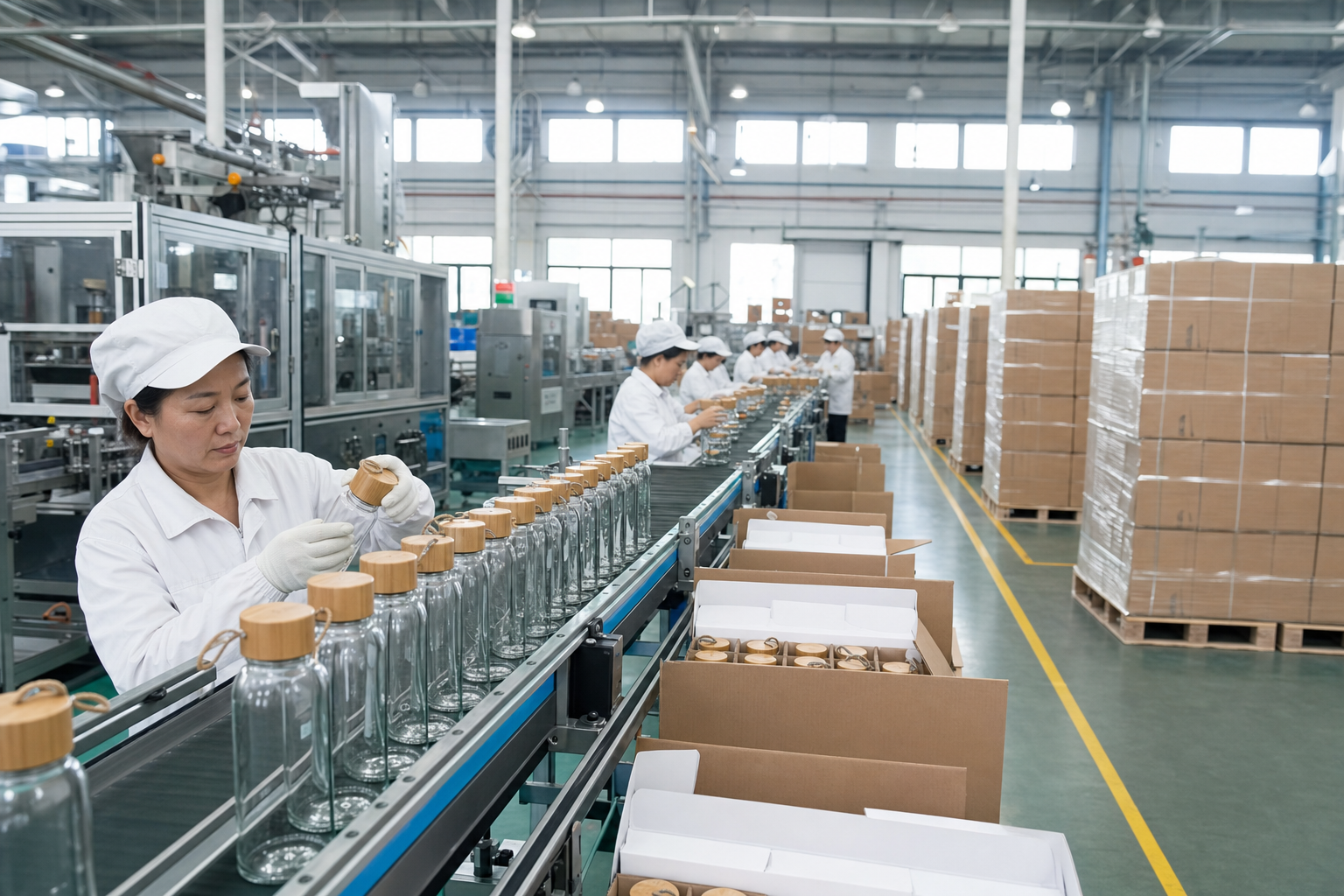
Next, check whether you are dealing with a real glass water bottle factory or a trade office with a nice website. Ask for one production video that shows melting, forming, annealing, printing, and packing in the same plant. Ask for plant headcount, monthly output, and the number of molding lines or decoration lines. A proper line can talk about neck finish tolerance, cap torque, and carton drop resistance in plain numbers. If they dodge those points, the math does not work.
A practical supplier check looks like this:
- Factory audit: on-site or third-party inspection
- Sample review: 1 master sample, 2 pre-production samples
- QC system: AQL 2.5 for major defects, AQL 4.0 for minor defects
- Packaging test: 70 cm or 80 cm drop test depending on carton weight
For glass water bottle wholesale bulk orders, I tell buyers to work with 2 suppliers only when the SKU risk is high. We have seen this go sideways when a buyer spreads 3,000 pcs across three factories and then spends a week chasing three carton specs. One strong vendor is easier to control. QC pulled the sample, the label was 3 mm off center, and that one issue saved a bad shipment.
Pricing, MOQ, and freight math
Most buyers stare at unit price and miss the math that moves margin. For a glass water bottle wholesale program, the gap between USD 1.42 and USD 1.58 is not what breaks the deal. Freight, breakage, carton count, and pack size do. We ran a 500 ml borosilicate bottle with a two-piece set last month: 24 pcs per carton, then the gift box version dropped to 12 pcs, and ocean freight per unit went up 18%. That is the part buyers feel on the P&L.
Typical MOQ for a custom glass water bottle buy in bulk is 3,000 pcs per design. Some glass water bottle vendors will quote 1,000 pcs if they use stock shapes. We see the tradeoff on the line all the time: once the buyer asks for a bamboo lid, sleeve, and printed carton, the MOQ moves up. The buyer flagged it on a PO once with a typo on the lid color code, and QC still had to hold the sample. That is normal. The math does not lie.
Use FOB China pricing as your baseline, then add:
- Sampling cost: often USD 30 to 120 depending on tooling and print setup
- Third-party inspection: USD 150 to 300 per visit
- Ocean freight: seasonal, but often 80% to 90% cheaper per unit than air
- Duty and landed cost: check your HS code before approving the order
In Zhejiang, the stronger factories quote cleanly because they know experienced buyers compare landed cost, not headline price. If your supplier cannot tell you carton volume in CBM and pcs per 40HQ, you are not getting a useful quote. We ship from Hangzhou every week, and the first question is usually carton size in mm, not the pretty render.
Quality control before shipment
Glass does not forgive weak QC. A bottle can look fine under the line lights and still chip on a warehouse floor or crack after one dishwasher cycle. We run neck finish inspection, thread alignment checks, cap torque tests, and random leak tests before shipment. If there is a silicone sleeve, QC checks odor, fit tolerance, and stretch recovery too. One bad sleeve batch can sink a PO.
For export orders, we use AQL 2.5 for critical and major defects before loading. The inspector should pull cartons from finished pallets, not a handpicked box near the packing table. QC pulled the sample from 12 cartons on one 40HQ last month, and the buyer flagged a PO typo on the carton mark, so this step matters. Watch for these issues:
- Chips at the rim or base
- Uneven logo color or misalignment
- Loose cap gaskets
- Carton crush or divider failure
- Glass cloudiness or bubbles beyond your agreed limit
If you ship e-commerce, ask for a full carton drop test. For Amazon or similar channels, label placement matters too. A glass water bottle with custom logo may still need FNSKU labels, suffocation warnings on polybags, and outer carton marks that match your carton list. The math does not work any other way. We have seen a 2 mm label shift turn into a refused inbound shipment.
A disciplined glass water bottle supplier will not push back on inspection. They treat it as normal export work, not a special request. That is the line between a vendor and a partner.
Request a factory quote for your bottle project
Send your capacity, logo, and target MOQ. We’ll quote glass water bottle wholesale pricing with FOB terms, packaging options, and lead time from Zhejiang.
Frequently asked questions
What is the usual MOQ for glass water bottle wholesale orders?
For a standard stock shape, MOQ can start at 1,000 pcs. For true glass water bottle custom work with logo, lid changes, or color packaging, 3,000 pcs per SKU is more realistic. If you want a glass water bottle wholesale bulk program with private label and custom carton, some Zhejiang factories will ask for 5,000 pcs to keep setup cost under control. Lower MOQ usually means fewer options and a higher unit cost. A fair target for 500 ml borosilicate with one-color print is 3,000 pcs, FOB China.
How much does a custom glass water bottle cost from China?
A basic 500 ml borosilicate bottle with simple cap often lands at USD 1.18 to 1.85 FOB China at 3,000 pcs. Add USD 0.12 to 0.28 for one-color screen print, and another USD 0.10 to 0.35 for upgraded packaging. If you want glass water bottle personalized with sleeve, gift box, or laser logo, the finished cost can reach USD 2.40 to 2.95. The exact price depends on wall thickness, cap material, and how much packaging volume your design adds.
How do I verify a real glass water bottle factory?
Ask for a live factory video showing forming, annealing, printing, and packing in one site. Then request BSCI, ISO 9001, REACH declarations, and recent inspection records. A real glass water bottle factory in Zhejiang or elsewhere in China should know wall thickness, neck finish, and cap torque without hesitation. If they can only send catalog photos, they are likely a trade company or a glass water bottle vendor sourcing from several plants. That is not always bad, but you should know what you are buying.
What decoration method lasts longest on glass bottles?
For the bottle body, fired silk screen or decal with proper curing is common and cost-effective. For premium applications, laser engraving on a metal cap or sleeve lasts longer because it does not wear off in washing. If your glass water bottle private label must survive repeated use, avoid oversized ink coverage on high-touch areas. A good factory should test adhesion after 20 to 50 wash cycles, depending on your market. If you need a cleaner premium look, frosted or acid-etched glass is also durable.
How much breakage should I accept in shipping?
For export cartons packed properly, target under 1.5% damage. With good dividers, double-wall cartons, and sensible stacking, many glass water bottle suppliers can do better. If your shipment is for e-commerce, ask for a 70 cm or 80 cm drop test and carton compression testing. Anything above 3% is a serious packing problem, not a normal loss. Make sure the factory specifies carton count, CBM, and pallet pattern before you approve production. That is where breakage risk is usually decided.