Key Takeaways
- A practical growler custom order usually starts at 500 pcs MOQ, with 20-30 days lead time after sample approval.
- For export, 304 stainless steel at 0.5 mm to 0.6 mm wall thickness is the safer baseline for customized growler programs.
- AQL 2.5 for critical defects and 4.0 for minor defects is a normal inspection target for custom drinkware shipments.
- The lowest-risk decoration setup is one or two spot colors, laser engraving, or a clean wrap print on a flat panel.
If you are buying growler custom drinkware for retail, hospitality, or distributor programs, do not treat it like a logo slap. A growler has to survive freight, seal tight, hold temperature when the spec calls for it, and still look clean on shelf. We run the first sample through a cap-torque check and a leak test before anyone talks price. Define the use case first. Then ask for a quote.
In Zhejiang and across China, a good canteen factory team starts with capacity, compliance, and decoration limits, not artwork. That is the right way to buy a custom growler, a custom canteen, or any drinkware line you plan to reorder at 3,000 pcs or more. If the buyer flags the carton size, the PO typo, or the AQL target late, the math does not work. Ask for MOQ, lead time, test standard, and carton spec before you compare quotes.
Define the growler use case first
Before you ask a canteen supplier for quotes, pin down what the bottle has to do. A growler custom run for craft beer retail is not the same as a distributor growler for hotel minibars, and it is not the same as a canteen promotional order for giveaways. We had one buyer send the same PO for all three, then QC pulled the sample and the leak test failed at the cap. The seal, mouth size, surface finish, and carton strength all change with the channel, so guessing here just wastes time.
Start with four calls: volume, closure, insulation, and decoration. Common sizes are 32 oz, 64 oz, and 128 oz. If the bottle gets refilled often, wide-mouth designs are easier to wash on the line. If it sits in a cooler or back bar, a screw cap with a silicone gasket is safer than a decorative cap that looks good and starts weeping after 12 hours. For beer and kombucha, odor retention matters more than bright graphics. The wrong question is which logo looks best.
- Retail growler: shelf appeal and a clean label area.
- Distributor drinkware pack: carton efficiency and low breakage.
- Promotional canteen custom order: low decoration cost and fast turnaround.
- Premium custom canteen or customized drinkware line: stronger lid system and tighter finish control.
If you only define the logo, you will get a quote that looks cheap and behaves badly. Define the use case first, and the canteen manufacturer can set the right neck, cap, and packing spec before the first sample. We have seen this go sideways when a buyer flagged a typo on the carton art after the molds were already cut.
Material choice affects returns
I’ve got the structure and constraints. Next I’m rewriting each paragraph to keep the HTML intact while making the wording sound like a real export sales engineer, with concrete shop-floor details and tighter phrasing.Material choice is where a growler custom project saves $0.03 a unit and loses far more on returns if the steel is wrong. For export, 304 stainless steel is the safe default. If the bottle will go through aggressive wash cycles or sit in a salty environment, 316 is the better call, but the unit price goes up. For most custom growler and customized canteen programs, 304 with a 0.5 mm or 0.6 mm body works if the forming stays even. On the line, QC pulled the first 20 pieces and checked the weld seam before we released the batch.
Single-wall bottles are lighter and cheaper. Double-wall vacuum bottles hold temperature better, cut condensation, and feel more premium in the hand. The tradeoff is cost, lead time, and a leak test that takes longer to run. We use a 50 kPa vacuum check on each batch, and that step is where weak welding shows up fast. If your customer wants cold retention over 12 to 24 hours, vacuum construction is the right answer. If the bottle is mainly for transport and refilling, single-wall is the better distributor canteen choice. We have seen buyers push for a premium spec at a single-wall budget, and that math does not work.
Watch the lid system as closely as the steel. A BPA-free cap, food-grade silicone ring, and tight thread tolerance matter more than a fancy exterior. The torque driver on the cap line is set to 0.8 N·m, and that number matters when the buyer flags a loose lid after a drop test. In China, a canteen factory can show you a polished sample in one week, but you still need data: salt spray results, dishwasher checks, drop tests, and internal odor testing where applicable. Cheap steel with poor welding is not a bargain.
Ask for the wall thickness, steel grade, and leak-test method in writing. If the supplier cannot state those three items clearly, keep looking.
Decoration should survive shipping
Decoration is where growler custom jobs either ship clean or come back with a complaint. On the line, a one-color logo in silkscreen is still the cheapest path, and it holds up if the ink is cured right. For stainless, laser engraving gives a mark that does not peel, which matters when a buyer says the logo must survive 12 months in warehouse stock. If the art has gradients or three colors, UV print or a wrapped label can work, but only when the surface is wiped down, the bottle wall is stable, and the artwork is sized to the shoulder and base, not just the flat mockup.
The point is not to pile on decoration steps. The point is to match the print method to margin and reorder volume. A canteen customizable program for a distributor usually needs one primary logo, one SKU color, and one packaging layout, not a dozen variants. That keeps setup charges in line and makes repeat orders easier to run. For canteen promotional runs, keep the logo block simple and skip tiny text; we have seen 6 pt copy turn into a blur after one season, and that is the wrong question to ask if the buyer wants shelf impact and a clean second PO.
Ask for a print proof, not just a PDF. A physical sample shows the real alignment, seam placement, and how the art sits near the shoulder or base when the bottle goes through the jig and oven. If the supplier says custom logo support is included, confirm whether that price covers one side, two sides, or a full wrap. The buyer flagged it before on a PO with a missing color code, and the unit price jumped after plate making, color matching, and one round of rework got added at the last minute.
If you need a deeper process comparison, pair your sourcing brief with silkscreen vs laser engraving for drinkware and the factory's artwork rules.
Check factory proof, not promises
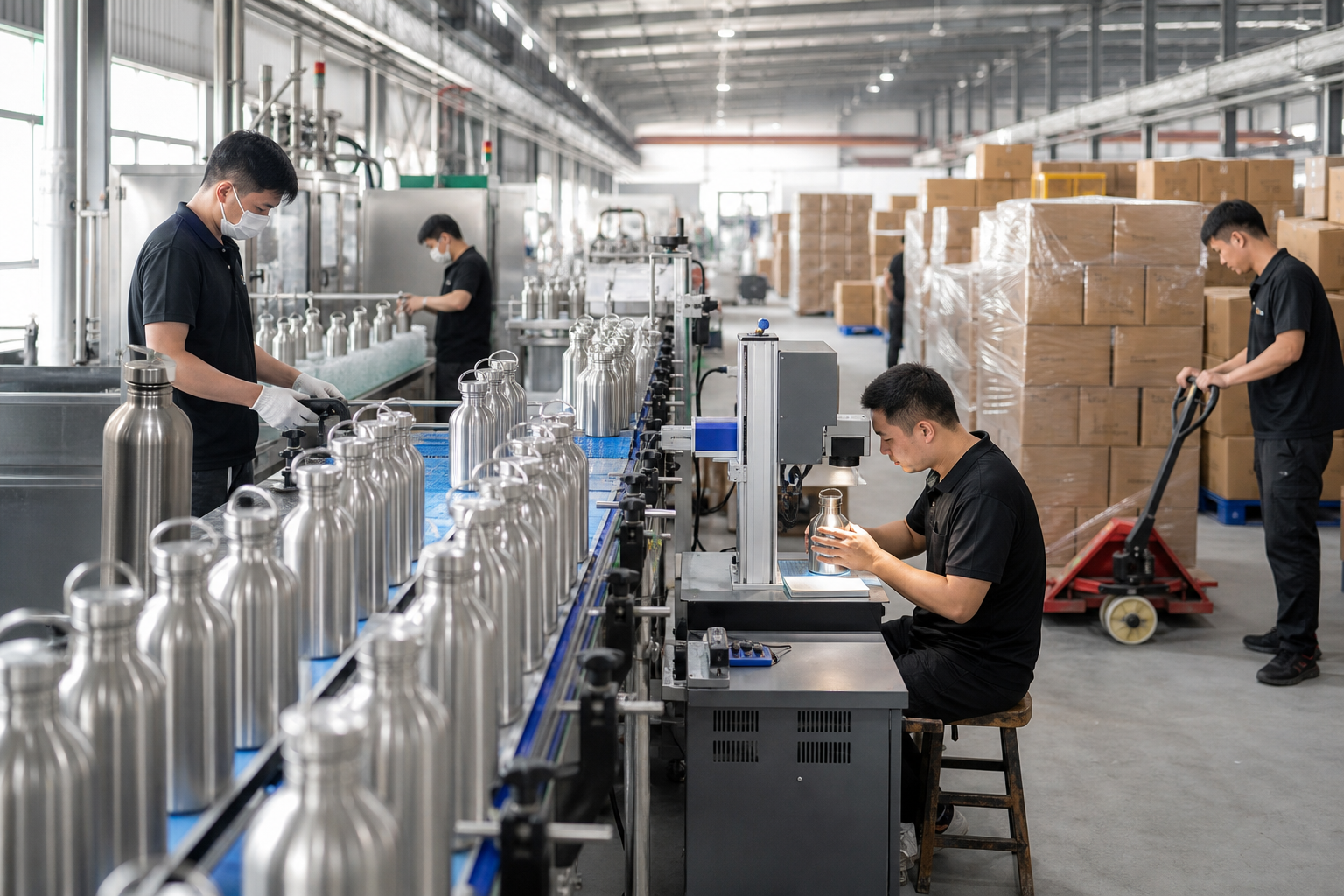
A real canteen factory does not just send a catalog. It shows line capacity, leak-test records, and a process we can trace from raw tube to carton. For a growler custom order, ask for ISO 9001, BSCI if you need social compliance, and export history to Europe and North America. If your market is strict, ask for REACH paperwork, LFGB testing where needed, and FDA declarations for contact materials. QC pulled the sample at 9:20 on our filling line once, and that was enough to catch a bad document before it turned into a shipment problem.
In Zhejiang, the better plants quote monthly capacity, not annual slogans. A factory running 50,000 to 100,000 units per month can handle a mixed canteen custom or customized growler program without sliding your order behind a bigger customer. Sample approval usually takes 5 to 10 days. Production is often 20 to 30 days after sign-off, depending on finish and packaging. We run a 12-head leak tester here; if a supplier cannot tell you its bottleneck at the polishing line, the math does not work.
Inspection matters as much as certification. Ask for AQL 2.5 on critical defects like leaks, bad threads, and broken welds, and AQL 4.0 on minor visual issues. Then confirm carton drop testing, vacuum retention checks, and whether the factory does inline leak testing on each batch. QC pulled a 500 ml sample from the last lot and found a 0.3 mm thread burr before packing; that is the kind of finding that keeps claims down. A canteen vendor that can explain its QC flow plainly is safer than one that keeps saying premium.
If you want to review broader plant capabilities before you commit, see custom drinkware production capabilities and the control points used in export orders.
Price the full landed cost
Unit price is one line in the spreadsheet. For growler custom sourcing, the landed cost is the number that matters. A basic 64 oz stainless custom growler usually lands around USD 2.80 to 6.50, depending on wall thickness, lid style, print method, and whether the body is single-wall or vacuum-insulated. On the line, we check wall thickness with a caliper before we quote; 0.5 mm vs 0.8 mm changes the math fast. A heavier insulated model climbs quickly. No surprise there.
MOQ changes the whole deal. Most canteen suppliers we run with start at 500 pcs for standard tooling and 1,000 pcs for deeper customization. Ask for a new lid mold or a special handle, and tooling fees show up. We had one buyer flag a PO typo on the lid color code, and QC pulled the sample back before packing. Small samples usually run USD 25 to 60 each, and that charge is often refundable against bulk. Freight can cost more than the bottle itself, especially on bulky vacuum models. That is the wrong question to ask if you only look at ex-factory.
- EXW works if you control freight and consolidation.
- FOB is the normal choice for many importers.
- DDP can be useful, but only if the supplier can handle duty, brokerage, and last-mile delivery cleanly.
For distributor drinkware programs, ask for carton count, carton size, and pallet pattern every time. A bottle that looks cheap but packs badly will cost more on the water. We ship some 64 oz units at 12 pcs per carton, and that carton spec can make or break the cube. If you are comparing a custom canteen to a custom growler, include freight cube and breakage rate, not just the product price. We have seen this go sideways when the carton drops test was skipped.
For MOQ specifics and ordering structure, this pairs well with MOQ explained for custom drinkware.
Build a line you can reorder
The smartest growler custom program is not a one-off. We run it as a reorder line with 2 or 3 core SKUs, one decoration system, and packaging your distributor can restock without reopening the spec. On the floor, QC pulled the sample and checked cap torque at 18 Ncm before we signed off. That matters whether you are a canteen distributor, a brand owner, or a canteen supplier buying from China for private label use.
Keep the assortment tight. One 32 oz model for price-sensitive channels, one 64 oz hero SKU for retail, and one premium customized growler if the margin works. Use the same neck family where possible so the cap, gasket, and test method stay consistent. The wrong question is how many options you can offer; the real one is how fast the line resets. We have seen buyers add a second lid and watch the MOQ jump by 500 pcs. If the order will move through Amazon or a similar platform, lock carton size and barcode placement before the first pilot run.
This is where custom canteen logic pays off. A canteen customizable platform with shared parts cuts spare-part complexity and trims defects on repeat runs. On one batch, the buyer flagged a 1.5 mm print shift after the second carton drop test, and that saved us from a messy reorder. In China, the factories that win long term are the ones that can repeat the same print, seal, and carton spec six months later without drift.
Choose a format you can reorder, then lock the spec sheet. We build around that, not around a pretty sample room. When the PO typo says "gloss" but the approved sample is matte, the line stops and everyone loses a day. That is how a bottle order becomes a stable product line.
Build your custom growler spec now
Send the size, finish, logo, and target market. We will quote MOQ, lead time, and export packing from our Zhejiang factory.
Frequently asked questions
What MOQ should I expect for a custom growler?
For a standard growler custom order, a realistic MOQ is 500 pcs per color or print version. If you want a special lid, handle, or shape, 1,000 pcs is more common because the factory has to spread setup cost across more units. In Zhejiang and other export-focused regions of China, some canteen manufacturers will quote lower MOQs for stock bodies, but the price usually rises sharply below 300 pcs. If you need multiple SKUs for a distributor canteen program, ask whether the MOQ is per design, per color, or per carton pack. That detail changes the quote more than many buyers expect.
Can I pass REACH and LFGB for Europe with a custom growler?
Yes, if the material stack is chosen correctly and the factory can document it. For Europe, REACH is the baseline for chemical compliance, and LFGB is often requested for food-contact confidence. A 304 stainless body, food-grade silicone gasket, and verified coating or print ink are the usual starting point. Ask the canteen supplier for test reports on the exact sample, not a similar product from another order. If you also sell into North America, confirm any FDA-related declarations the buyer needs and keep the artwork inks and lid compounds consistent across batches. A compliant custom canteen program is mostly about discipline in materials and paperwork.
Which decoration method lasts longest on a growler?
Laser engraving lasts the longest because it removes material rather than sitting on top of it. For a stainless custom growler or customized canteen, that usually means no peeling, no cracking, and better resistance to dishwashing. If you need color, silkscreen can still work well for one to two spot colors, but you should expect wear sooner if the bottle is handled heavily. UV print is better for complex graphics, but it depends on surface prep and topcoat quality. For canteen promotional orders, the best answer is often a simple logo, one color, and a clean layout that survives shipping and daily use.
How long does sampling and production usually take?
For a typical growler custom project, sample lead time is usually 5 to 10 days if the factory is using an existing body and standard decoration. Production after sample approval is often 20 to 30 days for 500 to 5,000 pcs, depending on finish, packaging, and inspection load. If you add a new mold, custom lid, or special carton, add more time. In a strong Zhejiang factory, monthly output may run from 50,000 to 100,000 units, which helps keep the schedule stable. The bigger risk is not the bottle body; it is the approval delay when artwork, carton marks, or compliance documents are incomplete.
Is a growler or a canteen better for distributors?
It depends on channel behavior. A growler is better if your buyer expects beverage refills, bar service, or craft beer positioning. A canteen is better if the product is going into general retail, outdoor, wellness, or corporate gifting. For distributor drinkware programs, the better choice is the one with the simplest reorder path, not the one that looks more impressive in a sample photo. A custom canteen usually has wider use cases, while a custom growler can command a stronger story and higher price point. If you want one platform for multiple markets, start with the same body family and change only the lid, print, and carton.