Key Takeaways
- A practical MOQ for a growler customizable program usually starts at 1,000 pcs per style, with 30-45 day production after sample approval.
- 304 stainless steel is standard; 316 is worth the upgrade only for acidic or premium beverage programs.
- FOB pricing for a basic custom growler often sits around USD 2.80-6.50 depending on size, wall thickness, and decoration.
- A reliable canteen manufacturer should offer AQL 2.5 major and 4.0 minor inspection, REACH support, and stable monthly output above 300,000 units.
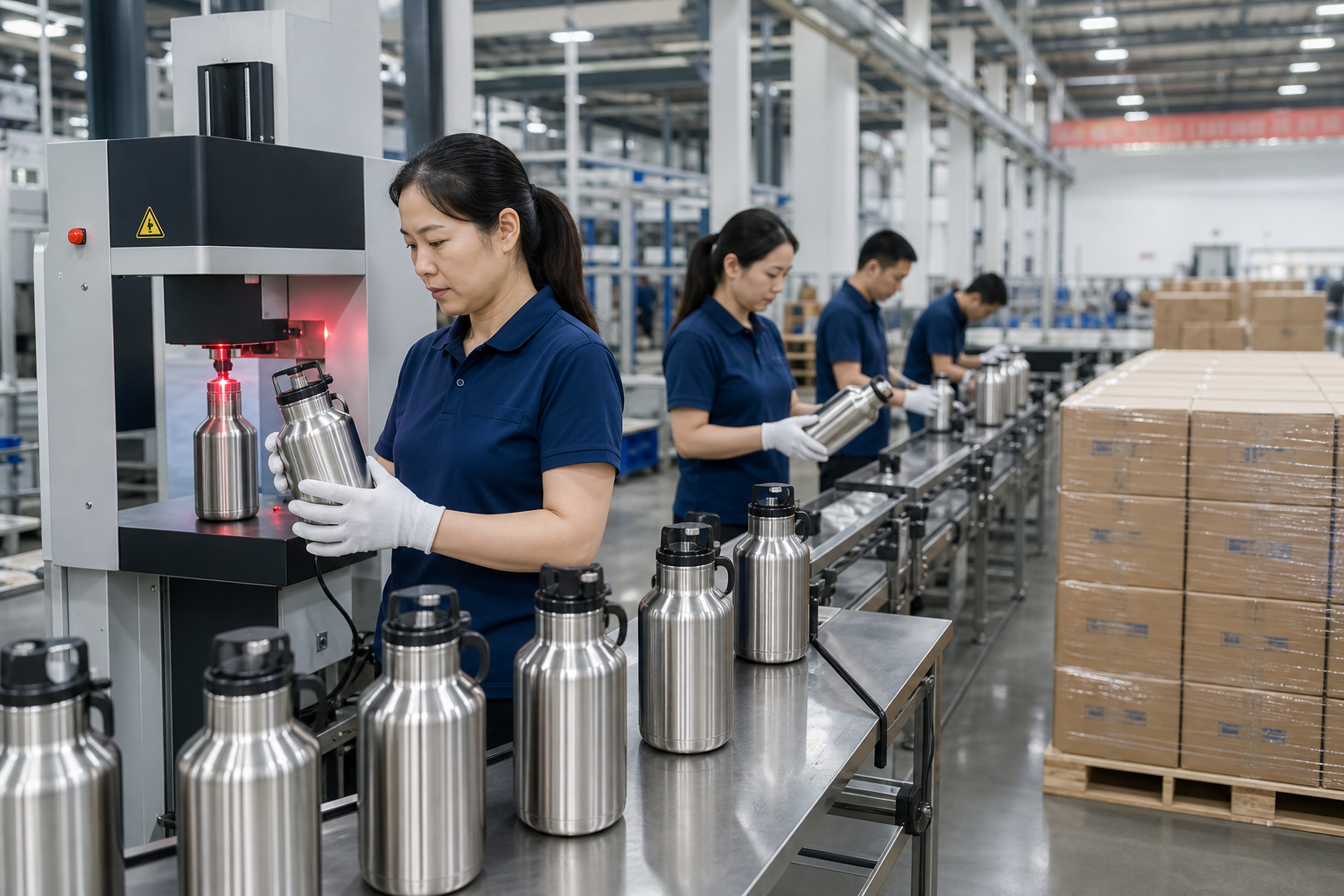
If you are sourcing a growler customizable program, the real question is not whether the bottle can carry a logo. The question is whether it will hold up in export packing, repeated washing, 30C swings, and the rough handling that hits a distributor warehouse or retail program. We run drop tests, cap torque checks, and carton compression on the line. That is where first-time buyers lose money.
In Zhejiang, China, we see this every week: a buyer asks for a custom growler, then the closure spec, coating thickness, carton ECT, or test standard was never written down. A serious custom drinkware project needs more than a render. You need a clear drawing, a realistic MOQ like 3,000 pcs, and a factory that can repeat the same finish across the full run. QC pulled the sample, found a 1.2 mm gasket mismatch, and the buyer flagged it before the PO typo turned into a late shipment. For canteen distributors and brand owners, this is the wrong question to ask after the sample arrives.
Start with the use case
Before decoration, pin down how the growler will work on the shelf and in the hand. A 32 oz craft beer retail bottle and a 64 oz distributor bundle solve different jobs. On our line, we check neck finish with a go/no-go gauge before anyone talks print. The use case decides the lid, handle, insulation, and even the body shape. If the bottle moves through stores, e-commerce, and carton packs, it needs a profile that stacks cleanly and takes a drop. If it stays on-premise or at events, grip and pouring control matters more.
For most B2B buyers, the clean starting point is a custom growler in 18/8 or 304 stainless steel, single-wall for price or double-wall vacuum for temperature retention. A double-wall build adds weight and cost, but it cuts condensation and usually sells better. We had one buyer push back on a 0.6 mm wall spec because the math did not work for their margin. A canteen customizable program follows the same rule: keep the shell simple, make the closure reliable, and choose the finish after the use case is fixed. That is how you avoid paying for features the channel will never use.
Typical formats we ship from canteen suppliers are 32 oz, 40 oz, and 64 oz bodies with wide-mouth openings. Wide-mouth helps cleaning and filling, but it changes lid compatibility, so we always check the cap with a torque tester before approval. If your buyer base is in Europe or North America, ask for dishwasher testing, a lid cycle count, and a sample drop test before mass production. QC pulled a sample last week with a 1.2 mm dent from a 90 cm drop, and that is the kind of failure you want before shipment, not after.
Pick the right steel and wall
The material call is simple once you pin the target price. For most customizable drinkware runs, 304 stainless steel is our default. It holds up on the line, forms cleanly, and keeps the quote inside range. We move to 316 only for acidic mixes, salted drinks, or buyers who want a premium spec sheet. Chasing 316 for every job is the wrong question. On one 5,000-unit growler PO, the cover page said 316 and the spec block said 304, so we had to stop it before the line started.
Wall thickness is where a lot of projects go sideways. On insulated models, we usually run 0.5 mm to 0.6 mm for the inner and outer shells. Below that, dents show up fast and the body feels soft in hand; above it, freight climbs and the carton count gets ugly. For a single-wall bottle, thinner can work if the draw depth and neck finish are controlled. QC pulled the sample with a micrometer and found a 0.02 mm swing at the shoulder, which was enough to loosen the lid fit. A good canteen factory in China should quote the gauge, the steel certificate, and the tolerance window batch by batch.
Ask for test data, not promises. A credible canteen manufacturer should show salt-spray results for coated surfaces, thermal retention numbers where they matter, and REACH plus food-contact paperwork. We check the finisher's sequence on the line, because a skipped pass through the powder booth changes the result. If the seller cannot explain 304 versus 316 or point to the finish steps, you are not dealing with a technical supplier. You are dealing with a broker.
Rule of thumb: choose the material for the drink and the channel, not for the sample photo.
Decoration that survives transport
Decoration is where a lot of custom drinkware looks sharp in the render and then falls apart on the line. For a canteen customized for a price-sensitive rollout, a one-color silk screen is usually the safest call. If the buyer wants a premium finish, laser engraving holds up best because it does not chip or fade after carton rub and pallet movement. Powder coating gives more color choices, but we specify 60-80 μm and check adhesion with a cross-hatch test before we green-light mass production.
For a growler customizable program, logo placement has to work with the curve, not against it. A long wrap print can look clean on a flat artwork file and then stretch once it hits the bottle body. This is the wrong question to ask if the buyer only wants the mockup to look good. Keep the print zone clear, and ask the canteen supplier for a curved-surface proof; QC pulled a sample with a 220 mm wrap once, and the buyer flagged the distortion on the first round. If your buyer wants a canteen promotional run, cut it back to two spot colors. That usually beats four-color art once you count lead time, ink matching, and reject rate.
For higher-end orders, we run a two-step decoration plan: laser logo on the cap or neck ring, then screen print on the body. That gives brand visibility without risking the main coating. On the floor, the cap laser jig is the cleanest part of the job, and it keeps the logo off the wear zone. In Zhejiang, China, we often push a plain body with controlled branding because it photographs well, moves faster through distributors, and avoids color drift on reorders.
MOQ, pricing, and lead time
Buyers ask for a custom canteen or custom growler like every factory runs the same playbook. It does not. For a new style, 1,000 pcs is the floor we see most often, and 3,000 pcs shows up fast if the body mold or cap tooling is new. If the buyer wants mixed colors, we set MOQ per color unless we already have that coating line running. On the line, a 3,000 pcs PO with two lid colors is where the math starts to bite, and that is the wrong question to brush aside.
For sample work, the clock starts after art confirmation. We usually ship in 7-10 days, and mass production sits at 30-45 days after deposit and sample approval. Peak season and complex decoration add 7 days, sometimes more if QC pulled the sample for a print mismatch on a 32 oz body. A competitive FOB price for a basic 32 oz stainless custom drinkware item might start around USD 2.80-3.60 for single-wall and USD 4.20-6.50 for vacuum-insulated, depending on steel cost, lid type, and print method. The buyer flagged it because the lid insert changed the cycle time by 18 minutes per batch.
Do not look at unit price alone. Ask for carton count, carton dimensions, and whether the quote includes export inner packs. A canteen distributor needs landed cost discipline, not a cheap sample. We have seen a PO typo on carton count turn into a 12% freight jump, and that is where the deal gets ugly. If the factory ships more than 300,000 to 500,000 units a month and keeps replenishment stable, that matters more than shaving 12 cents off the first order.
Compliance and quality control
If you sell into Europe or North America, compliance is not optional. A proper canteen manufacturers file should include food-contact declarations, REACH support, and any requested state or retailer paperwork. On our side, we keep the food-contact binder at the packing table and check lot codes before we ship. For stainless drinkware, ask for LFGB where the market requires it, and get clear statements on BPA-free lids and silicone parts. If the lid uses a gasket or straw part, those materials matter as much as the steel shell, and the buyer should not treat them as a footnote.
Quality control needs to be set before the first sample run. We agree the AQL on the PO, usually AQL 2.5 for major defects and 4.0 for minor defects on consumer drinkware. QC pulled 10 pieces from the line with a leak rig, then we locked the cap fit check and visual inspection for coating defects, weld marks, and dents. For vacuum bottles, ask for insulation verification on a statistically valid sample, not one hero bottle pulled from the middle of the carton.
A serious canteen vendor can walk you through incoming material checks, in-process inspection, and final carton audit. If they also keep traceability by lot number, claims get handled faster when the buyer flags a bad batch. We have seen a PO typo on the carton count turn into a chargeback, so this is the wrong question to ask if someone says traceability is extra admin. A product that looks fine on day one can still fail in transit if the carton spec, pallet pattern, or seal design was weak. Good QC stops that before it reaches the dock.
Package for your channel
Packaging should match the channel, not the way the factory likes to ship. If you sell through a retail distributor, you need a shelf-ready carton, barcode placement that scans the first time, and a clean master pack that loads fast. If you supply Amazon or another marketplace, you need FNSKU labeling, carton drop resistance, and tight size control so freight does not eat your margin. We run a 1.2 m drop test on the line, and QC pulled a sample once because the outer box split at a corner seam. A custom canteen with a weak carton will cost more in claims than you saved on unit price.
For export, the standard pack is one product in a polybag or kraft sleeve, then 6 or 12 units per master carton with clear gross and net weight marks. If the bottle is heavy, double-wall corrugate is the right call. Ask the canteen supplier for a carton compression target and a pallet pattern that fits your destination port. We shipped one lot to Hamburg on a 1100 x 1100 mm pallet, and the buyer flagged the stack height on arrival because the carton top panel was already flexing. A pattern that works in Ningbo is not always right for Germany or the US.
This is where a canteen custom program can turn into a full line. Once the body, lid, and pack-out are locked, you can build a family of customized drinkware SKUs: growler, tumbler, and canteen promotional items with shared parts. That cuts spare-part chaos and makes reorders cleaner. The math works because the same lid mold can cover three SKUs, and MOQ drops from 3,000 sets to 1,000 when the pack is standardized. In China, the factories that win are the ones that run repeat jobs well, not the ones that chase one-off samples.
Request a custom growler quote today
Send your target size, lid type, logo method, and MOQ. We will quote FOB China pricing, lead time, and compliance options fast.
Frequently asked questions
What is the usual MOQ for a growler customizable order?
For a standard stainless growler customizable program, the practical MOQ is often 1,000 pcs per style and color, with 3,000 pcs if you need a new mold, cap, or premium coating. If the factory already has the body tooling and lid system, some canteen suppliers will quote lower, but the unit price usually rises 8-15%. Sample lead time is commonly 7-10 days, and mass production is usually 30-45 days after sample approval and deposit. If you are planning a distributor canteen launch, ask for the MOQ per color and per logo version before you confirm art.
Should I choose 304 or 316 stainless steel?
For most custom drinkware projects, 304 stainless steel is the right default. It handles beer, water, coffee, and most neutral beverages well, and it keeps cost under control. Use 316 only when the beverage is more corrosive, the market expects a premium spec, or you need extra resistance for salty or acidic content. The price delta is often 15-30% higher on the steel component alone. For a canteen manufacturer, the important point is not just the grade number, but whether the steel mill certificate, weld quality, and passivation process are documented.
Which decoration method holds up best on a custom growler?
Laser engraving is usually the most durable because it removes the top layer instead of sitting on it, so it will not peel. For a canteen customized in color, powder coating is the best visual option, but you should specify coating thickness around 60-80 μm and request adhesion testing. Silk screen is cheaper and works well for 1-2 colors, especially for canteen promotional orders. If your design has fine lines or gradients, ask the factory for a curved-surface proof first. On a rounded bottle, flat artwork often looks better on screen than it does on the actual product.
How do I package custom drinkware for Amazon or retail?
For Amazon or retail, packaging should be designed around damage prevention and labeling, not just appearance. Most buyers use a printed inner box or sleeve, then 6 or 12 pcs per master carton, with FNSKU or barcode labels applied at the unit or carton level as needed. If the growler is insulated or heavy, use double-wall corrugate and confirm carton drop testing. Ask the supplier for master carton dimensions before you book freight, because a 2 cm change can affect pallet count and landed cost. A good canteen supplier will also confirm carton compression and pallet stacking limits.
How do I know if a canteen factory is reliable?
Start with proof, not promises. A reliable canteen factory should show current audit records, food-contact compliance support, and a clear quality plan with AQL 2.5 major and 4.0 minor inspection. Ask how many units they ship per month; for a serious export line, 300,000 to 500,000 units monthly is a useful benchmark. Check whether they control incoming material, in-process checks, and final inspection, and whether they can trace each lot. If they hesitate on REACH, LFGB, or leak-test procedures, that is a warning sign. Strong canteen manufacturers can explain these steps without guessing.