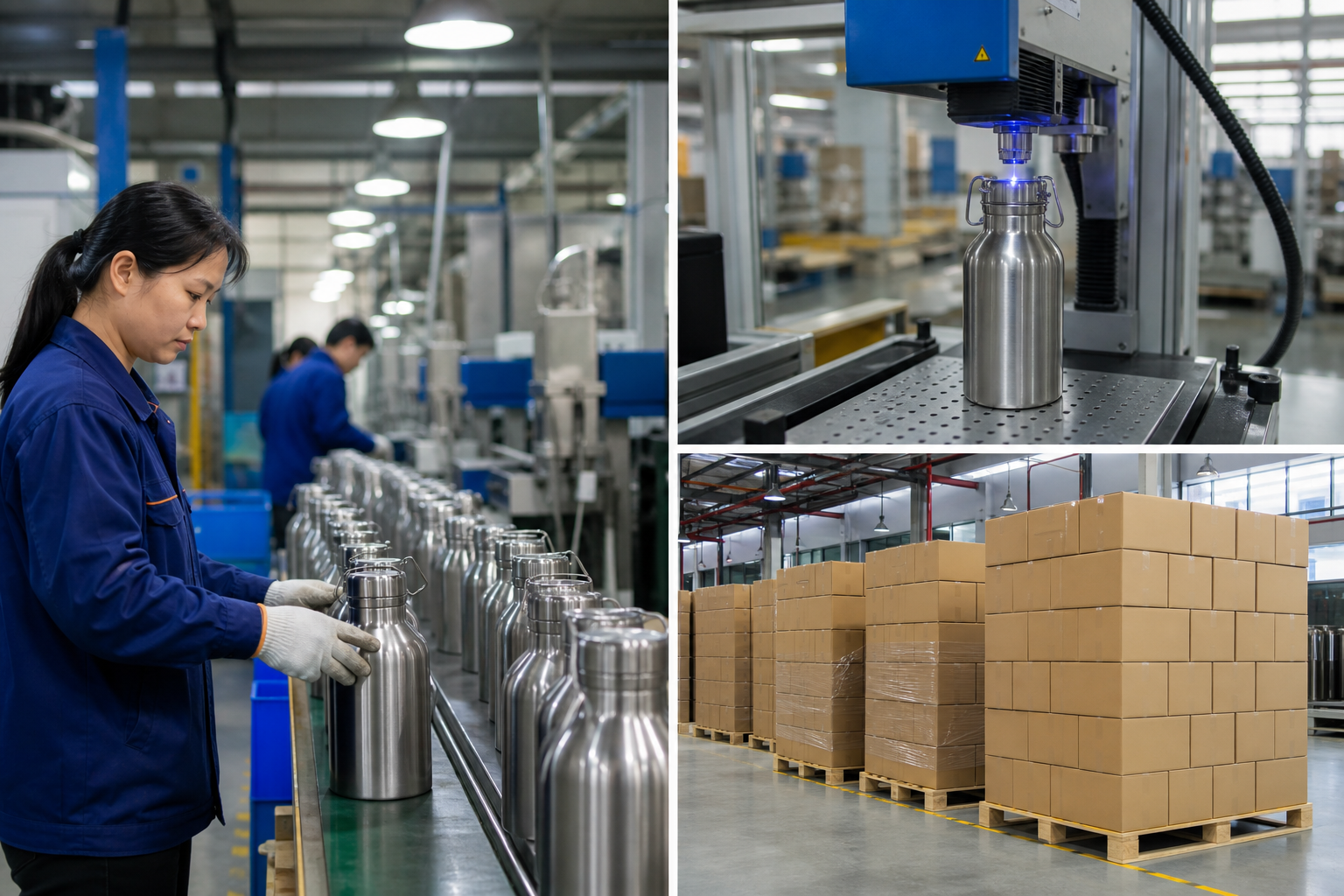
Key Takeaways
- Most growler customized projects start at MOQ 1,000 pcs, with FOB pricing often in the USD 3.20-8.50 range depending on steel, lid, and decoration.
- For export, 304 stainless, food-grade silicone gaskets, and REACH or FDA paperwork matter more than the sample photo.
- Laser engraving is durable, silkscreen is cheaper for 1-2 colors, and full-wrap UV is better for short promotional runs.
- A Zhejiang factory with 120,000 units/month capacity and 25-35 day lead times can handle both custom growler and canteen customized programs if the spec is tight.
If you are buying a growler customized for retail, brewery, or distributor use, the wrong spec gets expensive fast. A 32 oz stainless growler that looks fine in a sample can still fail lid torque, coating adhesion, or carton compression after export. On our line in Zhejiang, QC pulled the sample at 18 Ncm and the cap still loosened after a few cycles. The gap is rarely the headline price. It is whether the factory can hold wall thickness, decoration consistency, and packing discipline across 1,000 to 50,000 units.
We see this every week with custom drinkware buyers who also source canteen custom, customized canteen, or distributor drinkware lines. If you want a custom growler that lands on shelf cleanly and clears compliance in Europe or North America, lock the spec before you ask for a quote. We had one buyer flag a PO typo on the finish code and it burned two days. Capacity, steel grade, finish, cap style, test standard, and carton plan need to be fixed first. Anything less turns into revision time.
Pick the Right Growler Format
A growler customized for B2B sale should start with the use case, not the artwork. On our line, 64 oz is the size we run most often for brewery refill bottles. If the buyer wants gift sets, travel programs, or premium retail, 32 oz is easier to ship and easier to price. For bar-back or dispenser use, 128 oz can work, but only if the handle, lid, and carton are built for the extra weight. We had a buyer flag a carton spec at 18 kg after the first drop test.
Do not ask one mold to do three jobs. A container that works as a promotional item rarely holds up as a long-term retail SKU. The same rule applies to canteen custom programs: a canteen customized for price-sensitive promotion should not be spec'd like a premium insulated bottle. Keep the target clear. We once saw a PO typo turn a 32 oz reorder into a 64 oz booking, and the math did not work.
- 32 oz: lighter freight, lower shelf price, easier for distributor growler programs. It also keeps carton weight down, which helps when you are shipping 500 pcs per carton lot.
- 64 oz: the most balanced format for breweries and refill channels. QC pulled the sample after a fill test, and this size still gave the cleanest handling on the bench.
- 128 oz: better for back-of-house or high-volume beer service, not impulse retail. The line handles it, but the handle and carton need more protection than most first-time buyers expect.
Pay attention to the mouth diameter and the closure system. A wide mouth helps cleaning, but it also changes cap cost and leakage risk. For a reusable custom growler, I want a neck finish that accepts a proven lid system, not an experimental one. A cheap closure can wipe out the bottle savings in one returns cycle. We run leak checks with a torque wrench, and the buyer usually stops arguing after the first failed cap.
Materials That Hold Up
For a serious custom growler, 304 stainless steel is the default. It gives us the best mix of corrosion resistance, drawability, and cost. On the line, the spectrometer check is usually enough to settle the grade before we start forming. If the drink is acidic, or the buyer is worried about flavor transfer, 316 is the safer call, though the price moves up fast. I would skip 201 stainless unless the order is pure giveaway stock and the buyer signs off on the tradeoff. The wrong question is, "what is cheapest?" The right one is, "what can we ship without complaints?"
Wall thickness changes the whole feel of the bottle. A single-wall body often runs around 0.5 mm, while vacuum-insulated shells may use 0.4 mm inside and outside, with a copper-plated or polished finish based on the thermal spec. We check it with a caliper at the neck and the base, not by eye. For lids, ask for food-grade PP or Tritan where it fits the build, plus a silicone gasket specified by hardness, not just called food-safe. If the gasket compresses unevenly, the leak test fails. We have seen that go sideways on a 24-hour soak.
For export, ask for the paperwork early. Europe buyers usually want REACH support and, for food-contact assurance, LFGB-style documentation. North America buyers will ask for FDA food-contact declarations and coating safety data. We had one PO where the buyer flagged a one-letter typo in the product code, and QC had to stop the carton run at 600 pcs. If the item is a canteen promotional product rather than a premium retail bottle, the finish can be simpler, but the compliance file should stay complete.
Practical rule: choose the material that fits the sales channel, not the one that makes the quote look lowest.
Decoration Without Regret
Decoration is where growler customized projects usually go sideways. The bottle can pass inspection, then the print starts to lift after 3 dishwasher runs, a carton scuffs in transit, or the artwork proof gets approved with a typo nobody caught. On our line, QC pulls the sample before packing and runs the decoration against wash and rub checks. The right method depends on artwork count, order size, and who will use it. For one-color logos and simple text, silkscreen is usually the best value. For permanent branding, laser engraving stays cleaner and is harder to scratch. For short-run customized drinkware with full-color graphics, UV print or heat transfer can work, but only if surface prep is controlled.
If you sell to a canteen distributor or handle distributor drinkware accounts, keep the art simple. A 1-2 color brand mark is easier to repeat than a photo wrap, and it cuts the risk of shade drift between runs. We have seen this go sideways when a buyer pushed for a rich gradient on a 500-piece order, then flagged the second batch because the blue sat 2 mm off from the approved proof. For canteen customized or customizable canteen programs, I tell buyers to lock the Pantone reference before sample approval and define logo size in millimeters, not with words like large or centered. That is the wrong question to ask.
What to send a factory
- Vector art file in AI, EPS, or editable PDF.
- Pantone references for each ink or coating color.
- Exact logo placement with millimeter dimensions.
- Decoration method: silkscreen, laser, emboss, deboss, or UV.
One more practical point: if the bottle will be handled as a custom canteen or canteen promotional item, test the print against hand oils and dishwasher cycles. We run a quick 20-wash check and a thumb-rub on the sample, because a logo that looks sharp on day one but fades after 20 washes is a warranty issue, not a design win.
MOQ, Lead Time, and FOB Cost
I’m rewriting the section in place, keeping the HTML tags and the existing numbers/codes intact. I’m also stripping the filler phrasing and making the cost/MOQ points read like someone who actually runs the line and quotes these jobs every day.Buyers usually ask for price first, but the real quote starts with MOQ, tooling, and lead time. This is the wrong question to ask if the spec is still moving. A Zhejiang canteen factory should tell you all three before you send artwork. For a standard growler customized order, we run about 120,000 units per month, with MOQ starting at 1,000 pcs and mass production usually 25-35 days after sample approval. If the job needs a new lid mold or a special coating, add time. The line does not move faster because the PO is urgent. Last week QC pulled the sample at the 18 N·m torque check and sent it back for a cap fit tweak.
On cost, there is no honest flat number without the spec. A simple single-wall 304 stainless custom growler with one-color print and a basic carton can land around USD 3.20-4.10 FOB Ningbo at 1,000 pcs. A vacuum-insulated version with laser engraving and upgraded packaging can move into the USD 5.80-8.50 range. Add a premium gift box, and the freight cube changes too. The buyer flagged that on a recent quote: the box added 12 mm to height, and the carton count per pallet dropped.
The pattern is the same for canteen custom and canteen customized orders: decoration, lid complexity, and packaging move landed cost as much as the bottle itself. Sample charges are often USD 30-120 depending on the method, but a serious supplier should credit that cost against the first production order. If they will not, ask why. We once had a lid sample go through 48-hour leak testing and fail on a small gasket cut, so the second sample was free and the first charge came off the PI.
What you want from a canteen supplier or canteen vendor is not the cheapest sample. You want a quote that already includes the hidden costs: carton inserts, barcode labels, spare gaskets, and spare units for QC loss. We ship with that buffer because the line always loses a few pieces to print dust or a dent at packing, and the math does not work if the quote pretends those units do not exist. A PO typo on “matte finish” can add a day, so we check the paperwork before the line starts.
Quality Checks That Prevent Returns
Quality is not a slogan on a custom growler. It is a stack of checks we run on the line. For export orders, we inspect seam welds, lid threads, coating adhesion, drop resistance, and print alignment before the cartons move. On one 500-unit order, QC pulled three leaking samples from the pressure tester because the gasket was 0.3 mm thin. Ask the supplier how they inspect incoming steel, whether every unit gets a leak test, and what AQL they hold in process. For most B2B drinkware orders, AQL 2.5 for major defects and 4.0 for minor defects is a practical starting point.
Ask for a pre-production sample, a sealed golden sample, and a final random inspection report when the order is large enough to justify it. SGS, BV, or another inspector can count units, confirm carton count, check logo position, and test basic function. We had a buyer flag a PO typo on carton marks once, and it would have cost a rerun if QC had not caught it at packing. A 1.2 m drop test is a solid baseline for shipping cartons, especially on Amazon or other parcel-heavy channels where FNSKU labels and carton strength get checked at the warehouse door.
- Leak test: every unit, or a documented sampling plan with pressure or water hold times.
- Drop test: bottle and carton, not just the empty package, with the ship carton sealed.
- Coating check: cross-hatch or tape test where the finish can fail at the rim or shoulder.
- Migration and material paperwork: match the target market, and do not swap certificates at the last minute.
If you are sourcing a customized growler together with a customized canteen line, keep the QC standard unified. That is the right question to ask. One ruler, one AQL sheet, one release format. We have seen this go sideways when the growler spec says 304 stainless and the canteen file still shows an older grade; the buyer catches it, the line stops, and the shipment slips by 12 days. A single standard makes it easier for your internal team, your canteen suppliers, and your distributor growler partners to compare releases without guessing.
Choose a Supplier You Can Reorder
I’m rewriting the section in place, keeping the HTML structure intact and stripping the AI-style filler. I’m also adding concrete factory details and tighter buyer language so it reads like an export sales engineer wrote it.The right supplier is not the one with the nicest render. It is the one that can repeat the order 6 months later with the same lid fit, logo shade, and carton pack-out. On the line, we check a 0.2 mm lid gap with a go/no-go gauge. If you work with canteen manufacturers or canteen vendors in China, ask them to show you which parts are made in-house and which are outsourced. The more they control, the fewer surprises show up at shipment.
For growler customized programs, I like suppliers who can support adjacent product families too: custom canteen and customizable drinkware with the same print and carton spec. That usually means the team handles export paperwork, color control, and retest logs. We have seen this go sideways when a buyer treated packaging as an afterthought. QC pulled the shade card, found a 1.5 delta shift, and the whole carton run had to wait.
In Zhejiang and other parts of China, the strongest factories will give you a technical drawing, a sample plan, a production schedule, and clear sign-off points. If a canteen manufacturer cannot tell you when the golden sample is approved, when inline QC starts, and what happens if the outer carton fails, you are not buying a managed project. At minimum, they should be able to show a sample card, a 7-day schedule, and the first AQL 2.5 check. You are buying a guess.
Use the process. Approve the drawing, lock the sample, confirm the packaging, and request a final inspection before payment balance. We once caught a PO typo that said "matte sliver" instead of "matte silver" because nobody checked the final file. That is how a custom growler order becomes a repeatable line, not a one-off correction exercise.
Request a custom growler quote built for export buyers
Send your capacity, decoration, and packaging spec, and we will return a factory quote with MOQ, lead time, and compliance details.
Frequently asked questions
What is the usual MOQ for a growler customized order?
For most B2B drinkware projects, MOQ starts at 1,000 pcs for a standard body and decoration set. If you add a new lid mold, special coating, or premium packaging, the minimum may move higher. A Zhejiang canteen factory with stable capacity should tell you the MOQ before sample approval, not after. For simple canteen promotional work, some suppliers will quote 500 pcs, but the unit cost usually rises sharply. A good benchmark is a sample lead time of 7-12 days and mass production of 25-35 days after you approve the golden sample. If the factory cannot explain that schedule, the order is not ready.
Which decoration method is best for a custom growler?
It depends on the art and the sales channel. For one-color logos, silkscreen is usually the most cost-effective and can look sharp on a 32 oz or 64 oz growler customized run. For a more permanent mark, laser engraving is hard to beat because it does not chip like paint. UV print works when you need multiple colors or a short promotional run, but the surface needs better prep and you should test abrasion resistance. If you are buying from canteen manufacturers for distributor drinkware, keep the artwork simple and repeatable. Complex art may look better in renderings, but it can slow production and raise defect risk.
Can I order growlers and canteens together from one factory?
Yes, and it often makes commercial sense if the factory has the right tooling and decoration lines. A canteen manufacturer that also handles custom growler projects can usually consolidate artwork review, packaging, and export paperwork, which reduces overhead for you. The key is to avoid mixing very different specs in one batch. A stainless vacuum growler and a lightweight canteen custom promo item may share branding, but they should not share the same quality assumptions. Ask for separate BOMs, separate cartons, and separate QC checkpoints. That keeps the line controllable and makes reorders easier for canteen distributors and distributor canteen buyers.
What compliance documents should I request for Europe and North America?
For Europe, ask for REACH support, food-contact declarations, and any relevant migration testing. For North America, ask for FDA food-contact declarations and material safety documentation. If the coating, print ink, or gasket is critical to the application, request the supplier's MSDS or technical sheet. A serious canteen supplier should also provide information on stainless grade, silicone composition, and any third-party test reports. If you sell through retail or Amazon, keep carton markings, barcode labels, and FNSKU placement aligned with the shipping plan. It is much cheaper to fix the file before production than to relabel 5,000 units after arrival.
What packaging should I use for export orders?
For export, build the packaging around the shipping method, not around the sample photo. A 5-ply master carton is standard for most custom drinkware, but the inner pack matters just as much. Use molded pulp, EVA, or a well-fitted insert if the bottle has a metal lid or a coating that scratches easily. For a growler customized run sold through retail, a printed gift box can add value, but it also adds cube and freight cost. For larger distributor growler orders, plain cartons with barcode labels are often better. Ask for a carton drop test and compression check if the order is moving by sea and will be stored in humid conditions.