Key Takeaways
- A serious growler distributor program should start with 304 stainless steel, 0.5-0.7 mm wall thickness, and leak testing on every lot.
- Plan for 500-1,000 pcs MOQ, 25-35 day production, and a factory capacity of about 300,000 units/month for stable reorders.
- For Europe and North America, ask for REACH, LFGB, FDA, and AQL 2.5/4.0 inspection records before you approve tooling.
- Decoration choice matters: laser engraving lasts longest, while silkscreen and powder coat are better for canteen promotional runs with color control.
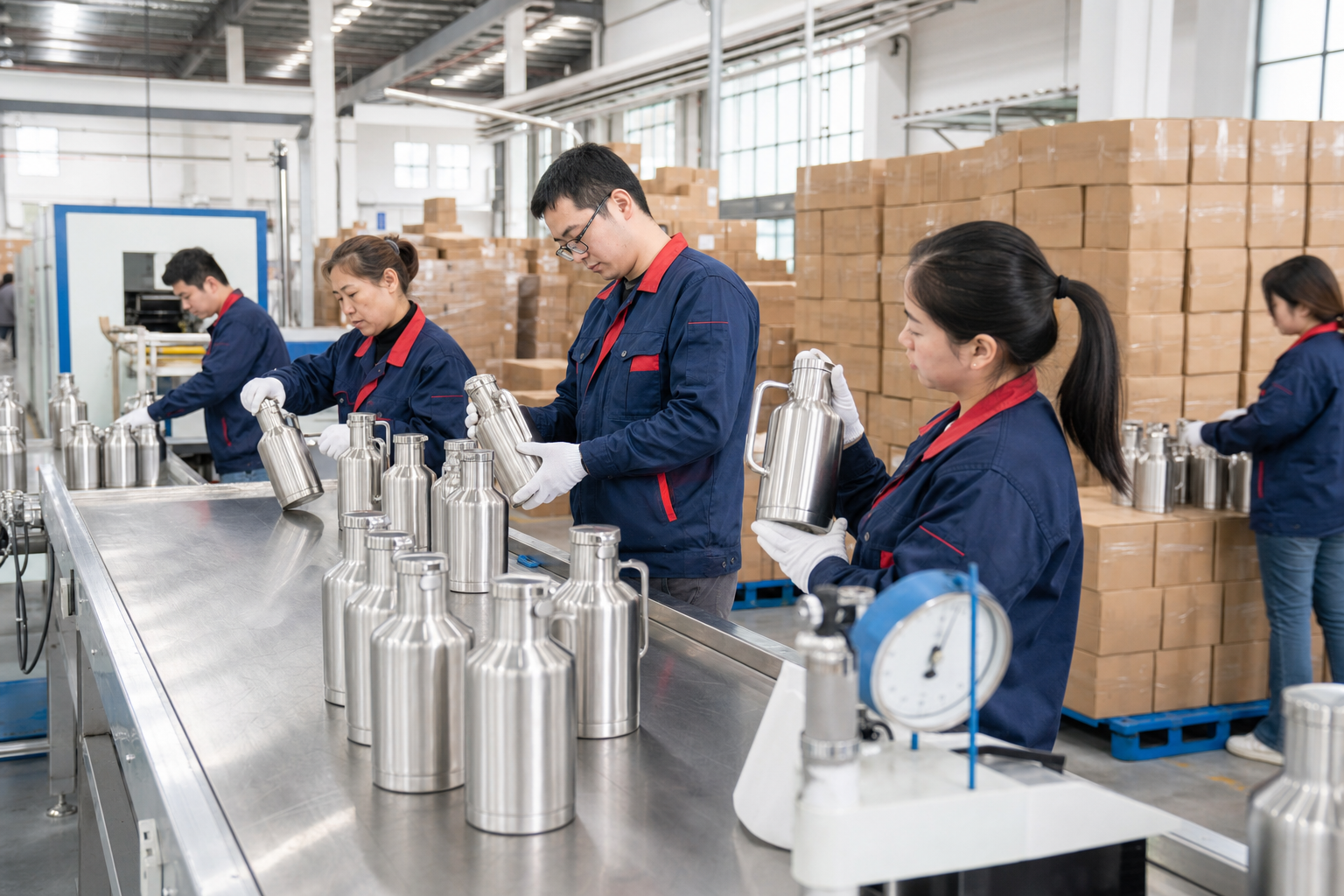
If you are a growler distributor, the hard part is not finding a supplier. The hard part is finding a canteen manufacturer or custom drinkware factory that holds spec, passes testing, and ships on time without turning every reorder into a fresh project. In Zhejiang, the gap between a clean sample and a stable production run usually comes down to steel grade, closure torque, coating control, and whether QC pulls the sample with a torque meter before the line starts.
Buyers who treat a custom growler like a simple promo item usually get burned. Retail cartons fail in transit, lids start leaking after 3 dishwasher cycles, and a sharp first print can fade by the second reorder. If you also source canteen custom, canteen customizable, or customized drinkware for the same distributor program, the better move is to standardize parts, lock the test plan, and work with a canteen supplier that can run 500 to 1,000 pcs MOQ without pushing lead time past 25 to 35 days. The buyer flags this late, and the math does not work.
Start With the Right Growler Format
The first call is body style, not logo art. We run this decision against the next 12 months of orders, because a growler distributor usually needs one platform that can cover retail, on-premise, and distributor programs without opening three molds. The line moves cleaner when you pick one path: vacuum stainless, single-wall beer growler, or a glass body with a sleeve. For export, vacuum stainless is usually the safer default. QC pulled a glass sample last week and it chipped at the rim after one carton drop, while stainless held shape and freight stayed sane.
Keep the spec tight. A 64 oz or 1.9 L body is the retail workhorse, and a 32 oz SKU makes sense as the lower-ticket entry. If you also ship canteen distributor programs, use the same play: one neck finish, one cap family, two body sizes. That gives you cleaner replenishment and less dead stock. On the packing bench, we check fill line, carton size, pallet count, and whether the item is built for shelf display or direct shipping. A 275 mm carton that misses a pallet layer creates trouble on the dock.
What you should ask before PO:
- Is the cap threaded to a standard 0.6 N·m torque spec, or is it a custom closure?
- Does the neck opening let a brush reach the residue line, or will the end user fight buildup under the lip?
- Can the same platform support customized growler and customizable drinkware variants without changing the shell?
- Will the supplier keep the same steel spec and heat number on repeat orders from China and outside China?
The buyers who ship clean POs win. They keep the factory on one known structure, and that beats redesigning every season. We have seen this go sideways when a buyer changes the cap after the first 500 pcs and the carton plan breaks.
Choose Materials That Survive Real Use
Material choice decides warranty claims. For a custom growler sold through distributors in Europe and North America, 304 stainless steel is the floor. If the job really needs more corrosion resistance, ask for 316 on the parts that touch the product, not the whole body. We run wall thickness, weld quality, and coating adhesion first. For double-wall vacuum bodies, 0.5 mm to 0.7 mm is the practical range. Go thinner and the shell dents fast; it also feels cheap in hand. On the line, the thickness gauge comes out before anyone talks finish.
Lids and gaskets matter as much as the bottle. A bad gasket turns a clean sample into a return case. Specify food-grade silicone, confirm BPA-free claims in writing, and test the closure after hot-fill, cold-fill, and transport vibration. If your line includes canteen custom or custom canteen SKUs, keep one gasket standard across the family so your canteen suppliers do not create spare-part chaos. For glass growlers, insist on protective packaging and a drop-test standard before you talk price. QC pulled the sample after a 1 m drop last month, and the cap shifted 2 mm. The buyer flagged the extra insert cost, but the math does not work if you source the same seal three ways.
A practical export spec is boring on purpose: 304 stainless, food-grade silicone, passivated welds, and a closure that still seals after repeated dishwasher cycles.
When a canteen vendor pushes decorative changes before proving material stability, you are not buying a product line. You are buying returns. We have seen this go sideways on a 24,000-unit order, and the first complaint came from a 3 mm lid gap, not the artwork.
Decoration That Holds Up
I’m rewriting the section to sound like a factory-side sales engineer, keeping the HTML structure intact and tightening the claims so they read like something we actually ship.Decoration is where a lot of canteen vendors overpromise. We have seen a brushed-steel sample look clean at sign-off, then lose edge sharpness after 20 hand washes and a few trips across the line. For distributor drinkware, the options that hold up are laser engraving, powder coating under print, and controlled silkscreen on a stable base finish. Laser lasts longest. Silkscreen gives color, but only if mesh tension, ink viscosity, and cure time stay locked in. For canteen promotional sets, keep the artwork simple and skip 0.3 mm hairlines; they break down fast when we run them at production speed.
The logistics side is where buyers get burned. One extra Pantone color, one cap color change, or one carton typo can turn a 12-day run into 18 days because we have to stop the line and rematch ink. If you want canteen customized or customized canteen programs with multiple SKUs, one decoration method per channel is the clean way to do it. Retail can use laser on brushed steel. Corporate gifts can stay with one or two print colors. For e-commerce or Amazon-style programs, barcode placement, polybag spec, and carton label placement need to be set before we print, not corrected by hand after packing. The buyer flagged a PO with a wrong carton code once, and we lost half a day fixing labels.
Useful rules:
- Laser engraving for long-life branding.
- Silkscreen for lower-cost high-volume runs.
- Powder coat when you need color identity and grip.
- Embossed or debossed marks only when your MOQ justifies the tooling.
If the decoration cannot survive a distribution cycle, it is not a retail finish. It is a sample-room finish. QC pulled one sample after a 50-rub test on the abrasion wheel, and the print ghosted on the second pass. We ship for the warehouse, the truck, and the shelf, not for the photo booth.
Check Compliance Before Pricing
Price is simple after the compliance file is clean. Before you greenlight a custom drinkware order, ask for the papers your market actually checks. Europe usually starts with REACH and LFGB. North America wants FDA-related material declarations and a test trail for food-contact safety. If the growler moves through distributor channels, add carton compression, 1.2 m drop testing, and leak testing to the pack-out check. For most wholesale runs, AQL 2.5 for major defects and 4.0 for minor defects is a sane baseline. The wrong question is whether you can shave 3% if the carton fails at 12 kg compression on the line.
Do not take a verbal promise from a canteen factory in China. Ask for the actual report, with sample date, batch number, and the lab name on the first page. If the supplier is in Zhejiang, China, they should know how to show compliance without drama. The same rule applies to any mature canteen manufacturer elsewhere in China. We check whether the inks, powders, and silicone parts match the bill of materials before QC pulls the sample. We have seen a PO typo on the lid color code turn into a 2,000-piece hold, and that kind of mess is avoidable.
What to request before mass production:
- Material declarations for body, lid, and gasket.
- Leak test method and pass criteria.
- Drop or transit test standard for export cartons.
- Inspection report using AQL 2.5/4.0.
If the factory cannot produce those records, the unit price is not lower. You are just buying hidden risk, and we ship that kind of problem back to the buyer every week.
MOQ, Lead Time, and Factory Capacity
Most buyers look at unit price and skip capacity. That is the wrong question. For a growler distributor, the real issue is whether the supplier can keep reorder flow moving without changing the spec or pushing ship dates. We usually see 500 to 1,000 pcs MOQ per style, then 25 to 35 days for production after sample approval. If you want 3 colors, custom cartons, or mixed cap types, add time. QC pulled a sample with a carton typo once, and that one line item cost two days. We've seen that go sideways.
A serious canteen factory in Zhejiang should be able to tell you monthly throughput, line balance, and how repeat orders are slotted on the line. Around 300,000 units/month is a workable benchmark if the factory is serving export distributor accounts without constant bottlenecks. If they cannot tell you where your PO sits in the queue, the math does not work. They are acting like a trading desk, not a supplier.
FOB pricing should be quoted with the same assumptions every time: body material, print method, carton spec, and whether pallets are included. That matters for canteen distributors and custom growler buyers shipping into warehouse and e-commerce channels. We once had a buyer flag a PO that missed the 5-layer export carton note; the quote looked cheaper until the rework showed up on the packing list. Ask for a landed-cost view if you need DDP support, but keep the factory quote clean so you can compare apples to apples.
The low-price quote that misses a carton detail, a label step, or a pallet rule is not lower. It is deferred cost. We ship enough 18 kg pallet builds to know the freight desk finds those omissions fast.
Source better growlers with a tighter spec
Send your target size, artwork, and market requirements. We will match the right factory route, MOQ, and compliance path for China export.
Frequently asked questions
What MOQ should a growler distributor expect?
For most custom drinkware programs, a realistic MOQ is 500 to 1,000 pcs per design. If you want multiple print colors, special cartons, or a custom cap, expect 1,000 pcs or more. For a stable canteen distributor program, the lower MOQ only works when the factory already has the body platform tooled and the decoration is simple. New molds, new colors, or custom packaging always push the quantity up. The better question is whether the factory can repeat the same spec at the second order. That is where low-MOQ suppliers often fail.
Is stainless steel or glass better for custom growlers?
Stainless steel is usually the safer choice for export distribution because it handles freight, shelf handling, and drop risk better than glass. A vacuum stainless growler with 304 steel and 0.5-0.7 mm wall thickness gives you better thermal retention and lower breakage claims. Glass still works when the channel wants a premium look or short-distance delivery, but you need stronger cartons, more transit testing, and tighter pallet control. For most growler distributor programs in Europe and North America, stainless is the more forgiving platform.
What compliance documents should I ask the factory for?
At minimum, ask for REACH or LFGB where applicable, food-contact material declarations, and the full QC record tied to the batch number. For North American distributor drinkware, ask how the supplier supports FDA-related material compliance and whether inks, silicone, and coatings match the declaration. Also request AQL inspection reports, leak test results, and export carton test data. If the canteen manufacturer cannot provide dated reports with batch references, treat the compliance file as incomplete. A clean paper trail matters as much as a good sample.
How long does sampling and production usually take?
A typical custom growler sample takes 7 to 12 days if the body style already exists. New tooling or a new cap can stretch that to 15 to 25 days. After sample approval, production is usually 25 to 35 days for a standard run, assuming the factory is not changing materials or packaging late in the process. If you need printed cartons, pallet labeling, or Amazon FNSKU prep, add another few days. A canteen supplier with strong scheduling will tell you the critical path early instead of hiding it until the ship date moves.
Can you support distributor packaging and Amazon-style labeling?
Yes, but you need to specify it upfront. The factory should know carton count, master carton dimensions, barcode placement, polybag requirements, and whether you need FNSKU or other label handling. For distributor canteen programs, packaging discipline is often the difference between smooth warehouse intake and costly relabeling. Ask for inner box, master carton, and pallet specs before production starts. If the supplier understands export packing, they can usually support retail-ready custom drinkware, one-piece ship cartons, and mixed-SKU distribution without extra rework.