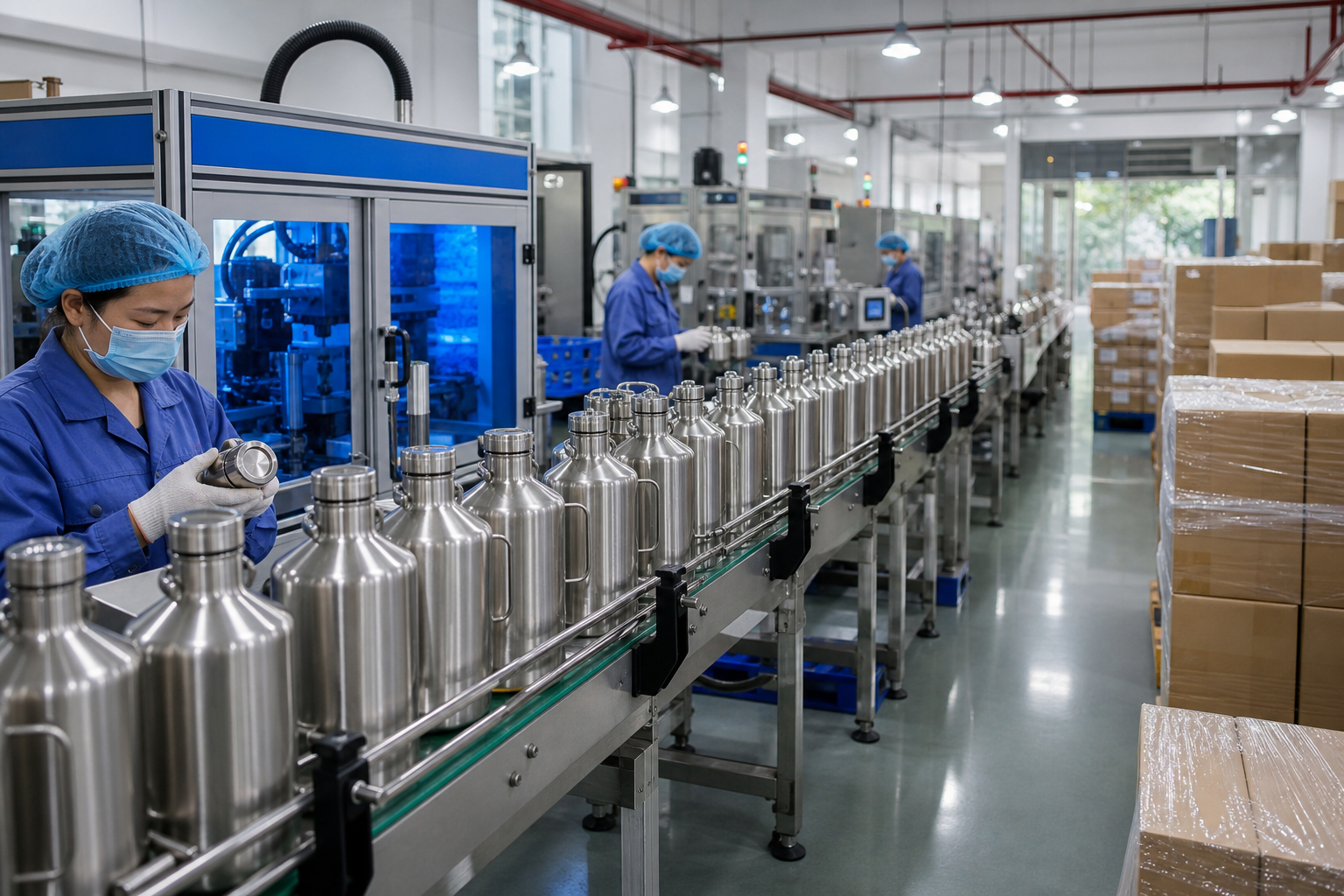
Key Takeaways
- A workable custom growler MOQ is often 500 pcs per SKU, with 25-35 day lead times after sample approval.
- For export, 18/8 stainless, 0.6 mm wall thickness, and food-grade silicone gaskets are the practical baseline.
- FOB pricing for a 64 oz custom growler often lands around USD 3.20-7.40 depending on finish, lid, and packaging.
- Use AQL 2.5 for major defects, REACH and LFGB for Europe, and BSCI or ISO 9001 as supplier filters.
If you are buying for growler distributors, the problem is not finding a bottle. It is finding a custom growler program that ships on time, survives retail handling, and still leaves margin after freight, duty, and local warehousing. We have seen a 64 oz sample look perfect on a desk, then fail after three forklift moves in a warehouse. The wrong question is "what is the cheapest sample?" It is "what will still move cleanly through the line after 5,000 units, a torque check, and one bad pallet in Rotterdam or Chicago?"
The safer way to buy from Zhejiang or broader China is to treat the job like a production spec, not a design brief. Lock the body size, lid system, coating method, carton count, and test standard before you send artwork. QC pulled the sample at the leak bench, and that is where the real issues show up. This is how a canteen manufacturer or canteen supplier keeps repeat orders steady, and the same rule applies to growlers and canteen custom work. If the PO still says "same as sample" with no neck finish or carton count, we ship problems, not product.
What Growler Buyers Need First
Start with use case, not decoration. A growler for a bar chain, a bottle shop, or a distributor catalog does not take the same spec as a gift item. On the line, we see that fast. For growler distributors, capacity comes first: 64 oz is still the retail standard, while 32 oz fits trial packs and cross-sell programs. Keep the family tight if you want the line to move through different channels. Two body sizes, one neck finish, no more than two lid types. That keeps the SKU count under control and makes reorders cleaner.
Do not let the sample room sell you features you do not need. A sturdy 18/8 stainless body, food-grade silicone gasket, and steady cap torque matter more than a novelty handle. QC pulled a sample last week because the lid was loose by 2 mm at the rim, and that kind of miss turns into a buyer complaint fast. For distributor drinkware, the carton spec matters almost as much as the bottle. Ask for 12 pcs or 24 pcs per master carton, corner protection, and a drop-tested pack plan. If the product is going to chain buyers, you want repeatable pallet counts, clean UPC placement, and simple reordering. A custom drinkware line fails when the buyer has to explain surprises to their own warehouse team.
Experienced canteen distributors think in systems, and that is the right way to buy growlers too. Standardize the parts that hit operations, and leave customization for the visible surfaces. We have seen a PO typo on lid color add 8 days to a ship date, so this is not theory. The math does not work any other way. A customized growler, a customized drinkware program, or a canteen promotional line all run better when the factory keeps the working parts fixed and the branded parts flexible.
Choose Materials That Hold Up
For export, 304 stainless is the practical default. If a buyer is worried about corrosion or taste carryover, 316 has a place, but it usually adds cost without changing how the bottle sells off the shelf. For most distributor canteen and growler programs, 18/8 stainless with a 0.6 mm to 0.8 mm wall is enough. At 0.5 mm, QC pulled the sample and you can feel the flex in your hand. At 1.0 mm, the pallet gets heavier and the unit price jumps for no real gain. That is the wrong question to ask if the cartons have to cross the Atlantic or sit through a Zhejiang summer at 38 C in a warehouse.
Check the closure harder than the body. A lid can look clean and still fail in vibration if the gasket is too soft, the thread pitch is sloppy, or the coating is thick at the sealing edge. We run leak tests, hot-water hold tests, and torque checks for a reason. Put food-grade silicone on the spec sheet, keep the lid seal from twisting under hand tightening, and ask for powder coat at 60 to 80 microns if you want scratch resistance that survives the line. On one order, the buyer flagged a PO typo on the cap size and we caught it before mold setup. For a canteen custom order, the body can be sharp, but the seal has to be boringly reliable.
If you sell both custom growler and customizable canteen ranges, keep the finish family consistent. Matte powder, brushed steel, and gloss paint wear differently in carton transit, and the test report shows it fast. Your canteen factory should tell you where each finish will scuff first. If they hide that under sample lighting, they are selling you a photo, not a product.
Decoration That Survives Distribution
I’m rewriting the section in place, keeping the HTML tags intact and tightening the language so it reads like a factory-side sales note rather than generic copy. I’m also adding a few concrete production details and a bit of pushback where it fits, since that’s what makes the section feel real.Decoration is where distributor margin disappears. A logo that looks sharp at sample stage can chip after 200 warehouse touches if the process is wrong. On brushed steel growlers, we run laser engraving first; the mark stays legible after pallet rubbing and forklift scuffs. Silkscreen is still the cheapest route for one-color branding and larger reorders. UV print handles complex artwork, but it should not be the default on a heavy-use piece unless the buyer accepts some surface wear. If the buyer wants the lowest print quote, that is the wrong question to ask.
Keep the print area realistic. Curved bottles do not reward oversized logos. A clean 60 mm to 80 mm mark usually looks better than a crowded wrap, and the line can hold registration better there. For a canteen customizable program, the same rule applies: design for hand grip, carton rub, and shelf distance. Ask your canteen vendor for artwork proofs on the actual substrate, not a flat render. QC pulled a 72 mm strike-off from the line last month, and the edge distortion showed up before shipping. Request a physical strike-off if the order is over 1,000 pcs. That is where a bad color match turns into a chargeback.
For distributors shipping into Amazon or mixed retail channels, put the packaging rules in the quote. FNSKU labels, carton markings, and master pack counts should be settled before approval. If you are building a canteen customized range beside your growler line, align label placement now. We have seen a PO typo move the barcode 8 mm onto the front panel, and relabeling cost more than the print itself. It saves one round of rework in the warehouse and keeps the photo-ready side clean.
MOQ, Pricing, and Lead Times
Buyers often fixate on MOQ and miss the unit economics. A serious canteen supplier or growler factory will price the same bottle differently once you change the decoration method, lid complexity, or carton spec. For a straightforward 64 oz stainless custom growler with one-color silkscreen and kraft box, an FOB China price around USD 3.20 to 4.80 at 500 pcs is realistic. Add powder coating, premium lid hardware, or multi-color print, and you move into USD 5.10 to 7.40. At 3,000 pcs, the same build usually comes down 12% to 18% if the tooling and carton plan stay unchanged. QC pulled the sample on the line last week and the buyer still tried to compare it to a plain bottle quote. That is the wrong question to ask.
Lead time should be quoted in stages. Sample approval often takes 5 to 7 days for an existing mold and 15 to 25 days if a lid or cap mold needs adjustment. Production is commonly 25 to 35 days after approval for a standard order, longer if you want a custom box or special insert. A Zhejiang factory that runs 120,000 units per month can still miss your ship date if you keep changing art after approval. We had a PO with the lid color typed as "matte black" in one place and "gloss black" in another, and that one typo cost two days while the line waited. Lock the spec first, then place the order. That discipline is why canteen distributors and growler distributors with repeat volume get better pricing than one-off buyers.
Ask for the quote in the right terms. FOB Ningbo or FOB Shanghai is fine if you know your forwarder. If you want the supplier to handle inland freight to port, include it in the structure and call it out. It is better to compare like for like than to chase a lower sticker price and discover missing cartons, looser QC, or unplanned packing fees. We run a carton drop test at 76 cm before shipment, and that is where bad packing shows up fast. The math does not work if the quote leaves out those costs.
Quality Checks That Protect Margin
Quality control is not paperwork. It is what keeps a distributor account out of claims. For a custom drinkware order, we ask the factory to run incoming material checks, in-line leak tests, and final inspection against AQL 2.5 for major defects and 4.0 for minor defects. That is the baseline most import buyers know. For a premium bar program, push for 100% lid torque checks with a calibrated torque wrench and a random drop test on packed cartons from 1.2 m. The carton matters. A scratched pallet is still a defect, and QC pulled the sample on the line knows that fast.
For Europe, ask for REACH and, where relevant, LFGB evidence on food-contact parts. For the US, request FDA-compliant material declarations on contact components and match the coatings, inks, and silicone to the declared use. ISO 9001 tells you the factory has a system. BSCI or a similar social audit tells you it can survive customer audits without drama. If your canteen manufacturer cannot show lot traceability, metal composition, and gasket certificates, treat it as a real risk, not a small omission. We once caught a PO typo on a 304 stainless sleeve order, and that one line would have blown the file at customs.
China has capable factories, but the good ones talk in failure modes. They will tell you where print rubs at 50 cycles, where threads loosen after 12 turns, and which carton style cuts breakage on a 2 kg master case. That is the difference between a factory that sells samples and a canteen factory that can ship through three seasons without excuses. The wrong question is, "Can you make it?" The right one is, "What fails first, and at what point?"
Build a Broader Canteen Line
If you only sell growlers, you are leaving margin on the table. The same buyer who asks for a distributor growler program usually wants a smaller SKU for a 200-person tasting, staff gifts, or a bar promo. That is where a custom canteen line makes sense. Keep the family tight: one body family, two lid options, two finishes, and one packaging standard. We run this setup on the line all the time, and it keeps the range coherent instead of looking like three separate projects.
A practical assortment for distributors is 18 oz, 24 oz, and 32 oz stainless bottles. The 18 oz works as a promo canteen, the 24 oz sells as a retail add-on, and the 32 oz becomes the core item. If you need a customizable canteen for branding campaigns, use the same decoration method across the range so your color control stays stable. One buyer once pushed back on mixed powder coat and print specs, and the math did not work after the first re-order. A canteen distributors buyer should demand the same QC standard across every SKU, whether it is a lighter promotional item or a heavier customized canteen. QC pulled the sample at AQL 2.5, and the defects showed up fast when one lid spec drifted by 1.5 mm.
- Use one lid platform to cut mold complexity.
- Keep carton sizes consistent across the range.
- Match color codes between growler and canteen lines.
A canteen vendor in Zhejiang or elsewhere in China that can handle both lines well will usually earn repeat orders faster than a factory chasing one-off seasonal runs. We have seen it go sideways when a PO typo changed the carton count from 12 to 10, and the shipment had to be reworked at the warehouse. If you want distributor drinkware that scales without rebuilding the supply chain every quarter, this is the right question to ask.
Lock Your Growler Spec Now
Send your size, lid, artwork, and target MOQ. We will quote a factory-ready custom drinkware plan with clear pricing and lead time.
Frequently asked questions
What MOQ should I expect for custom growlers?
For most export programs, 500 pcs per SKU is a realistic starting MOQ if you use an existing mold and standard packaging. If you need a new lid, special box insert, or a multi-color finish, the MOQ may move to 1,000 pcs. Many growler distributors prefer 2 or 3 SKUs per order so they can test demand without overcommitting cash. Ask for MOQ by decoration method, not just by product. A laser-engraved 64 oz growler can sometimes stay at 500 pcs, while a full-color printed version may need a higher run to make factory setup worthwhile.
How do I compare FOB pricing fairly?
Compare the full build, not just the bottle price. One quote may include a kraft box, silicone gasket, and one-color logo, while another excludes all three. For a custom growler, ask for the price by bottle, lid, print, inner pack, and master carton. On standard China sourcing, a difference of USD 0.40 per unit looks small, but on 5,000 pcs it is USD 2,000 before freight. Also confirm whether the price is FOB Ningbo or FOB Shanghai, because inland trucking and port handling can change the final number. If the factory is in Zhejiang, FOB Ningbo is often cleaner for comparison.
What tests should I require before shipment?
At minimum, require leak testing, lid torque checks, visual inspection, and carton drop testing. For export drinkware, AQL 2.5 major and 4.0 minor is the standard starting point. If the bottle is meant for repeat use in bars or retail, ask for a hot-water hold test and a 1.2 m drop test on packed cartons. For Europe, check REACH and LFGB on all food-contact parts. For the US, request material declarations that cover stainless steel, silicone, and coatings. A good canteen manufacturer in China should be able to show lot traceability and test records without delay.
Can I mix growlers and canteen products in one order?
Yes, but only if the factory already runs both product families on compatible lines. A growler and a custom canteen can share print methods, packing rules, and sometimes lid components, which helps you reduce freight fragmentation. The risk is that mixed orders create uneven MOQs and longer approval cycles. A cleaner approach is to keep one order for your core custom growler program and one for your canteen custom or customizable canteen line, then align the artwork and carton schedule. That gives you better control of QC and keeps reorders simple for your distributor team.
How much production capacity should I ask about?
Ask for monthly output, not vague promises. A serious stainless bottle factory in Zhejiang should tell you its real capacity by line, such as 120,000 units per month across drinkware SKUs, plus the number of assembly workers and inspection stations. You also want the sample lead time, production lead time, and the maximum number of active SKUs it can manage without missing dates. For growler distributors, this matters because a supplier that can make 20,000 pieces but only pack 5,000 reliably is not ready for a rollout. Capacity only helps if the factory can hold spec and ship on time.