Key Takeaways
- A serious growler factory should show 120,000 units/month capacity, a 500-piece MOQ per SKU, and 25-35 day production after sample approval.
- 304 stainless at 0.5-0.7 mm is the standard starting point for most custom growler programs; 316 is usually overkill unless the use case justifies it.
- For export orders, ask for REACH, LFGB or FDA food-contact support, plus AQL 2.5 major and 4.0 minor inspection records.
- Decoration choice affects margin: laser engraving is durable, silk screen is cheaper, and full-wrap printing is best reserved for larger customized drinkware runs.
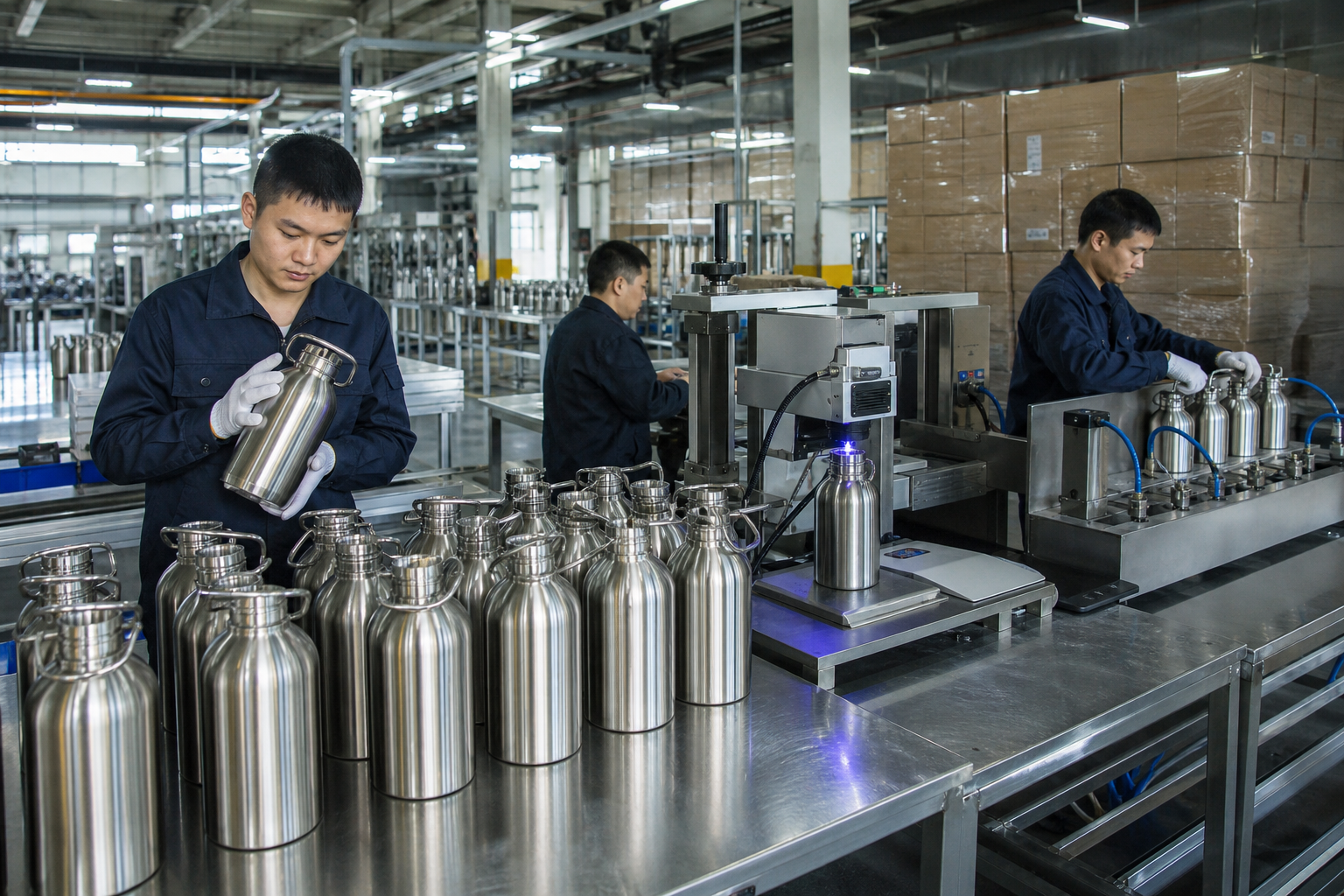
If you are sourcing a growler factory, the real question is not who can print a logo. It is who can hold a 0.3 mm tolerance, keep the lid from leaking after 3,000 open-close cycles, and ship the same product twice. On our line, QC checks weld seams with a gauge and measures coating thickness before the carton is sealed. A serious supplier in Zhejiang or elsewhere in China should show tooling control, weld quality, coating thickness, and a documented QC flow before you talk about price. That is the wrong question to ask first if the sample looks nice.
For European and North American buyers, custom drinkware programs fail when the factory treats a growler like a generic canteen. A custom growler has different mouth geometry, sealing demands, and retail expectations, and we have seen a 2 mm neck mismatch turn into a whole PO delay. The right growler factory will give you a clear MOQ, a realistic lead time, and proof that the same line can handle customized drinkware without turning every order into a new experiment. We ship that way or the buyer flags it fast.
What A Real Factory Should Prove
Before you compare unit prices, ask the growler factory to prove it can build at scale. One sample photo means nothing. We want machine shots, incoming material checks, and a sample approval flow with names, dates, and measured sign-off. If the plant also handles canteen custom work, fine, but only if the welders, polishers, and QC team stay on stainless drinkware and do not get bounced across random jobs. QC pulled one sample at 0.2 mm seam drift last month. That is the kind of detail that tells you the line is real.
In Zhejiang, the stronger shops run two stainless lines and keep one for standard growlers and one for heavier custom orders. 120,000 units per month is a workable benchmark. MOQ can sit at 500 pieces for standard SKUs and 1,000 pieces or more for heavily customized orders. Lead time should be plain: 7 to 10 days for samples, then 25 to 35 days for mass production after artwork and packaging are approved. If the factory cannot show where tolerance drift starts, usually at neck rolling or vacuum sealing, the math does not work. We have seen buyers push back on a PO typo before, and it turned into a 12-day delay that nobody wanted.
- Ask for live production photos, not stock images from last year.
- Confirm whether the line handles single-wall and vacuum insulated bodies.
- Check whether carton packout and pallet plans are part of the quote.
- Verify whether the factory exports under FOB Ningbo, FOB Shanghai, or another clear term.
Materials That Hold Up
For beer, kombucha, and cold brew, 304 stainless is the default for a reason. It holds up against rust, keeps the press brake work stable, and does not push the unit cost into a bad place. If a buyer asks for 316 without chlorine, salt spray, or marine use, we usually push back. The math does not work. We ran a batch last month where 316 lifted cost and the shelf price moved, but the buyer got no real sales lift. For most custom growler programs, 0.5 mm to 0.7 mm wall thickness is the practical range on single-wall bodies. On vacuum insulated builds, the inner and outer shells usually sit at 0.4 mm to 0.6 mm, and we check that with a micrometer at the neck and shoulder.
The failures we see are small and expensive. Rim finish, thread pitch, and gasket fit decide whether the lid feels solid or comes back as a complaint. QC pulled a sample once because a 0.3 mm burr at the mouth cut the silicone after 20 openings. A good lid should seal with food-grade silicone and keep its bite after repeated use, without cross-threading. The brushed finish also needs to stay even across the body if the same line is running a customized canteen or another customizable drinkware order. If a factory says it can run custom canteen and custom growler bodies on the same line, fine, but ask for separate QC records for each SKU. The buyer flagged a PO typo once, and the wrong gasket spec nearly shipped.
What to lock down in writing
- 304 or 316 grade, not just stainless steel.
- Wall thickness and tolerance band.
- Gasket material, usually food-grade silicone.
- Internal surface finish and passivation step.
Decoration Drives The Retail Result
I’m rewriting the section in place, keeping the HTML structure intact and tightening the language so it reads like a factory-side sales note rather than polished marketing copy.Most buyers spend time on artwork and skip wear tests. That is the wrong order. If the order is for distributor drinkware, corporate gifts, or canteen promo work, the decoration has to survive stacking, handwashing, and one bad trip through the dishwasher. On our line, QC pulls a sample after the 24-hour cure and runs a tape test before packing. Silk screen is the cheapest for a one-color logo, but on retail shelves it scuffs fast. Laser engraving looks cleaner and holds up better. Pad printing fits a small mark on a curved wall, while powder coat plus engraving gives a stronger retail read on a customized growler.
Choose by channel, not ego. A canteen distributor placing 5,000 pieces usually wants one-color branding at the lowest landed cost. A craft beer buyer may ask for a full wrap or a tone-on-tone mark that looks better under bar lights. We have seen buyers flag a 1.5 mm logo shift on a second SKU because the PO said “same as sample” and the art file did not match. If one supplier handles both customized drinkware and a wider canteen manufacturer program, ask how they hold Pantone across separate runs, whether they check registration before final packing, and who signs off on the first-off sample. For multi-SKU orders, write the logo size, placement, and approval sample standard into the order sheet. The math does not work if the factory is guessing.
Good decoration should not create rework. If it needs constant hand touch-up at the pad-print station, the line is not ready.
- Silk screen: best for simple logos and lower MOQs.
- Laser engraving: best for durable, premium branding.
- Wrap print: best for larger campaigns with higher volume.
- Embossed or debossed marks: best if you want a more permanent custom drinkware look.
MOQ, Price, And Lead Time
I’m rewriting the section in place and keeping the HTML structure unchanged. The pass is focused on stripping the generic phrasing, tightening the pricing logic, and adding the factory-floor details the section needs.Price only makes sense when you see the full package. A bare FOB unit price can hide PE bags, carton strength, lid upgrades, and the extra handwork on logo placement. For a standard stainless custom growler from a Zhejiang growler factory, a realistic FOB range might start around USD 3.20 to 6.80 for non-vacuum models and move to USD 5.50 to 12.50 for vacuum insulated versions, depending on finish, lid style, and decoration. We have seen quotes come in 20% under that range, and the math does not work. Ask what was cut from the spec before you chase the low number.
MOQ usually follows tooling complexity and line setup. A standard lid or body can often begin at 500 pieces, while a new mold, new color coating, or special package can push the order to 1,000 to 3,000 pieces. Sample development usually takes 7 to 10 days. Mass production is often 25 to 35 days, with another week if you need export carton testing or FNSKU labels for Amazon FBA. On one run, QC pulled the sample after the art file said “black matte” and the PO said “matte black”; the line lost half a day on a typo. If you are a canteen distributor or a distributor growler buyer, mix-and-match cartons can work, but only if the warehouse runs a clean pick list. The wrong question is “can you do it?” The real one is whether your paperwork will hold up when the shipment is at the dock.
Ask for a quote that breaks out unit price, tooling if any, packaging, and freight assumptions. That is the only way to compare multiple canteen suppliers or growler suppliers without comparing apples to empty promises. We also ask for carton dimensions and gross weight, because a 1.2 m pallet stack or a weak outer carton changes the landed cost fast. One buyer flagged a 3 mm gap in the carton spec, and it turned into crushed corners on the first export trial. Get the quote line by line, then you can judge the factory instead of guessing.
Compliance And Quality Checks
Export buyers should treat a clean sample as a starting point, not proof. We have seen a 64 oz growler pass visual check on the bench and still fail when the paperwork landed, so ask for REACH support and LFGB for Europe, FDA food-contact documents for the United States, and California Prop 65 where the coating or accessories call for it. A BSCI-audited growler factory in China is a good sign. It is not a substitute for test data.
Set the inspection standard before the line starts. That is the right question to ask. For most drinkware shipments, AQL 2.5 major and 4.0 minor works as the baseline. Add a leak test, a drop test from 1.2 meters, a lid torque test, and a coating adhesion check. On one PO, the buyer flagged a 1 mm typo in the carton mark, and that same order later saved a recall because the lot code was clear. If you sell to a retailer or a brand owner, ask for batch traceability by date code or lot number. A serious factory in Zhejiang should already run this way.
- Incoming inspection for stainless sheet, caps, and gaskets.
- In-process check for weld seam, finish, and print placement.
- Final inspection with carton count and barcode verification.
- Documentation for REACH, LFGB, FDA, and test reports as needed.
Choosing The Right Program
A custom growler fits beer, cold brew, or beverage storage when the buyer wants a sharper shelf look. A customized canteen or customizable canteen fits better for outdoor retail, campus programs, or corporate gifting. The same canteen factory or canteen manufacturer in China can build both, but the math is different. Growlers need tighter sealing and more lid checks; QC pulled the sample last week after a 0.8 mm gasket miss on the torque wrench line. Canteen distributors usually push for pack density, color count, and margin across several SKUs.
If you are a canteen vendor or a canteen supplier serving multiple channels, run one body platform for both a custom canteen and a custom growler, then split the artwork, lid, and carton rules by market. That keeps tooling under control and makes replenishment easier. For a distributor drinkware program, the better setup is usually one standard body with tight decoration limits, not a new mold for every campaign. We shipped a 3,000-piece MOQ last quarter with the same shell and three lid codes, and it cut the PO error rate after the buyer flagged a typo in the carton mark. When a factory can also handle customized canteen and customized drinkware orders, freight and materials line up better on quarterly drops from China.
Buyer checklist
- Define end use: beer, outdoor, corporate, or retail.
- Choose one body platform and control the lid options.
- Keep artwork simple if you need faster replenishment.
- Ask whether the supplier can support both canteen customizable and growler SKUs on one forecast.
Send Your Specs, Get A Factory Quote
Share the target volume, lid style, and destination market. We will build a practical quote with MOQ, lead time, and compliance notes.
Frequently asked questions
What MOQ should I expect from a growler factory?
For a standard stainless custom growler, a fair MOQ is usually 500 pieces per SKU if the body and lid are existing tooling. If you want a new lid, a special coating, or a unique carton format, the order can move to 1,000 to 3,000 pieces. A Zhejiang factory with stable export volume should state this before sampling. If a supplier says yes to anything with no MOQ detail, that is usually a warning sign, not flexibility.
How long does production usually take in China?
For a normal drinkware order from China, expect 7 to 10 days for samples and 25 to 35 days for mass production after artwork approval. If you need new packaging, third-party testing, or Amazon FBA labels, add another 5 to 7 days. A good growler factory in Zhejiang will tell you where the schedule can slip, usually at printing approval or packaging confirmation. The problem is rarely the machine time; it is usually change control.
Should I choose 304 or 316 stainless?
For most growlers, 304 stainless is the correct commercial choice. It is strong enough, widely available, and cost-effective for custom drinkware. Use 316 only when you have a clear reason, such as a harsh chemical environment or a premium specification that your buyer actually values. In practical terms, 304 at 0.5 mm to 0.7 mm wall thickness is enough for most retail and distributor programs. If the supplier cannot explain the grade, do not accept a generic stainless label.
What tests should I request before shipment?
Ask for leak testing, a 1.2 meter drop test, lid torque verification, coating adhesion, and a final AQL inspection. For export to Europe, request REACH support and LFGB if needed. For the US, request FDA food-contact documentation and any relevant compliance notes for coatings or accessories. A serious factory should also keep batch records by lot number. That gives you traceability if a retailer, distributor, or marketplace customer reports a defect later.
Can I combine growlers and canteens in one order?
Yes, if the supplier has the right production setup. Many canteen manufacturers in China can support both a custom growler and a customizable canteen from related stainless lines, but you should not assume the same packaging, lid hardware, or QC rules will work for both. The best approach is to consolidate materials and freight while keeping the artwork and acceptance criteria separate. That is how canteen distributors and drinkware distributors protect margin without creating a messy warehouse mix.