Key Takeaways
- A serious growler program usually starts at 500 pcs MOQ, with 35-45 days lead time after sample approval.
- 304 stainless is enough for most beer growlers, while 316 makes sense for harsher use or premium positioning.
- Ask for AQL 2.5 major and 4.0 minor inspection, leak testing, and REACH or LFGB paperwork before deposit.
- A Zhejiang factory with 600,000 units/month output is useful only if it can hold repeatable decoration, lid fit, and carton strength.
If you are buying from a growler manufacturer, you are not just buying a bottle. You are buying weld quality, lid fit, coating durability, packaging strength, and the discipline to repeat the same order six months later without surprises. A 32 oz or 64 oz custom growler that looks clean in the sample room can still fail in transit, leak at the neck, or scuff after three wash cycles. QC pulled the sample with a 0.2 mm feeler gauge last week. That is where the real story starts.
The practical way to source custom drinkware is to think like a procurement manager and an engineer at the same time. In Zhejiang and across China, the factories that handle this well talk in wall thickness, gasket material, MOQ, and lead time, not vague promises. We run the same check on canteen custom and canteen promotional jobs, and the math does not change. If the PO says 1,000 pcs and the drawing misses a 1.5 mm neck detail, the buyer flags it on day one. That is the wrong question to ask if you only look at the brochure.
What a growler buyer is buying
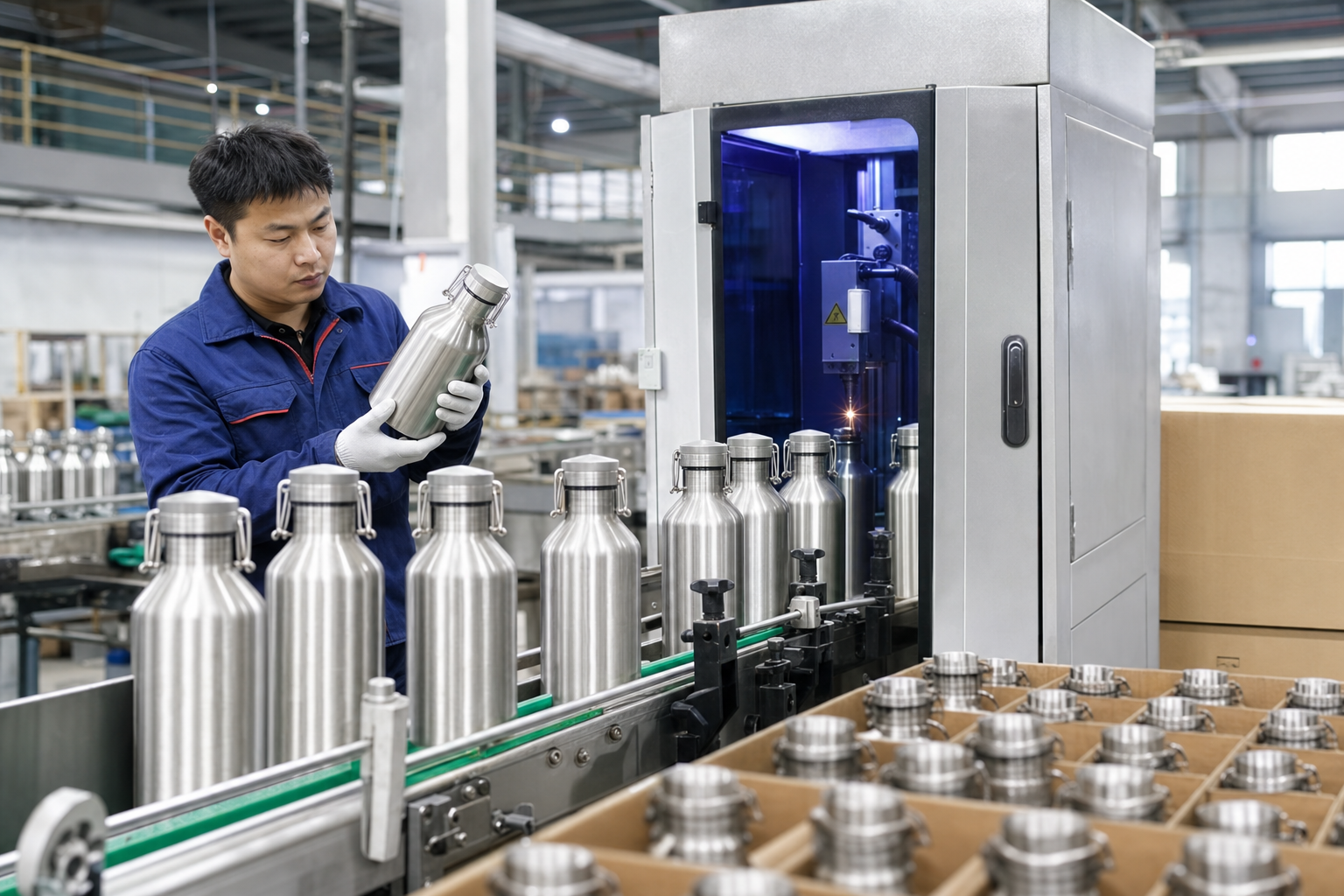
A growler looks simple on the page. On the floor, it is a sealed drinking system that has to survive filling, handoff, packing, freight, shelf display, and rough treatment from the end user. The bottle body, neck finish, cap or handle, gasket, coating, and carton all have to work together. We had QC pull one sample at the seam check, and the carton print was off by 2 mm. That is the kind of miss that turns into a buyer complaint later. For export, judge a custom growler the same way you judge a canteen built for a chain account: by repeatability, not by one good-looking sample.
For most B2B orders, the real questions are plain. Is it 32 oz, 64 oz, or another market volume? Is it single-wall or insulated? Does the closure need to be screw-on, swing-top, or a threaded cap with a silicone seal? Can the surface take laser engraving, silk screen, or powder coating without flaking after the line runs 500 pieces? If you buy for a canteen distributor or a distributor drinkware program, the math does not work any other way: the product that ships cleanly and opens the same way every time is the one that moves through reorder.
- Choose volume by channel, not by guesswork.
- Match the cap style to the beverage and the market.
- Confirm packaging before you approve the sample.
- Ask for repeat order control, not only first-order approval.
Materials that survive export
Most growler manufacturer talks start with stainless steel, and that is the right place to start. For beer and other cold-chain programs, 18/8 or 304 stainless steel is the default. We run it on the line because it stays stable, is easy to source in China, and clears food-contact requirements when the rest of the build is done right. If a buyer wants a premium badge or expects harsher storage, 316 can make sense. Do not pay for it unless the use case justifies the added cost.
Wall thickness matters more than many buyers expect. On export orders, we usually see a body around 0.5 mm, and the lids and fittings need enough meat to hold the thread after a drop test and a 1 kg carton stack. QC pulled the sample last week and the buyer flagged a dent at the collar, which came from thin material near the seam, not the steel grade. For insulated models, check the inner shell and outer shell, not just the temperature claim on the spec sheet. A good factory in Zhejiang will tell you the coating thickness, the gasket grade, and whether the finish is powder coat, spray paint, or UV print. That is the level of detail you want from a canteen manufacturer or canteen supplier too.
Practical spec targets
- Body material: 304 stainless for standard programs.
- Premium option: 316 where corrosion resistance justifies the cost.
- Typical body gauge: around 0.5 mm for export use.
- Seal: food-grade silicone, not a generic rubber guess.
If a supplier cannot explain why a material was chosen, you are buying a story, not custom drinkware.
Decoration that sells through
Decoration is where a lot of custom growler jobs get messy. We run the line, pull a sample at QC, and check it under shipping light because the logo has to read clean at a distance, survive hand marks, and stay legible after transit. For simple branding, silk screen is still the lowest-cost route, especially on a 500 pcs MOQ with one-color art. For premium retail, laser engraving gives a cleaner, permanent mark. Powder coating can lift the look of a customized growler, but only when curing time and adhesion are controlled. If the coat is soft, the logo chips before it reaches the shelf.
Pick decoration by channel and artwork complexity, not by trend. That is the wrong question to ask. If you are building a canteen promotional line for distributors, one color usually gives the best cost-to-impact ratio. If the body is black or brushed, laser is often the safer call. We had a buyer flag a PO that asked for a fine logo on a matte black shell, and the first sample disappeared at 2 meters. For distributor canteen or distributor growler programs, keep the artwork readable from 1.5 meters away. Buyers in Europe and North America usually care more about clean washing performance than decoration tricks. We see that go sideways when the print looks good in photos and fails after real use.
- Silk screen: best for volume and simple logos.
- Laser engraving: best for permanence and premium positioning.
- UV print: useful for color complexity, but check abrasion resistance.
- Embossing or debossing: good for molds, but raises tooling cost.
When you compare canteen customizable and customizable drinkware options, ask for photo proof after dishwasher testing, not only a proof file. On our side, QC wants the actual cup back from the wash rack, not a PDF.
What a China factory should quote
I’m tightening the wording for a buyer-facing factory section and keeping the HTML structure unchanged. I’m also adding a few concrete shop-floor details so it reads like someone who actually quotes and ships growlers.A real growler manufacturer should send an itemized quote, not one flat number. Break out the body, lid, decoration, inner packaging, outer carton, and any mold or tooling charge. In Zhejiang, some drinkware lines push 600,000 units a month, but volume does not tell you whether the operator keeps logo placement within 2 mm shift after shift. We check that with a steel ruler and a go/no-go gauge. If the mark drifts, the carton still ships wrong.
For standard custom drinkware, MOQ often starts around 500 pieces per design and color. For a fully custom mold, 1,000 pieces or more is normal, and tooling usually lands between $1,500 and $4,000 depending on cavity count and lid geometry. Sampling usually takes 5 to 10 days, and production lead time is often 35 to 45 days after sample approval. If a canteen factory promises faster, ask how the coating cures, how many minutes the oven runs, and who signs off the first 50 pcs. We’ve seen rush jobs turn into rework when the buyer flagged a lid leak on day 3 of inspection.
Ask for the quote in the same structure every time: material, decoration, packing, carton dimensions, unit weight, MOQ, sample time, and FOB port. If one supplier leaves out carton size or unit weight, the freight math is already wrong. We’ve had a PO typo on carton size add 12 kg to volumetric weight. Consistency in quoting is a useful sign of manufacturing discipline.
That is the difference between a canteen vendor that only moves boxes and a canteen manufacturer that can keep repeat orders straight. QC pulled the sample, checked the lid at 28.4 mm, and signed off only after the seal passed again. The wrong question is whether the quote is lower. The right one is whether they can quote it the same way next month.
Quality checks you should require
Quality control belongs in the PO, not as a polite note at the end. For export growlers, we write the inspection plan into the order: AQL 2.5 for major defects and 4.0 for minor defects unless your brand asks for tighter limits. On the line, QC pulled the sample from the 12-head leak rack and checked every finished unit for seepage. If the product is insulated, test thermal retention under fixed conditions, not a claim like keeps drinks cold for hours. State the fill temperature, ambient temperature, and lid closure used. The math does not work any other way.
Compliance is not optional, and this is the wrong question to ask when someone says the certificate is enough. For Europe, ask for REACH and, where relevant, LFGB migration testing. For North America, confirm food-contact declarations and any state rules that apply. We have seen a buyer flag an ISO 9001 file because the batch record on the 304 stainless lid did not match the carton code. If you sell through retail or distribution, BSCI and ISO 9001 help only when the process on the floor matches the paper. A customized canteen program and a customized growler program still need material traceability, finished goods inspection, and packaging drop testing.
- Leak test every unit or every batch with signed results.
- Request carton drop tests from at least 80 cm.
- Ask for odor and taste neutrality checks on the liner and lid.
- Confirm the decoration passes abrasion and tape pull tests.
Choosing the right supplier
The biggest mistake is assuming every canteen supplier can handle growlers well. Some can, most cannot. A stock-merch factory may be fine for a 1,000-piece promo run, but a custom growler order needs tighter control on neck finish, sealing, and coating wear. We run a 38 mm neck check with a gauge ring on the line for that reason. If the same plant also handles canteen suppliers and custom canteen projects, ask whether growlers share the same line or get pushed to another workshop. You want a straight answer, not a slogan.
Ask direct questions before you commit. Who owns the mold? Who signs off on first article samples? What happens if 2 percent of units fail leak testing? Can the factory supply spare caps, seals, or replacement parts for later retail service? QC pulled the sample on one order because the cap torque was off by 0.6 N.m, and the buyer flagged it immediately. If the reply stays vague, you are dealing with a middleman, not a production partner. That is the wrong setup for repeat distributor business.
Questions worth asking
- What is the real MOQ by decoration method?
- Which tests are done in-house, and which go to a lab?
- Can you keep the same bottle finish on a reorder six months later?
- Do you support carton marking, FNSKU labels, or retail pack-outs if needed?
If the factory can answer those without confusion, you are close to a supplier worth keeping. If they cannot, the math does not work for a growler program that needs stable reorders and clean service parts.
Request a custom growler quote today
Send your volume, logo file, and target market. We will quote MOQ, lead time, and packing details with clear factory specs.
Frequently asked questions
What MOQ should I expect for a custom growler order?
For a standard custom growler with existing tooling, a practical MOQ is usually 500 pieces per design and color. If you want a new mold, a custom handle, or a shaped body, 1,000 pieces is more realistic. Some factories in Zhejiang will quote lower, but that usually means higher unit cost or limited decoration options. For retail or distributor programs, the better question is not only MOQ, but whether the factory can repeat the same logo placement, lid fit, and carton strength on the next order. Ask for a sample fee, mass production lead time, and whether the MOQ changes by printing method.
Is 304 stainless steel enough for beer growlers?
Yes, 304 stainless steel is enough for most beer growlers and general beverage use. It is the standard balance of cost, corrosion resistance, and availability in China. If the product will see harsher storage, salty environments, or you need a premium spec for a higher-end channel, 316 is worth considering. The key is not just the steel grade. You also need a proper silicone gasket, clean welds, and a finish that does not trap residue. Ask for food-contact declarations and, for Europe, REACH or LFGB where relevant. A poor lid will ruin a good steel body faster than the material itself.
Can I combine growlers with canteen custom programs in one order?
You can, but only if the factory actually runs both product families with proper process control. A canteen custom order and a custom growler order may share decoration and packing logic, but they often use different molds, lids, and quality checks. Combining them can reduce freight cost and simplify vendor management, especially for a canteen distributor or distributor drinkware buyer, but it can also create delays if one product fails sampling. Ask whether the factory is a true canteen manufacturer with in-house control or just a canteen vendor sourcing from multiple workshops. Shared cartons and mixed shipments are fine; shared assumptions are not.
What lead time should I budget from a China factory?
For a standard custom drinkware order, plan on 5 to 10 days for samples and 35 to 45 days for production after sample approval. If you need a new mold, decorated lid, or special coating, add time for tooling and first-article correction. A Zhejiang growler manufacturer with strong capacity can still miss deadlines if artwork is late or you keep changing packaging specs. Build in time for inspection and export booking as well. For peak season, add at least 1 to 2 weeks of buffer. The real risk is not the factory lead time alone, but your own approval delay on artwork, packing, or compliance documents.
What artwork files do you need for logo printing on growlers?
Send vector artwork in AI, EPS, or clean PDF format with outlined fonts and Pantone references if color match matters. For silk screen, one or two colors are usually the most reliable. For laser engraving, supply a black-and-white vector with the exact placement and size. If you want canteen promotional or customized drinkware packaging, include carton marks, barcode data, and any FNSKU or retail label requirements up front. A good factory will confirm the print area, curvature limits, and minimum line thickness before sampling. If they do not ask for those details, they are guessing, and guessing is expensive in mass production.