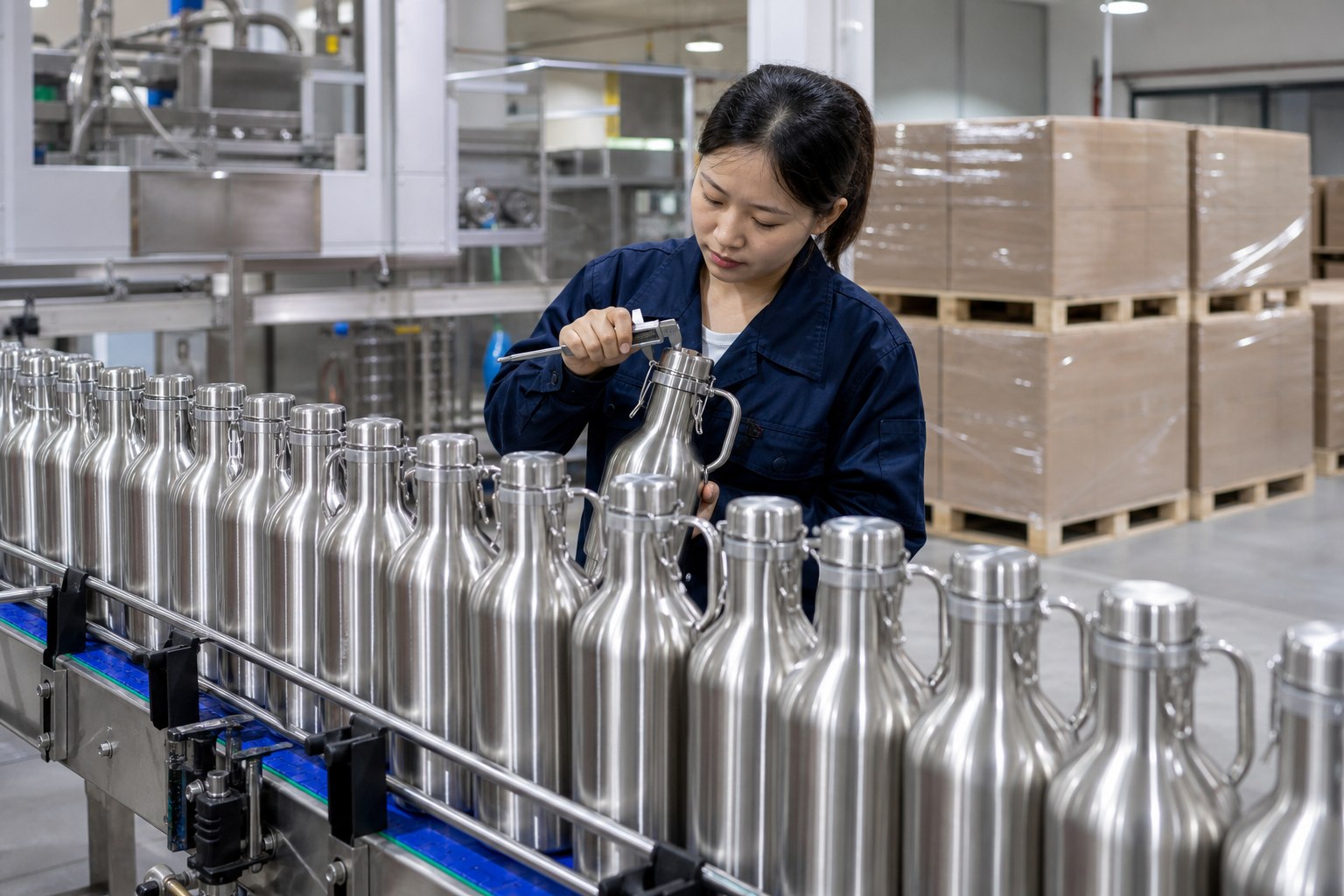
Key Takeaways
- A practical custom growler order usually starts at 500-1,000 pcs per SKU, with 25-35 days lead time after sample approval.
- For stainless models, 304 food-grade steel with 0.5-0.7 mm wall thickness is the normal B2B baseline, not a premium upgrade.
- Ask for AQL inspection, leak testing, and compliance documents such as REACH, LFGB, or FDA before you approve mass production.
- A Zhejiang factory with 300,000 units/month capacity can support distributor drinkware programs if artwork, cartons, and replenishment rules are clear.
Buying from growler manufacturers is not just a packaging decision. You are picking a vessel that has to hold carbonation, survive 1.2 m drop tests, print cleanly, and still clear a price your channel can live with. On our line, a bad seam shows up fast in a 24-hour leak check. This is the wrong question to ask if you only compare unit price.
If you already buy custom drinkware, custom canteen, or canteen promotional items, the playbook is the same: lock the spec first, then compare factories on tooling, QC, and repeatability. In Zhejiang and across China, the suppliers worth keeping are the ones that can show samples, test data, and a real MOQ, not a promise written in vague English on a PO. QC pulled the sample with a 0.2 mm wall gauge last week. The math does not work if the factory cannot repeat that.
Start With The Growler Spec
Before you ask for a quote, define the growler the way the buyer will receive it, not the way a merchandiser writes it. A growler is not just a big bottle. We need the size, material, closure, finish, and carton plan. The common commercial sizes are 32 oz and 64 oz, and stainless steel keeps winning repeat wholesale orders because it survives freight better than glass and gives us cleaner decoration runs. For a retail program, decide on single-wall, vacuum-insulated, or glass-lined construction before the first sample hits the line.
For most custom drinkware runs, the non-negotiables are plain: 304 stainless steel, 0.5-0.7 mm wall thickness, a food-grade silicone gasket, and a cap that passes inverted leak tests. QC pulled the sample on a 48-hour hold test once and the buyer flagged a drip at the hinge, so the wrong cap spec cost us a week. A wide-mouth customizable growler fills faster at a taproom, but it also demands tighter closure control. If you are building a customized growler line for a distributor, put the spec on one page and stop the supplier from guessing on material grade or coating thickness.
- 32 oz works well for on-premise sales and lighter shipping cartons.
- 64 oz is the standard retail and taproom size in most markets.
- Powder coat and brushed steel hold up better than soft-touch paint.
- Ask for the net weight, gross weight, and carton count before you approve a sample.
The math does not work if you leave the spec loose. We have seen a PO typo turn 5,000 units into the wrong cap thread, and that is a costly fix once the line is running.
Pick Materials That Ship Safely
Material choice is where buyers lose margin. Glass growlers look clean on a sample table, but in a 40-foot container they break more easily in ocean freight and need tighter carton engineering. Stainless steel is the safer call for 1,000-unit and 5,000-unit runs because it handles vibration, stacking, and last-mile drops better. If you are buying from China, ask for the build sheet, not the brochure line. On a coated stainless model, check whether the powder coat is 60-80 microns, whether the interior is electropolished, and whether the lid uses a one-piece seal or a multi-part seal. QC pulled a sample last week and the 1.2 mm wall spec was off by 0.15 mm. The sales deck will not tell you that.
Compliance matters as much as the finish. A serious China factory should show food-contact declarations, REACH support, and test reports from a lab that will stand up to a buyer audit. If your channel is Europe, ask for LFGB. If you ship to North America, check FDA-related declarations and packaging ink compliance. For a canteen manufacturer or canteen supplier already running reusable metal drinkware, the same process discipline should carry over to a growler PO. A canteen custom program that passes leakage and coating checks usually has the line control to handle customizable drinkware without surprises. We once caught a PO typo on the carton mark before print, and that saved a week on the line.
One practical point: do not over-spec the lid if your target price is mid-market. A $2 to $3 mistake on the closure can wipe out margin across 5,000 units, and we have seen that go sideways fast. If the lid is the failure point, the buyer flags the whole custom drinkware program, not just the cap. Keep the closure simple, then spend the money where it shows up in shipping and shelf appeal.
Price, MOQ, And Lead Time
Buyers ask for a quote before the factory knows the real job. That is the wrong question to ask. A growler plant needs a sample drawing, a traced carton size, or a clean reference unit before we run numbers. In Zhejiang, a solid stainless custom growler can be quoted in 24-48 hours once the spec is clear. For existing tooling, 500 pcs per SKU is a normal MOQ. If you want a new shape, a special handle, or a deep emboss, plan on 1,000 pcs or more, plus a tooling charge of 2,000 to 6,000 USD depending on the mold work. QC pulled the sample at the caliper bench last week and found a 1.2 mm wall difference that changed the cost.
Lead time is usually 25-35 days after sample approval for standard production, plus shipping. If a supplier promises 10 days for a fully customized program, treat it as a red flag unless they are only adding a logo to stock goods. A Zhejiang plant with 300,000 units per month can handle repeat orders, but the line only stays smooth if artwork is locked early and the PO does not come back with typo fixes after approval. FOB terms are common from China, so compare landed cost, not just unit price. A 0.20 USD change in printing, a 0.15 USD carton change, and a stronger lid can move the total more than the headline quote. The buyer flagged a lid spec once, and the whole schedule slipped 6 days.
If you are a canteen distributor or distributor drinkware buyer, run the same math across the full line. A good canteen factory should give you a clean breakdown: unit cost, sample fee, tooling, carton spec, and the surcharge for color changes. We ship that way for a reason. This is how you separate a real canteen supplier from a vendor that is only quoting low to win the order. On one order, a 3 mm carton change looked minor on paper and added real money across 20,000 pcs, so the math has to be checked before you chase the lowest number.
Branding That Survives Use
Decoration is not about a clean mockup. It has to survive washing, scratch marks, and retail handling on the shelf. For growlers, we run silkscreen, laser engraving, UV printing, and sometimes debossing on the body or cap. Laser usually gives the best wear life because there is no ink layer to fail. Silkscreen is still the cheaper answer for 1 or 2 colors, and on powder-coated surfaces it works if the curing temperature stays in spec at 180-200 C. A buyer once pushed for a "premium" logo on a 500 pcs promo run; the math does not work. For short promotional orders, silkscreen keeps unit cost down, while laser makes the product feel more permanent after 12 months on the line.
This is where a buyer of canteen promotional goods, custom canteen, or customizable canteen items already has an edge. Logo placement, print area, and carton layout affect sell-through. Use the same approach on a customized growler or customized drinkware line: keep the art simple, stay inside the 60 mm print band, and ask for a digital proof before we make plates. A PO typo like "Sliver" instead of "Silver" has forced a reproof before. A canteen custom program and a growler program both need Pantone numbers, not color names like blue or silver.
For distributors, the best decoration is the one that survives reorder cycles. If your canteen manufacturers or canteen vendors change ink batches every shipment, the brand looks off. On a growler, you catch that faster because the body is large and flat. QC pulled the sample on a 304 stainless unit and found a 6 percent shade drift after the second lot. We have seen this go sideways. Ask for the same ink lot or a signed batch match, or the repeat order will not match the first 500 pcs.
Quality Checks You Should Demand
Quality control should not show up at the end like a surprise carton damage claim. Ask which checks run on the line and which happen on finished goods. For custom growlers, we expect leak testing, cap torque checks with a torque wrench set around 0.6 N·m, surface adhesion checks, and carton drop testing from 1.0 m. If the supplier works to AQL 2.5 for major defects and 4.0 for minor defects, that is a sound starting point for retail drinkware. You can tighten it for premium channels, but only if the price covers the extra sorting. The wrong question is “can you inspect it?” The right one is “where do you stop the bad parts before they get packed?”
Good paperwork keeps the line honest. Ask for the inspection plan, the QC checklist, and the batch sample retention policy. If the factory says they are ISO 9001 certified or BSCI audited, check the certificate number and issue date, not just the logo on the PDF. For Europe, REACH support is not optional when your importer asks for it. For Amazon-style programs, carton labels and FNSKU placement need to be confirmed before shipment, not after the goods land at the warehouse. We have seen a PO typo on the carton count turn into a 12-day delay because the buyer flagged it at receiving.
A workable test spec is plain: no leakage after 24 hours upright and inverted, no visible coating blistering after 50 dishwasher cycles if the coating is sold as dishwasher-safe, and no cap failure after repeated open-close cycles. On one run, QC pulled the sample after a cap torque drifted past spec on the second shift, and that saved a full rework. If the factory cannot explain its rejection rate, you are probably dealing with a trading layer instead of a real canteen factory. The math does not work if they cannot tell you how many pieces fail at each station.
How To Qualify The Factory
The best growler manufacturers answer technical questions without trying to drag the talk back to price. Start with three checks: sample quality, production capacity, and response speed. Ask how many lines they run, what their monthly output is, and whether they can keep your SKU separated from other orders. QC pulled the sample from line 3, and that tells you more than a polished sales deck. In Zhejiang and across China, the stronger factories usually run a steady export schedule, keep carton control tight, and have at least one English-speaking sales engineer who can read a drawing, not just translate a quote.
When you compare a canteen manufacturer, canteen manufacturers, canteen suppliers, canteen vendors, or a canteen supplier that also handles customizable drinkware, look for the same maturity signs: clear SOPs, traceable batches, and written fixes when something slips. A canteen distributor does not need a factory that talks big; you need one that can repeat the same print, seal, and finish on the second order. The buyer flagged a 1.5 mm lid gap on one job, and the plant that kept the account sent a corrected sample by courier the next day. That is the line between a one-time custom canteen job and a reliable custom growler program.
Before you approve an order, request a recent inspection report, a production photo set, and one real export reference with similar packaging. If the supplier can show they already handle canteen custom work, customized canteen orders, or other custom drinkware projects with stable quality, you are closer to a low-risk source. Ask for the AQL 2.5 sheet, not a glossy deck. We once caught a PO typo on the carton count, and the factory fixed it before the first pallet left the stretch-wrap station. In China, that is usually the difference between a factory that sells samples and a factory that builds a supply chain.
Request a growler quote with real specs
Send your size, material, logo, and target quantity. We will quote the factory route, not a guess, so you can compare China sourcing cleanly.
Frequently asked questions
What MOQ should I expect from growler manufacturers?
For standard custom growler orders from China, 500 pcs per SKU is a realistic starting point if the supplier already has the tooling. If you need a new mold, a special handle, or a non-standard cap, 1,000 pcs is more common. For mixed colors, factories may ask for 300-500 pcs per color to keep line setup efficient. If you are buying through a Zhejiang factory with mature export systems, ask for the MOQ in writing along with the sample fee, tooling charge, and the price break at 1,000 and 3,000 pcs. That gives you a real landed-cost comparison, not a guess.
Can I get REACH and food-contact compliance for Europe?
Yes, but you need to ask early. A serious China supplier should be able to support REACH documentation, food-contact declarations, and lab reports from a recognized third-party lab. For stainless steel growlers, buyers in Europe often request LFGB as well, especially if the product is positioned as premium custom drinkware. Do not assume the factory will automatically include the right reports with the order. Confirm the exact SKU, coating, ink, and gasket material that were tested, because a change in lid or paint can invalidate the old report. The right factory will give you document control, not just a PDF folder.
Which decoration method lasts longest on a custom growler?
Laser engraving usually lasts the longest because it is not relying on ink adhesion. It is the safest choice if you expect heavy washing, retail handling, or a long shelf life. Silkscreen is still practical for one-color and two-color logos, especially on powder-coated bodies, and it is cheaper on larger runs. UV printing can handle more complex graphics, but it needs careful abrasion testing before you commit. For a distributor drinkware program, ask the growler manufacturers for a wear test after 20-30 dishwasher cycles or a scrub test equivalent. The right method depends on the finish, target price, and how your brand is used in real life.
Should I choose glass or stainless steel growlers?
Choose stainless steel if you care about freight safety, repeat wholesale orders, and lower breakage. Choose glass if your brand wants a visible fill line, a traditional taproom feel, or a lower tooling barrier. For cross-border shipments from China, stainless usually wins because cartons survive better and the product can be packed tighter. A 64 oz stainless growler often costs more to produce than basic glass, but the total landed cost can still be lower once you factor in breakage and claims. If you are building custom drinkware for retail or e-commerce, stainless is usually the more forgiving option.
How do I vet a growler factory in Zhejiang?
Start with evidence, not promises. Ask for factory photos, capacity by line, certificate copies, and one recent third-party inspection report. A strong Zhejiang factory should be able to show AQL standards, leak-test procedures, and traceable batches. If they also produce canteen custom or customizable drinkware items, that can be a good sign, but only if the QC system is documented. Request pre-production samples, then ask for a duplicate sample after the first production run to see whether the finish and print match. If the supplier can explain how they handle cartons, palletization, and repeat orders, you are probably dealing with a real manufacturer rather than a trading-only vendor.