Key Takeaways
- A workable custom growler program usually starts at 1,000 pcs MOQ, with FOB pricing from about USD 2.20 to 4.80 depending on lid and finish.
- 304 stainless steel at 0.5 mm to 0.6 mm wall thickness is the practical baseline for most growlers; 316 is only worth the premium for harsher use cases.
- For export orders, ask for REACH or LFGB testing, AQL 2.5 major inspection, and 100% leak checks on lids before shipment.
- A capable canteen factory in Zhejiang, China can run about 80,000 units per month and still ship in 25 to 35 days after sample approval.
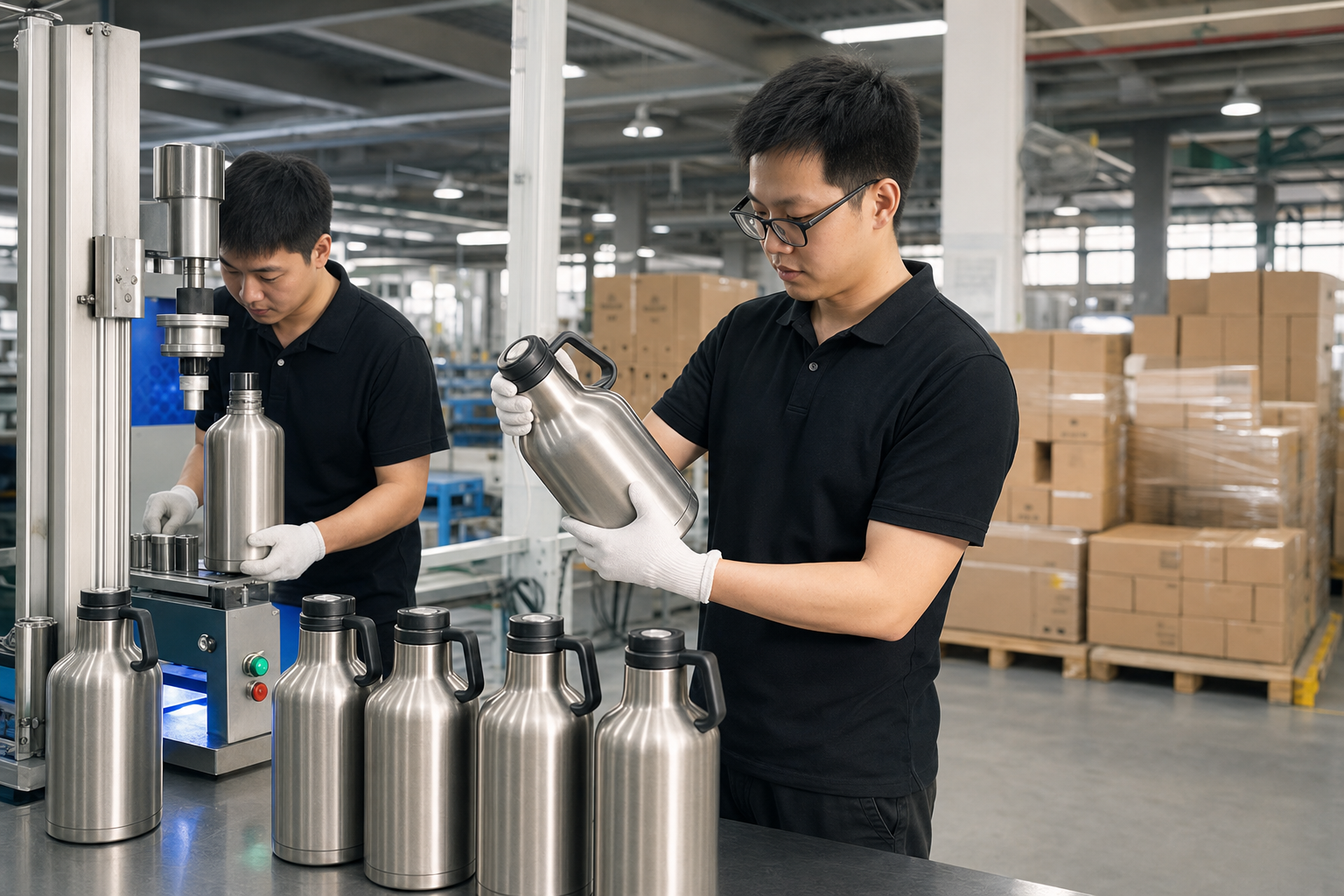
If you are comparing growler vendors, you are not buying a bottle. You are buying a leak-free package that has to survive filling lines, 18 kg cartons, freight, retail shelves, and customer abuse. A 64 oz or 128 oz growler with weak welds, a loose cap, or a print that flakes after three washes kills margin fast. We ship this kind of order every week, and the buyer flags it the moment a seam opens at the drop test. Ask for a real spec sheet, not a glossy sample.
For buyers in Europe and North America, the clean orders start with the same discipline we run on canteen custom and distributor drinkware programs in China and Zhejiang. Lock the steel grade, finish, lid torque, print method, and test standard before price talks start. QC pulled the sample on a 1.2 mm neck finish last month because the cap torque was off by 0.3 N·m, and the math did not work. Do that early, or custom growler, customizable drinkware, and custom canteen orders drift into rework and claims.
What Growler Buyers Should Check First
The first mistake growler vendors make is treating the item like a commodity. It is a food-contact vessel, a branding surface, and a shipping risk in one box. For retail, hospitality, or distributor programs, start with the use case. A bar refilling beer needs a different closure and neck finish than a merch program, and a 64 oz stainless growler for a canteen distributor should not be written the same way as a one-off promo run. We run into this all the time on the line: if the spec is loose, the factory fills in the blanks, and the buyer flags it after the first sample.
Ask three questions before you ask for a quote. What liquid will it hold, how will it be cleaned, and what shelf life do you expect in the field? Those answers decide the body style, the liner or no-liner call, and the cap system. For a basic custom growler, the spec sheet should state capacity, wall thickness, steel grade, neck finish, gasket material, and decoration area. If a vendor cannot reply with those details in one shot, they are not ready for a controlled B2B order. QC pulled a sample last week with a 0.2 mm wall swing, and that is the kind of gap that turns into a claim later.
- Define capacity in ounces and milliliters.
- Specify 304 or 316 stainless up front.
- Confirm whether the lid must be leakproof for transit.
- State if the buyer needs a customized growler, customized drinkware, or a broader custom drinkware line.
That discipline matters when you buy from a canteen factory in China, because the lowest quote often hides a thinner wall, a cheaper gasket, or a loose inspection plan. We have seen a PO typo turn 64 oz into 60 oz, and the math does not work when the carton spec is already locked. This is the wrong question to ask if you only compare unit price.
Materials And Construction That Hold Up
For most growler vendors, 304 stainless steel is the default because it keeps cost, corrosion resistance, and supply in balance. On our line, 0.5 mm works for normal retail, but 0.6 mm gives a firmer feel and holds up better when cartons get tossed at the dock. For a premium channel or outdoor buyers, that extra metal is worth the small price jump. 316 stainless resists chlorides and harsher wash cycles better, but it adds cost and usually is not the right call for standard beverage retail. If a supplier claims every grade behaves the same, they are skipping the part that fails on the floor.
Check seams, welds, and the lid interface. QC pulled a sample last week with a weld burr inside the neck, and that kind of residue traps odor fast and turns into cleaning complaints. The closure matters as much as the steel. A silicone gasket with even compression beats a loose TPE ring that starts to deform after a few heat cycles. For insulated versions, ask for vacuum integrity test results and the exact pressure loss method, not a vague promise. Your buyer spec should also say whether the powder coat needs a 50 to 70 micron film thickness, or whether brushed steel is acceptable for a simpler custom canteen or customized canteen line. This is the wrong question to leave open.
Do not ignore the packaging structure. A rigid inner tray or molded pulp insert can cut transit damage by a clear margin, especially on export pallets that get repacked three times before arrival. We saw one PO where the buyer flagged a typo in the carton mark, and the whole lot sat because the master carton was not built for the route. If your distributor drinkware order is headed to Amazon or a retail DC, the pack has to survive handling, stacking, and drop tests, not just product use.
Decoration That Survives Real Use
Decoration is where a lot of canteen custom projects get expensive fast, and the wrong call shows up on the line by day 3. The method has to match the artwork, the order size, and the wash life you promised. For a one-color logo on brushed steel, laser engraving is the toughest option. It does not peel, and it holds after repeated washing. For higher-contrast branding or a full-color retail look, silkscreen and UV print give more room, but they need tighter control. If you are sourcing canteen promotional units, ask how the print looks after 200 dish cycles, not just on the first sample. The buyer who skips that check usually comes back with a complaint after QC has already packed 3,000 pieces.
Keep the artwork rules simple. Curved surfaces distort fine lines, so thin text and tiny registration marks are a bad bet. We have seen a 1.2 mm font pass on screen and fail on stainless once the shoulder curve bites into it. A practical art file should include vector artwork, Pantone references, print size, and an approved placement drawing. If the buyer wants a customizable canteen or customizable growler with multiple SKUs, lock the logo area before production begins. That avoids the classic mess where one SKU prints cleanly and another needs a late adjustment because the shoulder curve is different. This is the wrong question to ask after the PO is signed.
For large distributor canteen or distributor growler programs, a mixed approach usually works best: laser on premium items, one-color silkscreen on volume SKUs, and no more than two print positions unless the margin can support it. We run the same rule on 304 stainless bottles with a 500-unit MOQ, and it keeps rework down. This keeps unit cost controlled while preserving a clean retail look. If you already sell custom drinkware, the same rule applies across the line: fewer decoration variables means fewer disputes. QC pulled the sample, checked the edge of the logo with a loupe, and the issue was clear in 10 seconds.
QC And Compliance For Export
Do not sign off on a growler by eye alone. We run it against a written quality plan that matches the product spec, or the order drifts fast. For most growler vendors, that means incoming material checks, in-process inspection, and final random inspection under AQL. A common starting point is AQL 2.5 for major defects and 4.0 for minor defects, with 100 percent leak testing on the lid line. If the supplier cannot name the defect buckets and show the check sheet, the inspection plan is not ready for a commercial order. On the line, QC pulled the sample with a 0.2 mm feeler gauge before the first carton was closed.
Ask for a pre-production sample, a sealed golden sample, and a first-article report before mass production starts.
Europe and North America are simple if you ask for the papers on day one. For steel drinkware, request REACH documentation, LFGB or equivalent food-contact evidence, and a declaration of materials. If the growler includes silicone or plastic parts, confirm they are food-grade and temperature-safe. You should also ask for drop-test data, usually around 1 m, and a leak test after thermal cycling. The buyer flagged a lid typo on one PO last month, and that kind of small error is where a shipment starts to slip. A solid canteen manufacturer already has these files ready; a weak canteen supplier waits until the last week, then scrambles.
Factory certifications help, but they do not close the deal by themselves. BSCI, ISO 9001, and traceable lot records matter, yet the real test is repeatability across 5,000 pcs or 20,000 pcs. That is the wrong question to ask: not whether the factory has a certificate, but whether the same weld seam, coating thickness, and leak rate hold from the first box to the last pallet. We have seen this go sideways when a trading company promises control and the actual line cannot keep the cap torque within spec. For customized drinkware, that is where a buyer separates a real factory from a middleman.
Pricing, MOQ, And Lead Time
I’m rewriting the three paragraphs to keep the same structure while making the pricing and operations details sound like they came from someone who has quoted and shipped these orders before. I’m also tightening the language to remove the AI filler and adding a few factory-floor specifics so the section reads more grounded.Price is not just metal cost. A standard 64 oz stainless growler with powder coating, one-color logo, and a basic leakproof lid usually lands in the USD 2.20 to 4.80 FOB range at commercial quantities. If the buyer asks for a custom cap, a special finish, or a full-color wrap, the quote moves fast. New lid or handle tooling runs USD 300 to 900, depending on cavity count and insert work. On our line, a 1.2 mm body blank and a simple lid are one thing; a new closure is a different job. A low-volume promotional order makes that tooling eat the first shipment, so spread it across 2 or 3 reorders or the math does not work.
MOQ is where buyers usually overstate their pull. A Zhejiang canteen factory can run about 80,000 units per month across similar stainless lines, but a custom growler still needs a real MOQ. For stocked shapes, 1,000 pcs is common. For more complex customized growler configurations, 3,000 pcs is the better starting point. Lead time after sample approval is usually 25 to 35 days, and it slips if you change packaging, add extra decoration, or ask for a special lid finish. QC pulled the sample twice on one run because the gasket groove was 0.3 mm off, and that kind of issue burns days. Sea freight from China still gives the best landed cost for most distributor orders, but you need to book space early and plan around Ningbo and Shanghai congestion.
If you are comparing canteen distributors, look past unit price. Ask for carton count, gross weight, pallet pattern, and the replacement policy for defects found at destination. We have seen this go sideways when a buyer only chased the lowest FOB and ignored a carton spec that added 0.8 kg per case. A slightly higher FOB from a steady canteen manufacturer is often cheaper than fighting shortages after arrival.
How To Run A Better Supplier Process
I’ve got the structure and the constraints. Next I’m rewriting each paragraph so it sounds like a factory-side buyer note, with tighter language, a few concrete line details, and the same HTML tags left intact.The cleanest growler programs start with a spec sheet. Send one file with capacity, steel grade, wall thickness, lid type, decoration, packaging, and shipping terms; a loose email thread just gives the line room to guess. We check details with a caliper at sample stage, then cut the pre-production sample against the final tooling, print, and carton spec. After that, lock the inspection standard in writing and confirm FOB Ningbo or FOB Shanghai if you are buying through Zhejiang or wider China supply chains. If the supplier changes a shoulder, cap, or carton after sample approval, treat it as a deviation and write it down. That is how you protect the order and your margin.
A practical buyer checklist:
- Capacity, steel grade, 0.8 mm or 1.0 mm wall thickness, and lid type.
- Decoration method, final artwork file, and Pantone number.
- Testing requirements, including leak tests and 1 m drop tests.
- Carton spec, master carton count, and pallet requirements.
- Inspection plan, AQL level, and replacement terms.
If you already buy canteen customized or distributor drinkware, the process will look familiar. Growlers are less forgiving on closure fit and odor control, so the supplier needs tighter control on finish. QC pulled a sample off the line at 10 a.m. once and found a gasket groove off by 0.3 mm; that job taught us fast. A good canteen vendor should not push back on clear instructions. The better factories ask for them, because clear specs cut rework and keep production moving. If you want repeat orders, treat the first run as a qualification run, not a one-time buy. That is the right way to scale in China and keep the second PO from turning into a headache.
Source your next growler run with fewer surprises
Send the spec, ask for the test plan, and compare the real landed cost before you commit to a supplier in China.
Frequently asked questions
What MOQ should I expect from growler vendors?
For a standard stainless growler, 1,000 pcs is a normal MOQ if the shape is already in production. If you need a new lid, custom handle, or unusual finish, 3,000 pcs is more realistic. Very small runs can be done, but the unit price climbs quickly because tooling, setup, and inspection cost do not change much. For a branded custom growler program, I would budget on 1,000 to 3,000 pcs for the first order and ask the factory to quote reorders separately. That keeps the economics clear and avoids false expectations.
Which decoration method lasts longest on a growler?
Laser engraving is the most durable for a single-color logo because it does not peel or chip. If you need color, silkscreen is better than a low-grade sticker, but it should be tested for washing and abrasion. UV print can look sharp, especially for retail packaging, yet it needs controlled curing and good surface prep. For export buyers, I usually recommend a laser logo on premium growlers and one-color silkscreen for volume SKUs. If the item is going into a canteen promotional campaign, ask for a wash test target of at least 200 cycles so you know how it will age in real use.
Can I sell custom growlers in Europe and North America safely?
Yes, if you require the right documentation and do not skip verification. For Europe, ask for REACH compliance and food-contact evidence such as LFGB or equivalent test reports. For North America, request food-contact declarations for all wetted parts, including the lid gasket and any plastic insert. Also ask for traceable batch records, AQL inspection results, and leak-test confirmation. If the growler has silicone or plastic components, check that those parts are rated for temperature and repeated washing. A compliant supplier in China should be able to provide these files without drama. If they cannot, the order is not ready for market.
How do I compare growler vendors on more than price?
Compare the full spec, not just the quote line. Look at steel grade, wall thickness, lid type, gasket material, decoration method, packaging, and testing plan. Then ask for MOQ, lead time, and the factory's monthly output. A serious canteen factory in Zhejiang should be able to explain where bottlenecks happen and what their inspection standard is. Ask for AQL levels and whether every lid is leak-tested or only sampled. A cheaper quote that omits those details is usually not cheaper once returns, claims, and replacement freight are added. For distributor growler programs, predictability is worth more than a small unit-price cut.
What lead time is realistic for a custom growler order?
If the shape is standard and the sample is approved, 25 to 35 days is a realistic production window in China. If you need tooling, special packaging, or multiple print methods, expect the schedule to stretch by one or two weeks. Shipping adds its own timing, especially for ocean freight to Europe or North America. I would not promise retail launch dates until the sample is sealed, the carton spec is locked, and the purchase order has been confirmed. For a canteen distributor or canteen manufacturer relationship, the fastest way to lose time is by changing artwork after production has already started.