Key Takeaways
- Stainless steel vacuum bottles usually start at 1,000 pcs MOQ and 25-35 days lead time from approved sample.
- For US and EU sales, ask for REACH, LFGB, FDA, or ASTM-related test reports before you commit to a run.
- A $1.80 bottle and a $4.20 bottle can both look good online, but wall thickness, lid construction, and coating quality decide returns.
- If you want a custom program in China, get quoting on material, decoration, packaging, and carton load together, not separately.
If you are figuring out how to buy drinkware for a retail program, corporate gift line, or Amazon launch, the first mistake is treating every bottle like the same product. A 500 ml stainless steel vacuum bottle, a Tritan sports bottle, and a glass water bottle solve different jobs, hit different price points, and bring different compliance checks. We had one buyer send a PO for “500ml bottle” with no material callout; QC pulled the sample and the spec sheet was wrong on page one. In Zhejiang and across China, the factories that do this well are the ones that can explain those differences clearly, not the ones that just throw out the lowest FOB.
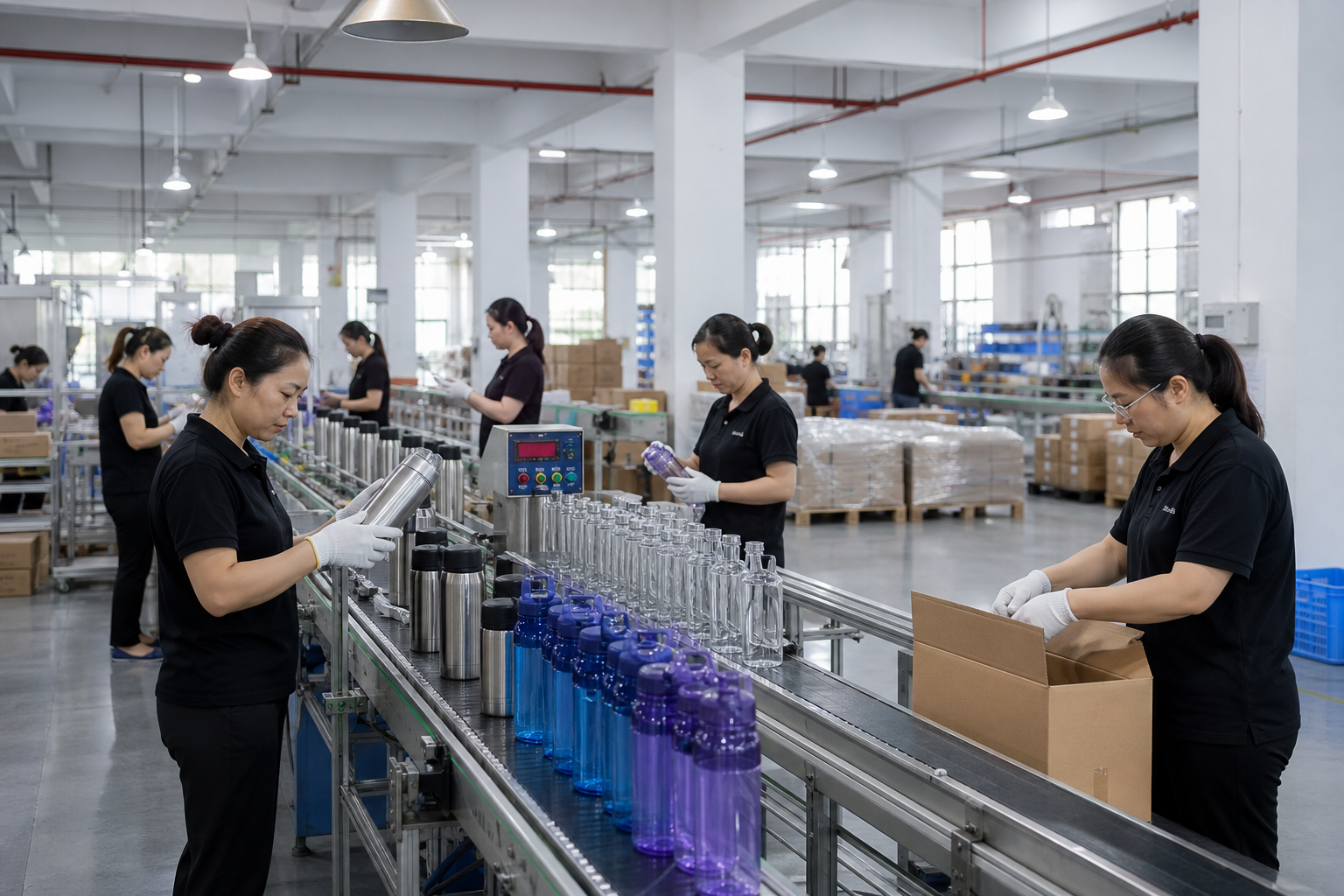
You need to balance function, margin, and lead time without guessing. At BottleForge Industrial in Hangzhou, we run over 300,000 units per month across stainless, plastic, glass, and insulated lines, with common MOQ starting at 1,000 pieces and standard lead times of 25-35 days after sample approval. On the line, a 0.2 mm wall-thickness shift can change the feel in hand and the quote too, so this is the wrong question to ask if a supplier only gives you a price and nothing else. That is the baseline you should ask every supplier to state upfront before you compare logo pricing, packaging, or test reports.
Start With the Use Case
Before you ask how to buy drinkware, pin down what the buyer carries and where they carry it. A 750 ml gym bottle, a 500 ml office thermos, and a 32 oz insulated tumbler do different jobs. We had one PO where the buyer wrote “500ml” in the spec but sent a pallet note for 16 oz cups. QC pulled the sample, and the mismatch killed the quote. If the customer drinks cold water all day, a single-wall plastic bottle can work. If they commute in winter, they will ask for a vacuum insulated bottle with real heat-retention numbers, not a shiny shell and a loose claim.
Use case drives the spec sheet. For retail, a size ladder like 350 ml for kids, 500 ml for office, 750 ml for sports, and 1,000 ml for outdoor covers the main shelf slots. For B2B gifting, 500 ml or 600 ml is safer; it fits most hands and keeps the carton weight under control. If you source in China, especially Zhejiang, ask which SKU families are already tooled. A line that runs 20,000 pieces a day can quote fast and stay steady. A workshop that swaps molds every week? The math does not work.
Do not skip the lid. A bottle with a weak lid creates complaints even when the body looks clean. For leak resistance, ask whether the closure was tested upside down for 30 minutes, whether the gasket is silicone or TPR, and whether the thread pitch is standard or proprietary. We ship enough replacements to know this: the lid is where the buyer flags it first. For schools or travel, that matters more than a printed slogan.
Choose the Right Material
Material choice is where margin disappears. We see it every season. If you are figuring out how to buy stainless steel bottle inventory, start with grade and construction, not the print on the carton. For beverage contact, 304 stainless is the usual baseline for export orders. If the buyer wants stronger corrosion resistance and a premium tag, 316 works, but the cost jumps. On the outer shell, some suppliers write 18/8 everywhere; that is a marketing label, not a spec sheet. Ask for the actual material report.
For insulated items, check the cup body structure and the base seal. A proper double wall bottle or double walled bottle should show a vacuum layer and a clean, even seal at the bottom. We run wall thickness checks with a caliper; outer wall thickness is often 0.4-0.5 mm, depending on capacity and forming method. One buyer once flagged a “12-hour” claim on a PO, but the sample only held heat for 7 hours in our 20°C test room. That is the wrong question to ask if the supplier cannot explain the test setup. For a 500 ml stainless steel vacuum flask, hot water usually holds 6-8 hours; cold water can go past that, but lid type, fill temperature, and room temperature all change the result.
Plastic still makes sense when weight and freight cost matter. If you want to know how to buy tritan bottle or how to buy tritan water bottle, ask for the resin brand, BPA-free declaration, and test report number. Tritan is clearer than PP or PET and takes a harder drop without cracking, which is why retail buyers keep pushing it for sports SKUs. For an entry-level line, how to buy polypropylene bottle questions usually come down to dishwasher safety and unit price. For gift programs, glass works, but only if you add a sleeve and improve the carton. If you are sourcing a glass water bottle, check the cap material too—stainless, bamboo-look, or PP changes both landed cost and breakage. We saw a PO with “bamboo cap” typed as “bambo cap”; that kind of typo usually means the buyer did not lock the spec.
- 304 stainless: baseline choice for most export drinkware
- 316 stainless: better corrosion resistance, higher unit cost
- Tritan: clear, BPA-free, strong for sports and retail
- PP: low cost, light weight, good for high-volume programs
Check Performance, Not Just Looks
Buyers often ask how to buy thermos, how to buy vacuum flask, or how to buy thermos flask, then look only at the print on the outside. That is the wrong question. The first thing we check on the line is retention data: start temperature, room temperature, fill ratio, and the exact test points. No numbers, no deal. A polished shell does nothing if the cup drops from 95°C to 58°C by lunch.
A decent supplier should spell out the vacuum level process, lid sealing method, and the hot-water leak test result. For a 500 ml vacuum flask, a claim like “above 60°C after 6 hours” is a normal target, depending on lid design and body structure. We had one buyer flag a PO typo on the capacity and it changed the neck size by 2 mm, which killed the first sample. If you are buying for winter promo sets, a wide mouth works better for tea bags and ice; for office use, a narrower mouth cuts spills and feels cleaner to drink from. This is the practical side of how to buy vacuum bottle or how to buy thermal bottle.
Do not skip odor testing. Plastic bottles can pick up smell when the resin is off-spec or the mold release is not washed off. Stainless steel bottles can leave a metallic taste when the inner wall finish is rough. We run a simple check: fill, cap, leave overnight, then QC pulled the sample and sniffed again in the morning. In Zhejiang, better factories will show you the passivation step and the post-weld cleaning. That is what keeps repeat orders coming back.
Ask for a sample filled with hot water, sealed, inverted, and left for 30 minutes before you approve mass production. If it leaks in sample, it will leak in cartons.
Price Your Program Correctly
If you are searching how to buy water bottle or how to buy water bottles for a catalog or marketplace launch, unit price alone will mislead you. Quote the full landed package: product, logo, carton, master carton, testing, freight, and the packing method. A stainless bottle at USD 2.10 FOB can turn into USD 3.20 once you add engraving, a color box, and export carton changes. We have seen a buyer flag a PO typo on “engraving” vs “silk print,” and that one line changed the whole margin. A plastic sports bottle at USD 0.95 looks cheap until you add three Pantone colors, individual bagging, and a custom cap.
For China sourcing, ask for three price tiers: 1,000 pcs, 3,000 pcs, and 10,000 pcs. That shows where tooling and setup get spread out. We run this comparison on the line with a sample cap, not a guess. A stock lid and standard body color can cut the quote fast. If you want a fully custom silhouette, mold cost usually sits between USD 3,000 and USD 12,000 depending on wall thickness and parting lines. In Zhejiang, mold lead time often adds 15-25 days before trial production starts. That is the normal schedule. Chasing a 7-day promise just burns time, and the math does not work.
If you are buying for retail, check carton quantity and pallet efficiency. A bottle that packs 24 pcs per carton can ship cleaner than one that packs 12 pcs if your warehouse labor is expensive. QC pulled the sample, measured the outer carton at 58 x 39 x 42 cm, and the smaller pack count lost on pallet space. The cheapest bottle is the one that arrives intact and sells without returns.
Know the Compliance You Need
For Europe and North America, compliance is not a box to tick at the end. If you want to know how to buy reusable water bottle or how to buy refillable water bottle inventory for a serious retail channel, ask for test reports tied to the exact material batch and the final build. For Europe, REACH and food-contact rules matter. For Germany and some EU channels, LFGB gets requested a lot. For the US, buyers usually ask for FDA-related food-contact support and, for kids' drinkware or sports use, ASTM mechanical tests too.
If the product has prints, coatings, or silicone parts, ask whether each piece was tested on its own. We have seen a bottle pass on the body and fail on the cap gasket. That is where the trouble starts. If you are asking how to buy bpa free water bottle stock, do not take a supplier statement and move on. Ask for the resin name, the test scope, and the report date. On one PO, the buyer flagged a typo on the cap material line, and QC pulled the sample back to the bench. For glass and stainless programs, ask for dishwasher resistance, coating adhesion, and drop testing from a retail-use height of about 1.2 m.
Good suppliers in China will give you more than one report. They will show factory audits such as BSCI or equivalent social compliance papers, especially if you sell through major distributors or chain accounts. We ship into those accounts, and the same question comes back six months later: prove the batch came from the same line. That is why traceability matters.
Ask Better Supplier Questions
The difference between a decent buyer and a strong one is the first email. If you are learning how to buy drink bottle stock or how to buy canteen stock, send a spec sheet with capacity, material, finish, logo method, target market, and delivery port. Do not ask, “What is your best price?” That usually gets a lazy reply. Ask for FOB Ningbo or FOB Shanghai, sample lead time, mass production lead time, packing method, and carton dimensions. The supplier should answer in the same format your boss uses for approval.
Ask whether the factory owns molding, polishing, coating, and packing, or outsources half the chain. We run into this all the time. In Zhejiang, a plant that keeps those steps under one roof usually controls schedule better. If a factory can confirm 300,000 monthly output, 1,000 pcs MOQ for standard models, and 25-35 day lead time after deposit, you are talking to a real exporter, not a trading-only middleman. We once saw a PO with “1,00 pcs” typed wrong, and the buyer flagged it before the line started. The math does not work if the seller cannot even quote cleanly.
Here is the practical checklist:
- Exact material and thickness
- Capacity in ml and oz
- Decoration method: silkscreen, laser, UV, or heat transfer
- Leak test standard
- Compliance documents for your market
- Carton quantity and pallet plan
If you are sourcing in China for the first time, make the supplier put every detail into the quotation. QC pulled the sample on a 2 mm thickness mismatch once, and that delay cost us 12 days. This one habit saves weeks later.
Request a quote with your exact bottle spec
Send capacity, material, logo method, target market, and quantity. We will reply with FOB pricing, lead time, and test options from Hangzhou, Zhejiang.
Frequently asked questions
How do I start buying drinkware from China as a first-time B2B buyer?
Start with one clear SKU family, not five. Choose capacity, material, target retail price, and decoration method first, then request samples and a formal quotation on FOB basis. For a standard stainless steel vacuum bottle, many factories in Zhejiang can quote MOQ at 1,000 pcs and sample lead time of 7-10 days. Ask for compliance documents, carton specs, and a production schedule before you pay the deposit. If you are serious about China sourcing, compare at least three suppliers and make sure they quote the same spec line by line.
What is a realistic MOQ for custom drinkware?
For standard models, 1,000 pcs is a common MOQ in China for stainless steel, Tritan, or PP drinkware. Fully custom molds can push MOQs higher, often 3,000 pcs or more, especially if you want a new shape or lid. A custom logo only order is easier: laser engraving or one-color silkscreen can usually stay at 1,000 pcs. If you ask for mixed colors, gift boxes, and special coatings, the MOQ may rise because setup time and scrap risk go up. Always ask whether MOQ applies per color or per total order.
How much should I budget for a custom bottle?
For export-grade drinkware, a simple plastic sports bottle may start around USD 0.70-1.20 FOB, while a stainless steel vacuum bottle often lands around USD 2.20-4.80 FOB depending on material, capacity, and finish. Decoration adds cost: silkscreen might add USD 0.10-0.30, laser engraving often USD 0.15-0.40, and custom packaging can add another USD 0.20-0.80. If you need a new mold, budget USD 3,000-12,000 one time. Freight, testing, and duty can easily change the landed cost by 15-40%.
What tests should I request for Europe and North America?
For Europe, ask for REACH and food-contact documentation, and for some channels LFGB is preferred. For the US, request FDA food-contact support, plus mechanical or drop testing if the item is for kids or travel use. If you buy insulated or coated products, ask for adhesion, leak, and dishwasher resistance testing. Make sure the report matches the actual SKU, not just a similar sample. A report on a 500 ml bottle does not automatically cover your 750 ml version if the lid or coating changed.
How do I choose between stainless steel, Tritan, PP, and glass?
Choose stainless steel if you need insulation, premium feel, and broad market acceptance. Choose Tritan if you want clear, lightweight, BPA-free bottles for sports or office use. Choose PP if price and volume are the priority. Choose glass if you want a clean premium look and your channel can handle breakage risk. A 500 ml stainless steel bottle may cost 2-4 times more than PP, but it also supports higher retail pricing. Your choice should follow the customer use case, not just the lowest factory quote.