Key Takeaways
- Most custom drinkware projects need 3,000 pcs MOQ and 25-35 days lead time after sample approval.
- Budget freight separately: a 500 ml stainless steel bottle can cost more in shipping than in unit price if you order small.
- For EU and US markets, ask for REACH, LFGB, FDA, or ASTM-relevant test reports before you place deposit.
- AQL 2.5 for major defects and 4.0 for minor defects is a practical inspection baseline for imported drinkware.
If you are figuring out how to import drinkware, the first mistake is treating it like a simple packaging buy. It is not. A 500 ml stainless steel bottle, a tritan water bottle, and a double wall tumbler all move through different compliance checks, tooling needs, and freight costs. One wrong call on wall thickness, lid sealing, or print method can turn a profitable order into a return headache.
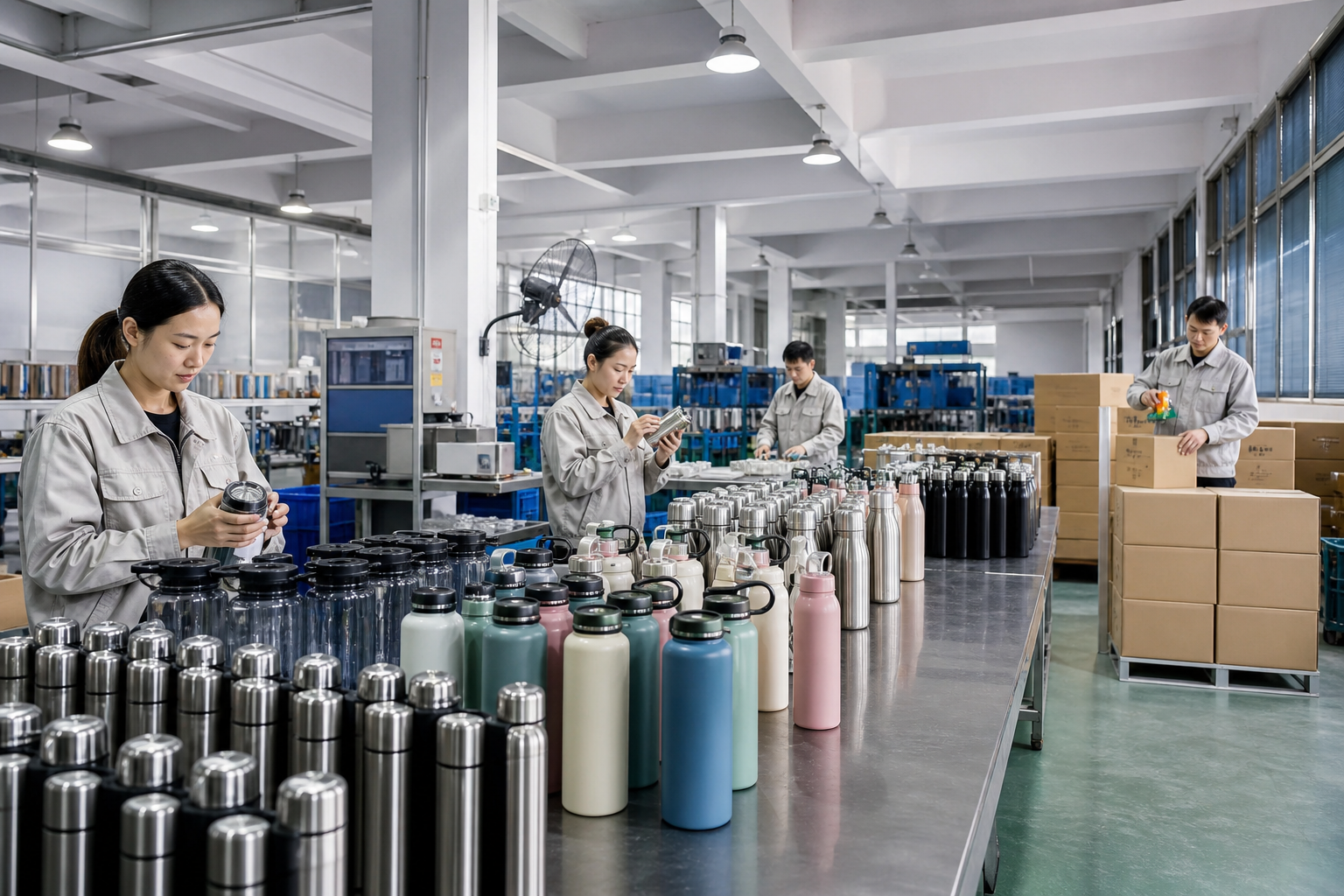
For buyers in Europe and North America, the safer path is to think like a sourcing engineer. You need the right material, the right test reports, the right Incoterm, and a supplier that can repeat quality at scale. At BottleForge in Zhejiang, China, we run production above 400,000 units per month across multiple drinkware lines, with standard MOQ starting at 3,000 pieces for most custom models and 25-35 days lead time after sample approval. QC pulled the sample, checked the lid torque at 0.8 N·m, and sent back a clean report. That is the level of planning you should expect from a real factory in China, not a trading guess.
Start with the right bottle category
Start by sorting the bottle by use case, not by shape. A how to import thermos search usually points to vacuum insulation, hot-hold numbers, and a lid that still works after 5,000 opens. A how to import water bottle or how to import reusable water bottle request usually means light weight, lower unit cost, and retail volume. For premium hydration, a how to import stainless steel bottle job is a different animal: the inner liner, outer shell, and vacuum seal all get checked. QC pulled the sample at 24 hours if the vacuum drop looked off.
Here is the split we run in Zhejiang, China:
- Stainless steel vacuum products: thermos, vacuum flask, thermal bottle, insulated water bottle, double wall bottle, double walled bottle.
- Plastic formats: tritan bottle, tritan water bottle, polypropylene bottle, BPA-free water bottle, plastic water bottle.
- Glass formats: glass water bottle for premium retail or wellness channels.
- Specialty vessels: growler, canteen, refillable water bottle, drink bottle, thermos bottle, thermos flask.
If you mix those categories in one RFQ, the quote comes back messy and the pricing is usually too rosy. The buyer flagged one PO last month because the carton spec said 24 pcs, then the packing list showed 20 pcs. Send separate specs for capacity, material, lid type, decoration, and carton pack. That cuts sampling back-and-forth by 30% on our line.
Know the compliance rules early
The fastest way to lose time is finding a compliance problem after the sample is signed off. For Europe, ask for REACH, LFGB where food contact applies, and a declaration of conformity for the exact material and ink system used. For the US, ask for FDA food-contact statements and, when you need performance claims, test data matched to ASTM methods or a comparable lab standard. If the item is for children, lock in age grading, leakage testing, and the market warnings before we run production.
Material choice changes the test burden. A how to import tritan bottle or how to import tritan water bottle job usually needs BPA-free declarations and migration reports. A how to import glass water bottle order needs glass strength and thermal shock checks. A how to import vacuum insulated bottle, how to import vacuum bottle, or how to import vacuum flask line should include vacuum retention and temperature-hold testing; we’ve seen buyers try to skip that and the math does not work. “Food grade” is too loose to buy on its own.
Ask for the test report number, the sample reference, and the exact product configuration. A report for a 350 ml matte bottle does not cover a 750 ml glossy one. QC pulled that mistake on a PO before—same shape, wrong lid code.
Good factories in China already keep material traceability and batch records on the line. If a supplier cannot name the resin, steel grade, or coating system, stop there. You are not ready to order, and I would push back hard on that supplier. One missing lot code can turn a clean shipment into a 12-day delay instead of 18 days on a re-test.
Build a quote the factory can price
A usable RFQ is not a brochure request. It is a build sheet. Put the capacity in ml or oz, product dimensions, target wall thickness, steel gauge if relevant, finish, logo method, lid color, and pack requirement. For a how to import stainless steel water bottle spec, tell us whether the body is 0.4 mm or 0.5 mm 304 stainless, whether the inner liner is brushed or polished, and whether you want powder coat, spray paint, or bare metal. QC pulled the sample last week and found a 1.2 mm gap at the lid seat because the buyer left out the wall thickness.
When buyers ask how to import water bottles at a good landed cost, the quote structure matters more than the unit price. I would split it like this:
- Unit price at FOB Ningbo or FOB Shanghai
- Sample cost and sample lead time
- Custom logo fee or plate fee
- Packaging cost: color box, white box, mailer, or gift tube
- Carton spec and drop-test requirement
We shipped a 500 ml bottle on a 3,000 pcs order at USD 2.10-3.80 FOB, and a premium vacuum insulated bottle with a more complex finish landed at USD 4.20-7.50 FOB. Tritan is cheaper to build, but tooling, lid complexity, and print coverage still push the number up. The buyer once sent a PO that said “gift box” and nothing else, and the line stopped for half a day. If the quote looks too simple, it is missing something.
Choose the right manufacturing route
There are three routes we run for drinkware imports from China. Stock model with logo. Modified stock with a different lid, coating, or package. Full custom tooling. Each one carries a different risk profile. If you only need a 90-day seasonal promo, stock plus logo gets the job done. If you are building a private label line for 2-3 years, you need shape control, lid tooling, and packaging that matches the brand on the carton and the shrink wrap.
For a how to import canteen or how to import growler project, the geometry matters more than logo placement. We had a buyer flag a growler because the carry handle flexed after 20 cycles in our bench test. That is the wrong question to ask if you only look at print files. A brewery retail growler may need thicker walls, pressure-aware cap design, and a handle that still feels solid after 20 drops from 1.2 m. A canteen often needs a tougher coating and better dent resistance. A how to import thermos bottle job also needs stopper design, pour speed, and cleaning access. The lid causes more complaints than the bottle body. QC pulled the sample on a leak test, and the failure was at the cap seal, not the shell.
Tooling is the gatekeeper. Some custom shapes need USD 2,500-8,000 in tooling and 30-45 days before first samples. On the line, we check whether the molds are in-house, whether they are aluminum prototype molds or production steel molds, and how many cycles the tool is rated for. A factory that can answer that cleanly usually also knows the print area limits and where the vacuum seam will land. If the supplier dodges that question, the math does not work.
Control quality before shipment
Do not let imported drinkware leave on trust. Set the inspection plan before production starts. For a normal order, we run AQL 2.5 for major defects and AQL 4.0 for minor defects, plus separate checks for leakage, finish, capacity, print position, carton strength, and accessory count. If your item is a how to import refillable water bottle or how to import insulated water bottle for retail, add scratch tolerance and label accuracy as fixed checkpoints. We once caught a PO typo on label height, 180 mm versus 108 mm, and the buyer still wanted to ship. No chance.
For vacuum products, a visual check is not enough. Ask for:
- Vacuum retention test
- 24-hour leak test
- Hot/cold holding test
- Drop test for carton and product
- Odor check for lids and gaskets
We see buyers assume every supplier in China runs the same line. That is the wrong question to ask. A factory with written QC, line inspectors, and batch traceability is not the same as a reseller shifting cartons between subcontractors. On our line, QC pulled the sample by lot number and matched it to the pressure test sheet. In Zhejiang, the better factories will show QC records by lot; if they refuse, treat that as a red flag, not a small inconvenience.
For higher-risk retail programs, bring in third-party inspection before balance payment. A 1,000-piece inspection usually costs less than one port-side dispute, and we have seen that math work every time.
Plan freight, customs, and landed cost
Most first-time buyers stare at the FOB price and stop there. Bad move. We run the numbers from factory gate to your warehouse: inland trucking in China, export docs, ocean or air freight, customs clearance, import duty, port fees, local trucking, and any FBA or retail labeling. For Amazon-bound cartons, the carton label and FNSKU placement need to be locked before packing; after arrival is too late, and QC pulled a sample once because the PO typo showed “FNSKU” on the wrong side.
A 20-foot container usually makes sense once the order moves past a small test buy, while an LCL shipment works for a 300-500 carton trial. Drinkware is dense and cracks if the outer box is weak, so pallet height, 5-layer carton strength, and stack load matter. The math does not work if you only look at USD 3.20 FOB and ignore the rest; we have seen it land at USD 5.90-7.20 after freight, duty, and last-mile charges. If you are importing how to import plastic water bottle or how to import polypropylene bottle lines in volume, freight per unit drops, but only when the case pack is tight and the master carton is efficient.
Ask the supplier to quote both FOB and EXW, then request carton dimensions in the first offer. No carton size, no real freight quote. A tape measure on the packing line gives you better planning than a polished sales email. Once you have the 60 x 40 x 35 cm carton size and gross weight, you can forecast landed margin before you send the deposit.
Use samples to de-risk the order
Sampling is not a courtesy. It is cheap insurance. For a how to import drink bottle or how to import double wall bottle project, we ask for one functional sample and one pre-production sample if the finish or logo is tricky. The first one proves the tooling and lid structure work. The second shows whether the line can repeat it at scale. We ship a lot of this from Hangzhou, and that split has saved buyers from 3,000-piece headaches more than once.
During sample approval, check these points closely. QC pulled the sample on our bench with a torque wrench at 0.8 N·m, and that is where the weak parts show up:
- Lid alignment and torque
- Silicone ring fit and odor
- Logo color under daylight and artificial light
- Surface scratches after basic rub testing
- Weight consistency across 3-5 samples
If you are building a how to import double walled bottle or how to import thermal bottle line, measure real capacity and empty weight, not the catalog number. We have seen a 500 ml bottle land at 470 ml because the inner wall takes space. That is not a defect if you disclose it. The buyer flagged it after the carton art already said 500 ml, and the math did not work.
The clean sample process ends with a signed spec sheet, not a loose email thread. Once production starts in Zhejiang, China, any change needs written approval. We keep the PO file tight on purpose. One typo on a lid code can stall the line for 12 days instead of 2.
Send your bottle spec for a factory quote
We can review material, MOQ, compliance, and FOB pricing in 24 hours from Zhejiang, China. You get a realistic plan, not a sales script.
Frequently asked questions
What MOQ should I expect when I import drinkware from China?
For most custom drinkware, expect 3,000 pcs MOQ per model or color. Simple logo-on-stock items can start at 500-1,000 pcs, but tooling changes and special lids usually push the MOQ higher. In Zhejiang, China, many factories price better at 5,000 pcs because packaging and line setup are more efficient. If you need multiple colors, ask whether MOQ is per color or per total order. That detail can change the quote by 12-20%.
How do I choose between FOB, EXW, and DDP?
FOB works best for experienced importers who already have a freight forwarder. EXW gives you the factory price only, but you handle pickup and export steps. DDP can be convenient for small test orders, yet the hidden margin is often higher and not always transparent. For drinkware from China, FOB Ningbo or FOB Shanghai is the most common starting point. Always compare landed cost, not just the incoterm headline.
Do I need food-contact test reports for every drinkware order?
Yes, if you sell into the EU or US, you should request the relevant reports for the exact product configuration. A stainless bottle may need REACH and food-contact declarations; a tritan bottle needs BPA-free and migration data; a glass bottle may need material and thermal-shock support. A report for one finish or lid type does not automatically cover another. Ask for the sample code and test date so you know the report matches your order.
What is a realistic lead time for custom bottles?
Standard custom drinkware usually takes 25-35 days after sample approval and deposit. If you need new tooling, add 30-45 days before production samples. Peak season in China can extend this by 1-2 weeks, especially before Q4 retail shipments. If you are importing vacuum bottles or complex lid systems, build buffer time into your schedule because vacuum formation, packing, and inspection take longer than basic plastic bottles.
How can I reduce defect risk before shipment?
Use a signed spec sheet, a pre-production sample, and an inspection standard before mass production begins. We recommend AQL 2.5 for major defects and 4.0 for minor defects. Add leakage testing, carton drop tests, and logo placement checks. For retail programs, third-party inspection is worth the fee. A 1,000-piece order can be damaged by a small lid leak, so a few hundred dollars on inspection is usually cheap protection.