Key Takeaways
- Most kids drink bottle wholesale programs start at 3,000-5,000 pcs per SKU, with printed logo orders often at 1,000 pcs.
- A reliable kids drink bottle factory in China should quote 30-45 days for production after sample approval, not vague promises.
- For North America and Europe, ask for REACH, LFGB, FDA-related material declarations, and AQL 2.5 inspection terms.
- Kids bottle pricing can swing from USD 1.20 to USD 4.80 per piece depending on material, lid type, and decoration.
Buy kids drink bottle wholesale, and you are buying more than a cup with a cap. The bottle has to take a drop test, pass safety paperwork, and still look clean in a school catalog or on a retail shelf. For Europe and North America, we usually start with material spec, lab reports, and lid structure; a 1 mm mismatch on the cap thread can turn into a leak claim fast. We’ve seen that go sideways.
The first trap is a supplier list or directory with 30 factories all saying the same thing. The math does not work until you check the numbers: 5,000-piece MOQ, 30-45 day lead time, 100,000 units per month, and whether the kids drink bottle manufacturer can show REACH, LFGB, or FDA-related test support. On our line in Zhejiang, QC pulled the sample after a buyer flagged a typo on the PO, and that order still moved because the factory could ship 12 days faster than the other quote. That is the real split.
What wholesale buyers really need
When you buy kids drink bottle wholesale, you are solving three jobs at once: margin, safety, and stock planning. A chain buyer may need 2,000 units for a back-to-school run; a brand owner may book 20,000 pieces for private label retail. Different volumes, same math. You need a kids drink bottle factory direct source that can hold spec on repeat orders and still tweak the lid or print without turning it into a new project. We run that line every week, and QC pulled the sample at 3 points on the cap thread before release.
Do not treat every kids drink bottle supplier as the same. They are not. One Zhejiang factory may cap out at 50,000 units a month and only do stock items; another in China may push 100,000+ units monthly and handle kids drink bottle custom work, from body color to sleeves and pack-out. If you want kids drink bottle in bulk, ask about age grading, leak test results, and whether the body is PP, Tritan, stainless steel, or glass with a silicone sleeve. For school accounts and promo programs, the spec sheet beats the catalog photo every time. The buyer flagged one PO because the lid was typed as “bluee” instead of blue.
Practical buying rule:
- Simple stock bottle: 1,000-2,000 pcs, and you can ship fast
- Custom color or logo: 3,000 pcs typical, with one print plate per design
- Full kids drink bottle private label: 5,000 pcs and up, with carton art and barcode work
- New mold or unique lid: budget USD 8,000-20,000 tooling, because the steel and trial shots add up
Materials and safety standards
For a kids bottle, material choice is not branding trivia. It changes weight, impact resistance, odor retention, and how the bottle holds up after 50 dishwasher cycles. A kids drink bottle manufacturer should tell you the exact resin or metal gauge, not stop at “BPA free.” On our line, PP and Tritan are common for plastic bodies; for metal, 18/8 stainless steel with 0.4 mm to 0.5 mm wall thickness is the normal export spec. If the bottle is insulated, check the vacuum gap and the powder coat. We run abrasion tests at 100+ cycles, and weak coating shows up fast.
For Europe and North America, ask for the compliance file before you approve artwork. That file should include material declarations, migration test support, and the third-party reports your buyer will ask for. We ship into these markets all the time, and the usual file set includes REACH for Europe, LFGB for kitchen-contact confidence, and documents that support FDA-related market entry in the US. If the kids drink bottle supplier cannot send those papers quickly, you are looking at a trading layer, not a dependable kids drink bottle factory. We’ve seen buyers wait 12 days for a file from one source and get it in 2 days from the factory. The math doesn’t work.
Important points to check:
- Lid seal: silicone ring, not loose TPE copy parts
- Straw parts: food-contact grade and removable for cleaning
- Drop test: 1.0 m to 1.2 m on hard surface
- Temperature tolerance: 0°C to 100°C depending on material
Do not buy a child’s bottle on photo approval alone. Ask for material and test documents first, then review decoration samples. QC pulled one sample last week and found a 0.3 mm seal gap at the cap, which is the kind of thing the buyer flags after shipment if you skip this step.
MOQ, pricing, and lead times
Buyers often ask for a kids drink bottle wholesale bulk price before they lock the model, material, or print method. That order is backwards. We quoted a school bottle job last month after the buyer sent only “350ml?” on the PO, and the math did not work until we nailed down size, lid style, logo method, and packaging. For a basic 350-500 ml plastic kids bottle, China export pricing often sits around USD 1.20-2.10 ex-works at 5,000 pcs. A stainless insulated version with better lid hardware can run USD 3.20-4.80. Add a molded logo, custom packaging, and individual insert cards, and the number moves fast.
Lead time matters just as much as unit price. A solid kids drink bottle vendor should give you samples in 5-10 days and mass production in 30-45 days after approval. If the order needs a new mold or a special cap, add 20-35 days for tooling and testing. On our line, we keep decoration and packing in separate areas, so mixed SKUs do not choke the schedule. QC pulled the sample and found a 1.2 mm lid gap on one cap, which is the kind of thing that saves a buyer from a bad first shipment. That is why serious buyers stick with a kids drink bottle distributor or factory that can handle OEM and repeat replenishment without changing the production line every week.
What drives the price:
- Material: PP is cheaper than Tritan; stainless steel costs more than plastic
- Decoration: silk screen, pad print, laser engraving, or heat transfer
- Cap complexity: flip lid, straw lid, push-button, carry handle
- Packaging: color box, blister, mailer, or retail sleeve
Ask for FOB Ningbo or FOB Shanghai, not a vague factory price. We see buyers get burned by this all the time. One PO came in with “FOB China” typed in the remarks, and the freight line turned into a mess because nobody knew whether it covered local handling, export docs, or pallet fees. FOB gives you a clean export number from China and exposes any hidden charges.
Customization that actually sells
Many brands ask for kids drink bottle customized or kids drink bottle customizable because they want an exclusive look without paying for a new mold. That works if the spec is set up right. We usually run a standard bottle body with custom color, logo, strap, and packaging. On our line, that gives a real kids drink bottle with custom logo program at a sensible MOQ, often 3,000-5,000 pcs. For kids drink bottle private labeling, we add branded boxes, instruction leaflets, and barcode labels for retail or Amazon-style channels. The buyer flagged a PO typo on barcode size last month, so we checked the carton file before printing. Simple fix. Better result.
For promotional buyers, a kids drink bottle promotional item should be durable first and branded second. A cheap print that scratches off in 2 weeks hurts your customer more than a plain bottle. Screen print works for one or two colors. Laser engraving stays clean on stainless steel because it does not peel. Full-wrap UV print looks good, but it still has to pass abrasion and dishwasher checks. QC pulled the sample after the 50-cycle wash test and the edge lift showed up on the first round, so we killed that artwork. A good kids drink bottle oem manufacturer will say when the layout is too crowded for the surface and push for a cleaner panel. That is the right call.
Use this hierarchy when deciding customization:
- Low risk: color, logo, packaging
- Medium risk: lid shape, handle, straw length
- High risk: new mold, special insulation structure, unique locking mechanism
If you are a distributor, keep one standard line and one premium line. We ship that way all the time. It gives you a clean kids drink bottle buy in bulk plan without turning inventory into a mess. One 350 ml entry model, one 500 ml upgraded model, and your stock math stays sane. We've seen the wrong question asked here: chasing 6 custom SKUs instead of moving volume on 2.
How to vet factories in China
If you are comparing kids drink bottle manufacturers, do not stop at photos and WeChat posts. Ask for factory size, monthly output, QC flow, and whether the plant is a real kids drink bottle factory or a trading company posing as one. A serious supplier in Zhejiang should explain, in plain language, how they control injection molding, leak testing, assembly, and packing. We once checked a line where the buyer flagged a 1.5 mm cap gap on the first sample, and the whole order was saved because the factory could trace the mold cavity. You want a partner who can move from sample to repeat order without drifting off spec.
Here is what a practical audit looks like:
- Factory output: 80,000-120,000 units/month for established lines
- QC standard: AQL 2.5 for major defects, AQL 4.0 for minor defects
- Documentation: BSCI, ISO 9001, REACH support, test reports by SKU
- Sample approval: written sign-off on color, print, and dimensions
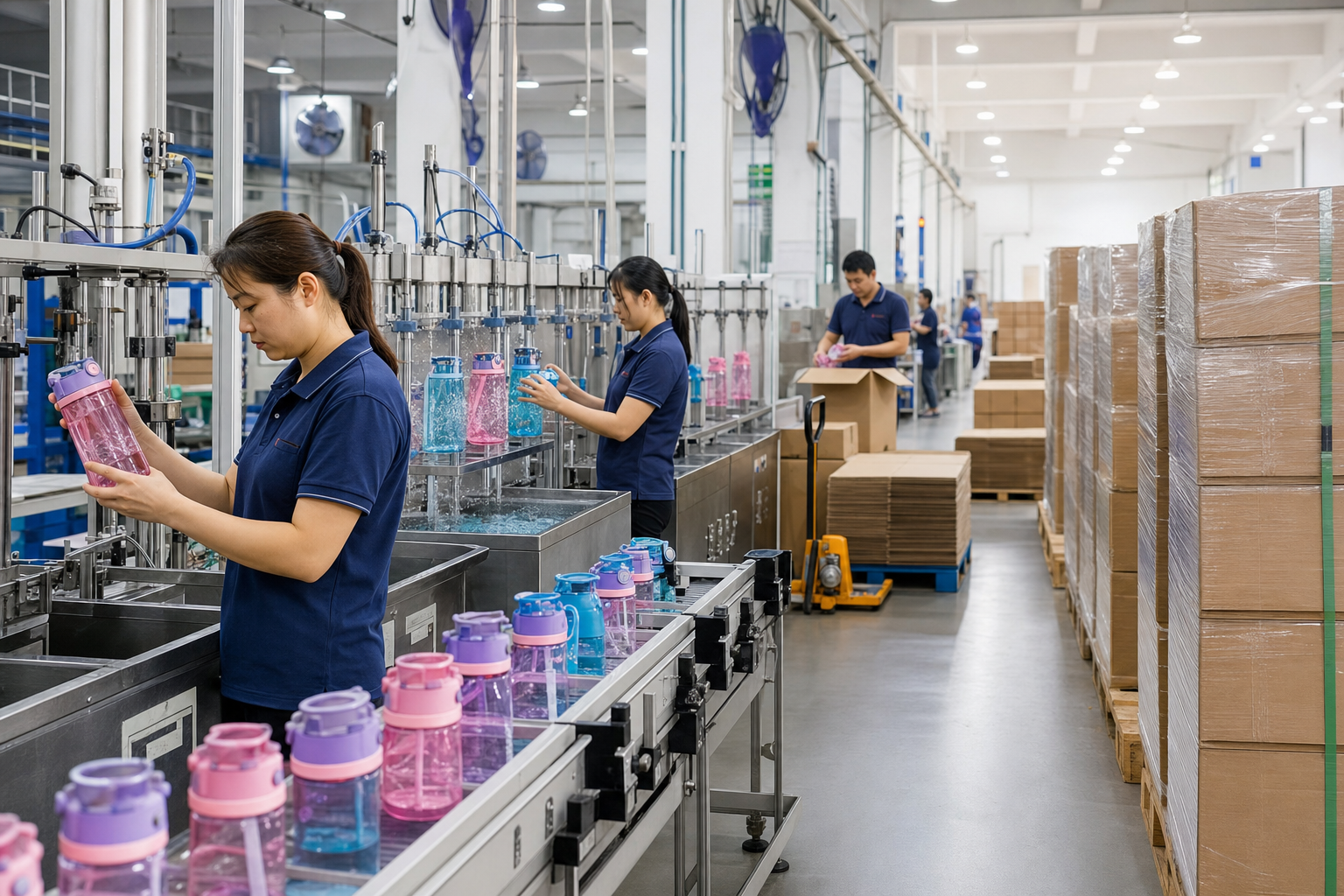
Ask for live photos of the production floor, not catalog renders. If the kids drink bottle vendor can show mold maintenance records, leak test rigs, and the final inspection table, that is a good sign. We run a 24-hour water-hold check on the line for leak-prone lids, and that catches problems fast. If they cannot answer basic questions about packaging dimensions or export cartons, keep searching. This is the wrong question to ask if you only want the lowest quote; the math does not work. In China, the gap between a strong exporter and a weak middleman shows up once you ask for operational detail, and good Zhejiang factories answer with numbers, not slogans.
Ask for a pre-production sample and a golden sample. Without both, any later dispute about print placement or cap color gets expensive. We had a PO last month with “blue” typed where the buyer meant “navy,” and QC pulled the sample before it hit packing. A 0.3 mm print shift sounds small until 20,000 bottles are in cartons. Get both samples signed off, or you will be chasing fixes after shipment.
Ordering for retail, schools, and promotions
Different channels buy for different reasons. A retailer wants shelf appeal and barcode-ready packaging. A school distributor cares about safe lids, easy cleaning, and colors that look age-appropriate, not babyish. A corporate buyer wants a kids drink bottle promotional item that lands inside budget and still feels good enough to hand out at a trade show. Define the channel before you lock the spec. We had one PO come in with the wrong cap color because the buyer mixed retail and school requirements, and the line had to stop for a recheck.
For retail, the usual kids drink bottle custom made setup is a standard mold, a branded insert card, and a printed carton. For schools, we run one-piece caps, wide mouths, and parts that come apart fast for washing. For promotions, a single-color print on a clean bottle often sells better than a busy full-color layout. The buyer cares about use, not factory terms. QC pulled a sample with a 2 mm scratch on the lid ring, and that is the sort of thing a retail account will flag in 10 minutes.
If you are building a catalog for a kids drink bottle distributor network, keep the tiers simple:
- Entry: 350 ml plastic, basic print, MOQ 3,000 pcs
- Mid: 500 ml Tritan or insulated stainless steel, MOQ 3,000-5,000 pcs
- Premium: custom lid, retail box, private label, MOQ 5,000 pcs
That structure keeps replenishment clean and keeps your kids drink bottle wholesale program on track. It also gives you a fair way to compare a kids drink bottle supplier in China with a factory-direct quote, not a reseller mark-up. If you want the program to scale, pick a plant that can hold reorder consistency on the same 3,000 pcs batch, not just one cheap first order. We have seen that go sideways when a PO typo changed “blue” to “blule” and nobody caught it before print.
Request factory-direct kids bottle pricing today
Send your target size, logo method, and annual volume. We will quote MOQ, FOB price, and lead time from Zhejiang in one reply.
Frequently asked questions
What is the usual MOQ for kids drink bottle wholesale?
For most export programs, MOQ starts at 3,000-5,000 pcs per design if you want custom color or logo. Simple stock bottles can sometimes start at 1,000-2,000 pcs, but that depends on inventory. If you want a full kids drink bottle private label setup with branded cartons and inserts, plan on 5,000 pcs or more. New molds usually require much higher commitment, often with tooling fees of USD 8,000-20,000 depending on complexity.
How much does a custom kids drink bottle cost from China?
A basic plastic kids drink bottle may cost USD 1.20-2.10 FOB at 5,000 pcs. A Tritan version often lands around USD 1.80-3.20. A stainless insulated bottle can reach USD 3.20-4.80 or more, depending on lid hardware and decoration. In China, the final price changes with material, logo method, packaging, and carton count. If a quote is far below market, check whether it excludes packing, testing, or export cartons.
What documents should a kids drink bottle manufacturer provide?
Ask for material declarations, relevant test reports, and compliance support such as REACH for Europe and LFGB-style food-contact confidence. For US buyers, many customers request documentation that supports FDA market entry. You should also ask for a factory profile, BSCI or ISO 9001 if available, and a written QC standard. If the supplier cannot give SKU-level paperwork, they are not ready for serious wholesale orders.
How long does production take for custom kids drink bottle orders?
Sample lead time is usually 5-10 days for standard modifications. Mass production is commonly 30-45 days after sample approval. If you need a new mold, complex lid, or special decoration, add 20-35 days for tooling and validation. A well-run kids drink bottle factory in Zhejiang should tell you the timeline clearly and stick to it. If they avoid giving dates, expect delays later.
How do I choose between private label and promotional bottles?
Private label works best when you need a long-term retail program, consistent replenishment, and brand control. Promotional bottles are better when price is the main driver and the product will be handed out or bundled. For private label, use a stronger bottle platform, better packaging, and a lower scratch print method. For promotional orders, a simple logo on a durable stock model often gives the best value. The right choice depends on whether you are building a margin product or a marketing giveaway.