Key Takeaways
- For kids water bottle wholesale, expect MOQ from 3,000 pieces and 25-35 day lead times on standard SKUs.
- Tritan and 304 stainless steel are the two most practical materials for school and retail programs.
- A proper kids water bottle custom order should include leak testing, drop testing, and AQL 2.5/4.0 inspection.
- FOB Zhejiang pricing for basic kids bottles often starts around USD 1.15-2.80 depending on material, lid, and print.
If you buy kids water bottle wholesale for schools, gift programs, retail, or Amazon, the hard part is not finding a pretty bottle. The hard part is getting a bottle that passes compliance, survives daily use, and still leaves margin after freight, duty, and packaging. We’ve seen buyers sign off on a cute sample, then the buyer flagged leaking lids or missing test reports 3 months later. That gets expensive fast.
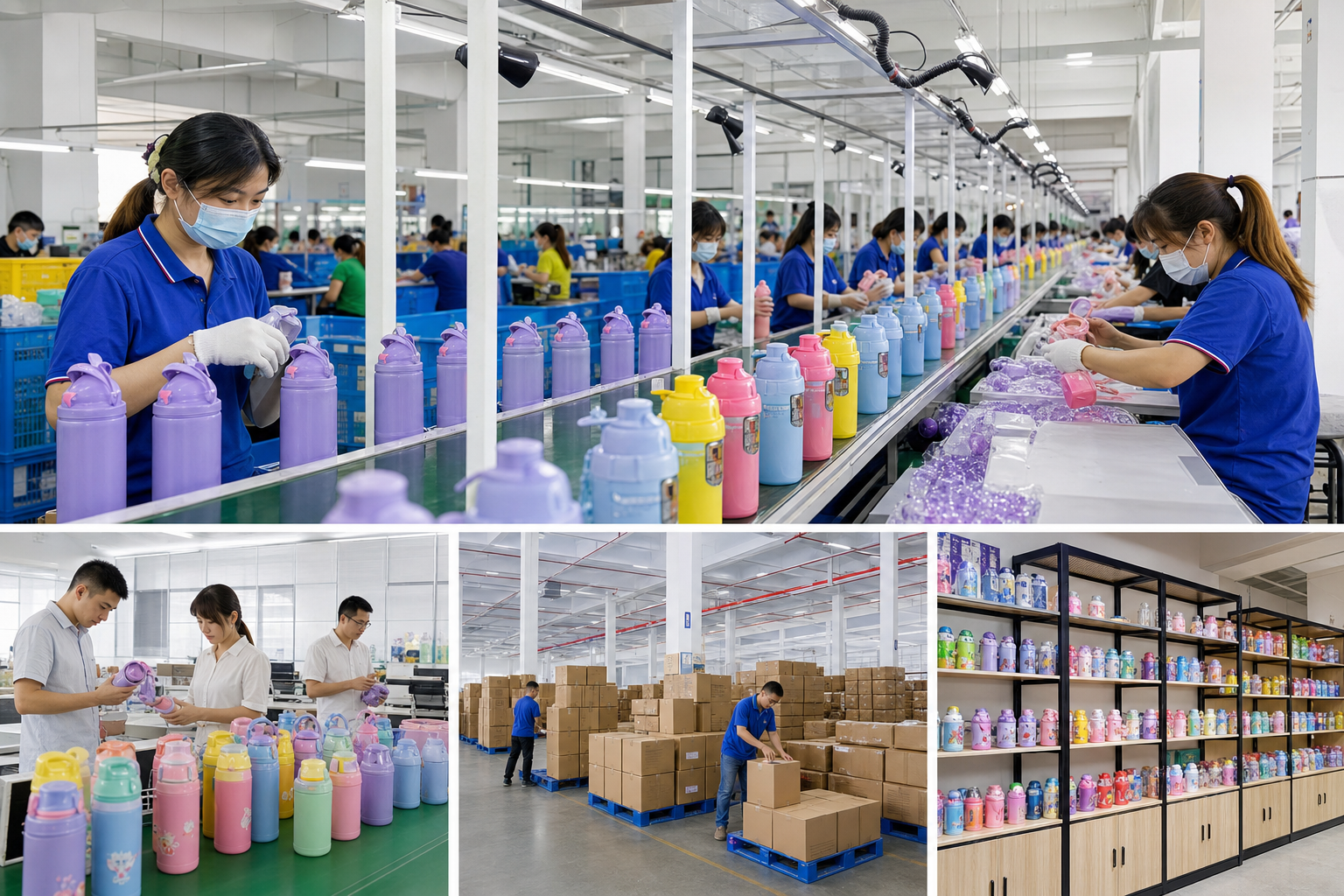
Treat kids water bottle bulk sourcing like a technical purchase, not a catalog order. A decent kids water bottle manufacturer will talk about materials, lid torque, drop tests, BSCI, REACH, and FDA-related documentation before they talk about print colors. At our Zhejiang factory, we run over 300,000 units per month, with MOQ starting at 3,000 pieces on standard models and typical production lead time of 25-35 days after sample approval. The line knows the difference between a 1.2mm seal and a 0.8mm seal, and that detail is where the math works or breaks.
What buyers should source first
Before you ask a kids water bottle supplier for a quote, pin down the use case. A school district buys one way. A retail importer buys another. For schools, we run low weight, easy washing, and a lid a child can open with one hand. For retail, shelf appeal matters, the carton has to survive Amazon drops, and you need enough print area for a kids water bottle with custom logo program.
Start with material and capacity first. For younger children, 350 ml to 500 ml is common. For older kids, 600 ml to 750 ml fits better. If you want kids water bottle wholesale bulk for school fundraising or promo use, skip the fancy lid stack. Every extra hinge or straw part adds breakage, and QC pulled the sample apart twice on a 1,000-cycle test when the buyer flagged a leak complaint.
Ask your kids water bottle manufacturer for these five basics first:
- Material: Tritan, PP, PC-free, 304 stainless steel, or glass with sleeve
- Capacity: 350 ml, 500 ml, 600 ml, or 750 ml
- Cap type: flip top, straw lid, push-button, or screw lid
- Decoration: screen print, heat transfer, laser, or full-color wrap
- Compliance file: REACH, LFGB if needed, FDA-related declarations, and test reports
Skip this step and you end up comparing kids water bottle vendors on the wrong spec. A low quote does not help if the bottle weighs 420 g and a first grader drops it on day one, or if the lid starts leaking after 50 openings. We saw a PO last month with “3500 ml” typed by mistake; the math does not work, and the line stopped for a half day while we rechecked the carton mark.
Materials that actually hold up
For custom kids water bottle programs, material choice decides the job from day one. Tritan sells well in Europe and North America because it stays clear, stays light, and gives a premium plastic look without the breakage risk of glass. We usually see 2.0-2.5 mm wall thickness on Tritan bodies; that extra meat makes a difference when a bottle gets dropped off a desk or kicked across the classroom. On 304 double-wall stainless steel, watch the weight. A 400 ml bottle can run 180-260 g before packaging, and that is the number the buyer flags once samples land in hand.
Here is the practical view from a kids water bottle factory in China. QC pulled the sample on the line, and this is what holds up:
- Tritan: clean look, good for kids water bottle private label, usually FOB USD 1.35-2.40 at volume
- PP: lowest cost, often USD 0.65-1.20, but it scratches faster and the finish looks basic
- 304 stainless steel: durable, better for insulation, usually USD 2.10-4.80 depending on construction
- Glass: niche for older children, needs a sleeve and stronger cartons; one broken neck can ruin a carton audit
Do not let a kids water bottle supplier sell you on body material alone. Lid quality matters just as much. A good bottle with a weak seal is still a bad product, and we have seen that go sideways on the first leak test. In Zhejiang, first-time buyers often spend all their time on print and miss the gasket spec. Use food-grade silicone, confirm hardness around 50-60 Shore A, and ask for a leak test after thermal cycling if the bottle is insulated. The math does not work any other way.
For school programs, a lighter bottle with a reliable straw lid usually sells better than a heavy “premium” design that children refuse to carry.
OEM and private label basics
If you want a kids water bottle custom made instead of pulling from stock, start with a kids water bottle OEM manufacturer. OEM is not just a logo hit. We run orders where the lid shape changes, Pantone color match is checked against a swatch card, strap length is cut to spec, and the carton gets a school name molded or printed on it. A real kids water bottle custom order should let you control artwork, carton spec, and barcode labeling for retail or distribution.
Kids water bottle private label programs usually sit in the sweet spot for distributors and brand owners. You skip a full new mold unless the design truly needs one, but you still get a bottle that does not look like every other SKU on the shelf. On one line, we shipped a standard bottle body with a custom lid color, logo, and printed measurement scale; the buyer flagged it as a stock item at first, then asked for the MOQ, because the finish looked new enough for retail without extra tooling.
Typical tooling ranges you should expect in China and Zhejiang:
- Silicone color change or standard cap customization: USD 0-300
- New print plate or laser setup: USD 30-120
- New lid mold: USD 3,000-12,000 depending on complexity
- New bottle mold: USD 6,000-25,000
Ask the kids water bottle factory direct what part is stock and what part is custom. That one question saves weeks. We had a PO typo once where the buyer wrote “blue” in the artwork note and “green” in the carton label, and QC pulled the sample before packing started. A decent kids water bottle vendor should tell you if the order is fully customizable, semi-custom, or only decorative. If they cannot split that out, they are probably reselling, not making.
Compliance for schools and imports
School district buyers and importers should check compliance first. For Europe, REACH and LFGB food contact rules are the usual checkpoints. For North America, we ask for supplier declarations, material traceability, and packaging and labeling that do not create problems downstream. If the bottle uses stainless steel, request 304 material certificates and confirm there is no lead-based solder in any hidden joint. QC pulled a sample with a flashlight and mirror at the weld seam on one order; that kind of detail catches trouble early.
For kids water bottle wholesale, a proper quality plan should include:
- AQL inspection: commonly AQL 2.5 for major defects and 4.0 for minor defects
- Leak test: inverted, shake, and pressure test where relevant
- Drop test: 1 meter or 1.2 meters depending on age group and packaging
- Dishwasher cycle check if the product is marketed as dishwasher safe
- Odor and staining review after first wash and after 24-hour water hold
Do not mix up a supplier directory with proof of capability. A kids water bottle supplier list gives names; it does not tell you if the line can pass inspection. You want a kids water bottle distributor or factory that can send test reports, carton test data, and production photos from Zhejiang or another China plant. We ship plenty of samples, and the buyer flagged one quote because the PO said "dishwaher safe" while the carton art said hand wash only. If the price looks too low, ask which standard they tested to and who issued the report. No answer, no deal.
For school buyers, I would also push for a written 90-day warranty on lid function from receipt. It is a small clause, but it keeps the factory honest and cuts arguments over shipping damage versus product defect. On one batch, the hinge pin spec was 1.8 mm, not 1.6 mm, and that difference saved us from a return pileup after the first month.
Pricing, MOQ, and lead time
Price only makes sense next to MOQ, decoration, and packaging. We see a kids water bottle wholesale quote swing by 40% when the lid changes from a flip top to a straw lid, or when the print moves from one-color silk screen to full wrap UV. For a basic PP bottle with one-color print, FOB Zhejiang usually sits around USD 0.65-1.10 at 5,000 pieces. A Tritan bottle with a straw lid often lands around USD 1.35-2.40. A 304 stainless kids bottle with vacuum insulation can move to USD 2.10-4.80, and that jumps again if you want a gift box instead of a plain brown carton. Last month the buyer flagged a PO typo on the carton count, and the math did not work until we fixed the pack-out.
Lead time is where buyers get caught. A solid kids water bottle factory in China usually sends samples in 5-10 days, then runs mass production in 25-35 days after confirmation. Add 15-35 days for ocean freight, depending on port, season, and destination. If you are buying kids water bottle in bulk for a school year launch, plan on at least 60 days from final sample approval to warehouse arrival. Faster shipping is possible, but only if you pay for air freight or accept a standard design with no custom mold work. QC pulled the sample at 1,000-piece check for a lid seal issue once; that single rework added 4 days on the line.
Use one simple rule: if your target landed cost must stay below USD 3.50, start with a plastic or single-wall design and keep the decoration tight. If your retail price or bid can carry a higher ticket, a stainless bottle or a more customized build can make sense. The wrong question is, “Can we make it fancy?” The right one is, “Will the buyer pay for it?” We’ve seen this go sideways when a school buyer only needed a functional kids water bottle promotional item, but the spec sheet asked for too much and MOQ 3,000 was already tight.
When you compare kids water bottle suppliers, ask for three quotes: EXW, FOB, and DDP if they can ship that way. Then you can compare real landed cost, not just a factory teaser. We run this sheet on every project, because a USD 0.12 gap on EXW can disappear once the carton size jumps from 58 x 42 x 38 cm to 62 x 45 x 41 cm.
Packaging for schools and retail
Packaging is where a lot of kids water bottle wholesale orders go sideways. Schools want bulk cartons they can split by classroom without a knife fight at delivery. Retail buyers want shelf-ready packs or hang tags that look clean and still hold up after 12 days on the line and 18 days on the boat. Amazon sellers push for FNSKU placement, clean barcode scans, and carton sizes that keep dimensional weight down. We had one buyer flag a PO because packaging pushed freight up 12%; the math does not work.
For school supply, we usually run inner polybag plus 24 or 48 pieces per master carton. Simple. For retail, individual color boxes sell better, but ask for carton drop testing and humidity resistance if the route goes by sea. QC pulled the sample and checked the outer carton to 5-ply for a 500 ml plastic bottle; that is usually enough. For heavier stainless sets, move to 7-ply or better, or the corners will crush in transit.
If you are starting a kids water bottle custom program, do not wait until production to approve the pack. Ask for dielines, exact carton dimensions, and barcoding rules at sample stage. We have seen this go sideways when the bottle fits but the pallet ends up 40 mm too tall for the destination warehouse. Get your customs broker, warehouse, and fulfillment team to sign off early, or you will pay for rework.
Practical packaging details that matter:
- Carton compression strength should match the shipping mode
- Plastic handles should not cut into outer cartons
- Instruction leaflets should use simple pictograms, not dense text
- Color boxes should be moisture resistant for ocean freight
How to compare suppliers
Do not judge kids water bottle manufacturers by catalog photos. Ask for a sample set, a production video, and one live reference from a buyer who ships the same kind of order. A school district buyer and a distributor building private label stock need different factory profiles. We ask for bottle weight, lid cycle life, daily output, and the share of orders going to Europe or North America. If they dodge those numbers, the math does not work.
Use this checklist to split a serious kids water bottle vendor from a middleman:
- Factory audit: BSCI, Sedex, or equivalent social compliance
- Export history: at least 2-3 years for your target market
- In-house decoration: screen print, UV print, laser, or heat transfer
- Lab access: leak, drop, and material checks before shipment
- Capacity: enough to handle your peak season without missing vessel dates
Ask where they sit. Zhejiang has a dense drinkware cluster, and that matters because mold shops, print shops, and packaging suppliers are next door. We run into a cracked lid insert on Monday and get a new one cut by Wednesday; a trading-only supplier has to call three cities first. A kids water bottle factory in China inside that cluster usually fixes problems faster than a middleman with no control over the line.
If you source for a school district, tell the factory to label samples by classroom or age band. If you are a distributor, push for market-exclusive colors or mold changes so your kids water bottle private labeling program has real value. We once saw a PO with “blue” typed three different ways, and QC pulled the sample before packing started. The goal is not the cheapest bottle. The goal is a bottle you can reorder without requalification headaches.
Request a factory quote and sample pack
Send your target age group, material, capacity, and logo files. We will quote FOB Zhejiang, confirm MOQ, and prepare compliant samples fast.
Frequently asked questions
What is the usual MOQ for kids water bottle wholesale orders?
For standard kids water bottle wholesale SKUs, MOQ is often 3,000 pieces per color or per design at a real factory in Zhejiang. If you want a custom lid, special Pantone color, or printed logo on multiple sides, MOQ can rise to 5,000 pieces. Stock items may start lower, around 500-1,000 pieces, but those are usually not true private label programs. For school bids, ask for mixed-color cartons if the factory allows it. That can reduce inventory risk without changing the mold.
How much does a custom kids water bottle cost from China?
A basic PP kids bottle can start around USD 0.65-1.10 FOB, while Tritan versions usually run USD 1.35-2.40. If you choose a 304 stainless steel insulated model, expect roughly USD 2.10-4.80 depending on lid and packaging. Custom logo printing often adds USD 0.03-0.18 per piece, and a new mold can add USD 3,000-25,000 upfront. Ocean freight, duty, and carton volume can change your landed cost by another 15-35%.
What compliance documents should I request before ordering?
Ask for material declarations, food-contact test reports, and recent factory audit documents. For Europe, REACH-related confirmations and LFGB testing are commonly requested; for North America, you should still verify material safety, odor, and packaging accuracy. If the bottle includes stainless steel, request 304 material certificates and confirm there is no unsafe soldering. A serious kids water bottle supplier should also show AQL inspection records and photo evidence from mass production, not just pre-production samples.
Is factory direct better than using a kids water bottle distributor?
Factory direct is usually better if you want lower pricing, clearer control over sampling, and faster technical feedback. A kids water bottle factory in China can usually explain mold, lid, and packaging changes directly, which saves time. A distributor can still be useful if you need mixed products, smaller quantities, or local stock. The trade-off is margin and control. If you are doing kids water bottle private label or custom made programs, factory direct is usually the cleaner route.
How long does production and shipping usually take?
For standard kids water bottle custom orders, sample time is usually 5-10 days, then mass production takes 25-35 days after sample approval. Ocean freight to Europe or North America often adds 15-35 days depending on season and destination port. If you are buying kids water bottle wholesale bulk for a school launch or retail season, plan on 60 days total from final sample to warehouse arrival. If you need a faster timeline, choose stock molds and simple decoration to avoid delays.