Key Takeaways
- Typical MOQ for lead-free glass double wall bottle bulk orders starts at 3,000 units per SKU; custom logos often add 7-12 days.
- FOB China pricing for a 450 ml lead-free glass double wall bottle usually lands around USD 1.20-2.40 depending on cap, print, and packaging.
- Ask for REACH, FDA food-contact, and AQL 2.5 inspection terms; lead-free claims should be backed by material declarations, not marketing text.
- A Zhejiang lead-free glass double wall bottle factory with 200,000 units/month capacity can support private label, OEM, and ODM programs with 25-35 day lead times.
If you are buying a lead-free glass double wall bottle wholesale program, the real risk is not the shape. It is whether the bottle passes chemical safety, survives a 1.2 m drop test, and still leaves margin after decoration and packing. We run this check on the line every week. A good supplier in China will talk about borosilicate content, thermal shock, and cap fit before they show glossy photos.
For Europe and North America, that matters more than ever. Buyers want safer materials, clean paperwork, and fewer claims. A lead-free glass double wall bottle manufacturer in Zhejiang should quote MOQ, show REACH and food-contact documents, and explain why the outer wall thickness, usually 1.2-1.8 mm, changes breakage and yield. QC pulled the sample on one order because the PO typo listed 1.6 mm as 1.0 mm, and the buyer flagged it the same day. If a supplier cannot answer that, the math does not work.
What buyers mean by lead-free
“Lead-free” gets thrown around a lot in drinkware sales, so we pin it down before a PO goes out. For a lead-free glass double wall bottle, the clean definition is simple: the glass body is made without lead oxide in the formula, and the supplier backs that up with a declaration plus test data. We run borosilicate and high-borosilicate on the line in Zhejiang for thermal shock resistance; that is not the same thing as soda-lime glass, and buyers who mix them up end up with the wrong spec.
Ask the lead-free glass double wall bottle supplier for three papers: material specification, food-contact compliance, and a recent third-party test report. For Europe, REACH and LFGB are the usual checkpoints; for North America, buyers ask for FDA food-contact confirmation, and Prop 65 if the bottle will be sold in California. QC pulled the sample on a 520 ml run last month and the buyer flagged a missing batch code on the carton, so yes, traceability matters. If the factory cannot show raw material records, melt logs, and QC records by production run, the math does not work on “lead-free.”
Do not accept “lead-free” as a sales phrase. Treat it like a specification with documents, test method, and batch traceability.
Double wall structure and performance
The double wall structure is why buyers place the order. The inner chamber holds the heat or cold; the outer wall keeps the hand from getting burned or chilled. We ship a lot of 350 ml, 450 ml, and 500 ml bottles, and the 450 ml size usually wins for tea, cold brew, and desk use. A buyer once pushed for 500 ml on a gift set, but the carton math did not work for retail shelf size, so we moved it back to 450 ml and the sample passed the shelf-fit check.
Glass thickness decides how the line runs. A normal spec is 1.5 mm inner wall with 1.2-1.5 mm outer wall, and once a factory goes thinner to shave cost, breakage shows up in packing. We ran 80 cm drop tests on packed cartons and a 120°C to 20°C thermal shock test for hot-fill orders; QC pulled the sample and found two neck chips after the second drop. Ask whether the bottle is hand-blown or machine-formed, because that changes wall consistency, unit price, and how much rework we see on the line.
- Inner capacity tolerance: usually ±5%
- Carton drop test: 80 cm minimum for export cartons
- Thermal shock: confirm actual test range, not a generic promise
- Weight: commonly 230-340 g depending on size
Pricing, MOQ, and lead time
For a lead-free glass double wall bottle bulk order, price comes down to glass shape, lid material, and decoration. A plain 450 ml bottle with a bamboo or PP lid usually starts around USD 1.20-1.60 FOB China at 3,000 units. Add one-color silkscreen, and the number moves to USD 1.45-1.90. If the buyer wants a branded gift box, sleeve, and custom color cap, USD 2.10-2.40 is the planning figure we use on the line. We once had a PO that said “green cap” and the buyer meant Pantone 7724C, so the sample came back wrong. That kind of typo costs time.
Most Zhejiang factories doing lead-free glass double wall bottle wholesale run MOQ at 3,000-5,000 units per design. Change the cap color, print position, or box structure, and QC pulls a fresh sample. Lead time is usually 25-35 days after sample approval and deposit. For repeat orders, some lines can cut that to 18-25 days if the glass tube and lids are already in stock. The wrong question is asking for the fastest ship date first; ask whether the factory truly has 200,000 units/month capacity or is farming out lid assembly. We’ve seen that go sideways more than once.
OEM, ODM, and private label choices
Buyers mix up OEM, ODM, and private label all the time, but the split is simple. OEM means you lock down the bottle shape, logo print, packaging, and test documents. ODM means you pick a stock mold or a standard platform and change the branding. Private label is the factory base item with your logo, your carton, and your SKU code. If you need a quick launch, lead-free glass double wall bottle private label is the low-risk route. If you want a line that looks built for one buyer only, lead-free glass double wall bottle custom or lead-free glass double wall bottle oem is the better call.
A solid lead-free glass double wall bottle manufacturer in China will tell you straight when a custom mold pays back and when it does not. We ran one 500 ml mold quote last month at USD 2,800 for a straight-wall shape and USD 5,900 for a curved shoulder design; the math only works if you move enough volume. A buyer once pushed for a new mold at 1,000 pcs, and we said no. That order would just burn cash. ODM is the middle ground for a lot of distributors. You keep the body structure, then choose the cap, surface finish, paper insert, and carton print. On our line in Zhejiang, we ship both lead-free glass double walled bottle branded and unbranded cartons, so a buyer can test the market before they spend on deeper tooling.
Testing and compliance you should request
If you ship to Europe or North America, compliance is a gate, not a checkbox. Ask for the file pack before you sign off the first run. We usually want product specification, material declaration, third-party test report, and the packing list with carton count and gross weight. One factory in Yiwu sent a PO with “carton quanity” typed wrong, and that typo saved the buyer from a bad shipment count. If the supplier already works with larger retailers, ask for BSCI, ISO 9001, and recent customer audit records.
Set the AQL terms in the PO before the line starts. We run AQL 2.5 for major defects and 4.0 for minor defects on appearance and function. Ask for a pre-shipment inspection on 100% of finished goods for appearance, then random checks for lid seal and bottle neck fit. This is where lead-free glass double wall bottle wholesale orders go sideways: scratches, bubbles in the wall, off-center logos, loose lids, and crushed cartons. QC pulled one sample with a 1.2 mm neck mismatch last month, and the buyer flagged it before loading. China is competitive because plants can scale fast, but only if your QC language is tight. Zhejiang factories that export every week know that; the weak ones wait for the buyer to find the defect at destination.
- Ask for: REACH, FDA food-contact, and any applicable LFGB evidence
- Inspection standard: AQL 2.5 major / 4.0 minor
- Packaging check: 5-layer export carton, drop-tested
- Traceability: batch code on carton and production record
Packaging and shipping basics
Glass breaks fast if the pack is sloppy. For lead-free glass double wall bottle bulk exports, we run each bottle into an inner box or molded pulp tray, then into a 5-layer master carton with gross weight and carton marks printed clear. A 450 ml bottle usually ships 24 pcs per carton, but we change it by bottle height, lid type, and drop-test result. We had one buyer flag a 1 mm loose fit on the rim, and that small gap turned into breakage at the destination warehouse.
For North America, buyers often ask for FNSKU labels, carton labels, and master carton barcodes before the goods leave the factory. That is normal. If you are sending into retail distribution, ask the lead-free glass double walled bottle supplier whether they can do shelf-ready packaging or Amazon-compliant prep; if they dodge that question, the math does not work. FOB Ningbo or Shanghai is common, and we also ship door delivery through a freight forwarder from Zhejiang. A 20-foot container usually takes about 12,000-18,000 units, depending on pack structure, pallet height, and whether the carton is 5-layer or 7-layer. If the supplier cannot quote carton CBM and pallet count on day one, they are not export-ready. On one PO, the buyer wrote "24pcs/ctn" but forgot the divider spec, and QC pulled the sample before loading.
How to choose the right factory
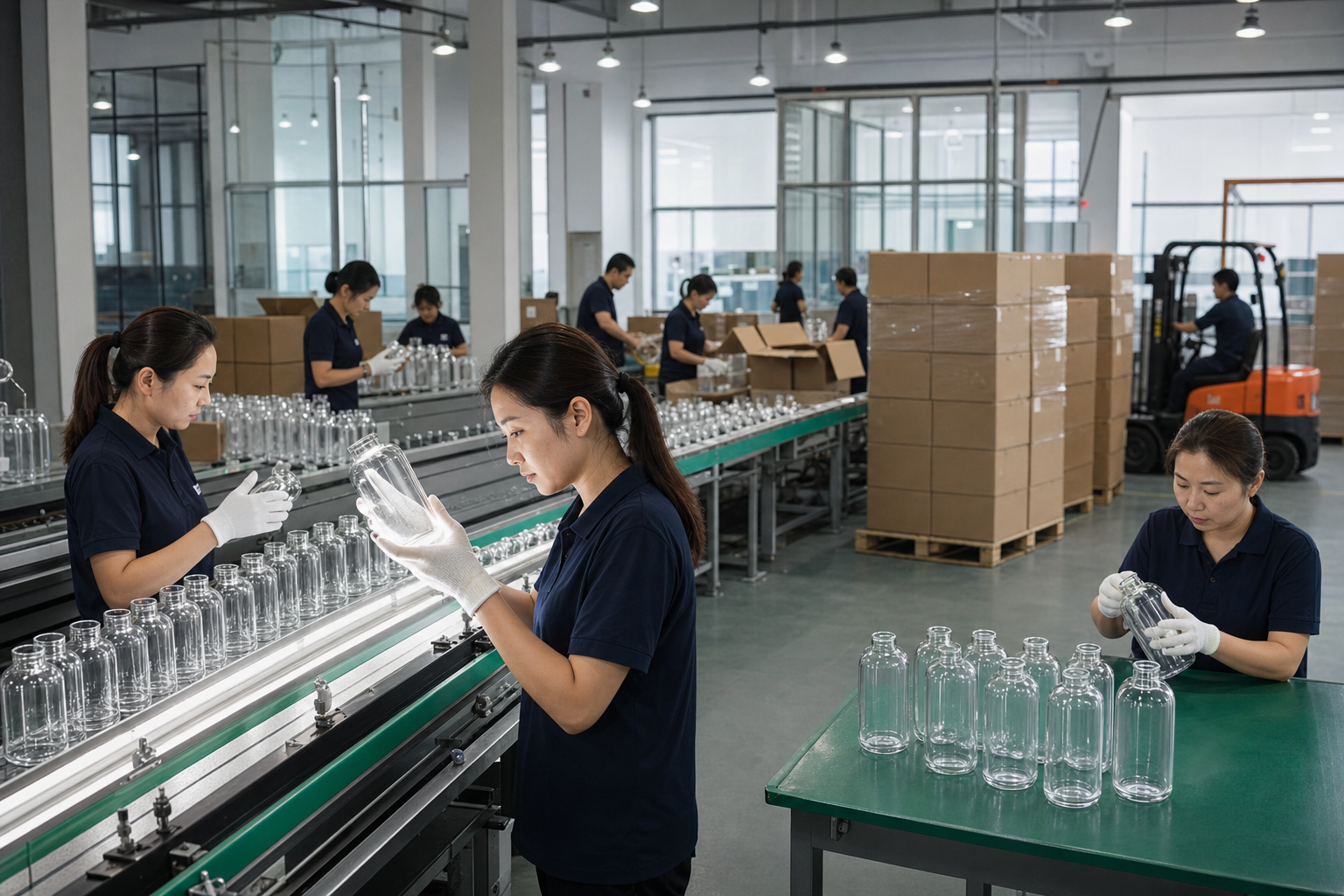
Start with capability, not brochures. A real lead-free glass double wall bottle factory should show production photos, QC checkpoints, and sample-room evidence, not a polished catalog. Ask for monthly output, reject-rate target, and whether they form the glass in-house or buy finished bodies from another shop. We’ve seen buyers get burned when the factory claimed “full line” and then admitted the bodies came from outside. If they say they are a lead-free glass double wall bottle manufacturer but cannot explain the process, that is a red flag.
Compare response quality next. A capable lead-free glass double wall bottle supplier answers with dimensions, weight, MOQ, lead time, and packaging details on the first round, not soft promises. In Zhejiang, the better plants usually quote fast because they already know the mold list, printing limits, and packing options. One buyer once flagged a PO typo on “5000 pcs” versus “500 pcs”; we caught it before the line ran, and that saved a headache. If your sourcing plan depends on speed, choose a factory that can ship samples in 5-7 days and production in 25-35 days. The math works; a 12-day sample delay kills a seasonal launch faster than a bad price.
Request a Zhejiang quote today
Send your target size, logo, MOQ, and destination port. We will quote lead-free glass double wall bottle options with clear FOB pricing and compliance documents.
Frequently asked questions
What is the usual MOQ for a lead-free glass double wall bottle wholesale order?
Most Chinese factories in Zhejiang start at 3,000 units per SKU for a standard lead-free glass double wall bottle wholesale program. If you need a new logo, printed carton, or custom lid, some suppliers will still keep MOQ at 3,000, but others move to 5,000 units. For a completely new mold, the factory may ask for 10,000 units to justify tooling. Always confirm whether MOQ applies per color, per logo, or per total order. That detail changes your landed cost more than people expect.
How much does a lead-free glass double wall bottle cost FOB China?
For a 350-500 ml bottle, a plain lead-free glass double wall bottle usually costs about USD 1.10-1.80 FOB China at 3,000 units. Add one-color print, and the number often rises by USD 0.08-0.20 per piece. A custom box can add USD 0.18-0.45, and a bamboo lid can add another USD 0.15-0.35. If you want a lead-free glass double wall bottle branded for retail, plan around USD 1.60-2.40 depending on the final spec.
What compliance documents should I request?
Ask for material declaration, food-contact compliance, and a recent third-party test report. For Europe, you usually want REACH and, when relevant, LFGB. For the US, request FDA food-contact confirmation and review for Prop 65 if the bottle is sold in California. If the factory is serious, it should also provide AQL inspection terms, batch traceability, and carton labels. A good lead-free glass double wall bottle supplier will not hesitate to share these before production. If they do, walk away.
Can I order lead-free glass double wall bottle private label with a low budget?
Yes, but keep the customization simple. The lowest-cost private label option is usually a standard mold, one-color logo, and plain kraft or white box. That can keep your unit price close to the base FOB level, often within USD 0.10-0.25 extra per bottle for print. If you add a custom lid, sleeve, or multi-color artwork, the cost climbs fast. For small and medium brands, lead-free glass double wall bottle private label is usually smarter than a fully custom mold unless annual volume exceeds 20,000 units.
How do I reduce breakage during shipping?
Use an inner box or molded pulp tray, then a 5-layer master carton with enough void control so the bottle cannot move. Ask the factory to run a drop test from 80 cm and share photos of the final packing structure. For export cartons, many buyers also specify carton compression resistance and palletization rules. Breakage often comes from poor packing, not glass quality. A lead-free glass double walled bottle factory with export experience will know how to keep damage rates below 1% if the carton spec is clear.