Key Takeaways
- Typical MOQ for a lead-free glass insulated water bottle custom order starts at 3,000 pcs per SKU in Zhejiang.
- FOB China pricing usually lands around USD 2.30-4.80 per unit depending on capacity, lid type, and decoration.
- A reliable lead-free glass insulated water bottle factory should quote 25-35 days for tooling samples and 35-45 days for bulk production.
- Ask for REACH, LFGB, FDA, and thermal retention data; do not accept a price without test reports and AQL inspection terms.
If you are sourcing a lead-free glass insulated water bottle wholesale program, the real problem is not finding a bottle. It is finding a factory in China or Zhejiang that can hold glass wall thickness, lid sealing, print wear, and food-contact compliance at scale. We run these jobs with MOQ 3,000 pcs, and the first sample often tells the story before the price does.
Glass-insulated bottles look simple on a spec sheet. On the line, they are not. The vacuum wall, the liner coating, the lid gasket, and the drop test all matter, and QC pulled the sample if the mouth finish was off by 0.3 mm. One weak point turns into leakage claims, broken units, or a bottle that looks premium in photos and cheap in the hand. For B2B buyers, the better move is to compare lead-free glass insulated water bottle manufacturer quotes with the right technical questions, not just the lowest FOB price. We've seen the buyer flag a PO typo on the cap code and the whole shipment slip by 12 days.
What buyers actually need
Brands asking for lead-free glass insulated water bottle wholesale are usually trying to solve three jobs at once: safety, margin, and shipping. The bottle has to read premium on shelf, then survive pallet drops, carton compression, and daily use. We have seen buyers get burned by glossy photos from a trading office. The better move is a lead-free glass insulated water bottle factory that can explain the glass wall, the vacuum layer, and where the breakage starts, without hand-waving.
For outdoor retailers and private label brands, capacity is the first line item. The common sizes are 350 ml, 500 ml, 600 ml, and 750 ml. Next comes the shape: a lead-free glass insulated tumbler with a wide mouth pours easier, while a slimmer bottle works better for gym bags and travel kits. Then there is decoration. A lead-free glass insulated water bottle with one-color silk print usually costs less than a full-wrap UV print, but the shelf read is not the same. We run into this all the time in Zhejiang: a buyer flags a 1.2 mm logo line as “too thin,” then asks for a packed price that leaves no room for a better carton. That math does not work.
- Common MOQ: 3,000 pcs per design
- Standard carton pack: 24 pcs or 48 pcs
- Sample time: 7-12 days for existing molds
- Bulk lead time: 35-45 days in peak season
If you want the product to sit in a premium channel, lock the lid spec, the gasket material, and the outer finish before you ask for unit price. We had a PO last month with “matte while” typed instead of “matte white,” and QC pulled the sample because the cap color code did not match. Small typo, big delay. That order matters.
Glass insulation and safety
The phrase lead-free glass insulated sounds simple, but buyers need the factory definition. We are usually talking about borosilicate glass or another heat-resistant glass, a sealed double-wall cavity, and a lid that keeps dust and rinse water out. Lead-free means the material declaration and test position, not a sales line. A serious lead-free glass insulated water bottle manufacturer should hand over material declarations and third-party food-contact reports before you place the order.
In China, especially in Zhejiang and the wider export supply chain, ask for REACH and LFGB where they apply, plus FDA declarations for the U.S. market. If the bottle is sold for hot and cold use, ask for thermal retention data under one fixed method. We have seen buyers accept “12 hours hot” and then the report shows a 500 ml fill, 95°C start temp, and the cap left loose. That math does not work. Ask for ambient start temperature, fill volume, cap closed state, and measured temperatures at 6 and 12 hours. Good suppliers give numbers. Weak ones send adjectives.
What to verify before PO
Look at these points directly:
- Glass wall thickness: typically 1.8 mm to 2.5 mm depending on design
- Lid gasket: food-grade silicone, often 50-60 Shore A
- Drop risk: carton and unit test from 80 cm to 100 cm
- Odor control: no plastic smell after hot-water soak
For a lead-free glass insulated water bottle bulk order, the defect limit must sit in the PO, with AQL terms, usually AQL 2.5 for major defects and 4.0 for minor defects. QC pulled the sample on one 20,000-piece run and found two lids with uneven gasket seating, so we stopped the line and fixed the mold gate before packing. If a factory refuses inspection terms, that is not a small issue. It means they expect trouble later.
OEM and private label choices
Most buyers do not need a full custom engineering job. They need a lead-free glass insulated water bottle OEM or ODM route that gets them to market in one buying cycle. ODM works if you want a proven bottle body and only need changes to logo, lid color, sleeve, and packaging. OEM fits when you want a different silhouette, a higher-spec closure, or a retail-exclusive volume shape. A true lead-free glass insulated water bottle custom project may need new tooling, and that changes both price and timing. We run this every week, and QC pulled one sample last month with a 1.5 mm lid gap that the buyer flagged before shipment.
For lead-free glass insulated water bottle private label programs, the cleanest path is usually to start with an existing mold from a Zhejiang factory, then adjust decoration and outer packaging. That keeps the MOQ manageable. If you ask for new tooling and a new lid in the same project, the risk climbs fast. We’ve seen it go sideways when the PO says “matte black lid” but the drawing shows gloss black. A normal tooling budget starts at USD 800-2,500 depending on complexity, and that needs to sit apart from unit price in the quote.
Use this rule: if your retail price is under USD 19.99, do not over-engineer the body. Put the money where the buyer sees it first: lid feel, logo clarity, and packaging protection. For a premium channel above USD 25, a heavier glass wall, brushed stainless cap detail, or custom sleeve can justify the extra cost. The math works. One buyer pushed for a 320 g bottle at a discount price, and the sample failed the drop test on the line, so we cut it back to a more practical spec.
Pricing, MOQ, and margins
Lead-free glass insulated water bottle wholesale pricing is never one flat number. It shifts with size, decoration, lid material, packaging, and order volume. A 500 ml stock-shape bottle with one-color print and a plain carton may quote around USD 2.30-3.10 FOB China at 3,000 pcs. Add a stainless cap, gift box, and custom sleeve, and the same SKU can move to USD 3.60-4.80 FOB. We run quotes this way every week, and the buyer usually asks why the gap is so wide. The answer is on the line: a 38 mm cap costs less than a full stainless lid, and packaging eats margin fast.
Read the quote like a production sheet. If the supplier throws out a low unit price but leaves out the insert, carton, drop test, and printing setup, your landed cost will climb fast. We’ve seen this go sideways when a buyer flagged a PO typo on the carton count and the math no longer worked. Ask for a full commercial breakdown:
- Unit price by quantity tier: 3,000 / 5,000 / 10,000 pcs
- Decoration charge: silk print, laser, decal, or pad print
- Packing charge: mailer box, retail box, or display box
- Freight-ready carton count and pallet size
A factory in Hangzhou or anywhere in Zhejiang should be able to produce around 80,000 to 120,000 units per month across similar glass drinkware lines, depending on how many SKUs are live. QC pulled the sample from one run last month and the bottle neck tolerance was off by 1.2 mm, which is the kind of miss that kills a launch. That capacity matters because your lead-free glass insulated water bottle bulk order may need a split shipment or a reserved slot in peak season. Ask for the monthly plan before you lock a retail date. If the supplier says yes to everything, press again.
Testing, compliance, and QC
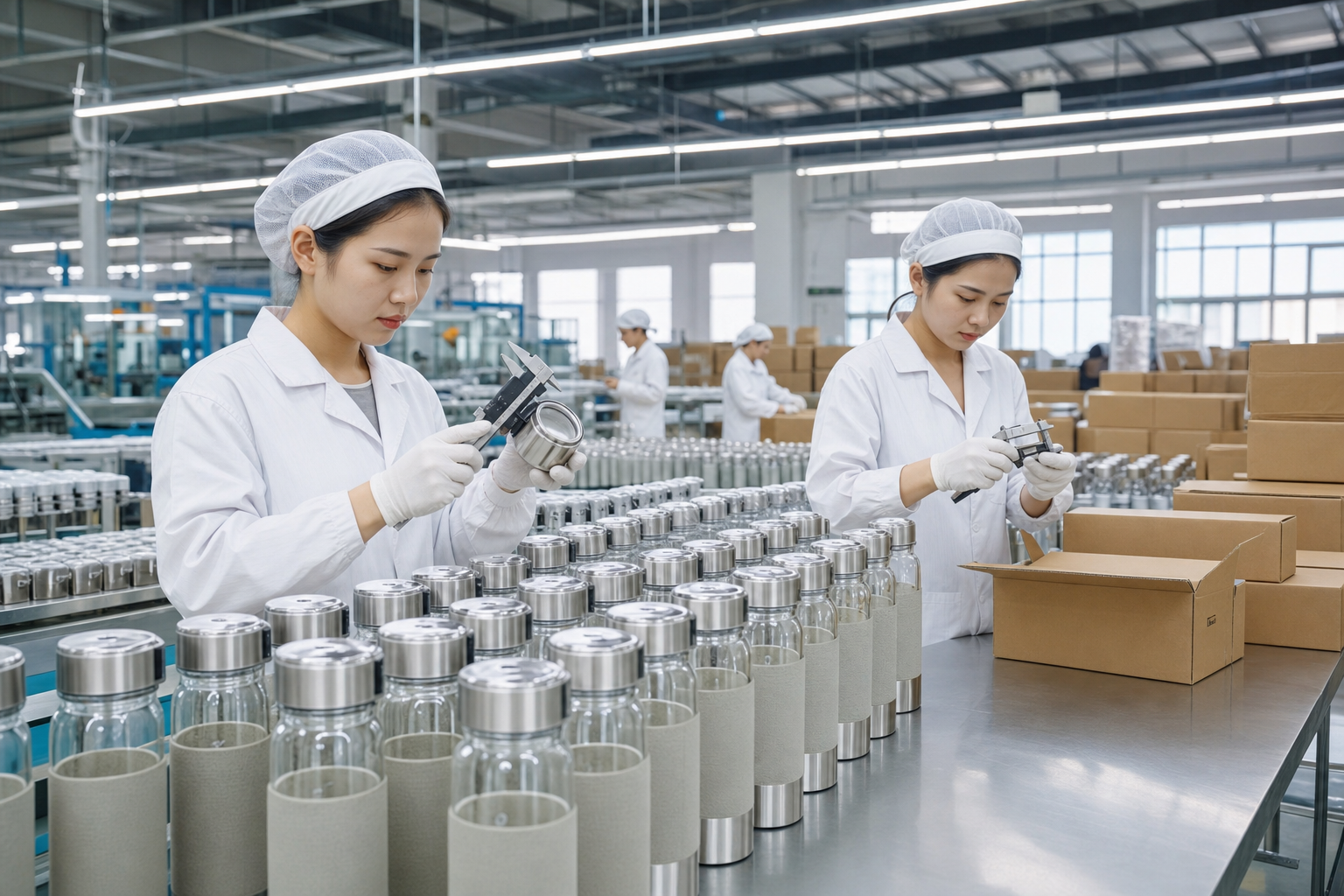
Quality control for a lead-free glass insulated water bottle supplier starts before the first oven run, not after the cartons are stacked. We run a pre-production sample, keep one golden sample on the line, and lock a written spec sheet with tolerances before anyone touches mass production. For glass, we check capacity, wall thickness, mouth finish, and lid fit in mm. For branding, print registration and curing temperature are the two numbers that bite you; a logo can pass at packing and fail after three hot wash cycles.
Ask the factory to follow the usual export checks: incoming material inspection, in-process inspection, and final AQL sampling. For a typical order, we use AQL 2.5 major / 4.0 minor, then pull a carton drop test and a hot-water leak test on random units. If your buyer is Amazon or a big-box chain, you want packaging that survives FBA-style handling. We have seen a 6-pack outer box with a 5 mm crush mark get flagged by the buyer on arrival. This bottle has to survive a warehouse, not just a table demo.
Good sourcing is not about asking whether a factory can make glass bottles. It is about asking how we stop breakage, leakage, and decoration failure at 5,000-unit scale.
Check the document pack too: commercial invoice, packing list, CO, test reports, and carton labels. If you sell into the US or EU, those papers save days when customs or the importer of record asks for proof. One PO typo on a carton mark can hold a shipment for 12 days instead of 18 days, and we have seen that turn into a shipping dispute fast.
How to brief your factory
A strong brief cuts weeks off your sourcing cycle. If you are talking to a lead-free glass insulated water bottle manufacturer in China, send a one-page spec with capacity, target retail price, lid style, logo method, packaging, market destination, and compliance requirements. Skip the target price, and the factory will quote a build that misses your shelf math. Skip the destination market, and the quote lands on the wrong compliance standard. We see buyers ask for “something premium” with no price band, then wonder why the sample blows past the target.
Here is the minimum brief that works:
- Capacity: 500 ml or 750 ml
- Material: lead-free glass, stainless cap, food-grade silicone gasket
- Decoration: one-color logo or laser mark
- Packaging: individual box + master carton
- Market: EU, US, or both
- Target MOQ: 3,000 pcs
If you want lead-free glass insulated water bottle custom development, send reference photos and a target sample deadline. A Zhejiang factory can usually turn first samples in 7-12 days if the mold exists, or 20-35 days if minor tooling is needed. We run this on the sample line all the time. Faster is possible, but only when your approval comes back same day. The buyer flagged it, then sat on artwork for 6 days; that is where schedules go sideways.
For a lead-free glass insulated water bottle wholesale program, the clean path is simple: start with a tested core shape, lock the compliance files, then use private label details to make it yours. QC pulled the sample at 1.2 mm gasket compression, and that caught a lid rattle before shipment. This is the wrong question to ask: “Can you make it premium?” Ask for the exact spec, then the margin and control both hold.
Request a factory quote with real specs
Send your target size, market, logo method, and MOQ. We will match the right Zhejiang production route, pricing tier, and compliance file set.
Frequently asked questions
What MOQ should I expect for a lead-free glass insulated water bottle wholesale order?
For most Zhejiang factories, a normal MOQ is 3,000 pcs per SKU for a standard body and lid combination. If you want a new mold, custom color lid, or special packaging, the MOQ may rise to 5,000 pcs. For mixed colors under one design, many suppliers still want 1,000 pcs per color, because setup time and yield risk increase. If a supplier offers 500 pcs with heavy customization, check whether they are quoting from stock or hiding tooling and print costs elsewhere. Low MOQ is useful, but only if the spec is locked and the defect rate stays under your AQL target.
How much does a lead-free glass insulated water bottle cost FOB China?
A standard 500 ml lead-free glass insulated water bottle usually lands around USD 2.30-3.10 FOB China at 3,000 pcs with basic print and simple carton packing. If you add a stainless cap, custom sleeve, retail box, or upgraded decoration, the price often moves to USD 3.60-4.80. Smaller runs can add 15-30% because setup costs are spread over fewer units. Freight, duty, and inland trucking are separate. If your buyer price target is under USD 20 retail, you need to control packaging weight and decoration spend very tightly.
What compliance documents should I ask for?
Ask for food-contact declarations, REACH if you sell into Europe, LFGB if your channel requires German-market compliance, and FDA declarations for the US market. For the glass itself, request material composition details and thermal test results with stated methods. A good lead-free glass insulated water bottle manufacturer should also provide carton labels, commercial invoice, packing list, and certificate of origin if needed. If your retailer or distributor asks for audit records, ask whether the factory has BSCI or similar social compliance coverage. Do not wait until after shipment to request these files.
Can I do private label and still keep the price competitive?
Yes, if you use an existing mold and keep changes focused on logo, lid color, and packaging. That is the normal lead-free glass insulated water bottle private label model. You can usually keep the factory price near the standard range while creating a product that looks unique on shelf. The mistake is demanding new tooling, a custom cap, and premium packaging all at once. That can push your FOB price up by USD 0.80-1.50 per unit. Keep the body standard, then invest in a stronger retail box and cleaner branding if margin matters.
How do I reduce breakage during shipping?
Start with packaging, not with prayer. Use a molded pulp tray or EPE insert, then a double-wall retail box if the bottle is going to DTC or FBA channels. For master cartons, ask for compression resistance and a drop test from 80 cm to 100 cm. A lead-free glass insulated water bottle bulk shipment should also be palletized if it is moving by ocean LCL or mixed freight. In production, the factory should sample random cartons under AQL and check the lid seal on hot-fill units. Good packing can cut transport damage by 30-50% compared with loose or thin carton packing.