Key Takeaways
- Typical MOQ for custom lead-free glass stainless steel bottle bulk orders starts at 1,000 to 3,000 pcs per SKU
- Factory lead time is usually 25 to 35 days after sample approval and deposit
- A usable wholesale target price is often USD 3.20 to 6.80 FOB China, depending on capacity and decoration
- Ask for REACH, LFGB, and food-contact declarations, plus breakage testing and AQL 2.5 inspection data
If you are buying a lead-free glass stainless steel bottle wholesale, the first trap is assuming “glass liner” automatically means safe, premium, and easy to scale. It does not. The real job is checking the inner glass composition, the stainless outer shell, the seal system, and whether the factory can keep the breakage rate under control at export volume. On the line, QC pulled three samples from a 200-piece batch after one cap gasket failed a 48-hour leak test. In Zhejiang and across China, the better factories say the same thing: materials matter, but process control matters more.
For B2B brands and outdoor retailers, the decision usually comes down to three questions: can the supplier prove the glass is lead-free, can they build to your branding spec without blowing up MOQ, and can they ship stable quality at 3,000 to 30,000 units per run? The wrong question is whether the bottle looks premium. A lead-free glass stainless steel bottle manufacturer in China should answer with documents, not slogans. If they cannot show compliance, test reports, and packaging discipline, you are buying risk, not bottles. We have seen a typo on a PO turn a 5,000-unit carton order into a mess at dispatch.
What you are actually buying
When buyers say lead-free glass stainless steel bottle wholesale, they usually mean a double-wall bottle with an inner glass liner, an outer stainless steel shell, and a cap set that keeps the liner safe in cartons and on the shelf. The label gets messy fast. We had one buyer flag a PO that said “glass stainless bottle” with no liner callout at all, and QC pulled the sample before the line started. You need the structure, not the sales copy.
A proper lead-free glass stainless steel bottle is built for hot drink hold, clean taste, and a cleaner retail look. The inner glass is usually soda-lime or borosilicate, depending on target price and heat load. The outer shell is often 304 stainless steel; 201 stainless is cheaper, but for an export brand run, the math usually does not work unless the margin is tight. Glass wall thickness is often 1.2 to 1.8 mm, and the stainless outer wall sits at 0.3 to 0.5 mm. On the line, that small gap changes breakage in transit. A sample that passes a drop test at 1 meter can still fail when the carton gets stacked 6 high.
For outdoor retail, the value is not only insulation. It is less metallic taste, a more giftable look, and easier premium pricing. If you are sourcing a lead-free glass stainless steel water bottle wholesale line for Europe or North America, ask the factory to put the full material stack in writing. We ship a lot of these from Zhejiang, and the serious plants will send a spec sheet, not a vague promise. One typo on the PO—“inner glas” instead of “inner glass”—has already caused a 12-day delay on one order. Better to lock it down before production starts.
How to judge a real factory
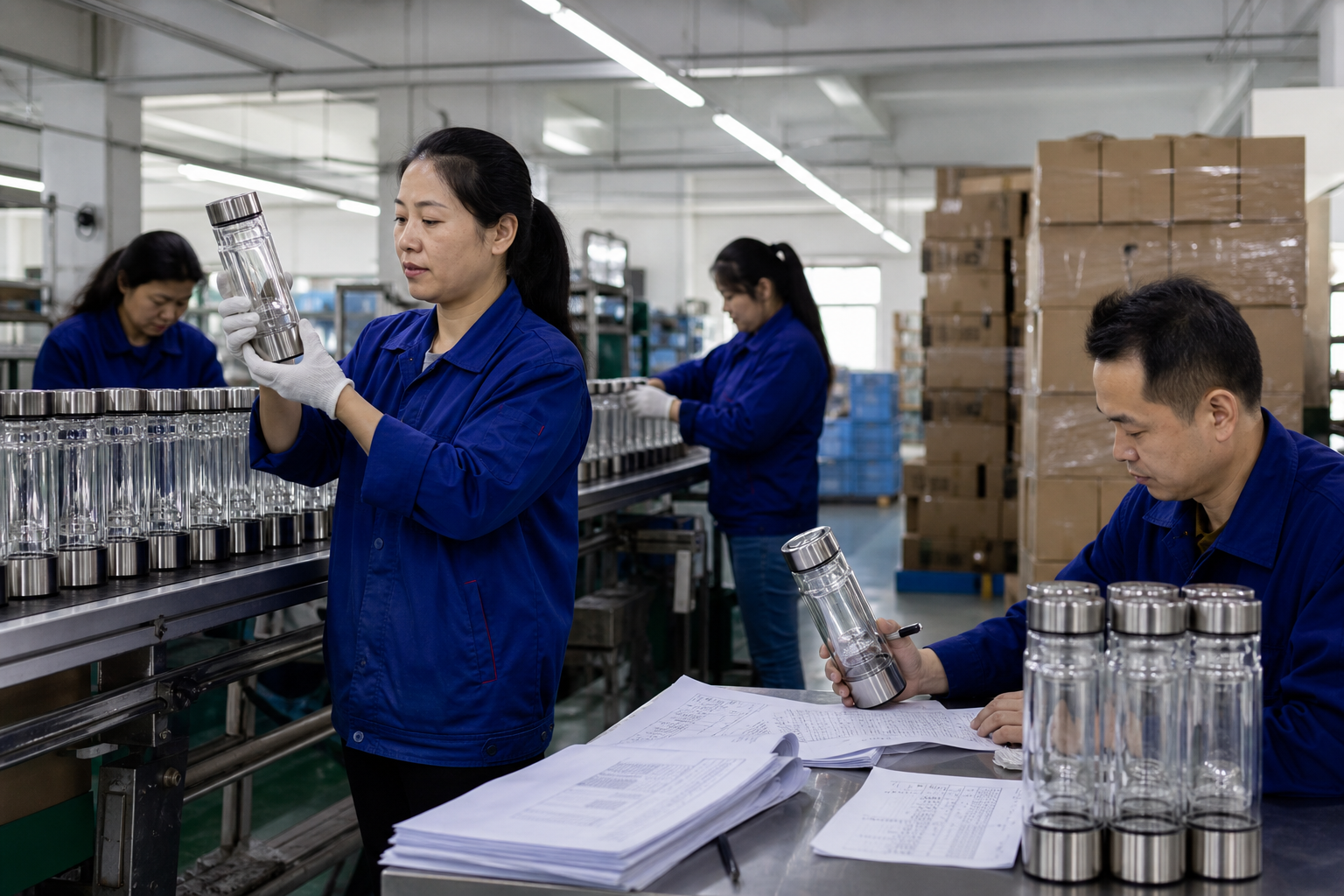
A real lead-free glass stainless steel bottle factory shows the line. Not a showroom, not a trading office with a stack of catalogs. Ask whether they blow or source the glass liner, whether the assembly runs on one line or two, and who checks the seal before packing. That changes defect control. A factory we visited in Zhejiang was shipping 120,000 units a month on stainless-thermos-style items, with a 6-person QC team and a separate carton room.
Here is what we check before any deposit:
- Compliance files: REACH, LFGB, FDA food-contact declarations, and ASTM-related test references if your market asks for them.
- Audit status: BSCI, Sedex, or your own social compliance audit if you sell into retail chains.
- Inspection process: AQL 2.5 for major defects is common; for fragile glass systems, some buyers push for tighter critical defect control, and we agree with them.
- Packaging spec: Inner box, drop-test carton, and outer master carton must be locked before mass production. We once caught a PO typo on carton size—2 mm off, and the pallet count was wrong.
If a lead-free glass stainless steel water bottle manufacturer will not discuss breakage rate, walk away. For this category, 0.5% breakage can wipe out margin fast and create a support headache. This is the wrong question to avoid. In Zhejiang, the stronger plants quote a real allowance, show the foam insert spec, and tell you how the glass core survives export handling in a 1.2-meter drop test.
Pricing, MOQ, and lead time
For most buyers, price is where the deal turns real. A lead-free glass stainless steel bottle wholesale program from China usually lands at FOB USD 3.20 to 6.80 per unit for 1,000 to 5,000 pcs, and the spread comes from capacity, print method, cap type, and packaging. We had a buyer flag a PO once because the 500ml and 750ml SKUs were mixed in one line item; the math did not work. If you want private label, gift box, and multi-color decoration, the cost moves fast. A laser logo may add USD 0.06 to 0.15, while full-color UV print or a custom sleeve can add USD 0.20 to 0.60.
MOQ is not random. A lead-free glass stainless steel bottle custom order usually starts at 1,000 pcs per color or 2,000 to 3,000 pcs per SKU if you need a special cap or molded part. QC pulled the sample on a 3mm neck finish before we released the line, and that kind of detail is why MOQ is tied to tooling, not mood. If you need a lead-free glass stainless steel bottle private label program with retail-ready packaging, some factories will ask for 5,000 pcs to keep setup efficient. Lead time is usually 25 to 35 days after sample sign-off and deposit, then another 5 to 12 days for sea freight depending on destination and port schedule. For air shipment on launch stock, the cost jump is obvious, so book it early.
The smart move is to ask the lead-free glass stainless steel water bottle supplier for an itemized quote: bottle, lid, print, box, carton, and test fee. That is how you compare quotes from China without guessing. We ship a lot of orders where the low unit price looked good, then breakage and rework wiped it out. A cheap box with weak drop resistance is the wrong question to ask.
OEM, ODM, and private label choices
OEM and ODM are different jobs on the line. They change your lead time, tooling spend, and how much say you keep on the final bottle. A lead-free glass stainless steel bottle OEM program puts you in control of dimensions, logo位置, and carton art. ODM is faster because the factory already has a base model; you pick the logo, the Pantone, and move on. For a lot of B2B buyers, that is the right call.
A lead-free glass stainless steel bottle branded item usually comes in three setups:
- Private label: factory base product with your logo and carton artwork.
- ODM: factory platform model with controlled changes to cap, color, or decoration.
- OEM: deeper structural changes, custom molds, or unique size profiles.
For a lead-free glass stainless steel water bottle OEM project, the timeline is longer for a reason. A new cap mold can take 25 to 40 days to open and test, and first article approval often needs two or three rounds. We had one buyer flag a PO typo on the size, and that single line pushed the sample schedule by 6 days. If your channel is Amazon or retail with a fixed launch date, ODM usually wins on math. If your brand needs a shape nobody else has, OEM can work, but only when your volume is big enough to cover tooling. A Zhejiang factory that runs this business every day will tell you that straight, not sell you the priciest option.
Testing, safety, and compliance
“Lead-free” is not decoration. It is a test spec. Ask for the material declaration for the glass part and the finished-product test report from a recognized lab. Depending on the market and bottle structure, the report may cite LFGB, REACH, FDA food-contact, or other migration tests. For a lead-free glass stainless steel flask or bottle sold in Europe, the lead migration result must sit within the local limit, and the supplier should tell you the exact test method. We had one buyer flag a report because the lab stamp was there but the method line was missing. That kind of gap matters.
Do not stop at paperwork. We run these checks on the line:
- Thermal cycling: hot/cold transitions to check liner stress.
- Drop testing: carton and individual pack drops from 76 cm or as specified by your freight plan.
- Leak testing: inverted and pressurized checks on every batch, not just samples.
- Odor testing: especially if the cap has silicone or PP parts.
Many buyers assume a lead-free glass stainless steel water bottle supplier in China already knows North American or EU rules. Some do. Some ship half the file and call it done. A factory that handles export accounts in Zhejiang will usually have the documents ready, but you still need to match them to your PO, carton spec, and product code. If the supplier says “no problem” and cannot show the report number, the math does not work. QC pulled a sample once and found a PO typo on the capacity line; that small error turned into a delay.
Packaging and freight decisions
With glass inside a stainless shell, packaging is part of the product. We learned that on a 12,000-piece order when the buyer flagged a 2 mm insert gap and the line started crushing cartons in the outer ring. One small miss on insert size, carton compression, or pallet stacking can wipe out margin fast. For lead-free glass stainless steel water bottle bulk orders, we push a 3-layer packing setup: individual box, master carton, and palletized export loading. For heavier sets, the carton should survive a 1.2 m drop with no liner fracture beyond your agreed defect rate.
Freight changes the damage pattern. Sea freight from China saves money, but cartons sit through more handoffs and more fork movement at the port. Air freight moves faster, and mixed consolidation can beat up box corners. This is the wrong question to ask: “Which mode is cheapest?” Ask which mode fits the carton spec. Your lead-free glass stainless steel bottle factory should match ECT strength and insert material to the route. A stronger insert can add only USD 0.05 to 0.12 per unit and save far more in claims. We run the math on every shipment.
If you sell through retail distributors, ask for retail-ready barcoding and, if needed, Amazon FNSKU labeling. QC pulled the sample on one PO and found a carton mark typo: one digit off in the SKU, enough to slow receiving. A lead-free glass stainless steel water bottle private label shipment that lands with inconsistent carton marks creates chargebacks and delays. Box dimensions, pallet count, and label placement are not admin work; they sit inside landed cost, and the buyer will notice it on the first inbound check.
Request a verified wholesale quote today
Send your target capacity, logo method, and market requirements. We will quote MOQ, FOB China price, and compliance documents without guessing.
Frequently asked questions
Is a lead-free glass stainless steel bottle safe for daily use?
Yes, if the glass liner and cap materials are tested and documented. You should ask for REACH and LFGB or FDA food-contact test reports, plus a material declaration confirming no lead in the glass formula. For export buyers, the finished unit should also pass leak testing and drop testing. A decent factory in Zhejiang or elsewhere in China will provide batch-level QC records. I would not buy on the word “lead-free” alone. Ask for report numbers, test dates, and the exact sample reference used. That is the only way to reduce regulatory and customer-return risk.
What MOQ should I expect for custom orders?
For a lead-free glass stainless steel bottle custom project, 1,000 pcs is a common starting point for logo and carton changes. If you want a special color, molded cap, or a full private label setup, 2,000 to 5,000 pcs is more realistic. A lead-free glass stainless steel water bottle bulk order with standard decoration can sometimes go lower, but fragile glass parts make tiny runs inefficient. The factory needs enough volume to absorb breakage allowance, print setup, and packaging labor. If someone offers 200 pcs with deep customization, the unit price usually hides the real cost somewhere else.
How much does wholesale pricing usually start at?
For China FOB pricing, a lead-free glass stainless steel water bottle wholesale order often starts around USD 3.20 to 6.80 per unit at 1,000 to 5,000 pcs. The lower end usually means a simpler lid, standard carton, and basic one-color logo. A lead-free glass stainless steel tumbler or flask with premium packaging, custom finish, or more demanding compliance can go higher. Add around USD 0.06 to 0.15 for laser logo, or USD 0.20 to 0.60 for richer decoration. Freight, duties, and local warehousing are extra. You should always compare the full landed cost, not just FOB.
How long does production take after I approve the sample?
Most lead-free glass stainless steel bottle factory schedules run 25 to 35 days after sample approval and deposit for standard custom orders. If you need a new mold, special cap, or upgraded gift box, add 15 to 40 days depending on tooling and print complexity. A lead-free glass stainless steel water bottle manufacturer in China can sometimes accelerate a reorder faster than a first-time project because the tooling is already verified. I always tell buyers to leave time for pre-production confirmation, not just mass production. If your launch date is fixed, you should build in at least one week of buffer for inspection and freight booking.
What documents should I ask from the supplier before paying?
Ask for a formal quotation, product spec sheet, compliance reports, factory profile, and packaging details. For a lead-free glass stainless steel bottle supplier, I would also request photos or video of the production line, AQL inspection standard, and sample carton dimensions. If you are buying for Europe, ask specifically for REACH and LFGB. If you are selling on retail channels, request BSCI or equivalent audit status. For Amazon or marketplace sellers, barcoding support and FNSKU labeling are useful. A serious supplier in China will answer these questions directly. If they avoid them, that is your signal to slow down.