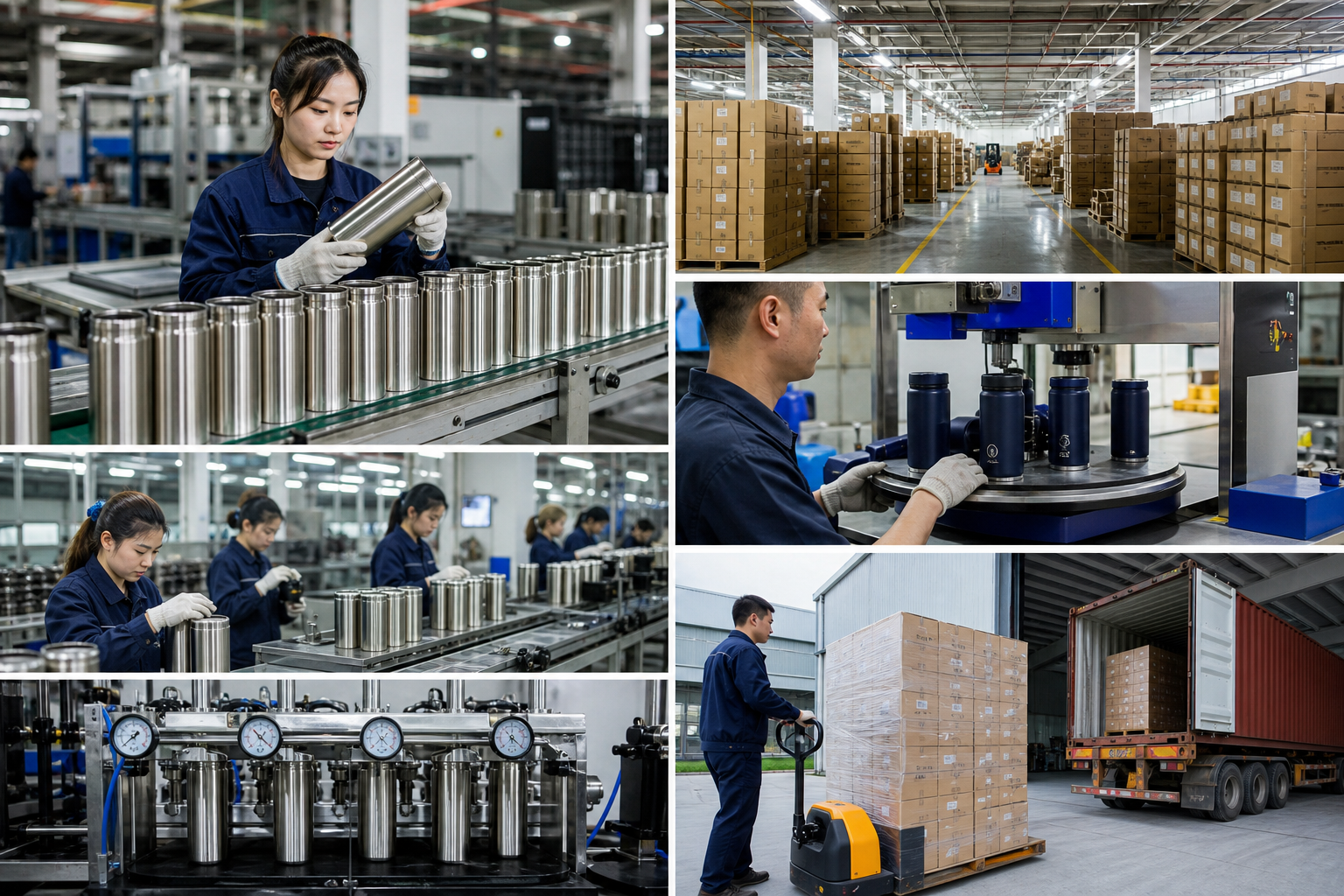
Key Takeaways
- For a custom canteen, expect 500 to 1,000 pcs MOQ for logo work and about 3,000 pcs for new lids, colors, or tooling.
- A solid China canteen factory can usually sample in 5 to 7 days and ship mass production in 20 to 35 days after approval.
- For EU and North America, ask for REACH, LFGB, FDA, ISO 9001, and BSCI evidence before you place a PO.
- At scale, a Zhejiang canteen manufacturer may run 600,000 units per month, so capacity is less important than process control.
If you are sourcing a manufacturer canteen, the logo is the easy part. The real question is whether the canteen custom spec fits the channel: retail, distributor drinkware, promotional packs, or a bundled custom growler program. A canteen manufacturer worth your time will ask about 750 ml or 1,000 ml capacity, lid style, coating thickness, and carton math before decoration. We run this every week, and the buyers who skip those details usually come back after the first PO typo lands on the line.
A cheap sample can still fall apart in mass production. QC pulled one sample with a 0.3 mm paint edge issue and it passed photos, then failed when we ran the full batch. In Zhejiang and across China, the export factories that hold repeat orders are the ones that lock down materials, tolerances, and testing early. If you want a canteen customizable enough for your brand and stable enough for reorders, the sourcing brief has to be tight on day one. The math does not work any other way.
Start With The Use Case
Before you ask suppliers for a quote, lock the job the canteen has to do. A trail-shop retail bottle, a trade-show gift, and a distributor refill item do not share the same spec. On the line, we check lid torque with a torque wrench and run a 3-drop leak test; if the buyer wants a display piece to act like a field bottle, the math does not work.
For most B2B drinkware programs, 400 ml to 1,000 ml is the practical band. A 500 ml model fits commute sets, while 750 ml to 1 L sells better for sports, travel, and custom growler-style channels. QC pulled the sample last week and measured the mouth at 55 mm, because wide mouth, handled cap, screw lid, and flip lid all change filling speed, washability, sealing, and carton size.
- Retail: focus on shelf impact, Pantone matching, and a tight defect limit.
- Distributor drinkware: focus on steady reorders and fewer SKUs.
- Promotional: focus on price, print area, and fast turnaround.
- Outdoor or utility: focus on grip, impact resistance, and leak performance.
If you are a canteen distributor, ask the factory to quote one base model with two or three decoration options. We run that setup a lot because it keeps the core bottle stable while you test canteen customized packaging or a second colorway. A PO once came in with "fliip lid" typed in the notes, and the buyer flagged it before sampling; that is the kind of typo that wastes a week. The best manufacturer canteen programs start with use case and margin, not decoration first.
Choose Materials That Pass
Material choice is where a canteen program usually goes off track. For most export runs, 304 stainless is the right starting point because it keeps cost, corrosion resistance, and supply stable. Chasing 316 on every quote is the wrong question. Use it when the buyer wants stronger chemical resistance or a premium label, and be clear that the price moves with it. On our line, we check 0.4 to 0.5 mm wall thickness with a micrometer, and for vacuum insulated bodies we normally see 0.4 mm inner and outer shells, plus a copper coating or vacuum layer based on the spec.
Do not stop at the body. Gasket rubber, coating, weld finish, and cap threads can sink the job just as fast. QC pulled the sample after a buyer flagged a loose cap, and the thread wear showed up after 1,000 opens on the bench. A canteen supplier should hand over food-contact declarations and test reports for REACH, LFGB, and FDA where relevant. If the product goes to Europe, ask for migration data, not a verbal promise. If it goes to North America, ask what the compliance file covers, and check whether the factory can support carton markings and retail traceability. We have seen that part go sideways on a PO with one typo in the carton code.
- 304 stainless: standard export choice, good for most custom drinkware.
- 316 stainless: higher corrosion resistance, higher price.
- BPA-free plastic caps: check impact resistance and thread wear on the line.
- Silicone gaskets: verify compression set and odor control after heat aging.
For a customized growler or insulated canteen, ask about passivation, inside polishing grade, and whether the factory runs a leak test after final assembly. We ship better when the weld seam is clean and the bottle passes a 10 kPa leak check, not when someone guesses at it. A serious canteen factory in China will answer with spec sheets and test records. If it cannot, that is the answer.
Branding That Survives Shipping
Choose decoration for wear, not just the first sample photo. On our line, silkscreen is still the workhorse for canteen promotional orders: fast, low waste, and clean on a 1-color logo. Laser engraving gives a stronger premium read and the mark does not rub off in transit. Pad printing works on small cap tops or tight curves, but the ink cure has to be watched closely or the first scuff test will catch it. Full-wrap graphics are possible, but the setup fee goes up and the color target gets tighter; that is the math, and it does not bend.
A canteen customizable for retail has to be packaging-ready from day one. We check barcode placement, hangtag position, color box size, and FNSKU label space before the sample leaves the line. Too many canteen vendors quote the bottle and leave the carton spec for later, then the buyer flags pallet height, master carton count, or a drop-test failure after the PO is already moving. We saw a 5 mm carton mismatch turn into a warehouse delay last season. That is the wrong place to discover it.
What to confirm before sample approval
- Pantone references for logo and body color.
- Print area size in millimeters, not just a visual mockup.
- Scratch test expectations after 50 dishwasher cycles if the item will be washed often.
- Secondary packaging requirements for distributor canteen and distributor drinkware orders.
If your product line includes a custom canteen and a custom growler, keep the decoration logic aligned across both. Buyers push back hard when one item gets a matte laser mark and the other gets a glossy screen print with no clear rule. We have seen that go sideways on reorders. A clean decoration spec is still one of the quickest ways to tell a real canteen manufacturer from a trading desk that is guessing at the details.
Price Drivers And MOQ
Pricing is not random. It tracks material, tooling, lid complexity, print method, and packaging. For a simple stainless steel canteen with one-color logo, FOB pricing may sit around USD 1.90 to 3.20 at 1,000 pcs, depending on size and finish. A vacuum insulated model or a custom growler with a more complex cap can move into the USD 4.80 to 8.50 range fast. We run quotes this way on the line every day. If a supplier gives you one number only, the math does not work.
MOQ should follow the process, not a sales script. A stock body with custom branding may start at 500 to 1,000 pcs. A new lid mold, Pantone-matched powder coat, or customized canteen shape can push MOQ to 3,000 pcs or more. Sample lead time is usually 5 to 7 days, and mass production after sample approval is commonly 20 to 35 days if the 304 stainless and lids are already on hand. QC pulled the sample last week and found a 1.2 mm cap gap, so we held the run. For China export orders, leave room for peak season and freight booking.
A capable Zhejiang canteen factory can have capacity around 600,000 units per month, but capacity only matters when the line is under control. Ask whether the quoted price includes carton packing, inner trays, desiccant, and outer shipping marks. We have seen buyers get burned by a quote that left out 12-piece inner packs and still called it a landed price. A canteen vendor that skips those items is not cheaper; it is incomplete.
Buy the full landed spec, not the bare bottle. That is the difference between a clean reorder and a pricing surprise.
If you are comparing canteen manufacturers, ask for an itemized quote. You want body cost, lid cost, decoration cost, packaging cost, and any mold amortization shown separately. We also check the PO for small mistakes, like a lid color code typed wrong by one digit. That is where you catch the gap before it hits the shipment.
Quality Checks You Should Demand
Good quality control is a checklist, not a slogan. Before the first run, ask the canteen manufacturer to put the inspection points in writing: where they test, how they sample, and what gets rejected. AQL 2.5 is common for critical appearance and function defects, but the sampling plan should match the order size and the buyer’s risk. For a vacuum bottle, we run leak checks and thermal tests on pre-production samples and final cartons. For a non-insulated custom drinkware item, the cap fit, smell after washing, and coating pinholes matter more. QC pulled the sample from the sealing jig once and found a 0.3 mm cap mismatch; that sort of miss turns into a chargeback later.
Use a simple acceptance plan:
- 100% leak test for vacuum bottles or any canteen customized for liquid transport.
- Drop test from 1.0 to 1.2 m, depending on packaging level.
- Torque test for caps to confirm thread durability.
- Salt spray or coating adhesion testing for painted exteriors.
- Incoming material checks for stainless steel, gaskets, and inks.
Ask the factory for ISO 9001 and BSCI status if you need audited social compliance and process discipline. For Europe, REACH and LFGB documents matter. For North America, make sure the file supports FDA food-contact expectations where applicable. If you sell through Amazon FBA, confirm carton labeling, case pack counts, and whether the line can apply FNSKU labels without stopping the packing table. We’ve seen a PO typo on case pack count leave 400 loose units in a warehouse. A supplier can quote a clean sample on day 7; holding that standard on 10,000 pcs is the real test.
Work With The Right Factory
I’m rewriting the section to sound like a real factory-side sales engineer: tighter phrasing, concrete production details, and fewer generic transitions. I’m keeping the HTML structure exactly as-is.A manufacturer canteen partner gives you more than a product. You are buying tooling discipline, export paperwork, and a line that can still hold spec after the first PO. In Zhejiang and other parts of China, the stronger factories ask for your target market, annual forecast, and repackaging requirements before they quote. That is a good sign. Last week QC pulled a sample at 18.6 mm rim height, and the buyer flagged a lid gap before the first run left the shop.
Look for response speed, but do not confuse speed with competence. A serious canteen factory will send a drawing, a spec sheet, and a sample schedule within 24 hours, then spell out what runs on the standard mold and what needs new tooling. On one lid job, we promised a first sample in 12 days; the other shop wanted 18. The math does not work if they cannot name the bottleneck. If you are building a canteen promotional line for distributors, ask how the factory handles spare lids, replacement gaskets, and reorder consistency across quarters.
Use this rule: if a canteen supplier cannot explain artwork control, color drift, and cap compatibility, it is not ready for distributor canteen orders above 5,000 units.
For buyers running multiple channels, the same factory may support a canteen custom program, a distributor drinkware line, and even a smaller custom growler range. The point is not to squeeze every item into one SKU. The point is to keep the production logic clean enough that your next reorder ships with the same 185 mm height, the same logo position at 22 mm from the base, and the same 24-pack carton count as the first one. We once caught a PO typo that turned 24 cartons into 42. That burns a week.
That is how a Zhejiang manufacturer keeps your program moving without surprises, and why the right partner in China is usually the one that asks better questions before it starts production. If it skips that step, we run into the same trouble on the line: loose tolerances, missing gaskets, and a claim after shipment.
Source your next canteen with fewer surprises
Send your spec, target price, and market rules. We will match the right build, branding method, and export compliance for China or EU orders.
Frequently asked questions
What MOQ should I expect for a custom canteen?
For a stock body with a custom logo, 500 to 1,000 pcs is a normal starting point. If you want a new lid, a custom color, or a molded shape, expect 3,000 pcs or more because tooling and color control add cost. For a canteen promotional order, some factories will mix designs under one body spec, but that only works if the decoration process stays the same. Ask for MOQ by SKU, not one blanket number. A good canteen manufacturer should also tell you whether samples are free, charged, or refundable against the first PO.
Can I get a canteen customized with my logo and packaging?
Yes, and packaging matters almost as much as the logo. Most canteen manufacturers can do silkscreen, laser engraving, pad print, or a full wrap label depending on the body material. For packaging, ask for a color box, barcode position, carton count, and if needed an FNSKU label for Amazon FBA. Logo sample approval usually takes 5 to 7 days, and a full packaging proof may add a few more days. If you are selling to distributors, keep the artwork simple and repeatable so reorders stay consistent across batches.
Which material is best for Europe and North America?
For most export drinkware, 304 stainless steel is the practical default. It gives you a good cost-to-performance balance and is widely accepted for food contact use when the full compliance file is in place. Choose 316 if you need stronger corrosion resistance or a premium positioning. For EU buyers, ask for REACH and LFGB support. For North America, request FDA food-contact documentation where applicable. Do not forget the cap and gasket: many failures come from the closure, not the bottle body. A canteen supplier should show you the material breakdown for every component, not only the shell.
How long does a China factory need to produce custom drinkware?
For a standard custom canteen with existing tooling, sample time is usually 5 to 7 days and mass production is often 20 to 35 days after sample approval. If you need a new mold, a special lid, or Pantone body color matching, expect a longer cycle. Freight booking can also add time during peak season. A Zhejiang factory with strong export systems may run 600,000 units per month, but that does not shorten lead time unless materials, artwork, and approval are ready on your side. The fastest orders are the ones with a clean spec and one decision-maker.
How do I compare canteen suppliers before placing a PO?
Ask each supplier for the same set of documents: product drawing, itemized quote, compliance file, sample schedule, and inspection plan. Then compare how clearly they answer questions on AQL, leak testing, packaging, spare parts, and reorder consistency. If one canteen vendor gives you only a single price, it is hard to judge real value. If one canteen manufacturer can explain body thickness, cap torque, coating test results, and carton counts in the same reply, that is a stronger signal. For larger distributor drinkware programs, also check whether they can support bilingual communication and stable lead times across peak season.