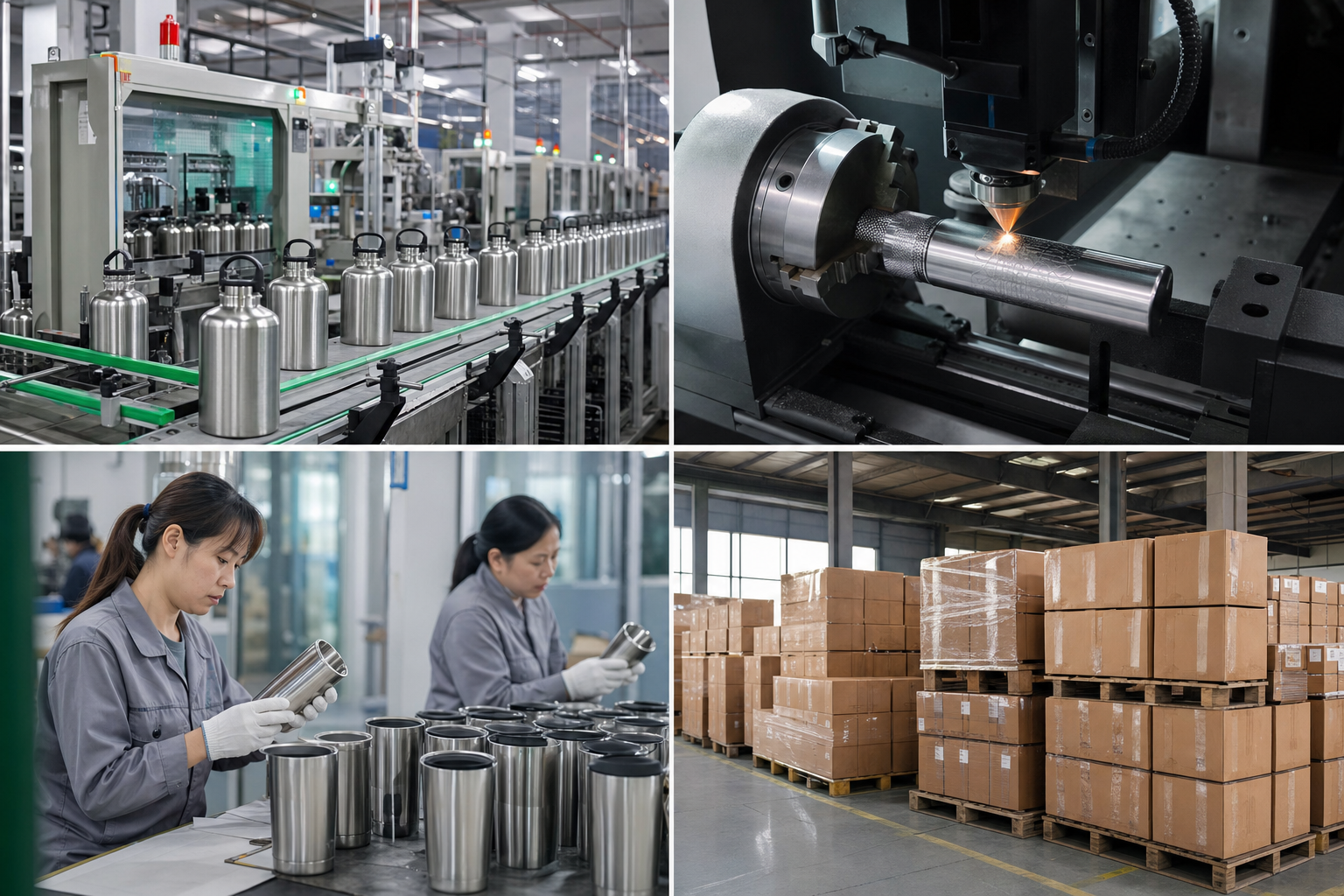
Key Takeaways
- A workable custom drinkware MOQ is often 500 pcs per SKU, but printed color sets can push that to 1,000 pcs.
- A Zhejiang, China factory with 120,000 units per month can still miss your deadline if tooling, artwork, and packing specs are not approved early.
- REACH, LFGB, FDA food-contact, and AQL 2.5 checks matter more than a low sample price.
- For distributor canteen and custom growler programs, decoration method and carton packing decide your real landed cost.
If you buy manufacturer drinkware for retail, promotions, or distribution, the gap between a good sample and a production order usually comes down to MOQ, decoration, and compliance. We have seen a canteen custom job pass on the table and then fail on wall thickness, leak rate, or carton packing once the line starts running, especially when the buyer wants customized drinkware for three channels with one artwork file. QC pulled the sample with a caliper at 1.2 mm, and that number changed the whole quote.
The wrong question is whether every canteen factory, canteen manufacturer, or canteen supplier is the same. A serious drinkware manufacturer in Zhejiang, China should show tooling, monthly capacity, test reports, and a clear FOB quote that ties back to the mold and print method. We ship orders where the PO still has a typo in the lid color or a buyer flags MOQ 3,000 vs 5,000 pcs, and that is where the math gets real before you commit to a custom canteen, custom growler, or distributor drinkware line.
What manufacturer drinkware means
I’m rewriting the section in place, keeping the HTML structure intact and tightening the wording so it reads like a factory-side sales engineer wrote it. I’m also weaving in concrete process details and removing the stock phrases the brief called out.When buyers say manufacturer drinkware, they usually mean more than a factory that fills a carton. They want one shop that runs forming, TIG welding, coating, printing, packing, and final inspection under one roof. On our line, a lid torque wrench and a 24-hour vacuum hold test tell you more than a sales deck. The cheapest quote often comes from a trading layer that cannot explain why two samples from the same line show different lid torque, vacuum retention, or print alignment.
A real canteen manufacturer should be able to tell you where the blank stock comes from, what steel grade is used, and how the line is audited. For stainless products, ask for 304 or 316 with a declared wall thickness, usually 0.5 mm to 0.7 mm depending on the shape. We had a buyer flag a PO typo that changed 0.6 mm to 0.06 mm, and that kind of error only gets caught when the factory checks the drawing before the line starts.
If you are comparing canteen suppliers or canteen vendors, look at the process, not the sales language. A solid canteen factory in Zhejiang, China should show you production flow, vacuum leak tests, and carton drop standards at 1.2 m. The wrong question is whether the sample looks good. You want a partner that can make a custom canteen once, then run the same spec again for the next 20,000 pcs.
- Ask for production photos, not just a polished sample.
- Ask for steel grade, coating spec, and lid material.
- Ask how many units are inspected per batch and what AQL is used.
For distributor drinkware, repeatability matters more than a glossy sample sheet. If QC pulled the sample and the print shifted 1.5 mm, that is a real problem, not a small one.
Pick the right canteen format
The wrong format costs more than the wrong color. We have seen a sports-retail canteen custom run fail because the buyer copied a campus-gift spec into the line. QC pulled the sample after the 1 m drop test, and the carton count no longer matched the freight target. Start with use case, then set capacity, lid style, and insulation. If freight is the priority, single-wall stainless or aluminum keeps weight down; if the shelf needs a higher ticket, double-wall vacuum is the better call.
For a canteen distributor, capacity drives sell-through. 500 ml, 750 ml, and 1,000 ml are the common SKUs we run. A 500 ml unit can move in 12 days instead of 18 when freight is tight, while 1,000 ml gives margin only if the channel can absorb the carton size. Wider mouths make filling and washing easier on the line; narrow mouths control pour and cut spills. If you need a customizable growler, check the neck finish before PO approval, because a standard cap and a proprietary closure are not interchangeable.
Material choice should stay plain and defensible. 304 stainless handles most B2B drinkware programs. 316 makes sense when salty or acidic contact is part of the spec and the buyer wants a cleaner compliance story. Glass and Tritan both have a place, but each needs its own breakage plan and pack-out. We checked one sample at 0.8 mm wall thickness and the math stopped there; this is the wrong question to ask if the carton has to survive a rough freight lane.
Use the format that matches the channel
Retail buyers often over-spec the bottle and under-spec the pack. Promotional buyers do the opposite. On one run, the buyer flagged a carton typo before shipment and we fixed it at the packing bench, not after the truck left. The right balance keeps your canteen custom order profitable, not just polished.
MOQ, lead time, and price reality
I’m rewriting the section to sound like a factory-side quote explanation, keeping the HTML structure intact and folding in concrete production details and tighter buyer-facing language.MOQ is where a lot of deals turn vague. A serious manufacturer drinkware quote should break out sample cost, tooling cost, unit price, and packaging cost. On our packing bench, we had a buyer flag a PO that mixed carton spec with lid color, and that is how mistakes start. For a standard custom canteen in stainless steel, a practical MOQ is often 500 pcs per SKU and color. If you want a full-color wrap, mixed cap colors, or custom packaging, 1,000 pcs is the cleaner number. For a laser-engraved custom growler, some Zhejiang factories can start at 300 pcs, but the unit price will be higher. The wrong question is, "What is the cheapest MOQ?"
Lead time depends on how much is already on the line. At our type of factory in China, monthly output can reach 120,000 units, but your order still needs artwork approval, pre-production sample approval, and material booking. On the line, a 2 mm print shift or a missing Pantone code can stop a run before filling starts. A simple run may take 25 to 35 days after deposit and sign-off. If a new mold is required, add 20 to 30 days. Sampling is usually 5 to 7 days for existing bodies and 10 to 15 days for new shapes.
Price should be read as FOB, not fantasy. A plain 500 ml stainless canteen promotional item may sit around USD 1.20 to 1.90 FOB. A double-wall vacuum bottle can move into USD 2.80 to 5.20. A premium customizable growler with powder coat and laser logo can land at USD 3.60 to 6.80 before freight. Last month QC pulled a sample with a 0.4 mm lid gap, and that kind of fix shows up in the quote fast. Tooling for a new shape can add USD 1,500 to 8,000 depending on complexity.
Watch for hidden costs: custom cartons, color-matched lids, extra test reports, and split shipments. On one order, the buyer asked for 3,000 cartons with a 1-color print and then changed the insert after approval; the carton line had already been booked. If your buyer asks for distributor canteen pricing without giving forecast volume, you will pay for uncertainty somewhere else. The math does not work.
Decoration and compliance rules
I’m rewriting the section to keep the HTML intact while making the wording sound like a factory-side sales engineer, with tighter compliance language and more concrete production detail.The decoration choice sets the job. A silkscreen logo is the cheapest route for a simple mark, but we do not trust it on a bottle that gets tossed into trucks every day. Laser engraving costs more per unit, yet it stays sharp after 300 washes and suits premium custom drinkware and repeat orders. UV printing handles gradients and small text better than basic pad printing. On the line, we check laser depth at 0.15 mm before we sign off. If the buyer wants a retail canteen, we lock the decoration method first and then redraw the artwork to match the real print area, not the wish list.
The compliance side is where a lot of canteen suppliers get loose with language. This is the wrong question to ask if you only want a pretty sample. For Europe, ask for REACH and, when relevant, LFGB evidence. For the US, ask for food-contact declarations and migration test support. If you are selling into regulated channels, request AQL inspection records, typically AQL 2.5 for major defects and 4.0 for minor defects. QC pulled the sample from carton 24 and found a 0.3 mm lid gap, which is the kind of miss that turns into a leak claim later. That should cover leakage, coating defects, dents, print misalignment, and lid failures.
Packaging matters just as much as the bottle. A distributor drinkware program for retail shelves needs clean inner bags, barcode labels, and carton marks that match the PO. We run carton drops from 76 cm and weigh the finished pack at 5.2 kg before shipment. If you sell on Amazon, build the pack for FNSKU labels, drop-test performance, and carton dimensions that avoid oversize fees. A canteen vendor that ignores packing is not saving you money; it is moving the risk downstream. The buyer flagged a PO typo on carton count once, and that one line cost two days at the dock.
Good decoration looks expensive. Good compliance looks boring. The 0.2 mm print gap and the test report both matter.
For canteen manufacturers in Zhejiang, China, the best sign is not a long certificate list. It is the ability to connect the test report to the exact batch you are buying. We ship a lot of orders at 5,000 pieces MOQ, and the trace code has to match the lot on the pallet, not a similar one from last month.
Audit the factory before you order
If you buy from a canteen factory without auditing the process, you are trusting the sample more than the production line. That is the wrong place to save money. Start with a live video or, if the order is large enough, a physical visit. Watch the line from blank tube to finished carton. We want to see polishing, welding, coating, leak testing, and packing in one place, not split across subcontractors with different standards. On a real line, QC pulled the sample at the leak tester, and the 0.2 mm seam gap showed up fast.
A useful audit checklist is simple. Ask where steel is sourced, how often the gauges are calibrated, how many units are checked per lot, and who signs off on the golden sample. If the line claims 120,000 units per month, ask for the last three months of output by SKU. The math has to work on paper and on the floor. A proper manufacturer drinkware partner answers without drama. A vague canteen supplier hides behind sales talk and asks you to trust the sample. We have seen that go sideways when a buyer flagged a PO typo on the logo size and the factory could not trace the approval.
- Check whether the factory keeps retained samples for future comparison.
- Confirm that carton specs match your warehouse or FBA requirement.
- Verify whether mixed-color orders are separated by lot number.
- Ask for clear responsibility on rework, replacement, and defect claims.
For canteen distributors and distributor growler programs, the best factories in Zhejiang, China will also help you manage repeat orders. They should keep the same logo file, the same print position, and the same packaging spec so your next PO does not become a new project. We run repeat jobs this way because a 1 mm shift on the pad print turns into a claim later. That is the difference between buying once and building a line.
How to place a safer order
A safer order starts with a narrow brief. Send the exact capacity, body finish, cap style, artwork file, target FOB, carton requirement, and destination market. If you only say you want a custom canteen, the factory will quote a guess. If you say you need a canteen custom order for Germany with REACH support, 500 pcs MOQ, and kraft packaging, the quote becomes usable. On our side, we run the first quote against the same checklist the line uses: 304 steel spec, lid gasket type, box size, and label art.
Then lock the approval sequence. First confirm the technical drawing. Next approve the color chip or Pantone match. Then approve the pre-production sample. Only after that should mass production begin. For customized drinkware, moving too fast is expensive because one tweak after the rotary laser or silk-screen setup can burn a full shift. A serious canteen manufacturer will keep a signed sample, a QC reference sheet, and a packing checklist tied to your PO. QC pulled the sample, found a 1.5 mm print shift, and the buyer flagged it before we ran 8,000 pcs. That is the right time to catch it.
When the order is for a distributor canteen or distributor drinkware line, make the service terms explicit. Decide who pays for failed samples, who owns the mold, and what the replacement rule is for leakage or print defects. If the vendor in China cannot put those answers in writing, the order is not ready. We've seen this go sideways on a PO typo that changed the carton count from 24 to 42, and the math did not work. If they can, you have a real manufacturing agreement instead of a conversation.
Build your next drinkware line with control
Send the spec, target MOQ, and market standard. We will quote the right custom drinkware setup without guessing.
Frequently asked questions
What MOQ should I expect for a custom canteen?
For a standard stainless custom canteen, 500 pcs per SKU is a realistic starting point if you use an existing body and a one-color logo. If you want a full wrap print, mixed lid colors, or special packaging, 1,000 pcs is more common. For a laser logo or simple custom growler, some Zhejiang factories in China can accept 300 pcs, but the unit price will usually rise by 10% to 25%. Ask whether the MOQ is by color, by SKU, or by total order, because those three numbers are not the same.
How do I compare canteen manufacturers and canteen suppliers?
Start with process control, not sales promises. A real canteen manufacturer should show material grade, wall thickness, leak test method, and packaging flow. A canteen supplier that only resells stock often cannot explain AQL, coating spec, or batch traceability. Ask for the monthly capacity too. A factory that can move 120,000 units per month has a different risk profile from a broker with no line control. For distributor drinkware, the ability to repeat the same color, logo placement, and carton spec on the next PO matters more than a polished sample photo.
Which decoration method is best for custom drinkware?
It depends on the channel. Silkscreen is the cheapest and works well for simple logos on canteen promotional orders. Laser engraving is cleaner and more durable for premium custom growler and customized drinkware programs. UV printing handles gradients, fine text, and larger wrap designs better than basic pad printing. If you sell in retail or export, ask the factory for print durability data and adhesion testing. A good supplier should also tell you the minimum line thickness they can hold, usually around 0.2 mm to 0.3 mm for sharp logos.
Can you support Amazon FBA packaging and labels?
Yes, if you specify it early. The factory needs the FNSKU label format, carton dimensions, inner pack count, and whether you need polybags or drop-test packaging. For Amazon FBA, the most common mistakes are incorrect barcode placement, oversize cartons, and weak corner protection. A good manufacturer drinkware partner will print the carton marks, apply the FNSKU, and confirm the master carton weight before shipment. If you are shipping from China, ask for carton photos and a packing list that matches the final pallet plan.
How do I check product quality before shipment?
Use a pre-production sample, then a golden sample, then batch inspection. Ask for AQL 2.5 on major defects and 4.0 on minor defects, plus a leak test and visual check for dents, scratches, and print misalignment. For insulated bottles, request temperature retention data at 6 hours and 12 hours if that claim matters to your market. If you are buying from Zhejiang, China, also ask for traceability by lot number and retained samples. That is the simplest way to protect a repeat order from becoming a new problem.