Key Takeaways
- A workable custom growler order usually starts at 3,000 pcs MOQ, with 25-35 day production after sample approval.
- 304 stainless at 0.5-0.6 mm wall thickness is the practical baseline for most distributor drinkware programs.
- Ask for ISO 9001, BSCI, REACH, and AQL 2.5/4.0 inspection records before you place any China order.
- FOB pricing only makes sense when you know carton count, logo method, FNSKU needs, and your target market.
If you are sourcing a manufacturer growler, price is only the first line on the quote. You need a bottle that survives 20 fill cycles, keeps the logo sharp after 50 dishwasher runs, clears food-contact checks, and fits a carton your distributor can actually move. QC pulled the sample and checked the shoulder at 2 mm. The cheap spec looks fine on paper and turns costly once it hits the port.
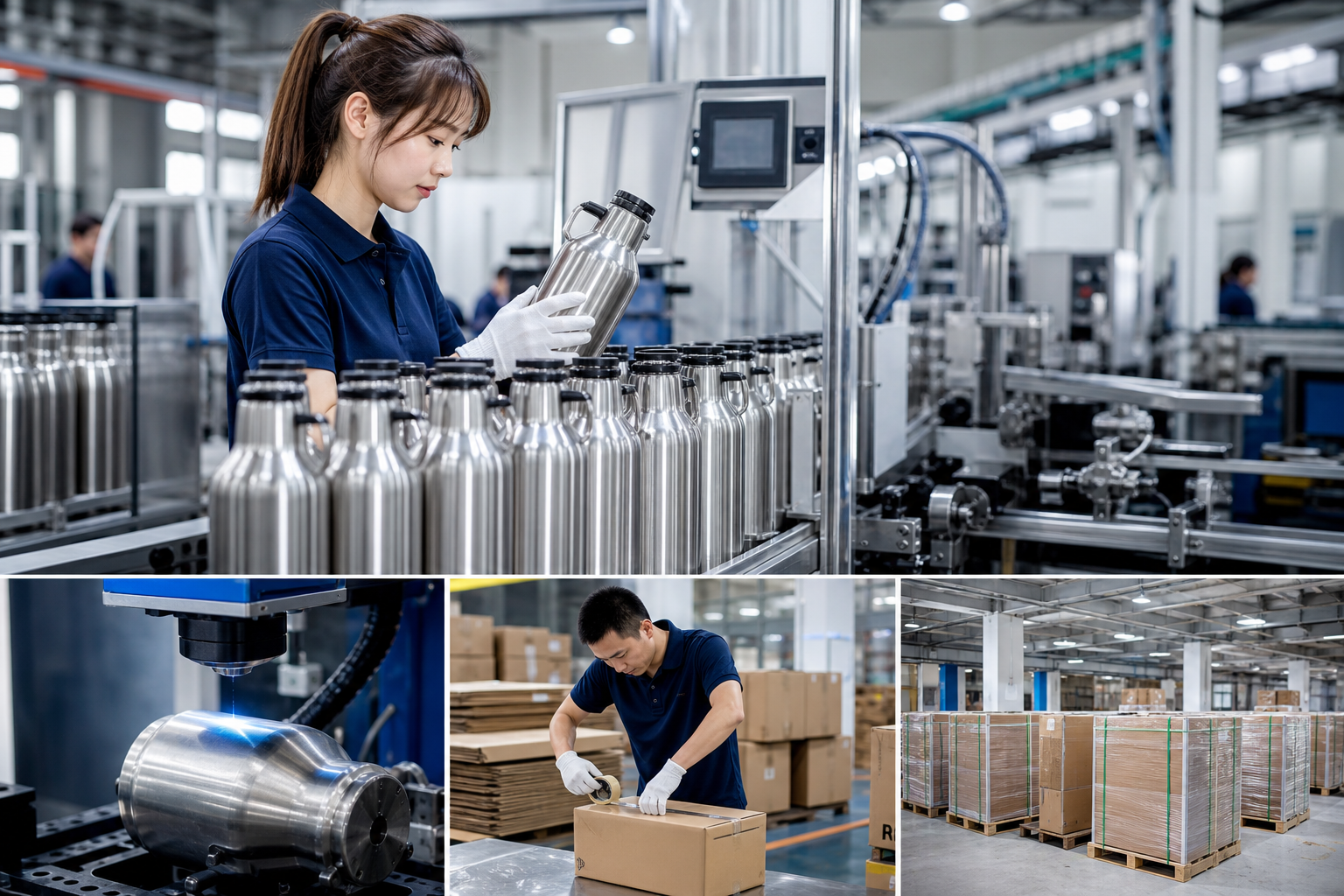
That is why serious buyers treat growler sourcing like a production job, not a one-off order. In Zhejiang and across China, the better factories ask about fill type, decoration area, carton plan, and target market before they talk unit price. We run the line that way for a reason. Asking for price first is the wrong question to ask. If you are building a custom drinkware program, or a canteen custom line that needs a clean retail shelf, start with the print size and MOQ, not the sample photo. The buyer flagged one PO typo last month, and a 12 mm artwork shift would have turned a sellable run into dead stock.
Define the growler job first
Before you ask for a quote, lock the use case first. A brewery taproom, a distributor canteen program, and a retail gift item do not want the same build. If the growler holds beer, we check seal integrity, headspace, and how the cap behaves after 50 opens. For water or cold brew, the line spends more time on temperature retention and print wear. A manufacturer growler should be built for the job on the sheet, not the photo on the buyer's mood board.
Start with capacity, material, cap type, and packaging. The common sizes are 32 oz, 64 oz, and 1 L. For most custom drinkware buyers, 304 stainless is the default. We run 304 because it is stable, cost-efficient, and easy to source from a canteen factory in China; the buyer flags 316 fast once they see the delta on a 5,000-piece order. Wall thickness usually sits at 0.5-0.6 mm for non-vacuum bottles and 0.4-0.5 mm on insulated bodies. A thicker wall is not automatically better if it pushes the unit over the shelf weight target, and we have seen that go sideways on retail racks.
Ask these questions up front:
- Is the bottle for still liquid, carbonation, or both?
- Will your buyer need a custom growler, customizable growler, or customized growler with gift packaging?
- Do you need a canteen customizable program with the same body and different lids later?
- Will it be sold as distributor drinkware or used as canteen promotional stock?
That first brief saves weeks. QC pulled the sample, checked the lid torque at 1.2 Nm, and the wrong answer showed up before we cut production. It also separates a real canteen manufacturer from a vendor who can only quote from a catalog, and that is the right question to ask.
Materials and build quality
For most buyer programs, 304 stainless steel is the practical choice. It is the baseline for a custom growler because it forms cleanly, holds up against normal corrosion, and keeps cost under control on 5,000-unit or 10,000-unit runs. We run wall checks with a micrometer on the line, and 304 gives us fewer surprises when the spec calls for stable drawing and consistent polish. If the bottle will see harsher use, or you are building a premium line for Europe, 316 stainless has a clear case. For glass growlers, the carton has to do more work, so the unit price alone is the wrong question to ask.
Build details matter more than most buyers expect. A poor weld bead, a weak shoulder radius, or a loose gasket will send product back even when the first sample looks clean. QC pulled the sample on one job because the cap sat 0.8 mm off center, and the buyer flagged it before we shipped. Ask for cross-section photos or cutaway samples if the factory has them. On insulated models, request the vacuum retention standard and the test time. On non-insulated models, ask for dishwasher resistance and cap torque limits. If you are ordering canteen customized or customized drinkware in the same season, keep the body spec and coating spec in separate lines so the line does not mix SKUs after the PO typo.
For quality control, ask for the factory standard and the inspection method, not just a certificate. ISO 9001 helps, but it does not replace incoming inspection, in-line checks, or final AQL sampling. A 2.5 major and 4.0 minor inspection level is common for export drinkware. We also track cap torque with a simple torque tester, because a loose closure turns into leaks fast. For a canteen supplier or canteen vendors chain, that level is usually enough if the artwork and cap system are locked before mass production.
Practical rule: if the growler will be used for repeated filling, do not optimize only for price. Optimize for seal, finish, and repeatability.
Branding that survives use
Decoration is where a lot of custom drinkware jobs fail. On the line, we see a logo look perfect on a first pull and then lose ink after 3 wash cycles because the method was wrong. For a manufacturer growler, the usual choices are silkscreen, laser engraving, heat transfer, and powder coat overprint. The right call depends on body finish, logo complexity, and target unit price. The wrong call shows up fast.
Silkscreen is still the cleanest pick for 1-color or 2-color branding at scale. Laser engraving is tough and premium, but it only works on stainless, and it exposes the metal. Powder coat gives stronger shelf presence and a better grip, but we check adhesion with a cross-hatch test before release. If you are building a canteen promotional line or a customizable canteen program for distributors, keep the logo panel generous and skip tiny text. 1.2 mm strokes survive retail handling; 0.5 mm type usually does not. QC pulled the sample and the buyer flagged the URL first after a warehouse wash.
Color control is not cosmetic trivia. Ask for Pantone matching, spray samples, and a production tolerance range of 1.5 to 2.0 Delta E, then say whether the match applies to the body, the lid, or both. If the PO says "red" on one line and "Pantone 186 C" on another, the line stops while we sort it out. Also confirm whether the factory charges extra for multi-position printing. A distributor selling across 3 channels usually wants one base body with 2 imprint versions; that is cheaper than retooling every color. This is the wrong question to ask: "Can you match any shade?" The better question is whether the shade stays consistent across 5,000 units.
- Use laser engraving when the logo has to survive repeated washing.
- Use silkscreen for clean, low-cost logo runs.
- Use powder coat when shelf impact matters.
- Request a pre-production sample with final artwork.
Compliance and testing
If your market is Europe or North America, compliance is not optional. A real canteen manufacturer in China should be able to support REACH, food-contact declarations, and the test reports you need for your channel. For the US market, buyers usually ask for FDA-relevant material declarations and export paperwork. For Europe, REACH is the baseline, and some retail channels also ask for LFGB-style testing. Define the destination before the PO is signed. We keep the batch file tied to the carton code on the line so the wrong market does not slip through.
Testing has to cover more than the metal body. Ask about gasket material, cap torque, drop testing, odor checks, and dishwasher tolerance if the product is meant for repeat home use. If the item is a custom growler for beer, validate seal performance after repeated openings. If you are sourcing canteen customized or customized drinkware for a distributor drinkware program, ask whether the factory keeps records by batch number. QC pulled the sample after 50 open-close cycles, and that is where leaks usually show up. A certificate on its own does not tell you that.
Many buyers focus on certificates and ignore process control. That is the wrong question to ask. Ask for incoming material checks, in-process inspection, and final packing checks. A factory that produces 300,000 units per month in Zhejiang can still miss an order if the artwork proof was rushed and the barcode went in upside down. Volume helps only when the line has discipline. The math does not work if the buyer skips the 0.2 mm gasket check and hopes the shipment sorts itself out.
For higher-risk programs, require pre-shipment photos, carton drop-test evidence, and retained samples. Keep two samples per lot and label them by batch. We run this as basic export control, not extra service.
MOQ, pricing, and lead time
Buyers ask for a unit price first. That is usually the wrong question. The real number sits in the order structure: MOQ, decoration steps, carton count, and whether you want a printed gift box. For a basic custom growler, we run a practical MOQ around 3,000 pcs per SKU in many China factories. Once you ask for three colors, two lid styles, or a rigid box, the line splits, inventory stacks up, and the quote moves fast.
Lead time is usually 25-35 days after sample approval for standard stainless products. Add artwork sign-off, testing, and freight booking, and the calendar stretches. QC pulled the sample on a Tuesday and found a 1.2 mm gap at the lid seat, so the buyer had to approve a fix before we could release the run. Rush orders are possible, but the math does not work the same way. You pay more, or you give up decoration options.
Compare prices on the same terms. FOB Ningbo or FOB Shanghai is standard for China exports. Ask if the quote includes inner boxes, master cartons, drop testing, and export marks. If you ship to Amazon, FNSKU labeling and carton barcode placement need to be locked before the first bottle hits the line. For canteen distributors and distributor growler buyers, landed cost is the number that matters. A low factory quote can disappear once you add inserts, overpack, inland trucking, and rework for a PO typo.
Sample costs are simple. Pay for the sample, then ask for credit against bulk order value if the project goes ahead. Good canteen suppliers accept that without drama. We have seen this go sideways when a buyer tries to squeeze a free sample and the whole order stalls over a $35 charge. Weak suppliers hide behind cheap samples and vague promises. Strong ones put the credit in writing and keep the file clean.
Choose a factory, not a broker
I’m rewriting the four paragraphs to sound like a factory-side sales engineer, keeping the same HTML structure and the compliance names intact while stripping out brokerish filler.The best result comes from working with a real canteen factory or canteen manufacturer that owns the production line, or at least controls it tightly. The people quoting you should know coating adhesion, cap fit, carton structure, and export packing, not just unit price. We had a broker once miss a 0.2 mm liner mismatch, and QC pulled the sample before packing. If they cannot explain the welding process or the inspection plan, they are adding risk. For a manufacturer growler order, that risk gets expensive fast.
Ask for factory photos, machine lists, and recent audit records. BSCI is useful if your retail customer asks for social compliance. ISO 9001 helps with process discipline. If they produce canteen promotional orders alongside retail drinkware, ask how they separate cosmetic grading from functional grading. A line that runs custom canteen, canteen customizable, and customized canteen programs should keep repeat orders stable across quarters, not just across one sample run. If they cannot show a seam welder, a UV printer, or a leak test bench on the floor, the paperwork means little.
Zhejiang is strong in this category because the region has a dense supply chain for caps, coatings, printing, and cartons. That matters when a change request lands late. A local factory can swap a cap insert in 3 days or fix a carton size in 24 hours; a fragmented source chain usually cannot. Still, verify who controls each process step. If the quote comes from a canteen vendor but the printing and testing are subcontracted, write that into the agreement. We have seen one typo on a PO turn into a carton reprint because the vendor did not own the die-cutting. The buyer is responsible for the result, so the buyer should know where the risk lives.
Use the first order to test execution, not to prove a theory. If the factory handles the sample, the pre-production proof, and the first mass run cleanly, you have a supplier. If not, you have a short-term price. We run that first order like a live fire check: sample approval, 200 pcs on the line, then a carton drop test at 76 cm. That is the wrong question to ask if you only look at the quote.
Request a factory quote with your exact spec
Send capacity, logo method, target market, and carton needs. We will quote a workable custom growler program, not a vague catalog price.
Frequently asked questions
What is a realistic MOQ for a custom growler from China?
For a standard stainless custom growler, 3,000 pcs per SKU is a realistic starting point at a real factory in China. If you need multiple colors, special lids, or gift packaging, expect the MOQ to move to 5,000 pcs or more because the factory has to split setup time and packaging inventory. Smaller runs are possible, but the unit price usually rises 15-30%. For distributors, the better question is not only MOQ but how many SKUs you can launch without destroying margin.
Which material should I choose for a manufacturer growler?
For most buyers, 304 stainless steel is the default choice. It balances cost, corrosion resistance, and formability, and it works well for retail and distributor drinkware programs. A 0.5-0.6 mm wall is typical for non-insulated bodies. If the growler will see harsher use or you are building a premium line, 316 stainless is an option, but the cost increases quickly. Glass looks clean, but freight breakage and retail packaging costs are higher, so the landed cost is usually less attractive.
Can you make the logo durable on a custom growler?
Yes, but you need to choose the right method. Laser engraving is the most durable on stainless because it does not rely on ink adhesion. Silkscreen is fine for simple logos and better for low-cost programs, but it needs good curing and handling control. Powder coat with overprint gives strong shelf appeal and better grip, but you must test scratch resistance. For canteen promotional orders, I usually recommend final artwork approval on the exact production surface, not just on a PDF.
How do I check quality before shipment?
Request a pre-production sample, then a golden sample after artwork is approved. Before mass shipment, ask for final inspection photos, carton photos, and AQL results. For export drinkware, AQL 2.5 major and 4.0 minor is a common starting point, but the exact level should match your risk tolerance. Also confirm seal performance, cap torque, and packaging drop resistance. If you are shipping to Amazon, verify FNSKU labels and master carton marks before the pallet leaves the factory.
What lead time should I budget for a custom drinkware order?
For a standard custom growler from a Zhejiang factory, plan on 25-35 days after sample approval. Add another 5-10 days if you need complex decoration, special packaging, or third-party lab testing. If the project is time-sensitive, give the factory a complete brief on day one: capacity, material, logo method, carton spec, and destination market. Slow approvals are the main reason a 30-day production plan becomes a 45-day problem.