Key Takeaways
- A practical starter spec is 304 stainless inside, 0.4 to 0.5 mm wall thickness, and 500 ml capacity for retail and promo use.
- Most custom thermos programs in China start at 1,000 pcs per SKU, with samples ready in 7 to 10 days and mass production in 30 to 45 days.
- For Europe and North America, ask for REACH or food-contact declarations, plus AQL 2.5 major and 4.0 minor inspection targets.
- FOB pricing for a standard 500 ml stainless thermos usually sits around USD 3.20 to 6.80 depending on lid, finish, and decoration.
If you are buying a manufacturer thermos for outdoor retail or a promotion, logo first is the wrong question. Buyers send artwork, then the first shipment shows up with a lid that leaks, a coating that scuffs in transit, or a carton that fails the 1.2 m drop test. A workable thermos custom program starts with the thermal spec, steel grade, lid system, and the real MOQ. The art comes later.
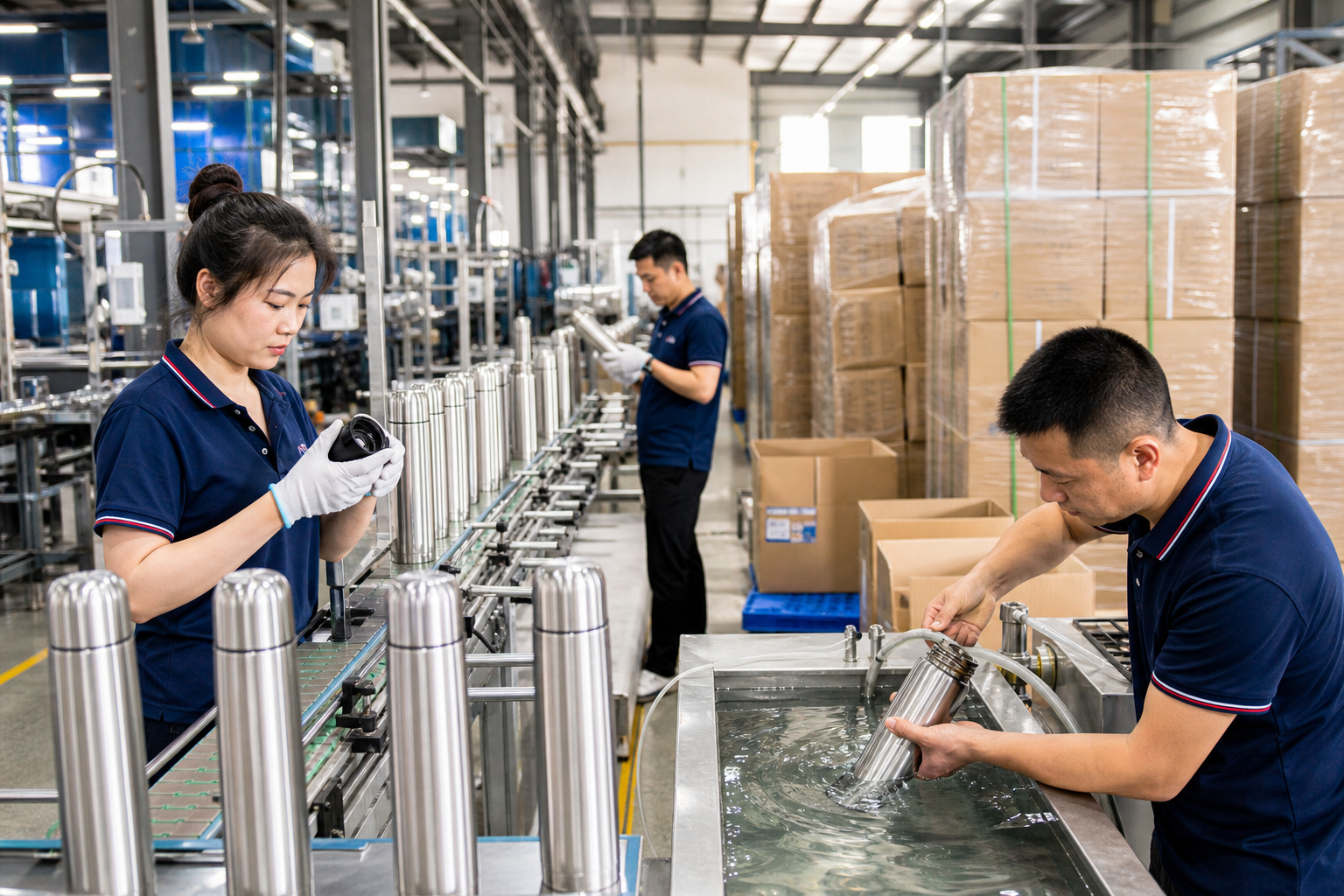
At our Zhejiang factory, we run both distributor thermos orders and branded promo runs. QC pulled the sample with a torque gauge last week, and the lid spec told us more than the logo ever could. The gap between a clean bulk thermos line and a headache is usually a few hard numbers: 304 vs 201 steel, 0.4 mm vs 0.5 mm wall thickness, AQL 2.5, and whether the supplier can hold a 30 to 45 day lead time. China has many thermos factory options; few will give you clean numbers up front, and that is where deals go sideways.
Specify the Thermos Before Artwork
Buyers often start with a logo file and end up with a thermos that misses the channel. That is the wrong question to ask. A manufacturer thermos should be set by use case first: commuting, hiking, gift sets, or retail shelf. We run the line that way in Hangzhou, because a 500 ml vacuum bottle with a tight screw lid behaves differently from a 750 ml gift item with a cup cap. Decide capacity, lid style, finish, and pack-out before you ask a thermos supplier for samples. If you sell to outdoor retailers, a 500 ml bottle with a screw lid is the safe start. For promo thermos jobs, a plain body and one-color print keep the margin from slipping.
Give the factory a short spec sheet and ask for a quote against that sheet. A PO typo on one run changed 500 ml to 550 ml, and the buyer flagged it before production; that kind of miss is expensive.
- Capacity: 350 ml, 500 ml, or 750 ml
- Lid: screw cap, flip lid, cup cap, or carry handle
- Finish: powder coat, polished steel, matte paint, or soft-touch coating
- Pack: retail box, mailer box, or bulk master carton
A serious thermos factory will confirm wall thickness, lid resin, gasket material, and carton count before it talks about decoration. QC pulled the sample on a 0.35 mm wall reading once, and the quote changed after that, which is how it should work. If you skip that step, you compare prices for products that are not the same. We see buyers waste weeks on this in China, then blame the market instead of the spec.
For distributor thermos work, keep the SKU structure simple. One body, one lid family, one carton format, then vary print or color. That keeps reorders clean and gives the line a stable setup, which matters when you are running 5,000 to 20,000 units. Push the buyer on this if needed. A customized thermos line with too many moving parts is hard to repeat six months later, and the math does not work.
Materials That Change Performance
The steel grade is not a marketing detail. On the line, we check the mill cert before anything else. For most custom thermos orders, 304 or 18/8 stainless inside the bottle is the baseline you should ask for. If you are buying a premium line, using 304 on both inner and outer shells gives better corrosion resistance and a cleaner feel. Budget builds may use 201 on the outside, but that trade-off shows up fast in dent resistance and long-term appearance. We had a buyer flag it after a carton scuffed in the 1.5 m drop test. If your buyer expects a premium factory thermos, do not hide those choices under a vague spec sheet.
Wall thickness matters more than many first-time buyers expect. On our gauge, 0.4 mm is common, while 0.5 mm feels stiffer and survives freight abuse better. For a 500 ml custom thermos, that extra 0.1 mm can be the difference between a clean retail return rate and a carton of dented rejects. Ask where the vacuum seam is welded and whether the bottle is laser welded or manually welded. QC pulled the sample when the seam wandered 0.3 mm off center. The cleaner the seam, the more consistent the heat retention.
The lid is the other half of the product. Use food-grade PP, Tritan, or similar resin for the top, and check the silicone ring hardness. A weak gasket will ruin even a good thermos manufacturer build. For Europe, confirm REACH compliance on coatings and plastics. For North America, keep food-contact declarations tied to the exact resin code and dye batch, not a generic supplier letter. We ship too many lids that look fine until the buyer measures the ring at 55 Shore A and the leak test fails. A good supplier thermos quote should name the material, not just say stainless steel.
For harsh outdoor use, many buyers also request a double powder coat or copper-plated vacuum chamber. That is not mandatory, but it does help thermal stability. Our powder booth runs at 180 C for 18 minutes, and we have seen this go sideways when a buyer asks for the coating after the sample is approved; the line has to reopen, and the math does not work. A real distributors thermos program should price those upgrades separately so you can decide where the money goes. We usually write it as a line item and keep the MOQ clear.
Decoration That Survives Use
Decoration is where a lot of thermos custom jobs get overdesigned. We run samples on a pad printer and a laser marker, and the first question is not what looks good but where the bottle will sit and how hard it will take abuse. For a promo thermos handed out at a trade show, one-color silkscreen or laser engraving is usually the safe call. For outdoor retail, matte powder coat plus laser mark holds up better against keys, car cup holders, and warehouse racks. If you need full-color branding on a customizable thermos, ask for heat transfer or wrap print, then pull the sample through real handling before you sign off mass production.
The main mistake is treating all print methods as equal. Silkscreen gives strong color on flat areas, but we have seen it scuff after 20 minutes in a metal basket or a week in a truck cab. Laser engraving is permanent, yet the contrast comes from the base coating, so a bad powder coat makes the mark look weak. UV print can look sharp on day one and still fail a simple rub test if the ink stack is thin. Ask for sample bottles that pass 50 rub cycles and a basic dishwasher check when the item will be washed at home.
If the decoration cannot survive 50 rub cycles, it is not ready for retail.
For bulk thermos orders, keep artwork simple. Thin lines below 0.3 mm, tiny type, and multi-stage gradients are where reject risk starts. If the brand team wants more detail, make them approve a production-like sample, not a clean PDF. We have seen a PO typo on a Pantone code turn into a 3-day delay, and this is the wrong question to ask if the line is already booked. That matters on thermos promotional items, where the schedule is tight and reprints burn margin. If you are comparing manufacturers thermos quotes, ask each vendor to state the decoration method, max print size, and color tolerance in writing.
We usually see the best balance on outdoor accounts with one logo placement, 1 to 2 colors, and a finish that does part of the branding work. On the line, QC pulled the sample at 300 mm because the logo sat too close to the shoulder, and that kind of issue is easier to fix before cartons are sealed. This is the setup we ship most often because it gives the buyer a clean result without asking the decoration to do the whole job.
MOQ, Pricing, and Lead Times
I’ve got the structure and constraints mapped. I’m rewriting the four paragraphs now so the wording stays close to how a factory-side sales engineer would actually quote and explain the numbers.Price only makes sense when it is tied to MOQ, packaging, and decoration. We run quotes as separate lines for the bottle, lid, print, and packing, because a thermos manufacturer in China can hide margin fast if everything is rolled into one number. If they hand you one lump sum, you cannot tell whether the supplier thermos price is sharp or just padded. For a standard 500 ml stainless model, FOB China pricing often lands around USD 3.20 to 6.80 per piece at 1,000 to 3,000 units, depending on steel grade, coating, and whether the lid is basic or upgraded.
Most custom thermos programs start with an MOQ of 1,000 pcs per SKU or per color. Some Zhejiang factories will accept 500 pcs if the design is standard and the decoration is simple, but the unit price will rise. A mixed-color order can add 10 to 20 percent. Laser engraving is usually cheaper than a multi-color print run because the line does not stop to swap screens, and the buyer who pushes for 600 pcs with three colors is asking the wrong question. Ask for a clear break at 3,000, 5,000, and 10,000 pcs if you want real thermos bulk pricing for a distributor program.
Lead time is where the factory thermos reality shows up. Samples usually take 7 to 10 days if the body is standard. Mass production runs 30 to 45 days after sample approval and deposit. If your project needs tooling changes, add 10 to 15 days. Our Zhejiang line capacity is about 300,000 units per month across stainless drinkware, so the bottleneck is often artwork approval, carton specification, or test sign-off. QC pulled one sample last week and found a 1.5 mm lid gap; that kind of miss will slow the line faster than the molding machine ever will.
For China sourcing, insist on a quote that states EXW, FOB Ningbo, and if needed CIF or DDP separately. That keeps the comparison clean across thermos suppliers and stops hidden freight assumptions from distorting landed cost. We have seen a PO typo turn a 500 ml carton spec into 550 ml, and the buyer flagged it only after sample packing. The math does not work if the trade term is vague.
Quality Checks That Matter
Quality control on a manufacturer thermos should be specific, measurable, and tied to the SKU. The inspection plan should not be a generic PDF. For a retail program, ask for pre-production samples, first article approval, in-line checks, and final inspection against AQL 2.5 for major defects and AQL 4.0 for minor defects. We run this with a sample sign-off sheet at the line, not a vague promise. If a thermos vendor cannot explain those numbers, they are pushing the risk back to you.
The tests that matter are simple. Leak testing is mandatory. Thermal retention should be checked with a defined fill temperature, ambient condition, and hold time. On the line, QC pulled the sample after a 30-minute soak at 95 C and checked the cap seal with dyed water. A useful spec might require the bottle to keep liquid above a target temperature for 8 to 12 hours, depending on capacity and lid design. Drop testing should cover at least 1.0 to 1.2 meters if the bottle is going into outdoor retail. For coated models, check abrasion and salt spray resistance if the finish will be used near coastal markets. This is the wrong question to ask: “Does it look fine in the showroom?”
For Europe, ask for REACH-related declarations and, where relevant, food-contact test reports. For North America, confirm the food-contact status of the steel, liner, coating, and lid resin. QC should pull the mill heat number and the resin lot against the report before carton close. If your customer needs social compliance, a BSCI audit or ISO 9001 certification helps, but only if it is current and tied to the correct factory address. A thermos supplier in China should be willing to show batch records, not just a certificate wall photo.
Good QC also means traceability. Put a batch code on the carton or master pack so a distributor thermos customer can isolate one production lot if there is a problem. Print it clearly, 6 mm high or more, or the warehouse will miss it. That saves money when you have multiple channels and multiple reorders in the same season. The math does not work if one bad lot takes three weeks to find.
Packaging for Retail and Promotion
I’m rewriting the section in place, keeping the HTML structure intact and tightening the language so it reads like a factory-side sales engineer, not generic copy.Packaging is not a side item. It changes freight, shelf appeal, and return rate. For outdoor retail, a retail-ready carton with a clean insert and barcode usually beats a plain white box. For a thermos promotion, a simpler pack-out cuts budget fast, but the carton still has to survive a truck from Ningbo to your warehouse. If you are shipping to Amazon FBA, you need FNSKU labeling, case-pack consistency, and a master carton that stays inside the inbound handling limit.
Ask the thermos factory to quote carton style, insert type, and packing count. A common setup is 12 pcs per master carton for retail and 24 pcs for bulk distribution, but the right count depends on bottle size and freight mode. A 5-ply outer carton with clear carton marks and a drop-tested inner pack is usually worth the small cost increase. We run this on the line all the time. The math does not work if you save 0.08 USD on the insert and then pay for dent claims in Seattle or Hamburg.
If you are a thermos distributor, packaging should be easy to reorder. Keep artwork on the carton minimal unless the box is part of the shelf display. For a custom thermos line, a simple belly band plus product card gives a premium look without pushing up unit cost. For promotional thermos orders, the box still needs to show capacity, insulation time, and cleaning notes. We have seen a PO typo turn 500 ml into 550 ml on the carton art. The buyer flagged it before shipping, and that saved a messy reprint.
One practical rule: if the bottle looks good but the pack fails compression or drop tests, it is not ready for export. QC pulled the sample off the 1.2 m drop table and the corner split on the second hit. That is the wrong question to ask if someone says the carton looks fine by eye. Especially when shipping from Zhejiang to Europe or North America, a few extra millimeters of pack protection can save a full container of product.
Build your thermos line with a clear spec
Send the target capacity, finish, and order volume. We will quote a practical custom thermos plan with MOQ, pricing, and lead time.
Frequently asked questions
What MOQ should I expect for a custom stainless thermos?
Most thermos manufacturers in China quote 1,000 pcs per SKU or per color for a standard custom thermos. If the body is already tooled and decoration is simple, some suppliers will accept 500 pcs, but the unit price usually rises 10 to 20 percent. For a more complex lid or custom mold change, plan on 3,000 pcs to make the economics sensible. Samples are usually 2 to 3 pcs, and the sample lead time is commonly 7 to 10 days. If you are buying for a distributor thermos program, ask for a price ladder at 3,000, 5,000, and 10,000 pcs so you can see where the real breakpoints are.
Which stainless steel grade should I choose?
For most bulk thermos projects, 304 or 18/8 stainless is the correct baseline for the inner wall. If you want a premium feel or better corrosion resistance, use 304 on both inner and outer shells. Budget builds sometimes use 201 on the outside, but that is a trade-off in dent resistance and long-term appearance. 316 is available for certain premium or harsher-use applications, but it usually adds 10 to 15 percent to material cost. Ask the supplier thermos quote to name the exact grade, wall thickness, and any coating system so you are not comparing mismatched samples.
How long will the bottle keep drinks hot or cold?
A normal double-wall vacuum thermos custom bottle will usually keep drinks hot for 8 to 12 hours and cold for 18 to 24 hours, assuming a 500 ml size, a proper seal, and preheated or prechilled contents. Real performance depends on wall thickness, vacuum quality, lid design, and how often the user opens it. A wide-mouth lid or cup-style cap usually performs worse than a tight screw lid. If a thermos supplier gives you a retention claim, ask what test temperature, fill volume, and ambient condition they used. Without that, the number is just marketing.
What decoration method is best for a promotional thermos?
For a promotional thermos, one-color laser engraving is the safest choice if you want a mark that lasts. It holds up well on matte powder coat and does not add much setup time. Silkscreen works well when the logo is larger and the color is simple, but it can wear with heavy handling. UV print or heat transfer is better for complex artwork, yet it needs testing before mass production. If you are buying thermos promotional stock for events or giveaways, ask the thermos vendor to provide a decorated sample that passes at least 50 rub cycles before you approve the run.
What compliance documents do EU and US buyers usually ask for?
For Europe, buyers often want REACH-related declarations and food-contact test reports tied to the exact thermos SKU, coating, and lid resin. For some markets, LFGB testing is also requested, especially by retail chains. For North America, a food-contact declaration and traceable material data are usually the minimum. Many larger retailers will also ask for ISO 9001 and, if they audit the factory, BSCI or a similar social compliance record. The key point is that the documents must match the actual production line in China, not a generic certificate from another product. Ask the thermos manufacturer to name the batch number and test lab on each report.