Key Takeaways
- A serious canteen manufacturer should quote MOQ, lead time, and monthly capacity up front; 5,000 pcs MOQ and 20-30 days is common for standard custom canteen runs.
- For branding, silkscreen is cheaper, laser engraving lasts longer, and powder-coated bottles need different validation than bare stainless steel.
- Ask for AQL 2.5 or 4.0 inspection terms, REACH documents, and material specs such as 18/8 stainless steel or Tritan before you confirm.
- A factory in Zhejiang that already runs 300,000+ units/month is usually better for repeat distributor canteen programs than a small workshop.
If you are buying from manufacturers drinkware for the first time, the real risk is not the color. It is signing off on the wrong bottle structure, the wrong decoration method, or a factory that cannot hold your launch date. A canteen custom order can look clean on a quote sheet, then fail on sealing, print wear, or packing once it moves into retail or distributor channels. We have seen a 12-day sample promise slip to 18 days because the buyer pushed a lid change after QC pulled the sample on the drop tester. That is the wrong place to cut corners.
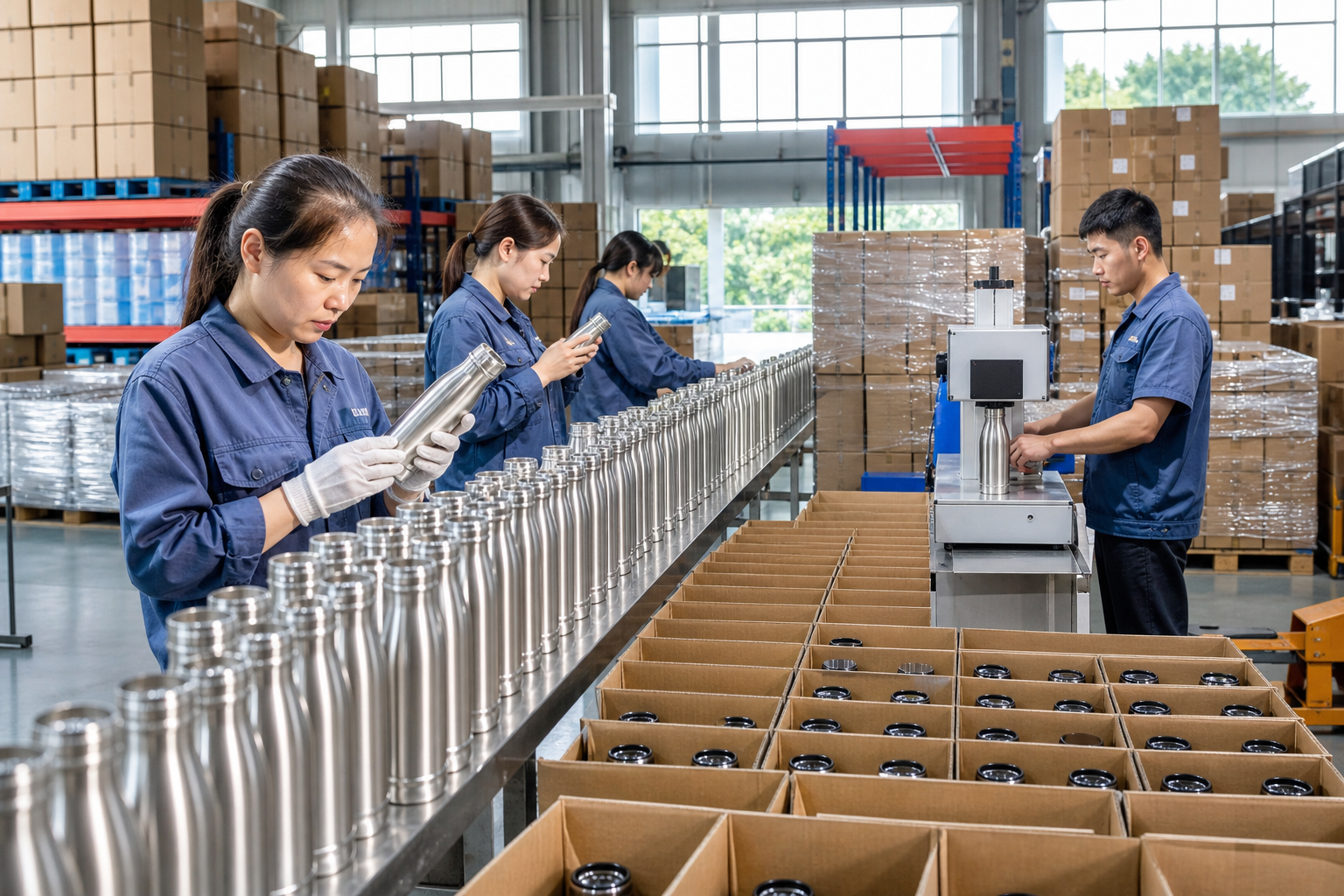
In Zhejiang and across China, a real canteen factory talks in units per month, cavity count, coating line capacity, and AQL targets, not only sample photos. A proper line will tell you whether the spray booth runs 0.2 mm coating control, whether the MOQ is 3,000 pcs or 10,000 pcs, and where the bottleneck sits on the packing table. If you want customized drinkware that ships cleanly and repeats well, judge the manufacturer on process, not sales talk. This is the part many buyers get wrong, and the math does not work any other way.
What a real factory quote should show
Start with the quote structure, not the product photos. A real manufacturers drinkware quote should split base unit price, decoration cost, packaging cost, test fee, and freight assumption. If a canteen supplier hands over one blended number, you still do not know what moves when the buyer changes from 1 color print to 2 colors, or from a standard carton to a retail box. We see that mistake on the line all the time.
For a custom drinkware program, the quote should state material grade, capacity tolerance, wall thickness, lid type, and whether the price is based on FOB Ningbo, FOB Shanghai, or EXW Zhejiang. That matters because a canteen distributor usually needs landed cost control, while a canteen vendor serving promotions may only want a fast FOB number. We run a lot of 500 ml and 750 ml jobs, and the math gets messy fast if the supplier skips the details. A real factory in Zhejiang should also give the practical MOQ, often 3,000 to 5,000 pcs for a standard customized canteen, plus a normal lead time of 20 to 35 days after sample approval.
Ask for these items before you compare prices:
- Exact material: 304 or 316 stainless steel, Tritan, PP, or glass
- Decoration method: silkscreen, laser, heat transfer, or UV print
- Packing spec: bulk, gift box, or e-commerce mailer
- Inspection standard: AQL 2.5 for critical defects, if applicable
If the supplier cannot explain these clearly, the quote is not ready for purchase decisions. QC pulled the sample last week and found a 1.2 mm wall thickness miss, so this is the wrong question to ask.
Choose the right material first
Material choice decides more than hand feel. It changes unit cost, drop resistance, carton weight, and how the bottle holds up after 50,000 uses in Europe or North America. A canteen factory that runs export orders does not force every job into one material. For a school promo bottle, PP or Tritan is enough. For a custom growler or a retail canteen made for outdoor use, stainless steel is the safer pick because it takes dents better and keeps temperature longer.
For stainless steel drinkware, 18/8 is the language buyers expect. We still ask for inner wall thickness, outer wall thickness, vacuum seam quality, and a 24-hour leak test, because a 0.3 mm mistake on the wall or a weak seam shows up fast on the line. For glass bottle programs, ask for borosilicate grade and thermal shock range. For a customizable growler, mouth opening and cap torque matter more than the artwork. A bad lid kills the product faster than a weak logo print. We have seen buyers argue over print color while QC pulled three leaking samples from the same carton.
China has enough production depth that the same shape can be made in several materials, but not every factory is strong across all of them. One Zhejiang canteen plant may be set up for stainless steel vacuum lines, while another is better on injection-molded lids and PP parts. If you are buying distributor drinkware, match the product to the factory line, not the other way around. That is the practical move. We shipped one program where the buyer wanted a steel body from a lid factory, and the math did not work once the first 2,000 pieces came back with fit issues.
Do not ask, “Can you make it?” Ask, “How many units per month do you make in this exact structure, and what fails most often?”
Branding methods that hold up
I’m rewriting the section now to keep the HTML structure intact while stripping the AI-style phrasing and adding concrete factory details that sound like a sales engineer wrote it.Branding is where a lot of canteen custom orders go wrong. Buyers approve the decoration from a rendering, then ask us to make it survive abrasion, dishwashing, and daily hand contact. On one PO, the buyer typed the decoration position as 15 mm from the base, then sent a photo marked 5 mm; that kind of mismatch shows up after the first carton is opened. If your customer base is retail or distributor canteen programs, the mark has to stay readable after use. For a canteen promotional campaign, the cheapest method can work. For a premium distributor growler, it usually fails.
Silkscreen is still the best value for flat-color logos on smooth surfaces. Laser engraving holds up better on stainless steel because it cuts into the metal instead of sitting on top of it. UV print gives sharper graphics, but it needs proper curing and adhesion testing; we run a 3M tape pull after 24 hours and reject weak bonds fast. Powder coating changes the rules again because surface energy shifts the ink bond and scratch resistance. A good canteen vendor will tell you which finish works for which logo style. If they cannot, you are dealing with a sales layer, not an engineering layer. The math does not work.
For a canteen customizable order, the logo position matters too. A mark near the base can look clean in a mockup, then disappear under hands, cup holders, or shelf stacking. QC pulled a sample last month and the buyer flagged the logo sitting 7 mm too low for retail display. For custom drinkware sold through distributors, I ask for one decorated sample with the exact Pantone reference, one abrasion test, and one packing test with the final carton. That costs more up front, but it saves you from a whole run of customized drinkware that looks right in photos and wrong on delivery.
Choose the method that fits the product life cycle: 30-day promotion, 12-month retail, or private label that has to hold up through repeated use. For MOQ 500 runs, we can switch decoration without changing the body tooling, but the buyer has to decide that before the cartons are printed. The real question is how long the mark has to hold up, not how bright it looks on a screen.
MOQ, pricing, and lead time reality
Buyers often stare at unit price and miss the cost drivers that decide whether a program works. MOQ, mold ownership, packaging, and lead time set the real math. A cheap quote with a 60-day lead time can lose to a slightly higher price with a 25-day lead time if you are feeding distributor replenishment or pushing an Amazon launch. We have seen that go sideways on the line when a buyer saved $0.18 and then missed a promotion window by 3 weeks.
For standard shapes, a Zhejiang canteen factory may offer a 3,000 to 5,000 piece MOQ. For a new mold or a deeply customized canteen, the MOQ can rise to 8,000 or 10,000 pcs because tooling and setup cost have to be spread across volume. If you need a custom growler with a unique lid or handle, expect a higher upfront cost and a longer tooling cycle. QC pulled the first sample with a caliper at 0.5 mm, and that is normal, not a warning sign. The wrong question is “why is the MOQ high?” The better question is whether the volume matches your sell-through.
Pricing also changes by season. When export capacity is tight, especially before peak shipping windows, factories in China will prioritize repeat orders and container-efficient SKUs. Ask whether the factory can commit to monthly production, not just one batch. A serious manufacturer might run 300,000 units per month across multiple lines, but you still need to know your SKU’s slot on that schedule. We ship by slot, not by wish list. Ask for sample lead time, production lead time, and shipment lead time separately. Those are not the same thing, and a PO typo on the requested ship week can push the booking by 12 days.
- Sample lead time: usually 5 to 10 days for standard items
- Production lead time: usually 20 to 35 days after sample approval
- Peak-season buffer: add 7 to 15 days if you need guaranteed booking
That is the realistic way to budget a custom canteen program.
QC and compliance you should request
QC is where an exporter keeps the repeat order or gets stuck paying for returns. A canteen suppliers list only matters if the factory can show the inspection record behind it. For Europe and North America, ask for REACH-relevant material declarations, food-contact compliance where it applies, and test reports tied to the exact batch. If the supplier cannot trace the report back to the resin lot or steel coil, the paper is weak. We have seen that go sideways on a 3,000-piece order when the buyer flagged a batch number typo on the PO.
A proper QA package for customized drinkware should cover incoming inspection, in-process checks, and final random inspection. AQL 2.5 is common for critical defects, but the defect table has to be agreed before the line starts. Leakage is critical. A 0.3 mm print shift may be minor if your brand allows it, while a dent at the rim is a major issue. That level of detail stops a canteen distributor from reopening the argument after QC pulled the sample at the packing table.
Good factories in Zhejiang and other parts of China will also show torque test results for lids, drop test results for packed cartons, and insulation data when the product is vacuum insulated. If you are sourcing a customized growler or insulated bottle, ask how they verify temperature claims. Do not take brochure copy at face value. Ask for the starting water temperature, ambient temperature, test interval, and lid setup. If the numbers are real, the technician can give them without checking a script. If they hesitate, the math does not work. We run these checks with a torque meter and a 1.2 m drop test on the carton line.
Minimum documents to request:
- Material spec sheet with grade and thickness
- Test report or declaration for food-contact use
- Final inspection checklist with AQL target
- Packing drop or carton compression test, if exporting at volume
How to fit supply into your channel
The best product is the one that fits your channel with no friction. A canteen distributor selling to outdoor shops needs pack-out that protects margin, while a buyer for corporate gifts cares more about logo placement and a clean PO. On our line, one channel wants 24-piece inner cartons and barcode stickers; another wants mixed colors and a 7-day turn. If you skip this step, QC ends up building the wrong commercial setup.
For e-commerce or retail, ask whether the supplier can print carton marks, barcode labels, and FNSKU stickers if needed. For wholesale, ask whether they can keep your logo plate, cap color, and gift box consistent across replenishment orders. QC pulled the sample once and found the cap color code was typed as `PMS 186 C` on the PO, then changed to `PMS 185 C` two lines later. That kind of mismatch turns into a headache fast.
There is also a sourcing geography question. If you are buying from China, Zhejiang has depth: lid makers, coating shops, print shops, and packaging vendors sit close enough to keep the loop tight. We run a cap seal test at 0.6 bar before shipment, and when a buyer flags a leak, we can usually fix it in 12 days instead of 18. The math does not work if a cheap quote burns two extra rounds.
Choose the factory that can run your channel structure, not the one that only wins on the first quote.
Request a factory quote that matches your channel
Send your capacity target, decoration method, and monthly volume. We will quote the right custom drinkware structure, not a guess.
Frequently asked questions
What MOQ should I expect from a canteen manufacturer?
For standard custom canteen or custom drinkware runs, a normal MOQ is 3,000 to 5,000 pcs per color or per design. If you need a new mold, a special lid, or a custom growler shape, the MOQ can rise to 8,000 or 10,000 pcs because tooling and setup cost have to be recovered. In Zhejiang, some factories can support smaller trial runs, but the unit price usually jumps 15% to 30%. Ask whether the MOQ is tied to one print method, one carton style, or one SKUs mix. That detail changes your real buying cost.
How long does production usually take in China?
For a standard order from a canteen factory in China, sample lead time is often 5 to 10 days and production is 20 to 35 days after sample approval. If you need a custom mold, add 15 to 25 days for tooling. Peak season, port congestion, or special packaging can add another 7 to 15 days. If a supplier promises 10-day mass production on a complex customized drinkware item, check whether they are counting only assembly and not decoration, curing, inspection, or carton packing. The schedule should be broken into steps, not presented as one vague promise.
Which branding method lasts the longest?
On stainless steel drinkware, laser engraving usually lasts the longest because it removes material instead of sitting on the surface. Silkscreen is cost-effective and works well for simple logos, but it can wear if the bottle is scraped often or washed aggressively. UV print gives more color flexibility, but adhesion depends on coating and curing control. For a canteen promotional order, silkscreen may be enough. For a distributor growler or retail canteen customized for long-term use, ask for abrasion testing and a decorated sample before mass production. The right choice depends on use, not just appearance.
What quality documents should I ask for?
At minimum, ask for material specifications, food-contact declarations where applicable, and a final inspection sheet with the AQL target. For export drinkware, REACH-relevant declarations, batch traceability, and test results for leakage or drop resistance are useful. If you are buying an insulated custom canteen, ask how the supplier verifies temperature retention and what exact test conditions were used. A credible canteen supplier will not hide behind marketing language. They should be able to identify the material grade, thickness, and inspection method for the exact production lot you are ordering.
Can one factory handle both distributor and promotional orders?
Yes, but only if the factory has enough line flexibility and process control. A large canteen manufacturer in Zhejiang may run 300,000+ units per month across different product lines, which helps them switch between distributor canteen programs and canteen promotional orders. The real question is whether they can keep documentation, packaging, and decoration consistent for reorders. A distributor usually needs stable SKUs, barcode labeling, and repeatability. A promotion buyer may need fast turnaround and mixed colors. Ask the factory how they manage both without changing your specification during replenishment.