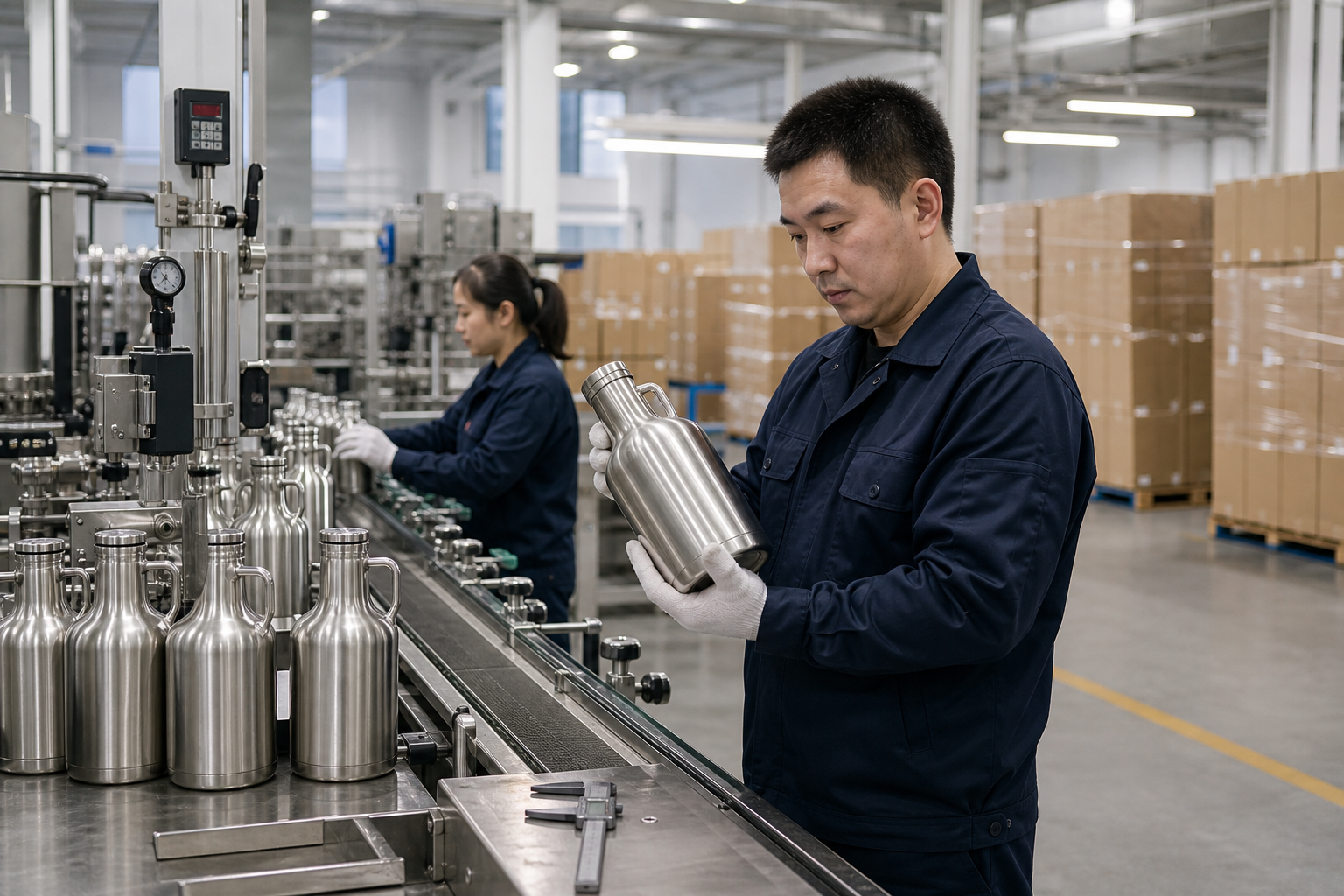
Key Takeaways
- Most custom growler programs start at MOQ 500-1,000 units, with 25-35 day lead times from a Zhejiang factory.
- 304 stainless steel at 0.5 mm is the usual baseline; 316 and double-wall vacuum builds cost more but reduce returns.
- Ask for AQL 2.5 major, leak testing, REACH or LFGB paperwork, and carton specs before you approve production.
- A good canteen manufacturer can handle canteen custom, promotional drinkware, and distributor packaging without changing the process twice.
If you are looking for manufacturers growler, you are not buying a generic bottle. You are buying a container that has to pour cleanly, seal tight, carry your logo, and survive truck loads, carton drops, and 12 days on the line without a leak. We saw one buyer send a PO with “growller” spelled three ways; QC pulled the sample, checked the lid torque, and the quote changed fast when the spec was fixed.
For buyers in Europe and North America, the real question is whether a canteen factory in Zhejiang or elsewhere in China can hit your market requirements without guesswork. The right custom drinkware supplier should quote by volume, show FDA, LFGB, or other compliance files, and spell out how a custom growler or customized drinkware program will be packed, printed, and shipped—down to the carton size and MOQ. The math does not work if nobody checks the lid liner or the 0.3 mm print shift before mass production.
What Buyers Really Need
A growler usually gets sold as a beer container. Buyers know better. Cold brew, kombucha, juice, water, and event kits all use the same base product family, so the real job is to control capacity, closure, finish, and decoration method. Skip one of those points and you get a custom growler that looks clean on the sample table and starts causing trouble in the distributor channel. We had one PO where the buyer wrote “64oz” but the carton art said 1,850 ml; QC pulled the sample, and the math did not work.
Start with the business model. A craft beverage brand may want a 64 oz custom growler for taproom sales. A sports buyer may want a 32 oz customizable canteen for retail. A promo buyer often pushes hardest on unit cost and ignores insulation, and that is the wrong question to ask. A canteen manufacturer that knows custom drinkware should ask about shelf display, FNSKU labeling, and bulk export cartons. If the supplier cannot split distributor drinkware from giveaway drinkware, the quote is noise. We run into this at MOQ 3,000 all the time, and the first sample usually tells the truth.
Ask for the exact fill volume, not the marketing size. A nominal 64 oz product may hold 1,900 ml in one build and 1,850 ml in another, depending on wall shape and closure headspace. That 50 ml gap matters when you print carton claims or bottle graphics. Give the factory a clear spec, and the line can quote cleanly and avoid rework. I have seen buyers send a PO with a missing decimal on the label copy; the buyer flagged it two days before shipment.
Materials That Hold Up
For most buyers, 304 stainless steel is the practical starting point. It is common, stable, and usually the best cost-performance pick for a custom growler. If the buyer wants harsher service, 316 stainless gives better corrosion resistance for acidic drinks or coastal routes, but the price moves up. On the line, QC will still pull a magnet and a caliper before release. Wall thickness matters too. A single-wall bottle often runs 0.4-0.6 mm, while a vacuum build may use 0.5 mm inner and outer shells with a copper or aluminum heat layer, depending on the structure.
Do not treat material choice as a branding decision only. That is the wrong question to ask. It changes weight, drop resistance, thermal hold, and freight cost. A heavier customized drinkware item can pass the spec sheet and still miss your landed-cost target by a wide margin. We have seen this go sideways after a buyer approved a sample, then the carton test showed scuffing and dent marks. The same applies to coatings. Powder coat improves grip and hides fingerprints, but weak coating systems chip during carton friction. A canteen supplier with real process control should tell you whether the finish is food-contact safe, scratch-resistant, and compatible with laser engraving or silk screen. If they cannot answer that without checking back three times, the line is not ready.
For Europe, ask for REACH or LFGB support where applicable. For North America, ask what documents the factory keeps for stainless composition, silicone seals, and packaging inks. A canteen manufacturer in Zhejiang should not stay vague on this point. We have seen a PO typo turn a 316 request into a 304 order, and that is a costly fix once production starts. If the paperwork is thin, the risk sits with you, not with the factory.
- 304 stainless for standard retail programs
- 316 stainless for harsher use cases
- Food-grade silicone for gaskets and seals
- 0.5 mm thickness as a common practical baseline
Decoration Without Regret
Decoration is where a lot of canteen custom programs go sideways. We keep it simple on the line: pick the process that survives handling, washing, and retail abuse. Silkscreen works for 1 or 2 colors and keeps setup cost down. Laser engraving gives a permanent mark on metal finishes. Heat transfer and UV printing can hold more detail, but QC pulled the sample after 2 washes if the settings are loose.
For a custom drinkware order, ask where the logo sits, how big it can go, and whether the print area will warp on the curve of the bottle. A custom growler with a tall shoulder can cut usable space fast. If you want full-wrap artwork, confirm the seam position and the alignment tolerance in mm. We show the artwork dieline before production, not after a buyer flags a PO typo on the decoration size. That matters on canteen promotional orders where 3 SKUs share one body and only the branding changes.
If you sell through a canteen distributor or distributor growler channel, packaging matters as much as the print. A scratched bottle in a retail case is a chargeback risk. Ask for carton inserts, sleeve protection, and barcode, UPC, or FNSKU labeling at the line. We ship with a sample carton dropped from 1.2 m when the buyer wants proof, because that is the difference between a nice sample and a usable distributor canteen program.
For buyers comparing print methods, the real question is durability versus cost. This is the wrong question to ask if the artwork is complex. If the budget is tight and the design is simple, silkscreen is enough. If the order has to survive heavy use, laser is the safer call. A canteen vendor should put the tradeoff in numbers, not sales talk.
MOQ And Lead Time Reality
Most first-time buyers miss the shop-floor math. A custom growler is not a stock carton pull. Tooling, artwork sign-off, packaging confirmation, and QC planning all eat calendar days. On a Zhejiang line, we run 50,000 to 80,000 units a month across several drinkware SKUs, but that does not mean your new design starts tomorrow. For custom work, MOQ usually lands at 500 to 1,000 pieces for a simple logo order, then 1,000 to 3,000 pieces when you want custom color, special coating, or new packaging. We had a buyer flag a PO once because they wrote “500 pcs” for a four-color print job. The math did not work.
Lead time is usually 25 to 35 days after sample approval and deposit for standard custom drinkware. If you need a new mold, a larger print area, or a complex accessory set, add 15 to 30 days. Sampling usually takes 7 to 10 days if the factory already has a similar body. QC pulled the sample on a caliper at 2.0 mm wall thickness before release, and that saved us from a bad batch. Buyers who know their plan save weeks by approving artwork and carton specs together instead of serial steps.
If a canteen manufacturer cannot tell you MOQ, sampling time, and production lead time in one clear answer, they are not ready for export work.
That is even more true for canteen manufacturers serving Europe and North America. Your sales calendar may be fixed by retail resets, event dates, or Amazon launch windows. A good supplier should not just say yes; they should tell you whether the schedule is realistic from China to your port. We ship to both coasts, and the buyer always asks the same thing first: can your line hold the date, yes or no? If they are in Zhejiang, ask for the weekly output on the exact line that will handle your order, not the factory total on the brochure. We’ve seen that go sideways fast.
Quality Checks Worth Paying For
Quality control is where low-price offers crack. A real custom canteen or custom growler order needs more than a quick visual check. Ask for a stated AQL level, usually AQL 2.5 for major defects and AQL 4.0 for minor defects on export orders. That gives you a number you can hold the factory to. Then ask how the line tests leaks, cap torque, coating adhesion, and carton drop performance. If the answer stays vague, the inspection system is weak. We have seen buyers accept a shiny sample, then QC pulled 12 pieces from the first carton and found two loose gaskets.
For stainless drinkware, leak testing belongs on the line, not at the end. Caps and gaskets need fit checks under pressure and after thermal cycling. If the item is insulated, ask for thermal-hold data under one fixed test condition, not a sales claim. A canteen supplier shipping into Europe needs the files for REACH or LFGB ready, not “we can send later.” For North America, ask what they can provide for food-contact materials, carton ink, and silicone safety. Good factories in China keep those docs in the office drawer before you ask twice. We run a 50 kPa pressure check on the cap station for a reason.
One practical rule: inspect the first 500 pieces as if they were the whole order. Check thread fit, paint uniformity, laser depth, and carton integrity. A canteen vendor serious about distributor drinkware will take that request in stride because it protects both sides. If a promotional canteen order is for resale, the pack has to be clean. No dents, no rubbed corners, no crooked inserts. The wrong question to ask is whether a sample looked nice; the real question is whether the line can repeat it on day 6, not only day 1.
Ask for pre-shipment photos, carton count, and if possible third-party inspection before balance payment. That is cheaper than handling complaints after the goods leave Zhejiang or another China export port. We have seen a buyer flag a PO typo on carton quantity and catch it only because the export mark on the outer box read 480, not 540. That kind of miss costs real money.
Choosing The Right Supplier Type
Buyers throw supplier labels around, but the gap matters. A canteen vendor may only resell stock items. A canteen supplier may do some customization and still lean on another plant. A canteen factory owns the line. For a custom growler or customized canteen order, we usually push buyers toward the factory or a trading partner that can show direct line control. One artwork tweak can cost 3 to 5 days if the chain has two middlemen.
If your business is retail distribution, ask whether the partner supports distributor canteen, distributor drinkware, or distributor growler packaging. If you run promotions, ask about canteen promotional packs, gift boxes, and multi-pack sleeves. We had a buyer flag a PO where “gift box” was typed as “giftbosk”; QC caught it before print, and that saved a rework on the packing line. If you are building a broader product mix, one plant may also run custom canteen, canteen custom, and customizable drinkware programs, so you can keep 5 SKUs under one supplier instead of juggling three factories.
The strongest sign of a good canteen manufacturer is not a glossy catalog. It is a straight answer on MOQ, sample cost, shipping documents, and who signs off artwork before the line starts. Ask for those four points in writing. A factory in China that answers them directly is usually safer than a middle layer that talks big but cannot show the process. We ship from Hangzhou, and we see this go sideways when the buyer only checks price.
For buyers in Europe and North America, the best supplier is the one that protects margin and cuts surprises. That usually means a Zhejiang factory with export experience, a documented QC flow, and monthly capacity that can cover reorders without stopping the line. A 6,000-piece repeat should not turn into a fresh 25-day wait because the partner has to “check with the plant” every time.
Send your growler spec for a fast factory quote
Share volume, material, logo, and carton needs, and we will map the right MOQ, lead time, and compliance path for your market.
Frequently asked questions
What MOQ should I expect for custom growlers?
For a standard custom growler with one-color logo and stock packaging, expect MOQ around 500 to 1,000 units. If you add custom color, special coating, or a new lid, many canteen manufacturers move to 1,000 to 3,000 units. A factory in Zhejiang may say yes faster than a local broker, but you still need to confirm whether the line is set up for your exact size. Ask for sample cost, bulk price at 1,000 and 3,000 units, and whether the MOQ changes for repeat orders. The real test is whether the supplier can hold the same finish and leak standard on the second run, not just the first.
Can I customize logo, color, and packaging?
Yes, but each layer changes cost and lead time. Logo-only custom drinkware orders are the easiest: silkscreen, laser, or a simple decal can often move with 7 to 10 days for samples and 25 to 35 days for production after approval. Custom color on powder coat or painted finish may add 5 to 10 days because the factory needs a separate coating setup. Packaging changes matter too. If you need retail boxes, barcodes, FNSKU labels, or a distributor carton spec, the canteen factory should confirm the exact insert and master carton count before production. That is how you avoid rework on a China export order.
What compliance papers should I request?
Ask for the documents that match your market, not a generic file bundle. For Europe, buyers commonly request REACH support and, where relevant, LFGB-related material information for stainless steel, silicone, inks, and coatings. For North America, ask what food-contact declarations, material specifications, and packaging statements the factory keeps on file. If the order is for distributor drinkware or retail canteen promotional use, ask for the inspection standard too, ideally AQL 2.5 major and 4.0 minor. A serious canteen supplier should also provide product photos, carton details, and test records for leak or drop checks before shipment.
How do I pack growlers for retail or FBA?
Packaging is not an afterthought. For retail, you want the bottle to arrive without scuffs, so ask for sleeves, dividers, or molded inserts. For Amazon FBA, the carton must match the warehouse rules, including unit labeling, carton markings, and pallet configuration where needed. If the product is going to a canteen distributor, ask whether the outer carton can carry barcode, SKU, and country-of-origin labels at the factory. A good supplier in China can usually handle this in line, which saves labor at your warehouse. Confirm the master carton size, gross weight, and drop-test expectation before the first order ships.
Should I buy from China or a local supplier?
If you need volume, China is usually the practical answer because the cost base and factory scale are better aligned with custom drinkware orders. A Zhejiang canteen factory may run tens of thousands of units per month and still quote a custom growler at a lower landed cost than a local reseller. The tradeoff is that you need tighter control on sample approval, QC, and documents. A local canteen vendor can be useful for urgent replenishment or small runs, but for repeatable custom canteen, customized drinkware, or distributor canteen programs, direct factory sourcing usually gives you better margin and more control over the spec.