Key Takeaways
- A realistic MOQ for custom thermos orders is usually 500-1,000 pcs for logo work and 1,000-3,000 pcs for new colors or lids.
- For export, ask for 304 or 316 stainless, REACH or LFGB support, and AQL 2.5/4.0 inspection before you approve production.
- A Zhejiang factory running multiple lines can often produce about 300,000 units/month, but custom sampling still takes 7-10 days.
- Most price gaps in thermos bulk orders come from lid design, coating, and packaging, not from the steel body alone.
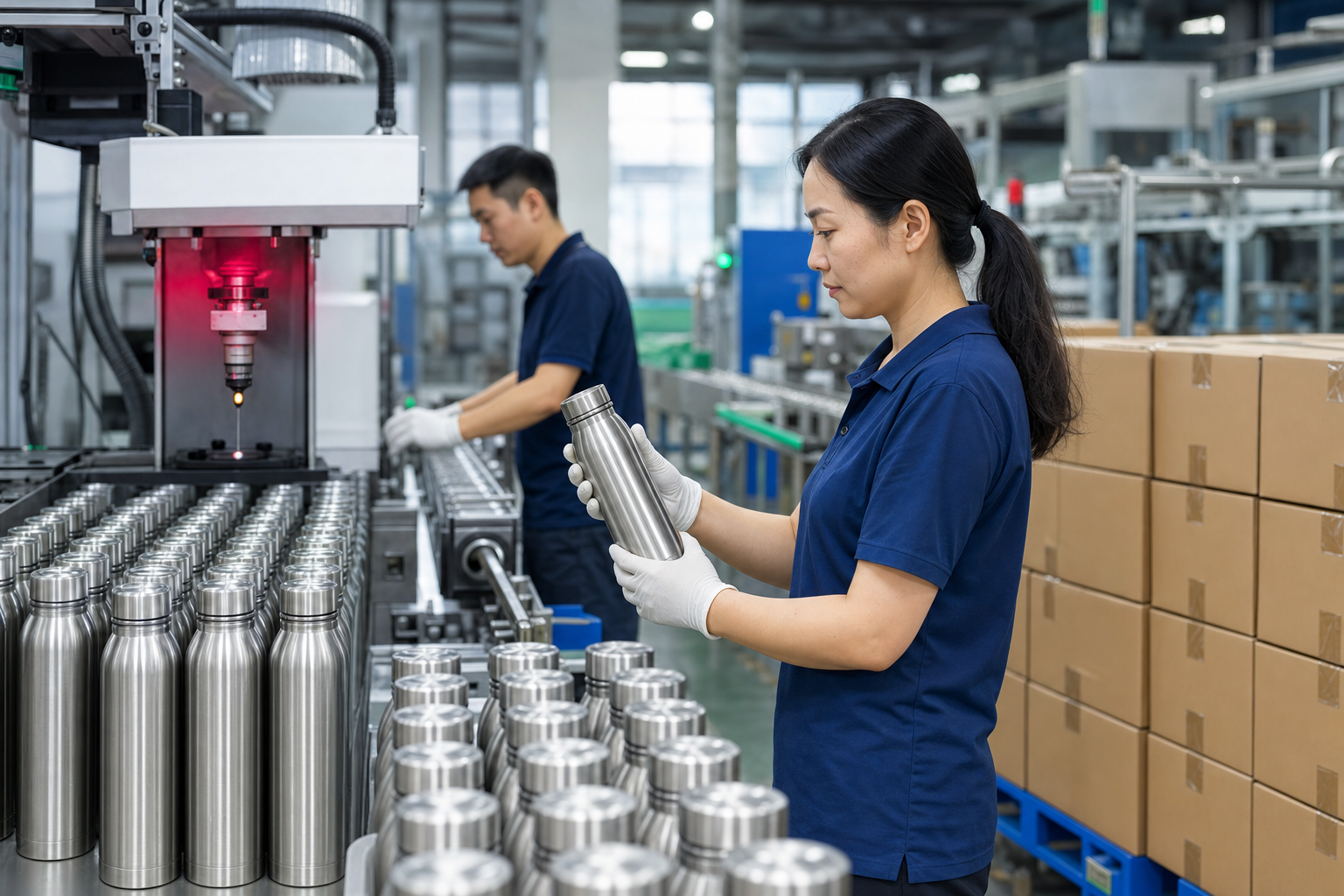
If you are comparing manufacturers thermos for outdoor retail or a promotion run, the wrong quote looks cheap until the lids leak, the steel stains, or the logo peels after two washes. We check the line with a torque gauge, a vacuum test, and a 24-hour water hold before we talk price. That is the line between a bulk thermos order that ships clean and a carton that comes back on claim.
In Zhejiang and across China, the better factory thermos suppliers work to plain specs: 304 or 316 stainless, wall thickness at 0.4 mm or 0.5 mm, AQL inspection, and lead times that match the print schedule. QC pulled the sample after a buyer flagged a typo on the PO, and that saved a 5,000-piece run from a bad carton label. If you want custom thermos, thermos custom, or thermos promotional work that lands with distributors and end buyers, lock the spec sheet first. The math does not work any other way.
Choose the Right Thermos Factory
Compare thermos manufacturers by who controls the line. A trading company can resell a decent bottle, but a factory with its own vacuum welding line, powder-coating booth, and QC desk ships steadier repeat orders. Ask for the steel spec, lid drawing, and the actual flow card. If they cannot tell you whether the weld seam is 0.3 mm or 0.5 mm, the quote is not ready for procurement.
A serious supplier thermos quote should break out body, lid, surface finish, print, and carton cost. One lump price is the wrong question to ask. A giveaway thermos can run with a screw lid and one-color logo, while a retail custom thermos with a trigger lid, powder coat, and insert box lands on a different MOQ. We have seen buyers flag a PO because the carton spec missed a 2 mm insert size and the packing table had to redo the count.
Rule of thumb: compare the process first, price second. If a factory cannot explain vacuum sealing, leak testing, and drop-pack protection in plain terms, keep looking.
In Zhejiang, factory thermos plants often run two lines, but the better ones still keep the basics on paper: ISO 9001 workflow, BSCI if social compliance matters, and traceability for raw material lots. We check the coil tag and the line card before release. That is what turns a one-off order into repeat supply. For outdoor retailers and brand owners, that matters more than shaving 0.15 yuan off the first PO.
Stainless Steel Specs That Matter
On stainless thermos products, the body spec drives performance more than the print. We usually run 304 stainless for both inner and outer walls; 316 only makes sense when the buyer wants higher corrosion resistance or acidic filling. For a standard factory thermos, we ask for 0.4-0.6 mm wall thickness on the body and a food-contact liner with no visible weld burn. Thin metal saves cost, but it dents fast, and if the forming is off by even 0.2 mm the heat retention drops. The math does not work any other way.
Vacuum construction is the real engine. A well-made bulk thermos should hold hot water above 60 C after 12 hours and cold water below 10 C after 12 to 24 hours, depending on volume and lid style. A wide-mouth thermos usually loses a little more heat than a narrow-mouth travel shape. If a vendor throws out perfect numbers without the test method, we ask for 95 C fill temperature, ambient 20-25 C, and the measurement interval. QC pulled the sample on one lot and the reading slipped 4 C by hour 12, so this is the wrong question to ask without the test setup.
Pay attention to the lid. A polypropylene cap with a silicone gasket can work for office use, but a better thermos distributor spec may need a threaded lid with a vent, a drinking cup, or a removable seal for easier cleaning. The gasket material and assembly tolerance matter because most leaks start at the closure, not the steel wall. We ship a lot of samples after a 0.3 mm seal gap gets flagged on inspection, and a buyer will catch that fast. Good thermos suppliers show the seal profile first, then the graphics.
Customization That Sells in Retail
For a custom thermos, the decoration method should match the channel. Screen print is the cheapest option for one or two colors and works well for promotional thermos runs of 500 to 2,000 pieces. Laser engraving is cleaner for premium retail, but it exposes steel and does not suit every coated surface. Heat-transfer graphics and UV print carry more detail, and they raise cost and demand tighter color control. On our line, a 60 mesh screen will keep a small logo sharp on a 500-piece run.
Color is where many custom thermos orders go wrong. Powder coating gives a tougher finish than basic spray paint, but it needs a controlled cure time. If you want a customizable thermos with a Pantone match, ask whether the factory will confirm the sample under daylight D65, not just under shop lighting. QC pulled the sample to the D65 box for a reason. This is the wrong question to ask if you only want to know whether it "looks close" under warehouse tubes.
Packaging is part of the product. A distributor thermos program often needs a plain mailer for ecommerce, while a retail brand may need a printed box, barcode, hangtag, and spare gasket. If you sell on marketplaces, ask for carton dimensions early so you can calculate landed cost and FBA fees before the PO. Many suppliers thermos quotes ignore packaging, then the freight bill shows the real number. We have seen this go sideways when the buyer flags the outer carton after booking. For custom logo work, a clear artwork file, print position, and tolerance of plus or minus 2 mm will save you a round of samples and keep your thermos custom launch on schedule.
Compliance for US and Europe
If you sell into Europe or North America, compliance is not side noise. For a stainless thermos, we ask for food-contact declarations, REACH screening for heavy metals and SVHCs, and a factory path that can stand up to FDA expectations for the US market. If the bottle is sold for children or school use, the rules change with the destination and the claim. A BSCI or ISO 9001 audit does not replace product testing. It only tells you the thermos manufacturer has some process control, which is the right starting point, not the finish line.
On incoming and final inspection, we use AQL 2.5 for major defects and 4.0 for minor defects as a practical starting point on finished goods. Check leak test, drop test from 1 meter, print rub resistance, and coating adhesion. On one run, QC pulled the sample and found a 0.3 mm gap at the cap seat after the drop test. If the product is sold with a hot-hold claim, write the test method into the contract. Zhejiang factories can usually run samples fast, but speed is not the question. Repeatable results are.
Ask for material traceability. A real factory thermos vendor should be able to link the raw steel lot, liner batch, and packing date to the export carton. That matters when a distributor asks for paperwork six months later, or when the buyer flags a PO typo and wants the shipment matched back to the right line. It also matters when you scale from one SKU to a family of thermos custom products, because the trail has to move with the order. If the supplier cannot produce that trail, the risk sits with you.
Pricing, MOQ, and Lead Time
Price only makes sense after you lock the build sheet. A plain 500 ml 304 stainless thermos with one-color print, standard lid, and carton usually lands around USD 2.80-3.60 FOB China. Once you add powder coating, an engraved logo, and a gift box, the same order often moves to USD 4.80-6.50 or higher. We run this every week on the line: the steel body is not the expensive part, the lid tooling, coating pass, and packaging spec are. A buyer once pushed back on a USD 0.18 lid upgrade, and the math did not work in his favor.
- MOQ for stock body plus logo: 500-1,000 pcs
- MOQ for new color or custom lid: 1,000-3,000 pcs
- Sample lead time: 7-10 days
- Bulk lead time: 25-35 days after approval
- Typical factory capacity in Zhejiang: 300,000 units/month on a multi-line plant
That capacity matters when you are lining up a distributor thermos launch or a seasonal promotional thermos order. If you need 20,000 units before a trade show, the real question is whether the coating booth, pad printer, and carton supplier can all hold the same schedule. QC pulled the sample at 7.6 mm lid fit and flagged one carton typo before we shipped, which is the kind of detail that saves a rush delay. For North American buyers, state the incoterm early. EXW, FOB Ningbo, and CIF are not interchangeable, and one quote always looks cheaper if freight and export fees are left out.
Order Checklist Before You Pay
Before you pay a deposit, pin the supplier down on the details. The good thermos factory answers fast; the weak one keeps sending the same vague reply. Ask for the drawing, the exact steel grade, logo file proof, and the pre-production sample number. On our line, QC pulled a sample at 8:30 a.m. and compared it against the signed board before we cut the first batch. If you sell retail, get the carton drop spec, inner-box count, and pallet height before the run starts. If you sell on ecommerce, confirm the pack can take FNSKU labels and single-parcel handling without the box crushing at 76 cm.
Questions that prevent expensive mistakes
- What is the inner and outer steel grade, and can you share the mill certificate?
- What is the leak test standard, and how many units are checked per lot?
- What is the logo method, print area, and color tolerance?
- What spare parts can be supplied for six months after shipment?
- What is the approved sample, and who signs off on it?
- What is the carton count, gross weight, and HS code for customs?
If a thermos manufacturer can answer those points cleanly, you are dealing with a real factory partner, not a broker who is guessing on the floor. We have seen this go sideways on a 2,000-piece order because the PO had one typo in the carton count, and the buyer flagged it only after loading. The math does not work if you leave the spec open. You may still get a bad lot, but the odds drop, and your next PO can reuse the same sheet instead of starting from zero.
Get a thermos quote built for your market
Send your spec sheet, target price, and artwork. We will confirm MOQ, compliance path, and the fastest route from sample to shipment.
Frequently asked questions
What MOQ should I expect for custom stainless thermos orders?
For a basic custom thermos with stock body and one-color logo, expect 500 to 1,000 pcs from a workable thermos factory. If you add a new color, custom lid, or retail box, 1,000 to 3,000 pcs is more realistic. Sample orders usually take 7-10 days, and bulk production often needs 25-35 days after approval. If a supplier offers 100 pcs with full customization, check whether the price includes setup, testing, and packaging, because those costs still have to go somewhere.
How do I know if the thermos is really 304 stainless steel?
Do not rely on a magnet test alone. After forming, 304 can show slight magnetic behavior, so that test is not proof. Ask for the mill certificate, the material declaration, and if possible a PMI spectrometer report. For export-grade bulk thermos supply, the inner wall should be labeled SUS304 or AISI 304, with 18% chromium and 8% nickel as the target composition. If you are buying a premium line, 316 can be specified for better corrosion resistance, but it costs more and should be used for a clear reason.
What certifications matter for Europe and the US?
For Europe, ask for REACH screening and, where relevant, LFGB food-contact support. For the US, ask for FDA-aligned food-contact declarations. If the product goes to a retailer or distributor, BSCI and ISO 9001 help show that the thermos manufacturer has process control, but they are not product safety tests. If you sell in California, discuss Proposition 65 exposure risk early. The right document pack should include material declarations, test reports, and traceability for the steel lot and finished goods batch.
Can I customize the logo and color on the same thermos?
Yes, but the decoration method matters. A one-color screen print is fine for promotional thermos orders, while laser engraving is better for premium retail. For a custom color, powder coating is usually tougher than basic paint, but the sample should be checked under daylight D65. If you need a Pantone match, allow an extra sample round and expect a tolerance discussion. Many thermos custom projects fail because the buyer approved a sample under warm shop lighting and then rejected mass production under neutral light.
How long does production take for a custom thermos shipment?
For a simple order, samples usually take 7-10 days and bulk production 25-35 days after sample approval. If you need a new mold, a special lid, or a large promotional thermos run during peak season, plan for 40-45 days. Freight booking can add another week depending on port congestion in China. A good supplier thermos team will give you a production calendar that shows raw material arrival, print date, QC date, and packing date, so you can plan launch timing with less guesswork.