Key Takeaways
- Double-wall 18/8 stainless steel is the safest default; expect 0.4-0.5 mm inner walls and 304/18-8 material.
- Typical factory MOQ in Zhejiang is 3,000-5,000 pcs per SKU, with 30-45 days lead time after artwork approval.
- FOB China pricing for basic OEM stainless steel bottles often starts around USD 2.10-3.80 depending on size, lid, and finish.
- For Europe and North America, request REACH, LFGB, FDA-related food-contact files, and AQL 2.5/4.0 inspection rules before shipment.
If you are sourcing an OEM stainless steel bottle, finding a factory is the easy part. The hard part is matching the build to your market without getting stuck on vague quotes, weak insulation claims, or decoration that drops after 50 dishwasher cycles. We run the line in Zhejiang, and the decision usually comes down to wall gauge, 18/8 steel grade, lid construction, coating process, and whether the supplier can hold a 0.3 mm tolerance in mass production.
From our factory in Zhejiang, China, we see the same mistake every week: buyers ask for one price, then the PO shows a different cap, a higher MOQ, or extra testing for REACH and food-contact compliance. QC pulled the sample on one order because the laser logo sat 2 mm off center. If you want an oem stainless steel tumbler, oem stainless steel flask, or oem stainless steel water bottle that moves in the USA, UK, Germany, or the wider Europe market, spec it like an industrial product. A souvenir won’t pass.
What makes an OEM bottle viable
An OEM stainless steel bottle should be judged by what we can run on the line, not brochure copy. Start with the steel. For daily drinking use, most buyers should call out 304 stainless steel for both inner and outer walls. If the spec needs less weight, we can thin the wall, but do not go so thin that dent resistance drops below retail standards. On a 500 ml double-wall bottle, 0.4 mm inner wall and 0.5 mm outer wall is a solid setup we ship all the time. For a premium oem stainless steel water bottle, some factories will quote 316 on the inner liner. Fine, but the math only works if your target market will pay for it. QC pulled a sample at 0.35 mm once, and the buyer flagged it fast.
Then check the structure. A vacuum-sealed body, laser welded and checked with a 100% air-pressure test, is what separates export-grade work from a cheap private-label run. If you are buying for the USA or UK, ask for cap torque, gasket material, and thermal retention figures in writing. A 12-hour hot retention claim means nothing unless the factory states the starting water temperature and the test batch. We have seen this go sideways over a missing gasket spec on a PO, and the bottle leaked after two weeks in transit. In Zhejiang, the good plants know this; the weak ones still sell off catalog photos and hope nobody measures.
Practical rule: if the supplier cannot tell you the steel grade, wall thickness, and test method in one message, the price quote is not usable.
Choose the right bottle format
The bottle format decides the sale. An oem stainless steel tumbler is usually the easiest move for urban retail and gifting because it takes a wide mouth, a simple lid, and coffee use without drama. We run 12 oz, 16 oz, 20 oz, and 30 oz on this line, and North American buyers keep asking for a sliding lid or straw lid. If the customer sells to offices, commuters, or Amazon, this shape is the safest bet. QC pulled a 16 oz sample with a lid gasket that sat 0.8 mm off-center, and the buyer flagged it before packing.
An oem stainless steel flask is a different animal. It stays slim, usually 6 oz to 12 oz, and the value comes from the look, not the volume. Screw cap or an integrated drinking cup, that is the usual spec. For premium gifting, a flask can carry a better margin, but this is the wrong question to ask if the market will not use it. We had one PO where the buyer wrote “fask” instead of “flask,” and the line almost loaded the wrong carton label. An oem stainless steel water bottle covers gym, school, travel, and outdoor, so you need to lock the lid early: sport spout, screw cap, or carry handle. Each one changes tooling and leak test results.
- Tumbler: best for coffee and desktop use
- Flask: best for compact gifting and premium sets
- Water bottle: best for active and general retail channels
The US buyer usually wants bigger capacity and dead-simple use. Germany and Britain push harder on finish, odor control, and carton work. We ship differently for each. That matters on an oem stainless steel bottle usa order or an oem stainless steel bottle uk launch, because a brushed 304 stainless body that passes AQL 2.5 in one market can still get rejected on a faint smell or a scuffed box in the next.
Price drivers you can control
Most buyers fixate on unit price and miss the cost stack. Steel grade, vacuum structure, lid parts, surface finish, print method, and carton spec move the number fast. A plain powder-coated 500 ml bottle with a basic screw lid can sit at USD 2.10-2.60 FOB China at 3,000 pcs. Add a carry handle, silicone base, custom color, and laser logo, and you land in the USD 2.80-3.80 range. If the lid uses a push-button or straw mechanism, the price goes up and the leak risk goes up with it. We once had a buyer flag a 0.3 mm wall-thickness note on the PO, and that tiny typo changed the quote.
MOQ is tied to line setup, not a random sales number. In our Zhejiang plant, standard MOQ for a new OEM color is often 3,000 pcs, while a full custom structure can need 5,000 pcs or more. Lead time is usually 30-45 days after sample confirmation, and a new mold or special cap adds 15-25 days. Buyers asking for an oem stainless steel bottle us program want fast replenishment, but the coating line still needs enough volume to cover setup and carton optimization. If you need a lower trial order, ask for mixed-color stock bodies with custom branding instead of a fully bespoke build. QC pulled the sample from the line last week, and the carton drop test failed at 70 cm, so we held shipment until the insert was fixed.
Be careful with the cheapest quote. If the price is 20 percent below market, the supplier is usually shaving steel thickness, vacuum quality, or passivation. That is the wrong question to ask. You do not want a bottle that passes sample inspection and starts leaking at 2,000 units into production. We ship enough of these to know the math does not work when the outer wall is 0.25 mm thinner than spec.
Compliance for Europe and North America
If your customer ships to the United States, the United Kingdom, or Germany, compliance is a must. We run this check before the line starts, because a 0.2 mm coating change or the wrong silicone grade can kill the order. Ask for food-contact safety papers, REACH restricted-substance data, and migration test results where they apply. For Europe, buyers usually want LFGB support files or the same level of food-contact proof; for North America, distributors usually ask for FDA material declarations and traceable supplier records. This is not admin work. It touches coatings, silicone gaskets, inks, and even the glue on the outer carton.
For an oem stainless steel bottle america program, labeling needs the same attention. If the bottles go to Amazon or a big-box chain, barcode position, carton marks, and case-pack count must match the channel spec. We have seen a buyer reject a PO over a barcode printed 8 mm too low. For the UK or Germany, carton size and pallet layout should suit local warehouse handling; dead space costs money, and the math does not work. An oem stainless steel bottle germany program usually sells better with a matte, neutral finish, while an oem stainless steel bottle united kingdom buyer often wants gift-ready packing or a bundle set.
Ask the factory for a compliance pack before mass production: material declaration, test reports, factory audit summary, and ink/coat specification sheet. QC pulled the sample and checked the document set against the 304 stainless file on one recent job, which saved a week of back-and-forth. If the supplier has BSCI or ISO 9001, fine, but those papers do not replace product testing. A Zhejiang factory should explain this without sounding lost, and a serious China supplier will already have the standard file on hand.
Branding that survives use
Decoration is where a lot of OEM drinkware jobs go sideways. A logo can look clean on day one, then fade after 3 dishwasher cycles, scuffing, or a week of handwashing if the method is wrong. On stainless steel, powder coat plus laser engraving gives the best life because the mark is cut in, not sitting as ink on top. Silkscreen costs less and works for a simple one-color logo, but we always ask for curing temperature and adhesion testing. If the artwork has 2 to 4 colors, pad print or heat transfer can work, yet you need wear tests on the line.
For an oem stainless steel water bottle uk or oem stainless steel water bottle germany order, buyers usually want tight branding and packaging that looks clean on shelf. We ship a lot of these with one small logo, no loud claims. In the USA and Canada, larger logos and lifestyle copy show up more often, especially on an oem stainless steel bottle american or oem stainless steel bottle united states program. Match the decoration to the sales channel. That is the right question. For corporate gifts, we run laser logo plus an engraved serial number; for online retail, we choose a finish that still looks good under warm warehouse LEDs and phone cameras. QC pulled the sample once because the buyer flagged a 1.2 mm logo shift, and that sort of miss gets expensive fast.
We always push for a pre-production sample with the final logo method, not a blank bottle with a sticker. A sticker tells you almost nothing. It costs more upfront, but it saves the kind of mistake that shows up when you move from 500 pcs to 5,000 or 10,000 pcs. One PO typo on a logo size can turn into a full rework, and the math does not work if you try to fix it after the line is running.
Factory control and shipment readiness
Even a good bottle turns into a bad shipment when QC is loose. Ask for an inspection plan that covers appearance, capacity tolerance, leak testing, vacuum performance, and carton drop testing. For B2B drinkware, AQL 2.5 for critical defects and 4.0 for major defects is a common target, but the call depends on your channel risk. On Amazon-heavy programs, packaging crush and barcode readability can fail the whole lot. We’ve seen that go sideways after a 1.2 mm carton dent.
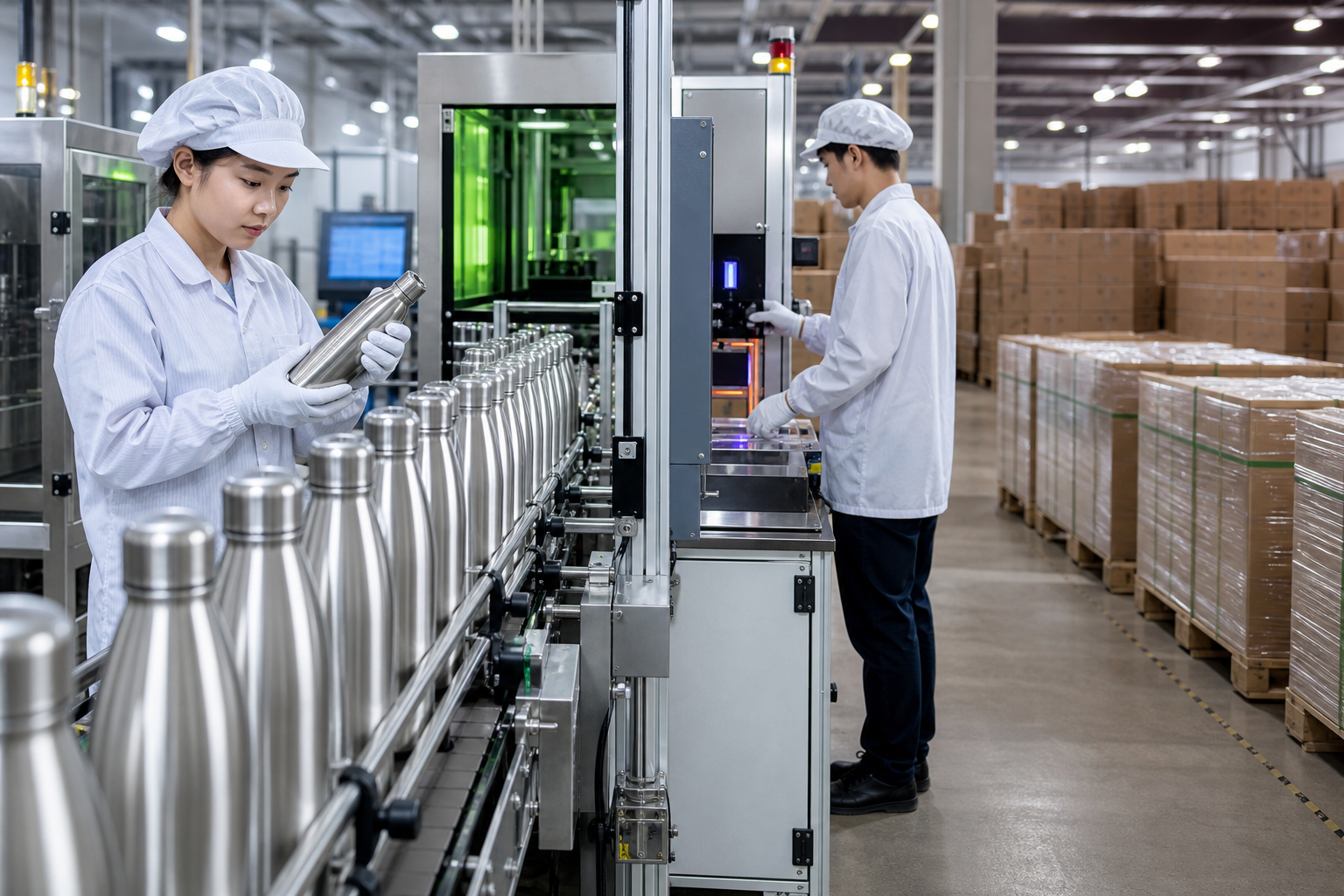
Our factory in Hangzhou, Zhejiang, runs up to 200,000 units per month across stainless drinkware lines, so process control is not a slogan for us. It means the welding jig stays set, the coating booth keeps film thickness in range, and assembly does not drift shift to shift. If you are ordering an oem stainless steel bottle britain or oem stainless steel bottle deutschland shipment, confirm carton compression strength, pallet height, and whether you need individual polybags or paper wrap. For an oem stainless steel water bottle usa program, buyers usually want FNSKU labels, master carton marks, and case packs that fit 24 or 48 pcs per carton. The buyer flagged a typo on one PO last month: 24 pcs per carton was written as 42.
Do not accept “we check before shipment” as a quality plan. Ask for photos of the line, sampling records, and final inspection reports. QC pulled the sample, not sales, and that matters. If a factory will not share defect photos or lot numbers, the math does not work and you should walk away. One missing lot number can stall a 12-day booking window and turn it into 18 days fast.
Get a factory quote built for your market
Send your size, lid style, and target country. We will spec the OEM bottle, confirm MOQ, and quote FOB China with usable compliance files.
Frequently asked questions
What MOQ should I expect for an OEM stainless steel bottle?
For a standard private-label bottle, expect 3,000 pcs per SKU as a normal MOQ in Zhejiang, China. If you want a new mold, special lid, or unique powder coat, 5,000 pcs is more realistic. Some stock-body programs can start at 500-1,000 pcs, but the branding and carton options will be limited. If your order mixes sizes or lid styles, the factory may split MOQ by component, which changes the economics quickly. For a real quote, ask for MOQ by body, lid, and print method separately.
How much does an OEM stainless steel bottle cost FOB China?
A simple 500 ml double-wall bottle with a basic lid often lands around USD 2.10-2.60 FOB China at 3,000 pcs. Add powder coating, laser logo, a carry handle, or upgraded lid parts, and the price can move to USD 2.80-3.80. Premium vacuum performance, 316 inner steel, or gift packaging can push it higher. The cleanest way to compare quotes is to normalize by capacity, lid type, logo method, and carton spec, not by the headline unit price alone.
Can you supply bottles for the USA and UK markets?
Yes, but the product file should be adjusted by channel. For the USA, many buyers want FDA-related material declarations, Amazon-ready barcode labeling, and case packs that fit FNSKU workflows. For the UK and Germany, compliance files should support REACH and food-contact expectations, and packaging should be more restrained. If you search for oem stainless steel bottle usa or oem stainless steel bottle uk, the supplier should understand the market differences instead of giving one generic spec sheet. That is basic export competence.
What lead time should I plan for custom orders?
For a standard custom logo order, plan 30-45 days after sample approval and deposit. If you need a new color, new lid tooling, or special packaging, add 15-25 days. Shipping time depends on route: roughly 18-28 days by sea to the US West Coast, 30-40 days to some East Coast and European ports, and much faster by air for urgent replenishment. If your launch date is fixed, build in one extra week for final pre-shipment inspection and carton correction.
What tests should I request before shipment?
At minimum, request leak testing, capacity verification, vacuum retention confirmation, and drop/carton tests. For export to Europe or North America, also ask for material declarations and food-contact test support, plus REACH-related substance checks where relevant. AQL 2.5 for critical defects and 4.0 for major defects is a sensible starting point. If your logo is printed, include abrasion or adhesion testing. If the bottle is going to Amazon or retail, ask for barcode scan checks and carton dimension confirmation too.