Key Takeaways
- Photo print on tumbler works best on coated stainless steel; raw steel and soft-touch finishes are poor substrates.
- For photo-grade decoration, expect 300 dpi source files, 0.2-0.3 mm registration tolerance, and visible trade-offs on curves.
- A CMYK tumbler can handle gradients and faces, but deep blacks, metallics, and fluorescent colors need special treatment.
- Typical MOQ for UV photo printing in Zhejiang is 500 pcs; realistic lead time is 18-25 days after artwork approval.
If you want photo print on tumbler products, the target is simple: decoration that still looks clean at retail, not just from 3 feet away. Full color UV print can do that, but the process has hard limits. A decent CMYK tumbler can hold gradients, product photos, and busy artwork. It will not act like a glossy magazine page on every cup body.
From our Zhejiang factory, we see the same buyer pushback all the time: they send a JPEG and expect photo-grade decoration on stainless steel, powder coat, or matte paint. Then QC pulled the sample and the buyer flagged banding on the shoulder curve. The result depends on wall curvature, surface energy, coating color, and your defect target. We run UV print lines next to laser and silk-screen work, with MOQ starting at 500 pcs and monthly output above 120,000 units, so the practical answer beats the sales pitch every time.
What UV photo printing really is
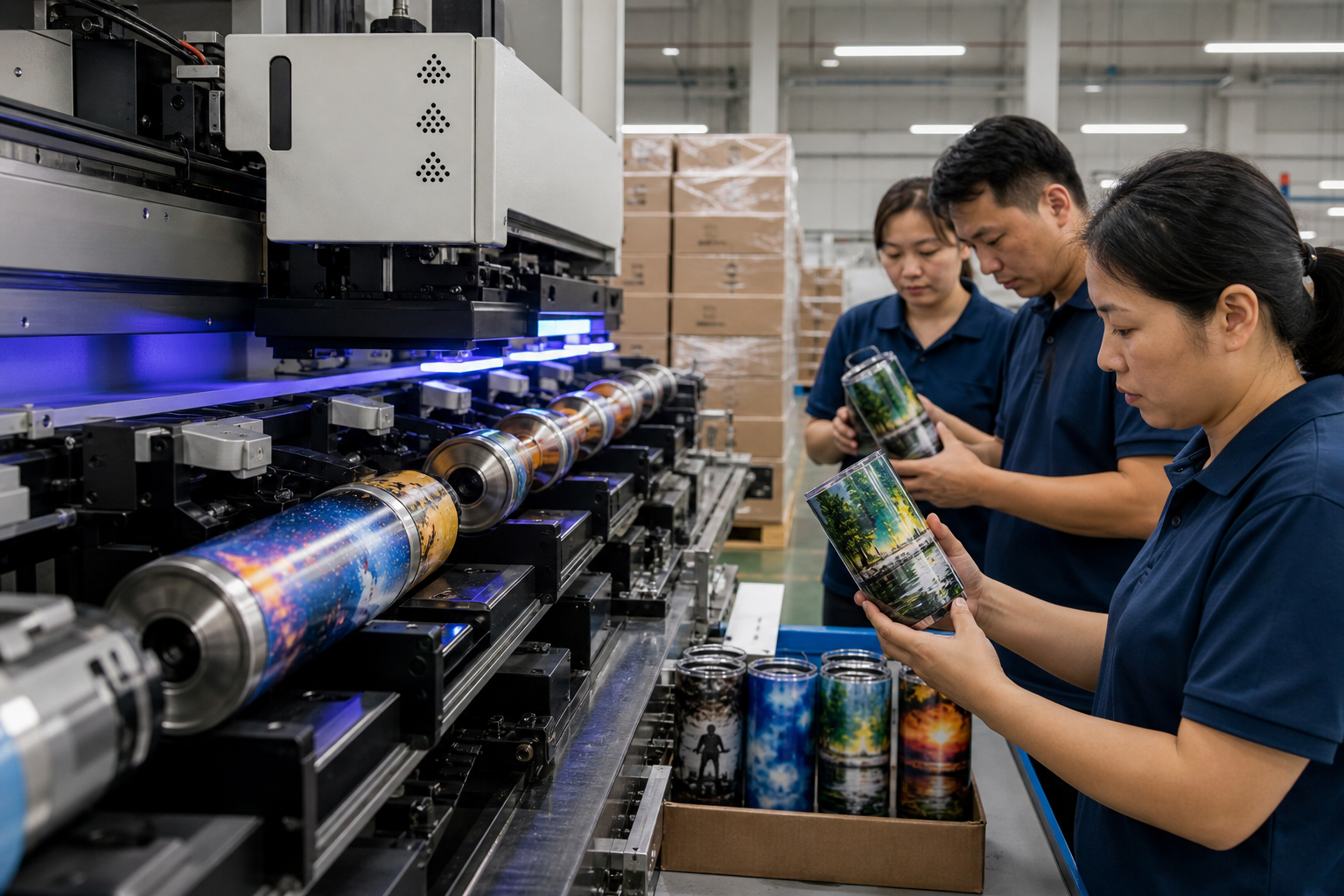
UV printing on drinkware is not sublimation, and it is not traditional screen printing. It is a digital deposit process that lays down CMYK inks, then cures them with ultraviolet light in seconds. On a flat panel, the print can look sharp. On a tumbler, we are wrapping a photo around a cylinder, so the seam, the curve, and small surface texture all change how the image reads under light.
For DTC brands, the draw is simple: one design, 20 designs, or 200 names, and you do not pay for full screens. That is why full-color UV print shows up on limited editions, creator merch, and personalized drops. The line gets busy fast. But the process has limits. UV ink sits on top of the coating, so adhesion starts with surface prep. If the tumbler has a powder coat with low surface energy, or if the buyer wants to ship in humid weather without a sleeve, the ink edge can chip sooner than they expect.
At BottleForge in Zhejiang, we call a photo-grade decoration job one that survives a 100-cycle hand-wash check, passes tape adhesion test after 24 hours cure, and still looks clean at 30 cm viewing distance. QC pulled the sample and checked the edge under a 10x loupe. That is a realistic standard. If you ask for museum-grade color fidelity on a $2.80 tumbler, the math does not work. You are asking the wrong process to do the wrong job.
Where photo-grade decoration works
The best substrate for photo print on a tumbler is a smooth, hard coating: glossy powder coat, UV primer base, or painted stainless with a controlled surface profile. We run the line with a 60° gloss meter and a simple thumb test, because the flatter and more even the surface, the cleaner the image. White or light bodies print easiest. CMYK stays closer to the file. Dark shells need a white underbase, and that pushes up cost while trimming fine detail.
Good applications include:
- Brand photography with soft gradients and mockup-style visuals
- Portraits and lifestyle artwork where a little softening is acceptable
- Seasonal graphics with multiple colors and small text
- Short-run personalization for events, creators, and e-commerce bundles
On a 20 oz straight-wall tumbler with a printable width of 250-260 mm, the result is usually predictable. We had one buyer flag a PO typo on the seam position, and that 2 mm mistake was enough to throw the face print off-center. If you switch to a tapered bottle or a heavily contoured travel mug, the image starts to stretch near the seam. So the problem is not the print method. It is the geometry. We tell clients in China and Europe the same thing: if the artwork has faces, logos, or product shots, choose a cylinder with minimal taper and a high-gloss base coat.
What the process cannot do well
UV printing is strong, but it is not magic. A real photo print on a tumbler will always give up something versus paper. Fine skin tones, shadow transitions, and hair detail can flatten if the source file is weak or if the image gets stretched around the barrel. We ran a 300 dpi sample on a 20 oz stainless tumbler last month, and the buyer flagged the cheek highlight first. If the artwork depends on exact flesh tone, expect a small color shift, especially on a dark background or a colored tumbler body.
The process also struggles with these cases:
- Metallic effects - UV cannot make true metallic silver or gold without a foil step or a special ink system.
- Neon and fluorescent colors - CMYK tumbler printing will miss the punch on neon; the math does not work.
- Very small reversed text - anything below 5 pt gets risky on a curved surface, and QC pulled the sample on a 12 oz cup when the white knock-out filled in.
- High-abrasion use - if the tumbler rides in backpacks with keys and coins, edge wear shows up sooner at the rim and seam.
If you need dishwasher durability, be careful. A lot of UV prints will handle light hand washing, but repeated high-heat dishwasher cycles can dull the gloss and speed up scratching. We ship a lot out of Hangzhou, and our line treats UV as retail-safe and daily-use-safe, not a forever coating. If you want maximum abrasion resistance, laser engraving or molded-in color is the better route, no debate.
Artwork specs you should demand
Your artwork file does more than the printer setting. For photo-grade decoration, we need the right source before the line starts. Send editable AI, PDF, or layered PSD files if you have them, plus a 300 dpi preview at actual print size. If the buyer sends a compressed social media image, the result looks like a compressed social media image. The printer cannot invent detail. We had a PO once with “blue-green” typed in the notes and the buyer flagged the sample on day 2.
Use these specs:
- Resolution: 300 dpi at 1:1 scale
- Color mode: CMYK, not RGB
- Bleed: 2-3 mm minimum
- Safe zone: keep critical text 4-5 mm away from edges and seams
- Minimum line weight: 0.25 mm for solid readable strokes
For a cylindrical tumbler, wrap length matters more than flat width. A 20 oz straight tumbler usually prints well at about 250 mm around the barrel, while a 16 oz slim bottle is often 210-220 mm, depending on the tooling. The math does not work if you guess. For Amazon or DTC, ask for a digital wrap proof before you approve mass production. That proof should show seam position, white underbase coverage, and edge distortion. We run a tape test on the first sample, and QC pulled one last month because the seam shifted 3 mm left.
Costs, MOQ, and lead time
For buyers, the real question is not whether UV printing can be done. It is what the math looks like at your quantity. On our Hangzhou line, MOQ for UV photo print on tumblers starts at 500 pcs per design, and 1,000 pcs is where the unit price starts to make sense. For a standard 20 oz stainless tumbler with single-side full color UV print, FOB China is usually USD 2.60 to 4.20, depending on body finish, print area, and carton spec. We run this on a flatbed UV printer with a 600 dpi pass, and the buyer flags the same thing every time: the blank body choice changes the cost faster than the artwork does.
Double-side art, white underbase, or special varnish adds USD 0.15 to 0.45 per unit. If you want individual retail boxes, barcode stickers, and FNSKU labeling for Amazon, plan another USD 0.10 to 0.35. Lead time is usually 18-25 days after sample approval and deposit, shipping not included. QC pulled the sample last week and caught a 1.2 mm image shift on one side; that cost us a reprint, and it is exactly why rushed artwork burns time. If you change the color after proofing, the line stops. The PO typo on a Pantone code can do the same.
Practical rule: if your gross margin depends on a clean image and a sub-$3.00 landed cost, keep the tumbler body simple and lock the artwork before you send the deposit.
How to spec a reliable DTC program
If you are building a DTC line, spec for repeatability first. First sample is easy. Running 5,000 pieces without drift is the real test. Choose a tumbler with coating thickness held within the same band lot to lot, diameter tolerance within ±0.5 mm, and a print zone big enough that the artwork does not crowd the seam or the bottom curve. Ask whether the surface is powder coat or liquid paint, because the ink bite changes, and so does scratch resistance. On our line, we tag cure settings by batch on the oven card, because under-cured UV ink can pass a quick glance on day one and fail after 12 days in transit or in a warehouse rack.
Keep the assortment tight:
- One body shape
- One or two coating colors
- One print method per SKU family
- One packaging spec across the line
That cuts changeovers and keeps the press setup from drifting. It also makes QA less messy. Ask for AQL inspection at 2.5 for major defects and 4.0 for minor defects, plus adhesion testing after 24 hours cure. If you are shipping into the US or EU, request REACH confirmation for coatings and ink system documentation from the supplier. We have seen buyers push for three body shapes and four lid colors in one launch; the math does not work, and the line starts eating time. The best custom drinkware programs are boring in production and strong at retail. That is the balance.
Choosing the right print method
UV print is not the answer for every tumbler. It works when the art carries photos or smooth gradients, when you need a 300-piece test run, and when you want to launch without paying for screen setup. It falls short if you want hard-wearing decoration, metallic shine, or the lowest unit cost at 20,000 pieces. QC pulled one sample last week with a 0.3 mm edge lift after abrasion testing, and the buyer flagged it fast.
Use this split:
- Choose UV print for photo-grade decoration, brand launches, influencer merch, and variable artwork
- Choose laser engraving for premium monochrome looks and long wear
- Choose screen printing for large quantities with simple spot colors
A smart buyer asks for all three quotes on the same bottle. We run that comparison every week for European and North American DTC brands, and the math does not work the same way on every SKU. One PO came through with “UV printe” in the notes, and the typo hid the real issue: the client wanted a 72-hour sample, not a full mass-production quote. The best option is usually the one that balances image quality, unit cost, and defect risk—not the prettiest sample on the rack.
Send your tumbler artwork for a real print check
We will review your file, advise on UV print limits, and quote MOQ, lead time, and FOB pricing from our Zhejiang factory.
Frequently asked questions
Can you do a true photo print on tumbler surfaces?
Yes, but only within the limits of UV printing. On a smooth coated stainless tumbler, you can reproduce photos, gradients, and fine artwork in CMYK with good retail appeal. Expect the best result on white or light bodies and straight-wall shapes. If the image needs perfect skin tone or metallic detail, UV will not match a printed poster. For production, we usually ask for 300 dpi artwork, 2-3 mm bleed, and a wrapped proof. MOQ is often 500 pcs per design, with lead time around 18-25 days after approval.
Will UV print survive dishwasher use?
Light hand washing is usually fine if the coating is cured properly. Dishwasher durability is less reliable, especially on high-heat cycles and with harsh detergent. The ink sits on top of the coating, so abrasion and thermal cycling matter. For a DTC tumbler, I would treat UV print as retail-grade daily use, not industrial dishwasher-safe decoration. If your customer promise includes repeated dishwasher cleaning, laser engraving or an embedded decoration method is safer.
What file do you need for a CMYK tumbler design?
Send a layered AI, PDF, or PSD if possible, plus a 300 dpi raster preview at actual size. Use CMYK color mode, not RGB. Keep critical text at least 4-5 mm from seams and edges, and avoid thin reversed text under 5 pt. If your artwork includes faces or gradients, ask for a digital wrap proof before mass production. A low-quality JPEG from a website will print exactly like a low-quality JPEG.
How much does full color UV print add to cost?
For standard stainless tumblers, full color UV print often adds about USD 0.15 to 0.45 per unit depending on print area, number of sides, and whether a white underbase is needed. If you add individual boxes, barcode labels, or Amazon FNSKU stickers, budget another USD 0.10 to 0.35. FOB pricing for a common 20 oz body with photo-grade decoration can land around USD 2.60 to 4.20 at 500-1,000 pcs, depending on finish and packaging.
What defects should I inspect before shipping?
Check color shift, seam alignment, pinholes, ink edge lift, scratches, and cure tack. For a commercial program, use AQL 2.5 for major defects and 4.0 for minor defects. Ask the factory to keep a 24-hour post-cure adhesion test record and a retained sample from each batch. If you are importing into Europe or North America, also request coating and ink compliance documents such as REACH declarations, plus any internal test reports for wash and abrasion checks.