Key Takeaways
- MOQ for a serious polycarbonate stainless steel bottle custom project is usually 3,000-5,000 pcs, not 500.
- Target factory lead time is 25-35 days after sample approval; faster is possible only on stocked parts.
- For compliance, ask for LFGB, FDA, REACH, and a vacuum leak test report, not just a PDF certificate.
- A good polycarbonate stainless steel bottle wholesale quote should separate bottle, lid, logo, packaging, and freight.
If you are sourcing polycarbonate stainless steel bottle wholesale, the first mistake is treating “plastic + steel” like a simple stack-up. It is not. The polycarbonate shell drives impact resistance, clarity, pad printing, and cost. The stainless insert drives heat retention, taste, and food-contact compliance. Pick the wrong wall thickness or liner spec, and you get stress cracks, warped lids, or a bottle that looks clean in photos and starts failing after 3 months on retail shelves. QC pulled a cracked sample on our last run at 1.2 mm wall thickness. That check saved a headache.
For B2B buyers, the right question is not whether the bottle exists. It is whether the polycarbonate stainless steel bottle manufacturer can hold injection tolerance, vacuum sealing, and compliance at scale. We run lines in Zhejiang that work to MOQ 3,000 to 5,000 pcs, lead time 25 to 35 days, and monthly output around 300,000 units. A buyer once flagged a PO typo on the lid color code, and the whole carton mark had to be corrected before shipment. That is the level to benchmark against, not a polished catalog shot.
What polycarbonate really changes
Polycarbonate changes the buying equation because it is not just a cosmetic shell. On a polycarbonate stainless steel bottle, the PC outer body takes the knocks, gives the grip, and carries print or decal work, while the stainless inner liner handles beverage contact and thermal performance. If the bottle is a true double-wall structure, the gap, sealing method, and lid thread matter more than the marketing name. We run into this on the line all the time.
For outdoor retail, polycarbonate is attractive because it is lighter and more shatter-resistant than glass. But “tough” does not mean indestructible. A 1.2 mm to 1.8 mm PC wall is common for durable consumer bottles; thinner than that, the bottle can feel cheap and start stress-cracking around the thread after a few heat cycles. One buyer once sent a PO with the wall spec missing and asked us to “just make it strong.” That is the wrong question to ask. If the supplier cannot tell you the wall thickness, they are probably buying from a trader, not a polycarbonate stainless steel bottle factory. QC pulled the sample and measured 1.05 mm at the shoulder with a caliper.
Watch the temperature range too. Polycarbonate can handle normal hot-fill use, but repeated thermal shock is where bad tooling shows up. If your channel is camping, gym, or commuting, ask for drop testing from 1.2 m and cycle testing of at least 5,000 open-close operations on the lid. We’ve seen this go sideways when a cap passes the first drop and then splits after the 200th cycle because the mold gate was off by 0.3 mm. That is the kind of data a real polycarbonate stainless steel water bottle manufacturer should have on hand, especially in Zhejiang where export factories compete on repeatable specs, not just low quotes.
Wholesale pricing and MOQ reality
Buyers ask for one “factory price” all the time, but polycarbonate stainless steel bottle wholesale pricing comes from five inputs: body size, liner grade, lid construction, logo method, and packaging. A 500 ml bottle with a basic PP lid and one-color silkscreen usually lands around USD 2.10 to 2.80 FOB Ningbo or Shanghai at 3,000 pcs. We ran that quote last month on a 0.35 mm liner, and the buyer flagged the carton spec before the price. Add a premium flip lid, molded gasket, matte finish, and private label box, and the same item moves to USD 3.20 to 4.60.
MOQ is set by mold setup and packing, not by wishful thinking. A polycarbonate stainless steel bottle supplier with in-house injection and assembly can often run 3,000 pcs per SKU. If the design uses a custom lid or a unique bottle contour, 5,000 pcs is the cleaner number. For polycarbonate stainless steel water bottle bulk orders, I treat 10,000 pcs as the point where tooling amortization belongs in the conversation, not just unit price. The math doesn't work any other way. One PO we saw even had “5000pcs” typed as “500 pcs,” and QC pulled the sample list right away.
- Simple stock shape: MOQ 3,000 pcs
- Custom color or logo: MOQ 5,000 pcs
- New mold or special lid: tooling fee applies
- Sampling: 7 to 12 days, depending on print method
If a seller promises 800 pcs with full customization, check whether they are a polycarbonate stainless steel bottle branded reseller. That works for sampling, not for wholesale production. We’ve seen this go sideways when the buyer tries to repeat the order and the line cannot hold the same lid fit. A real factory will tell you the MOQ up front, then show the mold and the 3,000 pcs packing plan.
OEM, ODM, and private label choices
Most B2B buyers do not need a ground-up design. You need control over branding, packaging, and maybe a lid upgrade. That is where polycarbonate stainless steel bottle OEM and polycarbonate stainless steel bottle ODM split. OEM means you bring the spec or drawing; ODM means you pick a factory platform and we tweak it. In Zhejiang, ODM is usually the faster lane if you want a sellable SKU in 30 days instead of 60. We ran that comparison on a 28 mm lid last season, and the buyer dropped OEM after the first sample because the math did not work.
If you want a polycarbonate stainless steel bottle private label program, put the effort into the parts shoppers see and retailers can handle: logo placement, Pantone color, label copy, and carton design. A solid polycarbonate stainless steel water bottle private label job usually starts from existing tooling, then adds a 1-color or 2-color lid or sleeve. That keeps tooling spend low and cash less tied up. QC pulled the sample at AQL 2.5, and one buyer flagged a carton typo before we shipped 2,000 pcs.
When OEM makes sense
Choose OEM when you need a proprietary silhouette, a special insulation target, or a lid with a patented-style mechanism. Choose ODM when you want fast sell-in, seasonal outdoor retail, or a marketplace test. For many buyers, polycarbonate stainless steel bottle custom work means standard body, custom branding, upgraded packaging, and a QC plan that fits the channel. We ship that way every week, and a 5,000 pcs MOQ is the line where a new mold starts to make sense.
Practical rule: if your first order is below 5,000 pcs, spend money on packaging and lid quality before you spend money on a new mold.
Compliance and testing you should demand
If you sell in Europe or North America, compliance is not optional. We ask for test reports on food-contact materials, migration, and heavy metals before a first PO leaves the line. If your market needs it, request REACH, LFGB, and FDA-related declarations too. For thermos-style products, ask whether the vacuum section and stainless liner passed leakage and temperature-retention checks on the same SKU, not a similar one.
Do not accept a generic certificate without the exact SKU, material code, and issue date. “Same as sample” is not a compliance document, and the buyer usually catches that after the first audit. The factory should state the stainless grade, usually 304 or 316 for premium lines, the polycarbonate grade, and whether any coating or printing ink is approved for food-adjacent use. If they cannot explain that without hand-waving, they are not the polycarbonate stainless steel bottle manufacturer you want.
- Leak test: 30 minutes inverted, no seepage
- Drop test: 1.2 m onto plywood or concrete surrogate
- Dishwasher claim: verify with actual cycle count
- Labeling: country of origin, volume, care instructions
For retail chains, I also recommend a pre-shipment AQL inspection at AQL 2.5 for major defects and AQL 4.0 for minor defects. We run that check before carton sealing, because a bad cap torque or a missing label turns into a chargeback fast. This is not a cosmetic extra. It is the floor standard for a polycarbonate stainless steel bottle factory shipping from China.
What a factory quote should include
A proper quote is not one line with a unit price. It should show the bottle structure, lid type, decoration, carton spec, and commercial terms. If a polycarbonate stainless steel water bottle wholesale quote lands on your desk without those items, the number is not usable. You are comparing apples to a half-written note.
Ask the polycarbonate stainless steel bottle supplier to split each cost item. Body price, lid price, print price, inner tray, master carton, and freight terms should all be visible. If you are comparing FOB China quotes, check whether the quote is from Ningbo, Shanghai, or Shenzhen, because the port changes inland trucking and timing. On our side in Zhejiang, Ningbo is usually the cleaner export choice. We run that lane every week.
Typical quote structure:
- Bottle body: USD 1.40 to 2.40
- Lid: USD 0.35 to 0.90
- Logo: USD 0.05 to 0.25
- Packaging: USD 0.20 to 0.60
- Tooling: one-time, if applicable
For a polycarbonate stainless steel water bottle custom order, ask about color consistency and print durability too. QC pulled the sample after a 48-hour rub test, and the buyer flagged a faint logo smear on a glossy shell. A smooth gloss finish shows scuffs fast; matte hides wear better in outdoor retail. This is the wrong question to ask if you only care what looks good in the sample room. Sell where the bottle will sit, then choose the finish.
How to avoid costly sourcing mistakes
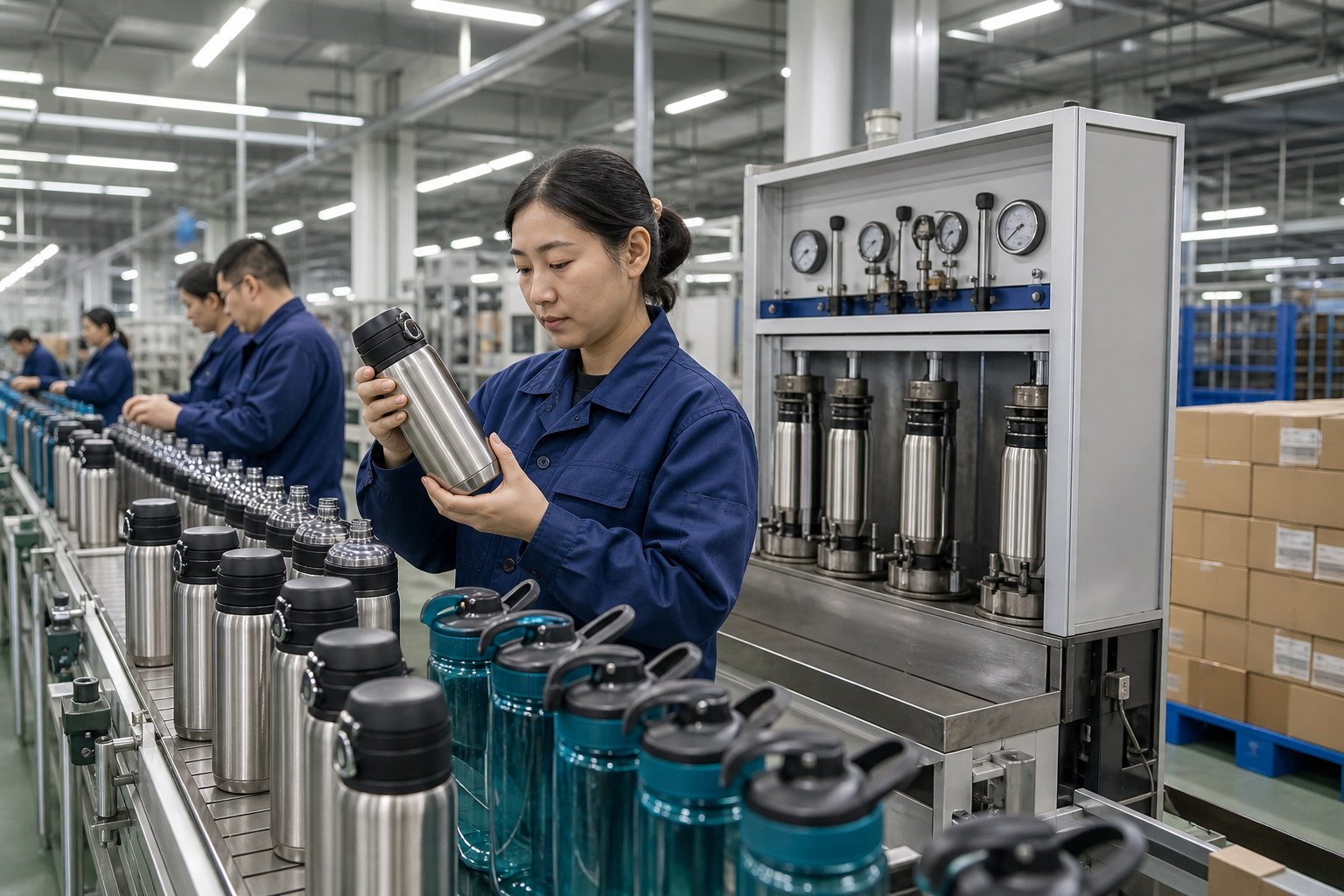
The biggest mistake is assuming every polycarbonate stainless steel bottle bulk supplier is a factory. A lot of them are traders. Some are fine. But you need to know who owns the molds, who signs off on QC, and who stocks the spare gasket rings. Ask for factory photos with the line running, not a staged showroom shot. Ask how many injection machines they run, how many assembly lines are on the floor, and the real monthly output. A credible polycarbonate stainless steel water bottle factory in Zhejiang should be turning out around 300,000 units per month across models. We’ve seen buyers get burned by a “factory” that could only do 80,000 and kept pushing delivery back. That math does not work.
Another mistake is ignoring lid ergonomics. Returns usually come from lids that bind, drip when tipped, or fail after a few weeks in backpack use. If you are buying a polycarbonate stainless steel flask or a travel-style thermos, test the lid with gloved hands and one-handed operation. QC pulled one sample with a 1.2 mm gap at the flip cap, and the buyer flagged it before shipment. Outdoor customers care about that more than the promo copy.
Do not over-customize your first run. A polycarbonate stainless steel bottle wholesale program works best when you standardize the liner, cap, and box, then change only the logo and maybe the color. We run it that way for a reason: faster replenishment, fewer mold issues, fewer packing mistakes. A buyer once sent a PO with a logo typo and a special carton size, and the rework ate the margin. Start clean. If the sales data comes back strong, then move to a deeper polycarbonate stainless steel bottle branded launch with dedicated tooling.
Request a factory quote with real specs
Send your target size, logo method, MOQ, and market. We’ll reply with FOB pricing, lead time, and compliance documents from Zhejiang, China.
Frequently asked questions
What is the usual MOQ for a polycarbonate stainless steel bottle wholesale order?
For a real factory order, MOQ is usually 3,000 to 5,000 pcs per SKU. If you want a new lid, new mold, or custom color matching, 5,000 pcs is safer. Some polycarbonate stainless steel bottle suppliers offer 1,000 pcs, but that is often a stock-item program, not true wholesale production. For private label and retail packaging, plan on 3,000 pcs minimum to keep unit pricing sensible.
How much does a polycarbonate stainless steel bottle custom project cost?
For a 500 ml unit, a basic polycarbonate stainless steel bottle custom quote often starts around USD 2.10 to 2.80 FOB at 3,000 pcs. With better lid parts, matte finish, or gift packaging, expect USD 3.20 to 4.60. Tooling fees are separate if you need a new bottle shape or custom cap. Freight, import duty, and lab testing also need to be budgeted.
What compliance documents should I request from a polycarbonate stainless steel water bottle manufacturer?
Ask for REACH, LFGB, and food-contact declarations if you sell in Europe, plus FDA-related compliance documents for North America where relevant. You should also request leak test data, material specs, and the exact SKU on each report. If the factory cannot tie the test report to your product code, the document is not useful for procurement or customs review.
Is OEM or ODM better for polycarbonate stainless steel bottle branded products?
ODM is usually better if you want speed and lower risk. OEM makes sense when you already have a strong design requirement or channel-specific feature. For most brands, a polycarbonate stainless steel bottle branded program starts with ODM: existing tooling, custom logo, custom carton, and maybe a color change. That keeps lead time around 25 to 35 days instead of stretching past 45 days.
How do I check if a polycarbonate stainless steel bottle factory is real?
Ask for live production photos, machine lists, monthly output, and recent export records. A solid polycarbonate stainless steel bottle factory in China should be able to discuss injection molding, assembly, vacuum testing, and AQL inspection without hesitation. If they say they make 300,000 units per month, ask how that volume is split across SKUs and how many lines are running. Real factories answer quickly and consistently.