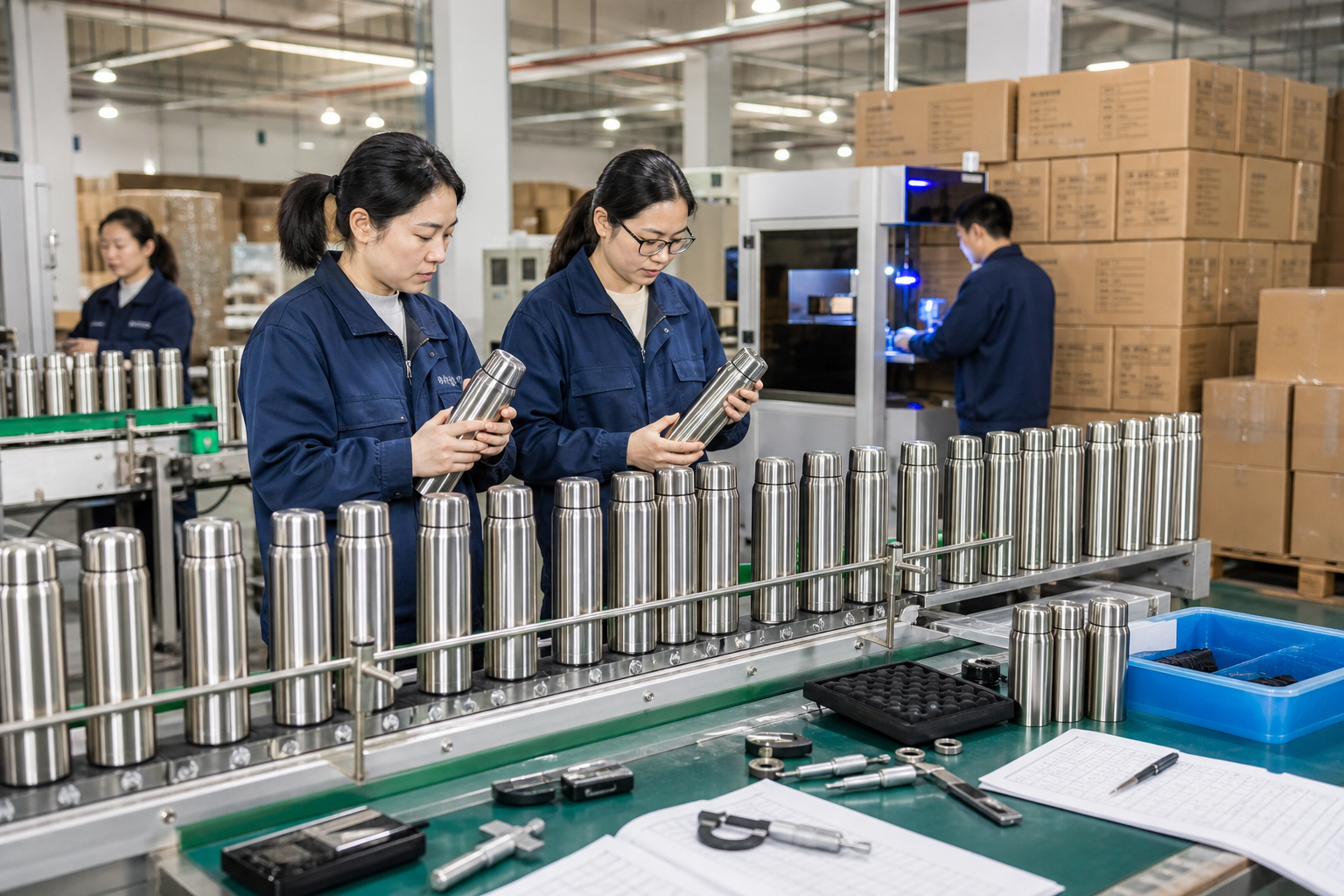
Key Takeaways
- Typical MOQ for a private label double wall bottle is 1,000 units per SKU, with 30-45 day production after sample approval.
- FOB China pricing for a 500 ml stainless steel double wall bottle usually starts around USD 2.30-4.80 depending on lid, finish, and decoration.
- Vacuum performance should be specified by test standard, not vague marketing; 6-12 hours hot retention is common, but a good build can do much better.
- For Europe and North America, ask for REACH, food-contact paperwork, and carton strength; damage claims often come from packaging, not the bottle itself.
If you are sourcing a private label double wall bottle, finding a factory is the easy part. The real work is choosing the build, decoration, and compliance package without getting caught by vague promises. On the line, two bottles can look the same at first glance, but one holds ice for 18 hours and the other drops fast after 8. We have seen that gap come from wall gauge, weld quality, coating cure, and even carton compression.
We run drinkware in Zhejiang, and the buyers who do well ask for hard numbers early: 18/8 or 304 steel, 0.4 mm or 0.5 mm wall gauge, powder coat thickness, lid torque, and proof that the supplier can hold AQL 2.5 every lot. QC pulled the sample last week and found a cap thread off by 0.3 mm; the buyer flagged it before the PO moved. If you sell into the United States, the United Kingdom, or Germany, you still need REACH, food-contact declarations, and FOB pricing that leaves room for freight. That is the question to ask. Otherwise the math does not work.
What buyers actually mean by private label
When a buyer says private label double wall bottle, they usually mean more than a logo on a stock item. On our line, that can be a bottle body, lid system, finish, and packaging set that carry the brand like they were built for the program from day one. Simple version: a 500 ml powder-coated bottle with a laser logo. A buyer once sent a PO with “logo in front” and left out the cap color; QC pulled the sample and the buyer flagged it the same day.
The first job is to split custom work from standard parts. Most factories in Zhejiang and other parts of China will change color, print, logo position, insert cards, and sometimes the lid. Full tooling changes are a different bill. We’ve seen that go sideways fast. For a private label double walled bottle for the US or a private label double wall bottle uk program, a good supplier should tell you which items run on existing tooling and which ones need a new mold or a new cap insert.
Ask for a spec sheet with:
- Capacity: 350 ml, 500 ml, 750 ml, or 1,000 ml
- Material: 304 or 316 stainless steel, PP, Tritan, or silicone
- Wall build: double-wall vacuum, usually 0.4-0.5 mm inner and outer shell
- Decoration: silkscreen, laser engraving, heat transfer, or UV print
- Pack-out: bulk pack, color box, or mailer pack for e-commerce
If a factory cannot turn that into a readable quotation, you are not buying a custom program. You are buying a headache. We had one buyer ask for “private label” and then miss the MOQ line by 2,000 pcs; the math does not work, and the quote should say so in plain English.
Build spec that controls price
The fastest pricing mistake is to compare bottles by capacity only. Two 500 ml bottles can differ by more than 40% in FOB price because of steel grade, lid build, coating, and assembly yield on the line. A basic private label double wall bottle made in China usually lands at USD 2.30-2.90 FOB with a simple screw lid and one-color logo. Add a stainless steel straw lid, matte powder coating, silicone base, and gift box, and you are at USD 3.80-4.80 fast. If the buyer wants a premium finish and a complex lid, USD 5.20 is normal, not a stretch.
For procurement, the build spec controls price more than the marketing label. Ask for steel gauge, vacuum gap, and coating thickness. A common outer wall thickness is 0.4 mm; some factories run 0.5 mm for better dent resistance, but the weight goes up and the quote follows. Powder coating should be written in microns, not just “durable.” We target 60-80 microns on the painted surface in Zhejiang, and QC pulled the sample twice when the first spray panel read 52 microns. If the lid uses PP, ask for food-grade resin and seal ring material; if it uses Tritan, ask for impact test data and dishwasher guidance. The buyer flagged it on a PO once: “lid material unspecified.” That line cost a day.
Good sourcing is not about finding the cheapest bottle. It is about specifying a product that survives transport, retail handling, and repeat use without generating returns.
For a private label double wall bottle united states or private label double wall bottle germany launch, the cleanest setup is usually a standard stainless body, a proven lid, and custom branding. Save budget for packaging and compliance before you chase exotic shapes. The math does not work the other way around. We have seen a fancy body and weak carton turn into crushed goods at 1.2% damage on arrival, then the buyer asks why the “premium” bottle looks cheap.
MOQ, samples, and lead times
Most buyers push for a low MOQ. Fair. The factory still has to pay for setup, print plates, and the first hour on the line. For a private label double wall bottle, 1,000 units per design and color is a normal starting point. We do see 500-unit orders from Zhejiang buyers when the mold is already in house and the decoration stays standard, but the unit price usually climbs 10-18%. If you need several SKUs for the private label double wall bottle USA market, keep the lid or color count tight instead of splitting the order into three tiny runs.
Sampling is where schedules go sideways. We had a buyer flag a PO last month because the artwork file had one wrong Pantone code, and that added two days before QC pulled the sample again. A realistic schedule is 3-7 days for a standard sample from existing tooling, 7-12 days for custom print or laser, and 15-25 days if you need a new box insert or a new lid color. After approval, mass production usually takes 30-45 days in China, plus 5-10 days for ocean stuffing, customs paperwork, and export booking. If the cargo goes to the United Kingdom or Germany, add inland trucking and destination handling on top.
Ask for monthly capacity. Not a brochure number, a real one. A stable plant in Hangzhou or wider Zhejiang can turn out 300,000 to 600,000 units a month across bottle lines. That matters because a line doing 50,000 units monthly can handle one brand cleanly, but it will miss the ship date when your Q4 order doubles to 100,000 units.
Do not approve a schedule without these checkpoints:
- Pre-production sample signed off by you
- Pantone reference confirmed in writing
- Carton drop-test standard agreed before packing
- Inspection date booked before goods finish
Decoration choices that look premium
Branding decides shelf appeal fast. We’ve seen a brushed 304 stainless bottle win with a laser logo, then lose at retail because the mark was too faint from 2 meters away. Silk-screen is the cheap route for one or two spot colors. UV print gives full color, but QC pulled samples after an abrasion test at 25 cycles and the edges started to haze.
For a private label double wall bottle us program, the safer sell is a one-color logo on a durable matte powder coat. It photographs clean, holds up better than gloss in transit, and the box still looks decent after a 3 kg carton drop test. If you are targeting a private label double wall bottle united kingdom launch, buyers usually ask for understated decoration and recyclable packaging. One UK buyer flagged a PO typo on the finish code, and that slowed approval by 4 days. In Germany, the ask is usually compliance wording and finish consistency. Flashy graphics do not save a weak spec sheet.
A practical decoration matrix looks like this:
- Laser engraving: durable, precise, premium on stainless, with a restrained look that suits 12 oz and 16 oz bottles
- Silkscreen: low cost, fast, best for simple logos on flat panels or straight walls
- UV print: full-color artwork, but it needs wear testing before we ship a daily-use bottle
- Embossed or debossed mold detail: strong brand feel, though tool changes can add 7-10 days and extra mold cost
If you want to sell across private label double wall bottle america and private label double wall bottle british channels, pick decoration that still reads after 50-100 wash cycles. Anything less turns into a return-rate problem. This is the wrong question to ask: “Which decoration looks best in a mockup?” The better question is which finish still looks premium after the line, the carton, and the customer’s dishwasher.
Compliance for US and Europe
Compliance is not a paperwork decoration. If you ship into the United States, the United Kingdom, or Germany, the factory needs food-contact files and test reports on the desk before the first PO is signed. For stainless steel drinkware, ask for material declarations, REACH compliance where it applies, and migration testing for coatings and contact parts. If the lid has plastic or silicone parts, list each grade separately. A one-line “food safe” statement is not enough. We have rejected that more than once after QC pulled the sample and found no lab report behind it.
For the private label double walled bottle usa and private label double walled bottle united states market, a lot of buyers ask about California Proposition 65, though the real requirement depends on the product build and sales channel. In Europe, REACH paperwork and, in some cases, LFGB evidence come up again and again from distributors. Britain works on a similar paperwork standard to the EU, even if the trade route changes. Germany is where the math gets strict: the buyer flagged a PO typo on a carton code once, and the order stopped until the lot numbers, barcode, and label files matched line by line.
You should set the inspection plan before production starts. We run AQL 2.5 for major defects and AQL 4.0 for minor defects, or whatever standard both sides sign off on. The line checks vacuum retention, leakage, coating adhesion, print alignment, and carton drop resistance. A 1.2 mm cap gap or a weak seal shows up fast at this stage. Some factories know these terms because they export every week. Others do not. Then you spend half a day teaching them what a major defect means, and that is the wrong question to ask after tooling is already running.
Ask for these documents before payment of the balance:
- Commercial invoice and packing list with accurate HS code
- Certificate of origin if needed by your importer
- Material declarations for metal, plastic, and silicone parts
- Test reports from recognized labs, not screenshots
Packaging and freight decisions
Packaging is not a side issue. A bottle can pass line inspection, load fine on the pallet, then show up dented in a U.S. warehouse and the product is dead on arrival. For e-commerce, we usually pack each private label double wall bottle in an individual box with internal inserts, then set the master carton size around the actual cube. If the order is going to Amazon FBA, the carton label, FNSKU, and case pack have to be fixed before the goods leave China. We had a buyer flag a PO typo on the case pack once; changing it after booking added 9 days and a pile of rework.
Master cartons need enough strength for ocean freight and warehouse handling. A 5-ply export carton with burst strength or edge crush matched to bottle weight is a common spec, and for one 380 g bottle we tested, the difference showed up fast at drop test height. If the pack includes glass components or infuser parts, give them more protection. For stainless steel bottles, 10-20% extra outer carton void fill looks wasteful on paper, but 2% damage claims cost more. The math doesn't work the other way. QC pulled the sample from a 1.2 m drop test last month, and the weak corner was the first failure.
FOB pricing tells you the factory cost at the port in China, not the landed cost in the United States or Europe. A buyer who compares only FOB usually misses inland trucking, customs brokerage, duty, ocean freight, and warehousing. If you are importing to the private label double wall bottle america market, calculate landed cost per sellable unit, not per factory piece. On a 12,000-unit shipment, that gap can run USD 0.60 to USD 1.50 per bottle depending on route and freight rates. We see this go sideways when someone ignores pallet space and pays for air in a container.
Finalize the pack-out first. Then inspect a packed sample. Then book the container. Reverse that order and you pay twice for rework, once on the line and once at the port. We run it that way because a 40HQ booked too early is hard to fix, and the freight forwarder will not care that the master carton spec changed after the fact.
How to choose the right factory
You do not need the biggest factory. You need the one that can repeat the same bottle 20,000 times with the same lid torque, logo placement, and coating finish. We run into buyers who chase capacity first, then find out the line cannot hold a 0.2 mm print shift. Ask for three things: monthly capacity, export history, and the defect handling process. A plant doing 300,000 units a month with no clear rejection workflow is weaker than one doing 120,000 units with steady audits and stable labor.
Ask for BSCI or a similar social compliance report if your retailer needs it. Check whether the factory does internal tests for leakage, vacuum performance, and dishwasher durability. One sample room here had a 24-piece leak rack and QC pulled the sample before lunch because the cap seal ring sat 1 mm off-center. If they promise 12-hour hot retention, ask for the test setup: starting temperature, ambient temperature, fill volume, and whether the lid was pre-warmed. “12 hours” can mean three different things, and the math does not work if the setup changes.
For buyers in the private label double wall bottle uk and private label double wall bottle germany channels, the safer pick is usually a factory with a documented export book, English-speaking merchandisers, and a clean sample room. You want someone who can answer a drawing change in 24 hours, not 24 days. We once saw a PO with a typo on the carton mark, and the buyer flagged it only after the film plate was already cut. If they can send a revised dieline, a carton layout, and a packing list in one business day, you are dealing with a real export team.
Before you place the order, confirm:
- Target MOQ and whether mixed colors are allowed
- Lead time from sample approval to ex-factory
- Inspection standard and who pays for re-inspection
- Spare parts policy for lids, gaskets, and straws
A good supplier in Zhejiang will not promise everything. They will tell you what can be done, what changes the cost, and what changes the schedule. We ship that way ourselves, because a supplier who says yes to every request usually has a problem on the line by week two.
Start your private label bottle quote today
Send your capacity, finish, logo file, and target market. We will quote a factory-ready spec with MOQ, FOB price, and lead time.
Frequently asked questions
What is the usual MOQ for a private label double wall bottle?
For standard stainless steel programs, MOQ is usually 1,000 units per SKU and color. If you reuse an existing mold and simple print, some Zhejiang factories will accept 500 units, but the price can rise 10-18%. For custom packaging, the carton and insert MOQ may be separate. If you want multiple destination programs for the United States, the United Kingdom, and Germany, it is better to combine volumes into one production run and split by carton label or language insert.
How much does a private label double wall bottle cost FOB China?
A common FOB China range for a 500 ml private label double wall bottle is USD 2.30-4.80. A basic bottle with a simple lid and one-color logo sits near the low end. Add powder coating, laser logo, better lid sealing, and retail box packaging, and you move higher. Premium lids, custom colors, and export-grade packaging can push the unit price above USD 5.00. Freight, duty, and warehousing are extra and should be calculated separately.
Can you support private label double wall bottle usa compliance?
Yes, but you need to define the paperwork upfront. For the private label double wall bottle usa market, ask for material declarations, food-contact test reports, and a clear list of plastic and silicone components. Depending on your channel, you may also need Proposition 65 awareness. Do not wait until cargo is ready to ship. The factory should prepare test reports before mass production so you can avoid delays at customs or at the Amazon receiving warehouse.
What lead time should I expect after sample approval?
For standard private label orders, mass production usually takes 30-45 days after sample approval and deposit receipt. If you need a new print layout, special box, or custom lid color, add 7-12 days for tooling or pre-production setup. Ocean freight from China to the US or Europe adds more time depending on port congestion. If you are in a seasonal category, you should start the project at least 90 days before your target in-stock date.
How do I check whether a factory is reliable?
Ask for three proof points: monthly output, inspection process, and export documents. A reliable factory should be able to state production capacity, often 300,000 units per month or more across lines, and explain AQL 2.5 inspection, leakage testing, and carton drop tests. You should also request BSCI or equivalent audit status if your channel needs it. A good supplier in China will not hide behind vague claims; they will show you photos, documents, and a clear sample approval trail.