Key Takeaways
- MOQ for a private label glass bottle typically starts at 3,000–5,000 pcs, depending on mold and decoration.
- A realistic lead time is 35–50 days after sample approval, plus 20–35 days ocean freight from China.
- For EU and US resale, ask for REACH, LFGB or FDA-related declarations, and carton drop testing at 1.0 m.
- Most private label glass water bottle projects fail on closure torque, liner quality, or packaging, not on the bottle itself.
If you are sourcing a private label glass bottle for a wellness brand or a sustainable retail line, the logo is the easy part. The hard part is getting a bottle that survives 1.2 m drop tests, clears compliance, and still leaves margin after decorating, packaging, and freight. Glass looks simple on a screen. On the line, it is not. Tempered and soda-lime price out differently, the closure spec changes the leak rate, and a 0.3 mm neck tolerance can turn a clean sample into a headache.
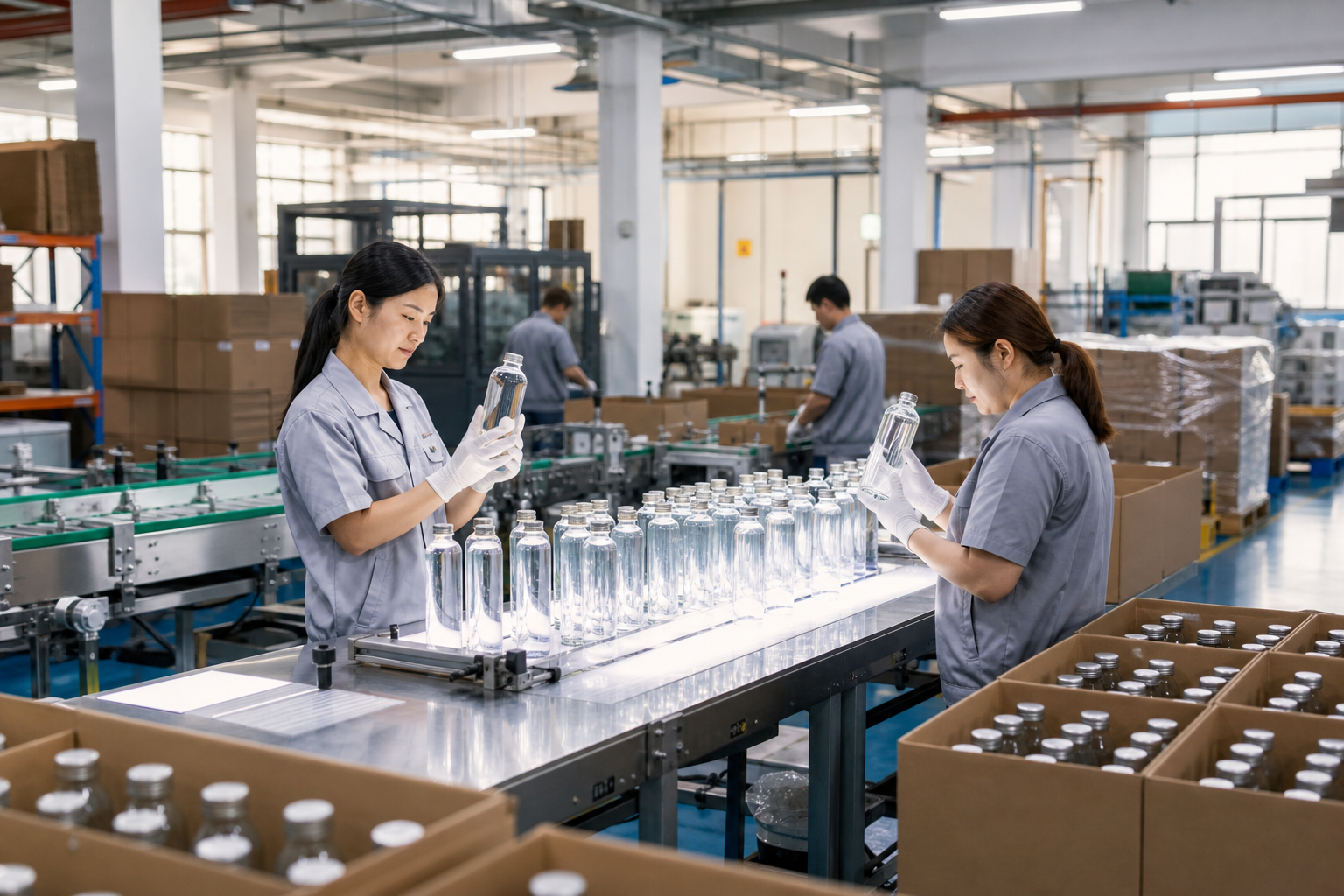
We build and export drinkware from Zhejiang, China, and we see the same problems every week: a buyer approves a good-looking sample, then the cap wobbles, the print shifts by 1.5 mm, or the carton fails a 6-drop test. QC pulled the sample at 9:20 a.m.; the buyer had flagged a typo on the PO, and that one line stopped the run. This is the wrong question to ask: “Can you make it look premium?” The real question is whether the factory can keep the spec tight from sample to shipment. If you want to sell in the United States, United Kingdom, or Germany, you need documents that match the market, not a vague “food safe” promise.
What buyers should specify first
Do not start with color when you ask for a private label glass bottle quotation. Start with the working spec. We need the capacity, glass type, wall thickness, neck finish, closure, decoration method, and packing format. Miss one item, and the quote is no longer apples-to-apples across factories. On our line, a buyer once sent a PO with “500ml” and no neck finish; QC pulled the sample, then the price changed after we matched the cap tooling. In Zhejiang, we usually quote 250 ml, 350 ml, 500 ml, and 750 ml because those four sizes cover most wellness and retail programs.
For a private label glass water bottle, soda-lime glass is the low-cost choice, while borosilicate is the pick when thermal shock matters. Soda-lime works for cold-fill, smoothies, infused water, and shelf retail. Borosilicate is the better call if the bottle will see hot-fill or quick temperature swings. Typical wall thickness is 2.5–3.5 mm for standard retail bottles; 1.8–2.2 mm is too thin unless the shape is locked down and the buyer accepts a higher reject rate. The math does not work otherwise. We’ve seen that go sideways on a 500 ml contour bottle with a 38 mm neck.
- Capacity: 350 ml, 500 ml, or 750 ml
- Glass type: soda-lime or borosilicate
- Closure: bamboo cap, PP cap, stainless lid, or silicone-sealed cap
- Decoration: screen print, decal, frost, spray, or laser on cap
- Packaging: individual box, egg crate, or export master carton
If you are targeting the private label glass water bottle usa market, say whether the bottle is going to retail shelves, DTC shipping, or gym studios. A shelf program can live with a simpler carton; DTC needs tighter drop protection and cleaner inserts; gym studios usually want a lighter pack and faster unpacking. One buyer flagged a typo on the carton PO—“12 pcs/ctn” became “21 pcs/ctn”—and that kind of slip is how breakage claims start.
Glass types and what they cost
Price is not just about bottle shape. Glass chemistry changes furnace cost, yield, and breakage rate. A plain 500 ml soda-lime private label glass bottle from a Zhejiang factory can land around USD 0.42–0.78 FOB depending on mold ownership, decoration, and cap. We run 8-cavity molds on this line, and if the buyer owns the mold, the price drops faster than people expect. The same size in borosilicate often moves to USD 0.85–1.60 FOB because the material and forming process cost more. Add bamboo caps, and you may add USD 0.08–0.22 per piece. Add a stainless cap with liner, and the closure cost goes up again.
For wellness brands, soda-lime usually wins on margin. Borosilicate works when your brand promise is purity, temperature stability, or a premium feel. Do not buy the pricier glass just because it sounds better. We had one buyer push back on this, and the math did not work: a 28% bottle cost jump on a USD 24 retail item needs a clear reason. Ask one question: does your retail message justify a 20% to 60% price increase? If not, use soda-lime and put the savings into a better cap, a thicker carton, or cleaner printing. QC pulled the sample last week and flagged a loose liner on the stainless cap, not the bottle itself.
“The bottle is rarely the problem. The cap, liner, and packaging are where the defect rate shows up.”
In China, good factories will quote by project, not just by bottle. Ask for separate lines for bottle, lid, print, and packaging so you can see where margin is going. We once found a PO typo on a 500 ml order: the buyer wrote 50 pcs instead of 5,000 pcs, and the quote changed by a mile. That breakdown makes negotiation cleaner and helps you compare suppliers in Zhejiang with suppliers elsewhere in China.
Decoration that looks premium
Private label is where buyers get charged for decoration they do not need. On a 500 ml glass bottle, a one-color screen print, a matte frost finish, or a clean decal with a thin ink layer usually looks the best. Screen print wins on price at 5,000 pcs and up because the line runs fast, the setup is simple, and the print is tough. We quote about USD 0.03–0.12 per location, depending on color count and coverage. Frosting or acid-etch style decoration gives a premium look, but the opacity has to be right. Too heavy, and the bottle looks foggy. We ran a batch last month where the buyer flagged the logo edge after QC pulled the sample under a 5000K light box.
If your brand sells in the private label glass water bottle uk or private label glass water bottle germany market, clean decoration usually moves better than loud graphics. Buyers in Britain and Deutschland want a bottle that looks calm on a kitchen counter and in a product photo. For US DTC brands, a larger logo can work, but keep it readable from 1.5–2.0 m and skip fine line art that will break in print. We had one PO with “1.5mm” typed as “15mm”; that typo would have blown the whole front panel. That is the wrong question to ask if someone pushes for extra colors just to look busy.
Decoration choices that actually hold up
- Silkscreen: best for 5,000 pcs and above
- Decal: good for multi-color art and short runs
- Frost spray: premium look, but scratch risk is real
- Laser on cap: durable branding for metal or bamboo top inserts
Ask the factory for curing temperature, abrasion test results, and a rub test after washing. We run a felt-pad abrasion check on the line, 50 back-and-forth strokes, and we want the ink to stay flat. If the print fails after 20 dishwasher cycles, it is not retail ready. The math does not work if you save USD 0.05 on decoration and lose the first replenishment.
Compliance for US and EU markets
If you sell private label glass water bottles into the United States, the bottle is a regulated food-contact item, not a plain SKU. We run this check on every export order: food-contact declaration, migration test report, and a clear note on the closure liner materials. If the cap uses a silicone gasket, that gasket needs its own material declaration too. Amazon and chain buyers have asked us for carton marks, lot traceability, and one typo on the PO can stall the file at customs for 3 days.
For Europe, ask for REACH declarations and LFGB test support from the supplier’s lab partner when the buyer asks for it. Germany is unforgiving on smell, residue, and finish. We had a 500 ml bottle rejected at QC because the printed logo rubbed at 200 cycles on the line tester. So a private label glass water bottle Germany order should include odor checks, print adhesion checks, and carton compression tests at the pallet level. The Britain market is similar: clean finish, stable packs, no puffed-up claims.
For the private label glass water bottle usa and private label glass water bottle us channels, the supplier should support FDA food-contact documentation at the component level. “Food grade” is vague, and this is the wrong question to ask. Ask for the glass composition, resin code, and cap liner data. We have seen customs hold a shipment for 12 days vs 18 days just because the invoice said “glass bottle” while the packing list said “water cup.” Match the invoice, packing list, and product declaration line by line.
MOQ, lead time, and factory reality
Most private label glass bottle buyers ask for a quote before they ask for a schedule. That is the wrong order. MOQ and lead time tell you if the job can run at all. On one Zhejiang line, we ship about 600,000 units a month, and a custom shape usually starts at 3,000–10,000 pcs MOQ because the mold work, annealing curve, and extra QC hours all sit on the cost sheet. A stock mold can start at 2,000 pcs, but once the buyer wants a printed logo plus a special cap, the real minimum moves up fast.
Lead time for a first order is usually 35–50 days after artwork and sample approval. If you need a new mold, add 20–30 days. Ocean freight to the US or Europe adds another 20–35 days, depending on port congestion and the destination port. We had one buyer flag a PO typo on the neck finish code, and that held the sample sign-off for 4 days. So a project can land at 70–100 days from first PO to warehouse arrival. If your retailer wants stock on shelf in 8 weeks, cut the customization or pick an existing mold. The math does not work.
Do not ignore AQL. For retail drinkware, a common inspection level is AQL 2.5 for major defects and 4.0 for minor defects, with extra checks on leakage, edge chips, and print position. QC pulled the sample on a rim chip that measured 1.2 mm, and it failed before packing ever started. A bottle with a chipped rim is a reject, not a discount item.
Packaging that survives transit
Glass shipping fails when the carton spec is weak. We treat packaging as part of the product, not an add-on. A 500 ml private label glass water bottle usually ships in an individual inner box or molded pulp tray, then a 5-ply or 7-ply export master carton based on bottle weight and the destination. On one run, QC pulled the sample after a 92 cm drop and found a chipped shoulder. The carton looked fine. It was the insert that moved. For direct-to-consumer shipping, the retail box needs to survive at least a basic drop test from 80 cm to 100 cm. For palletized wholesale, carton compression matters more than how pretty the shelf box looks.
We usually put 5% to 8% of ex-factory cost into protective packaging when the order ships far from the factory. That spend is easier to swallow than a stack of breakage claims. We had a buyer flag a PO because the carton code read “24pcs” while the ship plan called for 20pcs; that typo cost a week. If you are building a private label glass water bottle america program, ask early whether the retail unit is easy to FBA prep if Amazon is part of the route. Barcode placement, suffocation warnings where needed, and carton labels all have to match the shipment plan. This is the wrong question to ask: “Can we save $0.03 on the box?” The math does not work.
- Inner protection: molded pulp, EPE, or paper tray
- Master carton: 5-ply minimum, 7-ply for heavier sets
- Test target: 1.0 m drop without bottle fracture
- Labeling: SKU, lot code, carton qty, gross weight
Good packaging is the difference between a profitable private label glass bottle and a chargeback problem. We ship enough cartons to know that one loose insert can ruin an entire lane.
How to compare suppliers fairly
Compare suppliers on the same sheet, or you will pick the wrong factory. Put the same bottle size, same closure, same print method, same packaging, and same shipping term on every quote. We usually set one line item at 500ml, 28mm neck, FOB Ningbo, and the numbers tell the story fast. Then compare FOB, sample lead time, sampling fee, mold charge, and defect policy. A quote that is USD 0.08 cheaper but carries a 10% breakage claim risk is not cheaper. It is a bad buy.
Ask each supplier for photos of current production, not studio shots. A real factory in Zhejiang or elsewhere in China should show warehouse stack height, the QC line, and the molding equipment. QC pulled the sample on our last run with a caliper, and the buyer flagged a 1.2 mm neck deviation before we packed the cartons. Ask about monthly output, AQL inspection method, and whether they own the mold or use shared tooling. If a supplier cannot answer that cleanly, you are talking to a trading layer, not a production partner.
For long-tail search coverage, your buyer may search private label glass water bottle usa, private label glass water bottle united states, private label glass water bottle uk, or private label glass water bottle deutschland. Same bottle, different paperwork and pack rules. The math does not work if you send one carton spec everywhere and hope customs, label text, and warning copy sort themselves out. Build one core bottle platform, then localize labeling and carton language for each market.
That is how you turn a basic glass bottle into a private label line without paying for avoidable mistakes. We ship this way on the line all the time, and it saves weeks when a PO typo shows up on the sleeve artwork.
Source your private label glass bottle with confidence
Send us your size, cap, and target market. We will quote MOQ, lead time, and compliance details from our Zhejiang factory team.
Frequently asked questions
What is the typical MOQ for a private label glass bottle?
For a standard stock mold, MOQ is often 2,000–3,000 pcs. For a custom shape or special decoration, expect 3,000–10,000 pcs. If you want a full private label glass bottle program with custom cap and printed carton, 5,000 pcs is the more realistic planning number. In Zhejiang, factories with 600,000 units/month capacity usually prefer those volumes because setup time and breakage risk are easier to control.
How much does a private label glass water bottle cost FOB?
A plain 500 ml soda-lime private label glass water bottle usually lands around USD 0.42–0.78 FOB. Borosilicate is often USD 0.85–1.60 FOB. Add USD 0.08–0.22 for a bamboo cap, USD 0.10–0.28 for stainless closures, and USD 0.03–0.12 for single-color print. Packaging can add another USD 0.12–0.45 depending on carton strength and inner protection.
What compliance documents should I request for the US and EU?
Ask for food-contact declarations, material details for the bottle and liner, and migration test support. For Europe, request REACH-related declarations and, when needed, LFGB-oriented support. For the United States, make sure the supplier can back up FDA food-contact material claims at the component level. If you are selling in the private label glass water bottle usa market, keep invoice, packing list, and product description consistent to avoid customs questions.
How long does production take in China?
For a first order from China, plan on 35–50 days after artwork and sample approval. If a new mold is needed, add 20–30 days. Ocean freight to the US or Europe typically adds 20–35 days, depending on port and season. So a realistic end-to-end timeline for a private label glass bottle is 70–100 days, not 4 weeks.
What is the safest packaging for shipping glass bottles?
Use an inner protective tray or molded pulp insert, then a 5-ply or 7-ply export master carton. For retail and DTC shipments, ask the factory to test a 1.0 m drop target. For wholesale pallet moves, carton compression and corner crush become more important. Good packaging usually costs 5%–8% of ex-factory price, but it is cheaper than paying breakage claims.