Key Takeaways
- A private label insulated tumbler usually starts at 3,000 pcs MOQ and 25-35 days lead time after sample approval.
- FOB China pricing for a 20 oz stainless tumbler often lands around USD 2.10-4.20 depending on finish, lid, and coating.
- For Europe and North America, ask for REACH, FDA food contact declarations, and AQL 2.5 major / 4.0 minor inspection terms.
- Laser engraving, silkscreen, and powder coating each change cost, decoration speed, and the look of your private label insulated water bottle program.
If you are sourcing a private label insulated tumbler for retail, Amazon, or a distributor program, finding a cup is the easy part. The real job is locking the factory spec, the decoration method, and a landed cost that still leaves margin after freight, duty, and packaging. In Zhejiang and across China, a supplier can quote a 30 oz tumbler in 24 hours. Fewer can hold 18/8 steel, a true 304 inner wall, and a stable MOQ of 3,000 pieces without messing up the branding. We have seen buyers sign off on a nice render, then the PO typo turns “matte black” into “matt black.” That one goes sideways fast.
Buyers in the United States, the United Kingdom, Germany, and the rest of Europe need to look past the sample and into the production details. Wall thickness, vacuum performance, lid fit, AQL, and carton packing matter more than a pretty mockup. QC pulled the sample on a 0.45 mm wall spec last week, and the lid gap was off by 1.2 mm. At BottleForge in Hangzhou, Zhejiang, we run stainless drinkware with monthly output above 300,000 units, and the buyers who win ask for numbers on day one, not after approval. That is the wrong question to ask later.
What buyers really mean by private label
When a buyer says private label insulated tumbler, they usually mean a standard insulated stainless product with your logo, your color, your packaging, and sometimes a custom lid or straw set. We break it into three levels on the line. Level one is stock body plus logo. Level two adds Pantone powder coating, a fixed print position, and retail packaging. Level three brings semi-custom tooling, like a new lid shape, handle, or base ring. QC pulled the sample on a 650 ml tumbler last week and the buyer flagged a 2 mm logo shift; that is the kind of detail that changes an approval.
Do not overcomplicate the brief. This is the wrong question to ask. A good China factory in Zhejiang can run a private label insulated water bottle program fast if you keep the core structure standard: 18/8 stainless outer and inner wall, vacuum layer, and a leak-resistant lid. The moment you ask for a new mold, a new straw system, and a gift box with three inserts, the schedule jumps from 30 days to 60-90 days. We saw one PO with a typo on the carton mark, and the buyer pushed back hard because the carton had already been printed; that is cash tied up in inventory, plain and simple.
For the United States market, a private label insulated water bottle usa or private label insulated water bottle us search usually means the same thing: fast replenishment, retail-ready packaging, and compliance documents that your marketplace or distributor can file without drama. For the UK and Germany, buyers often ask for the same product under private label insulated water bottle uk, private label insulated water bottle united kingdom, private label insulated water bottle britain, or private label insulated water bottle deutschland. The bottle can be the same 304 stainless build. The label copy is not. We ship to both regions, and the carton language must match the filing set; one missing line on the inner box has held up clearance for 12 days vs 18 days on our side.
Spec sheet that keeps you safe
Most sourcing mistakes start with a vague spec sheet. Put the material callouts, dimensions, and test targets in writing before you sign off on a sample. A proper private label insulated tumbler should call out 304 stainless steel for food-contact surfaces, 201 only if it is clearly disclosed for outer parts, and a vacuum insulation structure with a tested hot-hold of 6-12 hours and cold-hold of 12-24 hours, depending on volume and lid style. We had one buyer flag a PO typo on wall thickness—0.04 mm instead of 0.4 mm—and the line had to stop while QC pulled the sample again.
- Steel grade: 304/18-8 inner wall, usually 0.35-0.5 mm thickness
- Capacity: 350 ml, 500 ml, 600 ml, 900 ml, or 1,200 ml common sizes
- Finish: powder coat, glossy spray, matte, or brushed metal
- Lid: PP, Tritan, or AS with silicone gasket
- Performance: boil test, vacuum leak test, drop test, and thermal retention test
Ask for wall thickness in millimeters, not “good material.” A 0.4 mm inner wall is common for a cost-sensitive SKU; 0.5 mm gives a sturdier hand feel and better dent resistance. On one 500 ml run, the buyer pushed back on a 0.35 mm sample because the finish looked fine but the shell rang too thin when tapped with a gauge. For branded outdoor retail, I would not approve a sample without a clear claim sheet and third-party test references tied to ASTM or ISO methods where relevant. If the seller cannot show a basic QC plan, you are buying a photo, not a product.
Pricing, MOQ, and lead time
Real sourcing starts with a cost stack. A private label insulated water bottle at USD 1.80 factory-side can land at USD 4.80 or more once you add coating, logo, inner packaging, export carton, ocean freight, and duty. For a standard 20 oz tumbler from China, FOB Zhejiang or Ningbo usually sits around USD 2.10-4.20 per piece at 3,000-5,000 pcs. If the buyer wants a gift box, custom insert, or color-matched lid, add USD 0.20-0.70. We had one PO where “inner box” was typed as “innder box,” and the line still had to stop and confirm the spec.
MOQ follows decoration and whether we run one color batch. For a private label insulated tumbler with one logo position and one body color, 3,000 pcs is normal MOQ in Zhejiang. For multicolor print or mixed SKUs, expect 5,000 pcs or more. Lead time is usually 15-20 days for blank samples, 7-10 days for logo samples, and 25-35 days for mass production after sample approval and deposit. If a factory says 12 days for a full private label run, ask what gets cut. QC pulled a sample at 1.2 mm coating thickness last week; that kind of check is why shortcut claims do not hold up.
From a procurement angle, the lowest unit price is not the cheapest program. A slightly higher FOB with steady coating thickness and a lower defect rate saves money in the end. At BottleForge, a stable line can output over 300,000 units per month, but only when buyers keep artwork final, carton specs fixed, and payment terms clean. Rework burns capacity fast. The math does not work if the buyer keeps changing lid color after print approval.
Decoration choices change the margin
Your branding method is not just about looks. It changes setup cost, lead time, and how the product lands on a shelf. A private label insulated tumbler usually goes with laser engraving, silkscreen, UV print, or heat transfer. Laser engraving gives a clean mark and holds up well, but it exposes the steel and works best on powder-coated or brushed bodies. Silkscreen is cheap for one-color logos, yet each extra color means another screen, another alignment check, and more time on the line. UV print handles full-color art, but we always check abrasion resistance before we quote it. QC pulled the sample after 200 rub cycles once, and the buyer flagged the scuffing.
If the buyer wants a premium look, powder coating with a laser logo is the safest call. We run that combo all the time. For a promo program for an outdoor retailer, silkscreen is usually enough, especially on high-volume SKUs with MOQ 3,000 pcs. For a private label insulated water bottle usa or private label insulated water bottle american program, buyers usually ask for shelf appeal and easy replenishment; one Pantone color and one logo position gives the best mix of cost control and stock planning. We had a PO last month with “Pantone 186C” typed as “Panton 186,” and that kind of typo turns into a sample delay if nobody catches it.
Logo placement matters
The same logo can look cheap or premium depending on size and placement. Keep it away from the weld seam and the curved shoulder if you want clean registration. On a 0.5 mm wall tumbler, a logo that sits too close to the seam can drift when the cup goes through heat shrink and packing. For lid printing, stay off any wear point that gets touched every day. If you want a second mark, put it on the base or the carton, not on every visible side. That cuts reject risk and keeps inspection straight under AQL 2.5. We’ve seen this go sideways when a buyer insisted on three logo locations; the math doesn’t work.
Compliance for US and EU buyers
Compliance is where a lot of private label insulated water bottle projects get stuck. US buyers usually ask for food-contact declarations, California Proposition 65 review where it applies, and carton labels that the Amazon team will accept on the first pass. For the UK, Germany, and the rest of the EU, we run REACH screening, LFGB where the buyer wants extra consumer confidence, and batch records that let us trace one lot back to one shift. A factory can say “pass” all day. Without the report, that answer is useless.
For North America, ask for FDA food-contact suitability for the full build: lid, gasket, inner liner, and any printed coating. On a 304 stainless tumbler, the steel is only part of the story. The buyer flagged a black powder coat once, and the coating supplier had never done migration work on the finished cup. For Europe, ask for migration testing on the finished article, not a sheet of raw steel. If you ship into Germany or the United Kingdom, the carton marks, origin, and invoice details need to match line by line. One typo on a PO can hold a pallet for 12 days instead of 18 hours.
My rule is simple: if the supplier cannot issue a document pack with item description, material breakdown, test references, HS code suggestion, and inspection terms, move on. This is the wrong question to ask if the factory only promises “no problem” and cannot show the file. We ship repeat orders from Zhejiang because the line is set up for paperwork as much as production. A private label insulated water bottle united states buyer and a private label insulated water bottle deutschland buyer both want the same thing: clean records, clean labels, and no customs drama.
Packaging for retail and fulfillment
Packaging decides whether the tumbler lands clean or gets dinged in transit, and whether it sells on shelf. For a private label insulated tumbler, we usually run one unit in a polybag or paper wrap, then a color box, then a master carton, with a drop test target of 1 meter or higher. One buyer once flagged a 2 mm box-height change before PO release; that small miss would have broken the retail shelf pack. If you are selling through retail distributors, the box should carry barcode, SKU, carton quantity, net/gross weight, and origin marking. If you are shipping to Amazon, you may need an FNSKU label and a case pack setup that cuts prep time at the fulfillment center.
Do not ignore carton dimensions. A box that is 8 mm taller can push freight class up and eat your margin. A 20 oz tumbler packed in a 12-piece inner carton may work for ocean freight but be too bulky for air. We saw that on a UK order: the buyer wanted 1,200 sets by air, then the carton count made the math fail. For private label insulated water bottle uk or private label insulated water bottle britain shipments, pallet height and warehouse handling rules matter more than people think. For private label insulated water bottle germany, outer carton printing in German and compliance symbols can stop distributor delays before they start.
“Good packaging is not decoration. It is damage control, retail compliance, and freight math in one box.”
If you are unsure, ask for a packaging mockup before production. It costs far less to fix a carton layout than to rework 20,000 finished units in Zhejiang. QC pulled the sample on one run and found the foam insert was 3 mm short; we fixed it before the line filled the cartons. That matters most when your launch window is tied to a seasonal outdoor program.
How to qualify a factory properly
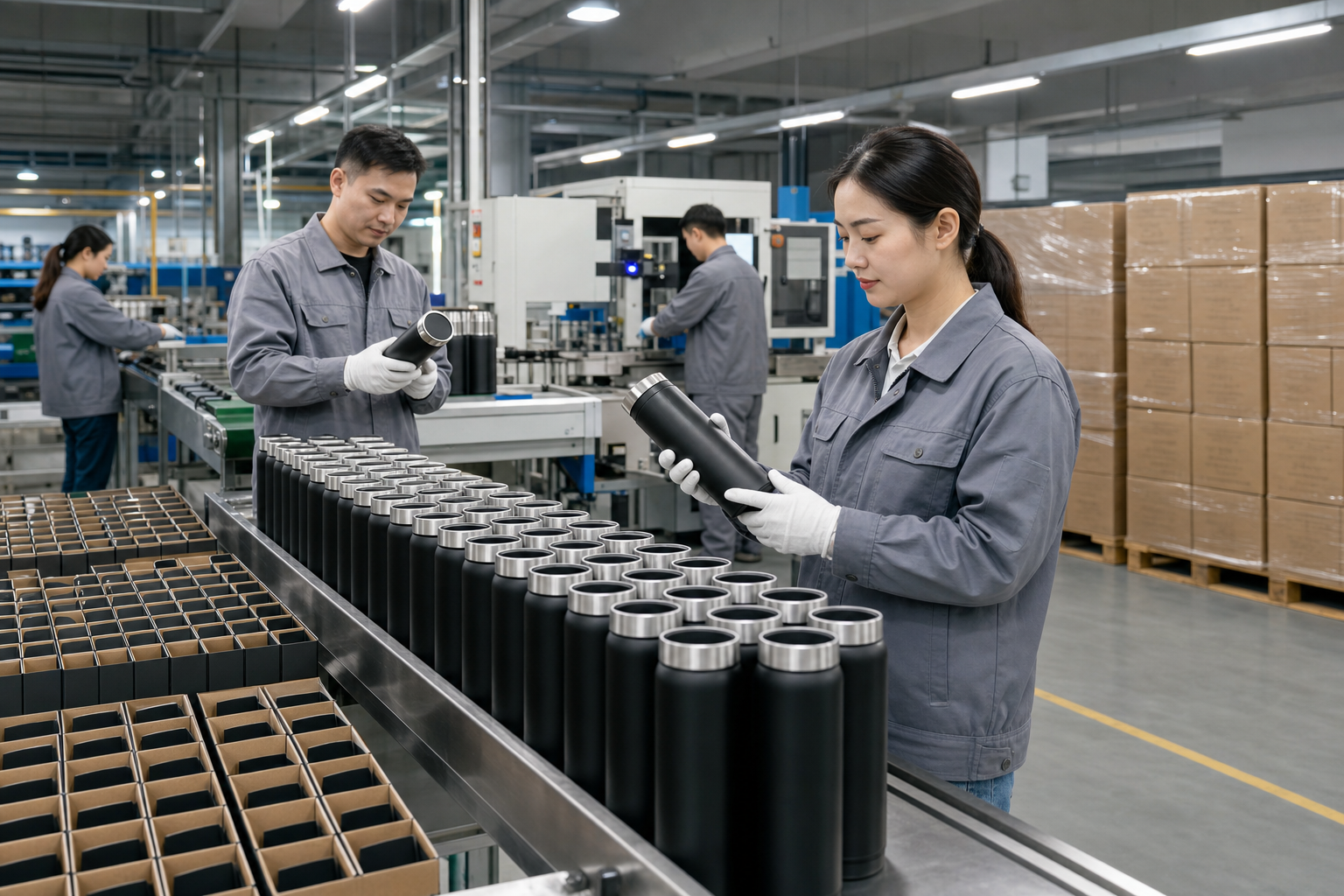
You do not need to fly around China and tour every plant, but you do need a hard qualification process. Start with the business license, export record, and photos from the actual line, not stock images from a trade show folder. Ask how many vacuum forming lines they run, what the daily output is in pieces, and whether printing stays in-house or goes to a subcontractor. If one site handles body forming, welding, vacuuming, coating, and packing, QC can hold the color and leak rate tighter.
Then ask for a sample set with two logo methods and one alternate lid. That tells you more than a glossy brochure ever will. A real supplier should quote one blank sample, one branded sample, and one mass-production price without changing the story halfway through. Put inspection terms in the PO: AQL 2.5 major, AQL 4.0 minor, and clear defect definitions for leaks, scratches, denting, print misalignment, and color deviation. We had a buyer flag a PO typo on “lid” versus “loid” once; the math was simple, the rework bill was not.
At BottleForge in Hangzhou, Zhejiang, we see buyers win when they keep the launch narrow: one capacity, one lid, one decoration method, one carton spec. QC pulled the sample, the buyer signed off, and the line kept moving. Once that first program is stable, you can expand into a private label insulated water bottle america line, then add variants for Europe. This is the right way to build a drinkware program without parking cash in ten slow-moving SKUs.
Get your private label tumbler spec checked
Send your target market, capacity, and artwork. We will map MOQ, packaging, and compliance for China production from Zhejiang.
Frequently asked questions
What is a normal MOQ for a private label insulated tumbler?
For a standard private label insulated tumbler, 3,000 pcs is a realistic MOQ in Zhejiang if you use one body color and one logo method. If you need custom packaging, multi-color print, or a special lid, 5,000 pcs is more common. For small test runs, some factories offer 500-1,000 pcs, but the unit price usually rises by 15-35% because setup cost gets spread over fewer units. Always confirm whether the MOQ applies per color or per design, because that changes your cash exposure quickly.
How much should I budget per piece FOB China?
For a 20 oz private label insulated tumbler, budget roughly USD 2.10-4.20 FOB China at 3,000-5,000 pcs. Simple powder coat and one-color logo sit near the low end. Premium finishes, laser engraving, gift boxes, and upgraded lids push the price up. If you are buying for the private label insulated water bottle usa market, remember that freight, duty, inland delivery, and prep labels can easily add another USD 1.20-3.50 per unit depending on shipment mode and carton density.
What tests should I request before mass production?
Ask for thermal retention, leak testing, lid fit check, vacuum integrity, and coating adhesion tests on the finished product. For Europe, request REACH-related material declarations and migration testing where applicable. For the United States, get food-contact documentation for the steel, lid, gasket, and print coatings. I also recommend drop tests at 1 meter and a basic transport vibration check. Do not accept only a photo sample. A private label insulated water bottle american or private label insulated water bottle united states order needs paperwork that matches the production lot.
Can I sell the same tumbler in the UK, EU, and US?
Yes, but not with one universal carton and one document pack. The core stainless tumbler can be the same, but labeling, barcode systems, packaging language, and compliance documents differ. The UK and Germany often need more careful attention to origin marking and material declarations, while the US side may focus more on marketplace prep and food-contact claims. If you want to serve private label insulated water bottle uk, private label insulated water bottle germany, and private label insulated water bottle united kingdom channels, plan separate pack-outs or at least separate outer labels.
How do I choose between laser engraving and silkscreen?
Use laser engraving when you want durability and a premium, no-fade mark on powder-coated or brushed steel. Use silkscreen when you need lower setup cost and a clean one-color logo on larger volumes. Laser is usually better for outdoor retailers and premium private label insulated water bottle programs. Silkscreen can be the better choice for promotions or multi-SKU launches. If the logo must survive abrasion in a backpack or jobsite setting, laser is the safer option. If you want lower landed cost, silkscreen usually wins by a small but meaningful margin.