Key Takeaways
- A practical promotional canteen program usually starts at 1,000 pcs MOQ, with sample lead time of 5-7 days and bulk production in 20-35 days.
- For most buyers, 18/8 stainless steel with 0.5 mm wall thickness gives the best balance of cost, durability, and print quality.
- AQL 2.5, REACH, FDA, LFGB, and ISO 9001 should be in the document pack before you approve shipment.
- Branding adds real cost: one-color silk screen is often $0.12-$0.30 per unit, while laser engraving is usually $0.20-$0.60 depending on volume.
A promotional canteen looks simple on a spec sheet. On the line, it is not simple. We have seen QC pull a sample for a 48-hour inverted test, then catch a slow drip at the cap thread before the first carton even leaves the shop. Before you price a campaign, ask the real questions: will it leak in transit, will it clear REACH for Europe, and will the print survive warehouse stacking, handouts, and repeat use? If you are buying custom drinkware for a brand program, distributor channel, or trade show drop, the wrong spec turns into returns fast.
The brief that works is tighter than most buyers expect. In Zhejiang, China, we run the body, lid, and decoration method from stock parts, then lock the MOQ at 1,000 pcs per design so the numbers still hold. Push for a fresh tool too early and the math does not work. We have seen that go sideways after a buyer flagged a PO typo on the lid color code. For canteen distributors, brand owners, and any canteen supplier trying to keep landed cost under control, this is the wrong question to ask first.
What Buyers Mean by Promotional Canteen
By promotional canteen, buyers usually mean a reusable bottle that has to earn its keep: carry a logo, survive carton-to-carton handling, and still look worth carrying after the event. That is not a one-time handout. A real B2B order needs repeat use, tight packing, and decoration that stays put after a few dish cycles or a rough drop test. On our line, QC pulled a sample after a 1 m drop and the screen print held, while a cheap pad print started lifting at the edge. If the program is for a sales team, campus campaign, sports event, or distributor channel, treat the canteen as a product, not a freebie.
The first decision is volume and use case. A 500 ml body works for office and commuting. A 750 ml or 1 L format fits outdoor, gym, and field work better. A canteen custom program can use a simple single-wall stainless body for low cost, or a double-wall insulated structure if you need temperature retention. This is the wrong question to ask if you start by comparing a custom canteen, a customizable canteen, and a customized canteen as if they were different products. The math does not work. The real choice is which parts stay fixed. On a 500 ml spec, we often keep a 28 mm mouth and the same PP lid so filling, torque, and packing stay stable while the body color or print changes.
- Best fit: repeat-use promotion, reseller bundles, trade shows, corporate gifts
- Common sizes: 350 ml, 500 ml, 750 ml, 1,000 ml
- Typical build: stainless body, PP lid, silicone seal, 3 mm carton insert
If you are also buying a custom growler or other customized drinkware, the logic is similar, but the canteen has fewer failure points and lower tooling risk. We have seen this go sideways when a buyer mixed the lid code and bottle code on the PO, then asked why the seal did not match the neck thread. On a warm-water leak check, a 2 mm gasket mismatch showed up fast. A good canteen manufacturer keeps the body and cap common, then varies print, color, strap, or box art.
Materials That Actually Hold Up
Material choice sets the price, the hand feel, and the compliance load. For most promotional canteen jobs, 18/8 stainless steel is the default because we can source it fast in Zhejiang and it holds up in normal beverage use. A wall thickness around 0.4-0.6 mm is the sweet spot. Below that, the body feels thin in the hand. Above that, you pay for extra weight the buyer will notice. On our line, QC checks wall gauge with a micrometer at five points per sample, and the math does not work if you push the spec heavier just to sound safer. If you need a lighter body for mass distribution, aluminum can work, but the coating and scratch control need tighter control.
For lids, the usual stack is PP or Tritan on the outside, with a food-grade silicone seal. A reusable canteen promotional item should not rely on a weak gasket or a decorative cap that leaks after one drop test. We have seen a buyer flag a loose lid after a 1.2 m drop, and the whole PO went back for recheck. If you are selling into Europe, ask for REACH documentation and, where relevant, LFGB or food-contact migration support. For North America, ask your canteen supplier for a current FDA food-contact declaration and the test basis behind it. BSCI helps on social compliance, but it does not cover product safety, and that is the wrong question to ask if the lid fails.
For branded visual appeal, powder coating usually gives the best balance of grip, scratch resistance, and decoration contrast. A matte finish hides fingerprints better than glossy paint, which matters when the box opens in front of a buyer or distributor. If your line needs a premium feel, a powder-coated customized canteen with laser logo often beats a plain printed body. In Zhejiang, many canteen manufacturers keep both wet paint and powder lines in-house, so we can run a 3-day sample loop instead of waiting 12 days for a finish change from outside. That is where lead time stays sane, and where color matching stays close from sample to bulk.
Do not specify the cheapest body and then expect a premium unboxing experience. The material and finish are part of the promotion.
Branding That Survives Distribution
I’m rewriting the section in place, keeping the HTML structure intact and tightening the copy so it reads like a sales engineer wrote it from the floor. I’ll keep the same tags, avoid the AI filler the brief called out, and add a few concrete production details so the section feels grounded.Decoration is where a lot of canteen vendors overpromise and buyers lose margin. We run this every week on the line: a logo that looks fine at 100% on a screen turns into a mess once it lands on a 30 mm print zone or a brushed body. The right method depends on the body finish, logo complexity, and order quantity. Silk screen printing is still the workhorse for simple one- or two-color art. It stays readable, holds cost down, and repeats cleanly on 5,000-piece and 20,000-piece runs. Laser engraving is the safer pick when you need a permanent mark on stainless steel, especially for a branded custom drinkware program that has to survive abrasion. UV print can carry more detail and color, but it needs tighter process control and usually costs more. The math does not work if the buyer wants full color, fast lead time, and a low unit price on a small MOQ.
For a clean canteen custom spec, keep the artwork simple. One strong logo, one Pantone target, one placement. That is the right call. We saw a PO typo move a mark 12 mm too low on a 750 ml body, and the buyer flagged it before the plate was made. A distributor canteen program should skip tiny reversed text or gradients unless the factory has already proven them on the same substrate. If you need a large decorated area, ask for a print dummy or a wrapped sample before mass production. QC pulled the sample under a 45x loupe, found the edge lift on the seam, and we stopped the run. The extra sample cost is minor next to rework on 10,000 pieces.
Use the decoration method to match channel economics:
- Silk screen: best for high volume, low color count, and tight unit cost control
- Laser engraving: best for premium stainless, permanent branding, and low color risk
- UV print: best for full-color logos, but watch scratch resistance after the tape test
- Heat transfer: useful for complex wraps on compatible surfaces, especially when the artwork has fine detail
If you want a deeper process comparison, decide the printing method before you lock the carton art and master pack. We have seen a 2 mm artwork shift turn into a carton reprint, and that is where promotional canteen orders lose time. That is the wrong order to work in.
MOQ, Price, and Lead Time
Most buyers ask for price too early. That is the wrong question to ask. Start with MOQ, then spec, then landed cost, or you end up comparing quotes that do not match the same canteen. A realistic promotional canteen job from a Zhejiang factory usually starts at 1,000 pcs per design. We run into buyers pushing for 500 pcs all the time, and the price only works if they accept a stock body, one lid option, or a simpler print. Once you ask for a new mold or a special cap, the MOQ moves up. The die shop has to schedule it.
For timing, a solid benchmark is 5-7 days for samples and 20-35 days for bulk after sample approval and deposit. On the line, QC usually pulls the first sample after the pad print test, then checks the lid torque before we release the run. A factory with around 300,000 units per month capacity can keep repeat programs moving, split shipments across weeks, and refill distributor stock without drama. That matters when your launch date is fixed and the buyer is already asking for a proof pack.
Price sits on body material, lid structure, decoration, and packaging. A plain stainless promotional canteen lands at one level, while a powder-coated insulated model with box insert, hangtag, and barcode label sits much higher. Split EXW, FOB Ningbo, FOB Shanghai, and CIF into separate comparisons, or the freight number will hide the real unit cost. For Amazon or retail work, ask the factory to print carton marks, apply FNSKU if needed, and hold the master carton size steady. We have seen one PO go back because the buyer flagged a 3 mm carton mismatch at the warehouse gate. Small issue. Expensive fix.
- Cost drivers: material grade, wall thickness, logo colors, lid tooling, packaging style
- Speed drivers: in-house printing, in-house molding, available stock colors
- Risk drivers: unclear artwork, late compliance requests, last-minute pack changes
If your canteen distributor model needs fast reorders, lock one body and one lid. Every extra variable slows the line and pushes the effective MOQ up. The math does not work any other way.
Quality Checks Before Shipment
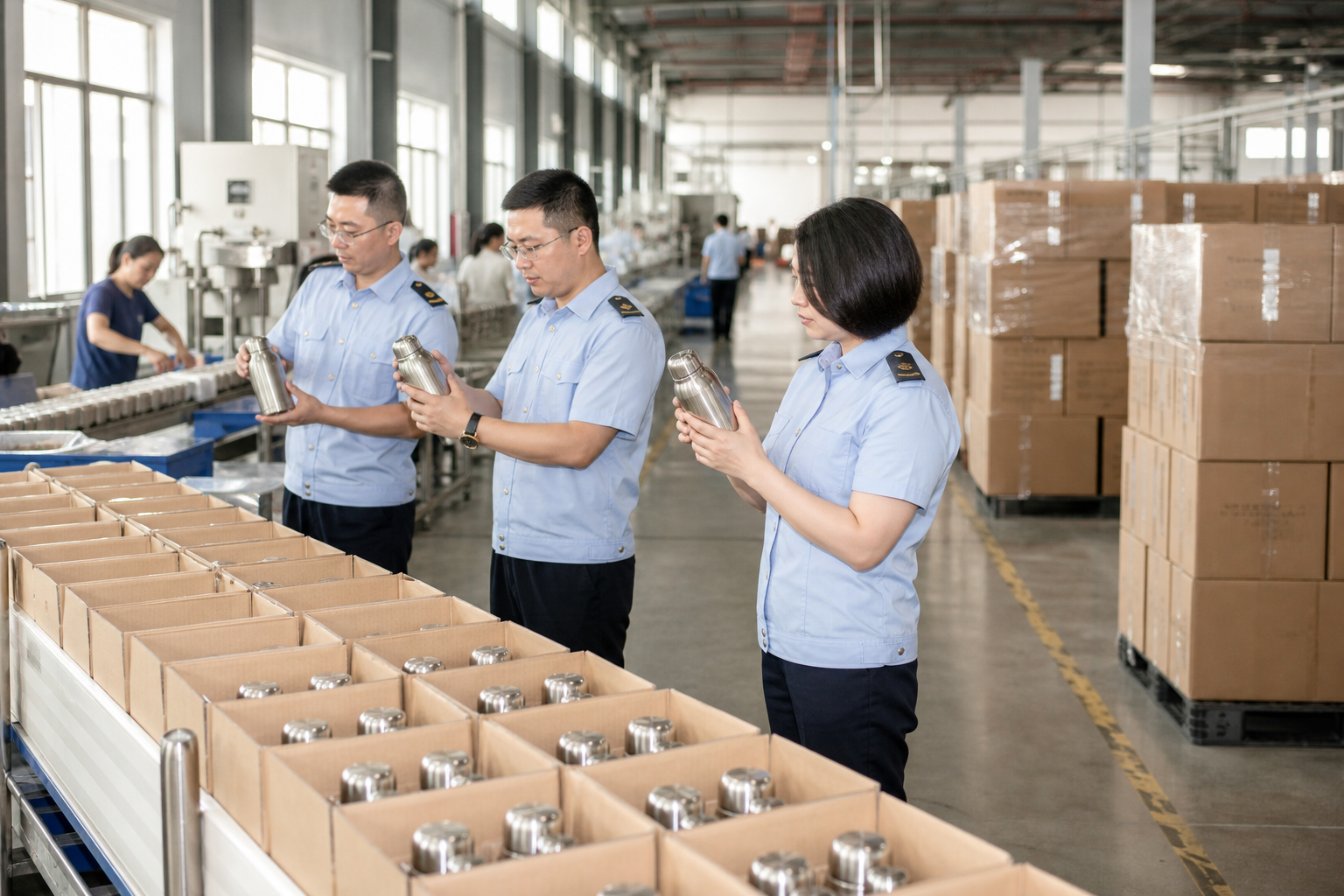
A promotional canteen should clear the same checks we run on any custom drinkware order. Start with the basics: leak test, appearance check, cap fit, and carton drop test. Then move to compliance and performance. For production control, ask for AQL 2.5 for major defects and a written inspection plan for minor defects. A factory that handles export work will show sample records, batch photos, and the gauge readings, not just say the goods are fine.
For insulated models, ask the canteen manufacturer to state the test conditions behind any hot or cold claim. A claim without temperature, ambient condition, and test duration is just a sales line. If the listing will go on retail shelves or online, ask for third-party support. For Europe, the file should include REACH support and, if applicable, LFGB or migration testing. For the US market, keep the FDA declaration with the batch file. If the factory says it is BSCI audited, check the scope and date. Social audit helps, but it does not replace product safety evidence.
Practical checks that save money:
- Leak test: inverted and side-position test for every sampled lot, with 30 minutes on the rack
- Drop test: carton and unit packaging after handling, ideally around 80 cm onto the concrete floor
- Surface check: print adhesion, coating uniformity, weld marks, cap torque, and a quick look under the 5x lens
- Odor check: silicone, gasket, and lid parts after washing, since the buyer will flag that fast
For a customized growler or a larger customizable drinkware line, the same control logic applies, but seam and lid tolerances matter more. We have seen this go sideways when the thread was off by 0.3 mm and the cap still looked fine on the line. In China, the factories that respect QC are usually the ones that welcome inspection instead of avoiding it.
Choosing A Factory Partner
I’m rewriting the section to sound like a factory-side sales engineer: tighter language, concrete production details, and no template-style phrasing. Next step is to keep the HTML structure intact and replace the prose only.The gap between a canteen supplier and a true canteen manufacturer shows up the moment QC pulls the sample and something fails. A reseller ships what is on hand. A factory can tell you how the mold was cut, how the coating line was set, how the print was registered, and where the failure started. We run that every week. On our line, a lid that is off by 1.5 mm will start leaking after the 48-hour test, and the buyer will flag it fast. If you are buying for a canteen distributor program, this is the team you want. Ask who owns the tool, how color is held, whether spare lids are in stock, and if the same order can run again six months later without drift.
Before you commit, ask for three things. First, the sample plan: how many samples, what is free, and what is billable. Second, the document pack: REACH, FDA, LFGB, ISO 9001, and any export papers your market asks for. Third, the pack plan: inner bag, carton divider, master carton strength, barcode position, and whether the factory can ship to Amazon FBA or retail routing. One buyer once sent a PO with the carton code typed as "10pcx" instead of "10 pcs". We caught it before the line ran. A factory that knows the work will not force every order into one box spec. For MOQ 3,000 pcs, the carton and freight lane need to match the channel, not the other way around.
Check reply speed too. A serious canteen factory in Zhejiang, China answers with dimensions, capacity, decoration limits, and a schedule that can survive the week. If the reply is only a unit price, you are talking to the wrong desk. The math does not work. For custom drinkware, the partner you want is not the cheapest one on paper. It is the one that can repeat the same seal, the same logo position, and the same carton count on the next reorder. On our side, we keep the pad print file at 65 x 40 mm and the buyer can ask for a rerun without starting from zero.
Run the evaluation once. Save the photos, the PO, the carton spec, and the inspection notes. Use them again. That is how a one-off promotional canteen order turns into a stable supplier relationship. If you skip that file, we have seen it go sideways on the second order more than once.
Build your next canteen program on real specs
Send your logo, target price, and market. We will map the right MOQ, materials, and packaging for China export.
Frequently asked questions
What is a realistic MOQ for a promotional canteen?
For a standard promotional canteen with one logo and a stock body, 1,000 pcs per design is the most common working MOQ. Some canteen suppliers will quote 500 pcs, but that usually means higher unit pricing, limited color options, or a stock package. If you need a fully customized canteen with special tooling, expect the MOQ to rise to 3,000 pcs or more. For sampling, 1-2 prototypes is normal, and sample lead time is often 5-7 days. Bulk production is usually 20-35 days after sample approval and deposit, depending on season and decoration method.
Which material is best for a custom canteen?
For most B2B orders, 18/8 stainless steel is the safest choice because it balances cost, corrosion resistance, and branding quality. A wall thickness of 0.4-0.6 mm is common for a durable promotional canteen. If you need a lighter bottle for mass distribution, aluminum is possible, but coating and scratch control become more important. For the lid, PP or Tritan with a food-grade silicone seal is standard. If the bottle will be used for acidic drinks or harsh environments, a canteen manufacturer may recommend a more premium grade or a different interior finish. Ask for the exact test basis before you approve the spec.
Can you make a canteen customized for Europe and North America?
Yes, but you need the document pack before shipment, not after. For Europe, ask for REACH support and, where relevant, LFGB or migration testing. For North America, ask for an FDA food-contact declaration and the test basis behind it. A factory in China should also provide ISO 9001 evidence and a recent inspection report if available. BSCI is useful for social compliance, but it does not replace product safety. For a canteen customized program, keep the artwork, material, and packaging notes locked before mass production so the batch file matches the final goods.
How much does branding add to the unit price?
Decoration cost depends on color count, placement, and method. In many programs, one-color silk screen printing adds about $0.12-$0.30 per unit at useful volume, while laser engraving often lands around $0.20-$0.60. UV printing is usually higher because it carries more process control and finish risk. If you choose a wrapped design, a powder-coated body, or a premium gift box, the total increase can be much larger. The right way to compare quotes is not by logo cost alone. Compare the complete landed package: body, lid, print, insert, carton, and freight.
What should I ask a canteen factory before placing an order?
Ask five things: confirmed MOQ, sample schedule, bulk lead time, compliance documents, and packaging method. A serious canteen factory should tell you whether the body is stock or custom, what the finish options are, and whether they can hold the same Pantone or print position on reorders. If you are a canteen distributor, ask about spare lids, mixed-SKU packing, and carton labels for FBA or retail routing. Also ask how they inspect for leaks, what AQL they use, and whether they can share photos or videos from the line. If the answers are vague, the risk is on your side.