Key Takeaways
- For promotional drinkware, a realistic first order is often 500 to 3,000 units, with standard factory lead times of 25 to 35 days.
- 304 stainless, Tritan, and BPA-free PP cover most custom canteen and custom growler programs; choose by use case, not by price alone.
- Laser engraving is usually the most durable branding method, while silkscreen is the lowest-cost option for large logo areas.
- For Europe and North America, ask for REACH, FDA or LFGB food-contact files, AQL 2.5 inspection terms, and carton specs before you pay deposit.
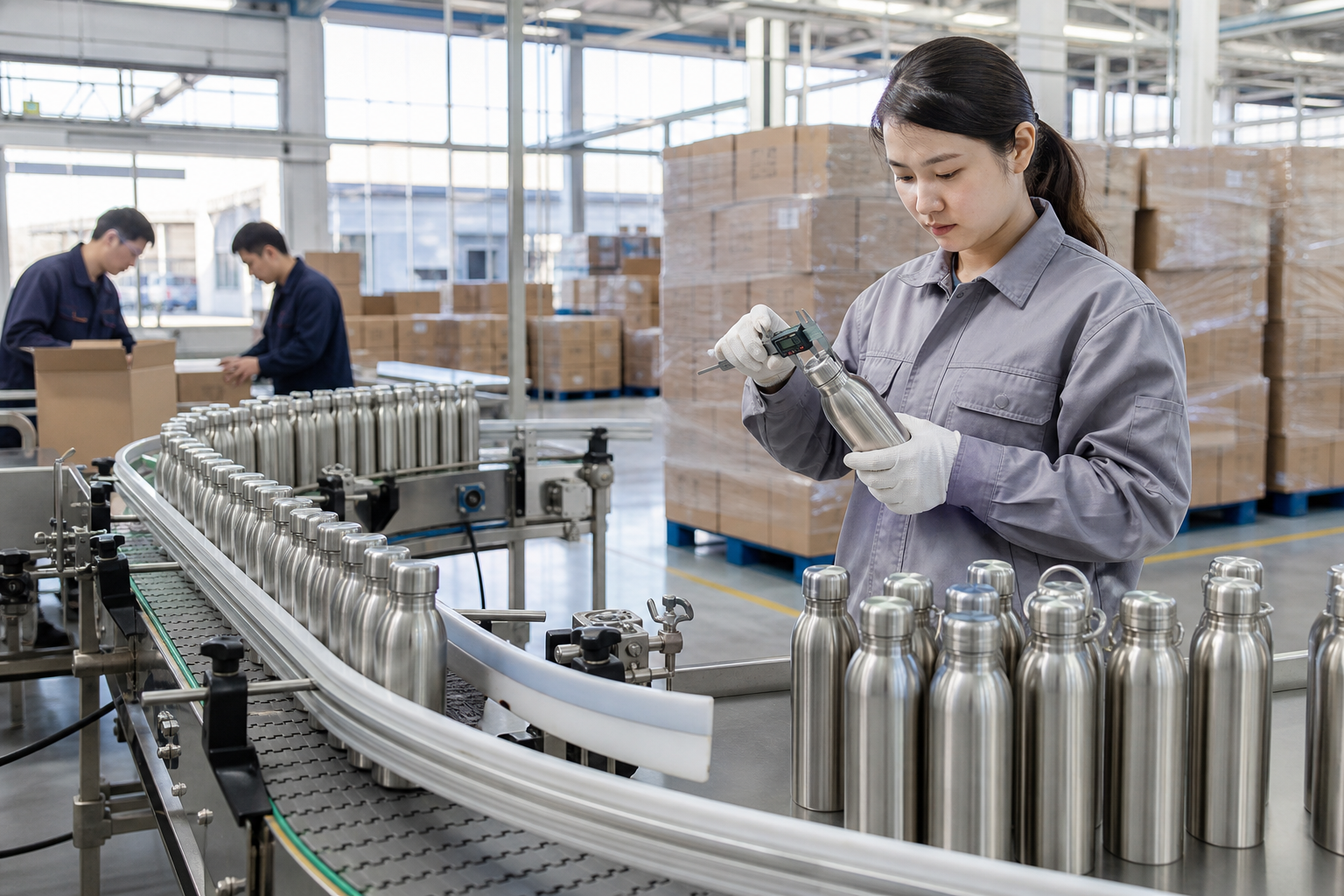
Promotional drinkware looks simple until you price it, test it, and ship it. The real job is not printing a logo on a bottle; it is choosing a format that survives daily use, passes REACH and food-contact checks, and lands at the right landed cost. On our line in Zhejiang, a 1 mm shift in wall thickness can change how a tumbler prints and how it stacks in carton packs, and that is where margin gets shaved. The wrong question is usually, "Can you print this?" The better one is, "What will break first, the decoration, the carton, or the budget?"
If you are sourcing custom drinkware for a brand launch, reseller program, or distributor canteen order, you need to balance MOQ, lead time, and durability. A good canteen manufacturer should be able to quote 3,000 to 10,000 units per month on a standard model, explain decoration risk, and tell you where the hidden costs sit before you approve samples. We have seen buyers flag a PO typo on capacity, then lose 12 days while QC pulled the sample and the art file got corrected. The math does not work if you ignore that.
Start With The Use Case
The fastest way to burn budget is to ask for promotional drinkware without saying where it will be used. On our line, QC pulled the sample for a 500 ml shaker and it failed the 1.2 m drop test, while a 1 L commuter bottle or a 32 oz custom growler runs on different rules. For a canteen distributor, the real choice is shelf appeal or abuse resistance. For a corporate gifting run, logo space and hand feel carry more weight. If this is for ecommerce, 40 g and carton count matter more than the sales story. This is the wrong question to ask if you skip the use case.
Split the order into four jobs: daily carry, hot beverage retention, sports hydration, or bar and hospitality use. A custom canteen for outdoor promotion needs a locking cap, a 55 mm mouth, and a body that survives a 1 m fall onto the concrete floor. A customizable drinkware line for office use can lean harder on finish and print area, and we run fewer impact checks there because the buyer flagged style first. If you are buying for a distributor drinkware program, ask how much ships in retail boxes and how much goes bulk, because 12 days versus 18 days on packing changes the landed cost fast. The math does not work any other way.
- Daily carry: vacuum tumbler, slim sports bottle, stainless thermos for desk bags and car cup holders
- Outdoor use: custom canteen, wide-mouth bottle, hard-wearing lid with gasket and carry loop
- Hospitality: custom growler, insulated jug, bar gift set that looks good on a shelf
- Promotional events: lightweight bottle with one-color logo, 7-day lead time, and simple carton packing
Once the use case is clear, a canteen supplier can set wall thickness, lid style, and print zone instead of pushing the cheapest SKU off the shelf. We ship that way because a 0.8 mm wall and a 1.0 mm wall are not the same when the buyer wants no dents, and QC catches it before it turns into a claim. Start with the job, then the spec. That sequence saves arguments.
Pick Materials That Hold Up
Material choice decides whether your promotional drinkware looks tired after one round of desk use or still clears a buyer’s inspection after a full season. For most custom canteen and customized drinkware programs, 304 stainless steel is the default because it keeps cost, corrosion resistance, and print compatibility in line. If the liquid is acidic, the spec calls for a longer service life, or the item sits in premium retail, 316 stainless is the safer pick, but the price jump is real. Tritan is a clean fit for clear bodies and youth SKUs. BPA-free PP still does the job for lids, flip tops, and lighter bottles. On the line, we run the same logo test on all four materials before we release a sample.
Do not ignore wall thickness. A vacuum bottle body around 0.4 to 0.5 mm usually holds dents better than a thin decorative shell, especially when the order moves through distributor canteen channels. For a canteen custom build, ask whether the inner and outer shells are both 304 or whether the outer body is painted carbon steel. That point changes rust risk and warranty exposure fast. Last month, QC pulled a sample at 0.38 mm and the buyer flagged it on sight. In Zhejiang, a serious canteen factory gives you the actual gauge, not a vague “food grade” line on the spec sheet.
Practical rule: buy the material for the liquid and the logistics, not for the sample photo.
If you are sourcing from China, request material declarations and test reports before tooling. A good canteen manufacturer should put the same spec on the PO, the sample card, and the production order. If one says 304 and another says “stainless steel,” the math does not work. We have seen that go sideways on a 5,000 pcs run when the buyer caught a PO typo too late. That alignment matters more than any sales pitch from a canteen vendor or canteen supplier.
Branding Method Changes The Result
Decoration is a wear item, not just a look. On our line, QC pulled samples after 48 dishwasher cycles and the logo edge started to haze. Promotional drinkware that looks sharp on day one can fail fast if the mark scratches off in dishwashing, friction, or ice bucket use. For a 5,000-piece canteen order, silkscreen is still the lowest-cost method when you only need one or two solid colors and a big print run. Laser engraving costs more per unit, but it gives a permanent mark and a cleaner premium look on 304 stainless. UV printing and heat transfer sit in the middle when you need gradients, wraps, or multiple colors.
Ask the factory how the logo will age. This is the wrong question to ask if you only look at the artwork proof. A customized canteen for a trade show giveaway can live with a simpler print. A customized growler sold through retail should not lose branding after a week in a cooler. If the buyer wants a canteen customizable across multiple colors, ask whether the color is powder coat, spray paint, or electroplated finish, because each one chips differently and reorders do not match the same way. We had one PO where the logo sat 3 mm too high on the drawing, and the buyer flagged it before tooling. A good custom logo setup should include Pantone matching, logo placement drawings, and a clear tolerance for minor registration shift.
- Silkscreen: low unit cost, best for flat logos and large quantities
- Laser engraving: strongest durability, best for stainless bodies
- UV print: flexible graphics, good for short runs and color logos
- Heat transfer: useful for full-wrap designs and detailed artwork
If you want the safest route, ask for one decorated sample, one abrasion check, and one dishwasher cycle test before you approve the production file. We run that sequence before release when the order is above 1,000 pieces, and it catches bad ink adhesion fast.
MOQ, Pricing, And Lead Time
Most B2B drinkware mistakes start on the quote sheet. Buyers stare at unit price and miss tooling, print setup, carton changes, and freight density. For promotional drinkware, we usually see MOQ at 500 to 1,000 pieces for standard decoration, 1,000 to 3,000 pieces for a custom color, and 3,000 pieces or more if you want a fully customized mold or lid. A basic stainless bottle often lands around USD 1.20 to 2.80 FOB China, while a vacuum insulated premium piece can run USD 3.50 to 6.50 depending on finish and packaging. We run this math on the line every day, and the buyer who only chases the lowest unit price usually gets the wrong answer.
Lead time is usually 25 to 35 days after sample approval and deposit for standard orders. Custom tooling, new lid development, or special packaging can push that to 45 to 60 days. A serious Zhejiang canteen factory should give you monthly output, not a sales pitch. QC pulled a sample last week and found a 1.2 mm gap at the lid thread, so the line stopped until we fixed the tooling. If a canteen manufacturer says 300,000 units per month across mixed SKUs, ask how much is actually open for your order and whether your color is already in stock. The headline number is cheap talk.
When you negotiate, split the quote into three lines: sample charge, production unit price, and freight. A sample might cost USD 30 to 120 depending on branding. A small order can look expensive because setup is spread over fewer units, and that is normal. The wrong question is whether the first order looks high; the real question is whether the canteen supplier can repeat the same spec on reorder without changing the lid, coating, or carton size. We have seen a PO typo turn 5,000 black units into matte blue, and nobody enjoyed that meeting.
Compliance And Packing Details
If your market is Europe or North America, compliance is not a checkbox you handle after the order. It is part of supplier selection. For beverage contact, ask for REACH, LFGB if the product will face German retail scrutiny, and FDA food-contact statements for the US market. On a 5,000-piece run, one wrong barcode position can mean a reprint and a day lost, so if the program is retail or ecommerce, ask for carton drop-test specs, barcode placement, and FNSKU labeling instructions before production starts.
Inspection terms matter just as much. A standard AQL 2.5 major and 4.0 minor inspection is common for promotional drinkware, but you need to define whether cosmetic marks on powder coat are acceptable. On a 450 ml matte canteen, a 1 mm dust nib may pass bulk work and still miss a premium gift standard. For custom growler projects, ask for leak testing, closure torque, and seal compression data, because a growler that drips in transit becomes a chargeback problem fast. The wrong question is whether it looks fine on the bench; the real question is how it behaves after 800 km on a truck.
Packaging choices that reduce loss
- Individual polybag plus white box for bulk distribution
- Color box for retailer or gift programs with a 4-color insert
- Master carton marks with model, quantity, and country of origin on two sides
- Barcode and FNSKU placement confirmed at sample stage
A serious canteen vendor will talk about packaging density, not just print quality. If a 24-piece carton measures 68 x 46 x 28 cm and leaves 18 mm of dead space around each bottle, the freight bill will show it. We ship that kind of load every week, and the math does not work if you ignore cubic meters. That is where the real shipping cost is hidden.
Choose A Supplier You Can Audit
There are dozens of canteen suppliers, but only a small group can handle repeat B2B orders without drifting on quality. You want a canteen factory or canteen manufacturer that can show process control, not just a clean sample on the desk. Ask for ISO 9001 or BSCI if you care about factory systems and social compliance, then check incoming material checks, in-process inspection, and final AQL records. On one audit in Zhejiang, QC pulled three caps off the line and found a 0.3 mm gap on the liner. The factory that refuses to show test logs usually has a reason.
Audit the supplier on five points: tooling ownership, color control, sample consistency, packing control, and communication speed. If you buy through a canteen distributor model, make sure the vendor can absorb forecast changes without breaking the MOQ logic. If you are screening a canteen manufacturers shortlist, ask who owns spare lids, which parts sit in stock, and how they control sub-suppliers for silicone seals and coatings. We have seen this go sideways when a PO typo changed "5000" to "500" cartons and nobody caught it until packing. Those details decide whether the next reorder is smooth or painful.
For most buyers, the right path is simple: pick one core SKU, confirm sample quality, lock the decoration file, then scale. A custom drinkware program makes money when the same item can be reordered with the same finish, the same carton count, and the same defect rate. We run it that way on the line, and the math works. That is what separates a real export partner from a one-off canteen vendor.
Request a quote with your exact spec
Send material, size, logo file, and target MOQ. We will price the right custom drinkware option and flag the tradeoffs before production.
Frequently asked questions
What MOQ should I expect for promotional drinkware?
For standard promotional drinkware, expect 500 to 1,000 pieces if you use one-color silkscreen on an existing mold. If you want custom color, special packaging, or a canteen custom lid, MOQ usually rises to 1,000 to 3,000 pieces. New tooling or a fully customized canteen or custom growler can push the first order to 3,000 pieces or more. The real question is not only MOQ but whether the canteen factory can hold the same spec on reorder. Ask for sample cost, production lead time, and packing details in the same quote.
Which material is best for a custom canteen order?
For most custom canteen orders, 304 stainless steel is the safest default because it balances cost, corrosion resistance, and print durability. If the drink is acidic, the use case is premium retail, or the product needs a longer service life, 316 stainless is stronger but costs more. Tritan works for clear bodies and lightweight customizable drinkware. BPA-free PP is fine for lids and some low-cost bottles. Ask the canteen manufacturer to confirm wall thickness, usually around 0.4 to 0.5 mm for insulated bodies, and request food-contact documents before payment.
Is laser engraving better than silkscreen printing?
It depends on the job. Laser engraving is usually better when you want a permanent mark on stainless promotional drinkware, especially for a premium canteen promotional run or a custom growler. It does not peel or fade the way some inks can. Silkscreen is cheaper and works well for large flat logos, especially on high-volume distributor drinkware orders. If your brand colors matter or the logo is complex, UV print or heat transfer may be better. For a reorder-heavy program, ask for an abrasion check and a dishwasher test before you approve the final artwork.
How do I reduce risk when buying from China?
Use a controlled process. Start with a sample, then confirm the material, finish, logo file, and carton spec in writing. For China sourcing, especially from Zhejiang, ask for REACH or LFGB where relevant, a food-contact statement, and inspection terms such as AQL 2.5 major and 4.0 minor. A good canteen supplier should also give you lead time, monthly capacity, and photos of in-process QC. If you are importing into the US, confirm FDA food-contact compliance; if you sell online, confirm barcode and FNSKU placement early.
Can I mix sizes or colors in one order?
Usually yes, but it changes cost and timing. Mixing colors in one custom drinkware order can raise MOQ per color, especially if the finish uses powder coating or spray paint. Mixing sizes in one PO often means separate cartons, separate labels, and separate inventory counts. For a canteen distributor or distributor canteen program, it is usually cleaner to keep one core size and two or three approved colors. That lowers packing errors and makes reordering easier. Ask the canteen factory whether components such as lids, seals, and cartons are shared across SKUs before you commit.