Key Takeaways
- A practical promotional growler order usually starts at 500-1,000 units, while custom colors and special lids often push MOQ to 3,000.
- For export programs, 304 stainless steel at 0.6-0.8 mm wall thickness is the safest baseline for a customizable growler.
- Laser engraving lasts longest; screen print is cheaper, but you should expect 1-3 color limits and more wear after repeated washing.
- A Zhejiang canteen manufacturer with 300,000 units/month can ship a 25-40 day production run if your artwork, packaging, and test requirements are fixed early.
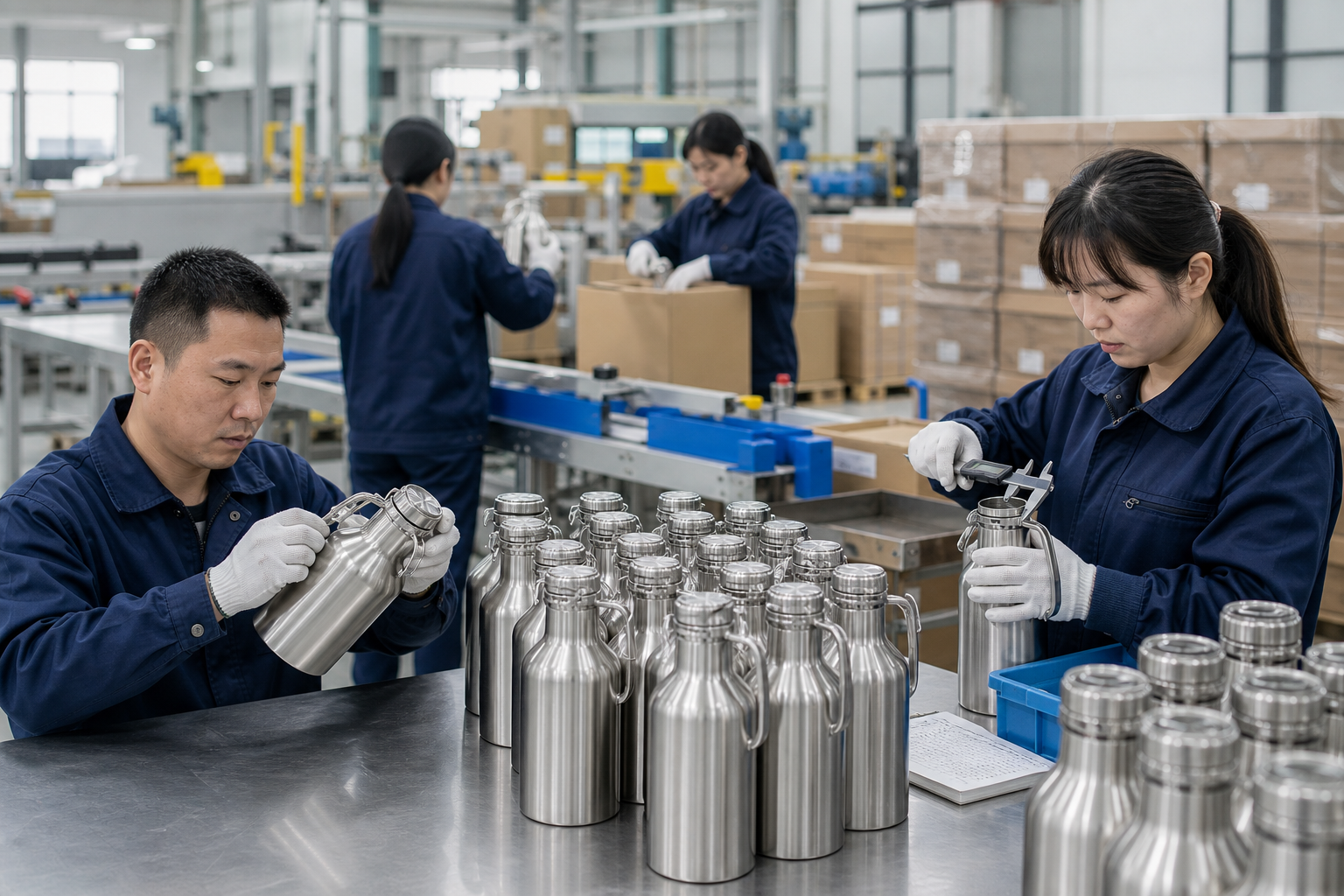
A promotional growler looks simple until you need 2,000 units that print cleanly, hold a seal, and survive export cartons from Zhejiang to Europe or North America. We run this kind of order on the line all the time, and the first failure is usually basic: a 0.3 mm wall spec gets swapped for a thinner body, then QC pulled the sample and the cap started weeping in transit. The real job is not putting a logo on steel or glass. It is matching the body, cap, finish, and packing to how the buyer will actually use the bottle.
If you source from a canteen factory in Zhejiang, treat the growler as a production spec, not a catalog photo. Ask for wall thickness, closure torque, logo method, and the true MOQ before you talk price. We have seen POs with the wrong lid code and a misspelled carton mark stall a shipment for 12 days, and this is the wrong question to ask if you start with unit cost. A custom growler works when the factory knows the target use, the inspection point, and the packaging load, not when everyone hopes the sample will sort itself out.
What Buyers Mean By Promotional Growler
When buyers say promotional growler, they usually mean a reusable container that carries a brand story without looking cheap. On our line, we check the laser jig and cap torque first, because a crooked logo or loose lid kills the whole order. In practice, that can be a 32 oz stainless steel growler for brewery promos, a 64 oz insulated version for retail bundles, or a glass body for premium gift sets. The right pick depends on whether the buyer needs a giveaway, a distributor program, or a shelf item that stays in stores.
Do not confuse a promo item with a throwaway item. A distributor growler or distributor drinkware program needs enough durability to handle shipping, storage, and repeated handoffs. A canteen custom project works the same way. We had one buyer push back on a 1.2 mm wall, then the drop test on six samples showed why the math works. If the product feels flimsy, the brand feels flimsy. Buyers in Europe and North America are better off with a simple structure that ships clean than a customized growler packed with extra decorative parts.
- 32 oz is common for a compact promotional run.
- 64 oz fits brewery and outdoor use better.
- Single-wall units are cheaper; insulated units sell harder.
- A screw cap with a reliable gasket matters more than a fancy silhouette.
For a canteen promotional program, the best spec is the one your customer can carry, wash, and reuse without thinking about it. QC pulled the sample, checked the gasket, and caught a PO typo before we packed 5,000 lids against the wrong bottle neck size. We run into that kind of mistake more than people expect.
Pick The Right Body Material
Material choice drives cost, shipping risk, and perceived value. For most custom drinkware buyers, 304 stainless steel is the safest starting point for a promotional growler. We run it through stamping, spinning, and laser engraving without much drama, and it is easier to explain than a mixed-material build. On our line, a 0.8 mm body usually gives a better dent margin than 0.5 mm. If the brief needs higher corrosion resistance, 316 stainless makes sense, but it will raise cost and the math does not work for a standard beverage promo.
Glass has its place, but it is less forgiving in export cartons and last-mile distribution. QC pulled the sample and the neck chip showed up after one drop test at 80 cm, so we treat glass as a premium retail call, not a rough-shipping call. It works better for a customized drinkware set or a custom growler that will be handled carefully. For outdoor use, a double-wall stainless body is more practical. Ask the canteen manufacturer for the exact wall thickness, because 0.5 mm and 0.8 mm behave differently in forming and dent resistance.
Here is the short version:
- 304 stainless for balanced cost and durability.
- 316 stainless for harsher environments or premium positioning.
- Glass for display value, not rough logistics.
- Powder coat or paint if you want color and grip.
If you already buy custom canteen, customizable canteen, or customized canteen lines, use the same logic here. The buyer flagged a PO typo once and asked for a color that did not match the cap spec; that is why we keep the body material aligned with the branding plan, not the other way around.
Decoration That Survives Shipping
The fastest way to ruin a promotional growler order is to pick decoration before you lock the substrate, shoulder radius, and carton size. We have seen a logo look clean on a screen and then crawl over a weld seam on a 2 mm shoulder. If you want a canteen customizable for export, define the print area and the weak point first. That is the right question, not the artwork alone, especially when the order gets boxed, palletized, and handed to a canteen distributor.
Laser engraving is the most durable choice for stainless steel. On our line, QC pulled the sample after 24 hours of wash testing and the mark stayed sharp, so it is the safest pick for a distributor canteen line or any customized growler that has to survive repeated cleaning. Silkscreen printing is cheaper and works well for 1-3 colors, but we have seen it wear early if the buyer runs a harsh wash cycle. UV print and pad print can work on smaller panels, but they need tighter control on jig position and ink thickness.
Choose decoration by use case
- Laser engraving: long life, low risk, best for premium branding.
- Silkscreen: good for cost control and simple logos.
- Powder coat with reserved logo panel: strong visual impact.
- Wrap label: useful for short runs or seasonal campaigns.
If your canteen vendors quote decoration without asking for artwork size, send the quote back. We run into this with 80 mm logo files all the time, and the math does not work on a curved body. Good custom logo execution starts with the actual geometry, not a template someone reused from another SKU.
MOQ, Price, And Lead Time
Pricing for a promotional growler comes down to the body material, print method, lid build, and how it is packed on the line. For a basic 304 stainless model, FOB usually lands around USD 2.20 to 3.80 at 1,000 units. Add a powder coat, a custom PP or bamboo lid, or a retail box, and the quote moves to USD 4.50 to 6.50 fast. We checked one 18 oz sample with a caliper at 1.2 mm wall thickness, and the buyer still pushed back on the box cost. Glass with a printed sleeve looks cheaper on paper, but breakage and carton weight can wipe that out.
MOQ depends on how the factory is set up. A Zhejiang plant that runs 300,000 units a month will usually take a 1,000-unit promo order with less drama than a 300-unit mixed-color job, because the spray booth and packing table are already tuned for volume. For custom colors or special lids, 3,000 units is the number we see most often. Sample lead time is usually 5 to 10 days. Mass production is usually 25 to 40 days after sample approval, once artwork and packaging are locked and the buyer stops changing the logo size on the PO.
Use this range as a working model:
- Stock body with logo: 500 to 1,000 units.
- Custom color or custom lid: 3,000 units or more.
- Artwork changes after sampling: add 5 to 7 days.
- Ocean freight to Europe or North America: plan 20 to 35 days.
If you are a canteen supplier, canteen manufacturer, or canteen vendor, the buyer is not just comparing unit price. They are comparing schedule risk. We have seen this go sideways when a supplier quoted the lowest number and then missed the ship date by 12 days because QC pulled the sample for a lid torque issue.
Compliance And Testing Basics
If you sell into Europe or North America, lock compliance before the first production run. For food-contact custom drinkware, ask for FDA food-contact documentation for the US and REACH declarations for the EU when they apply. If the product uses silicone gaskets or plastic lids, those parts need the same file review as the steel body. If the market asks for LFGB, get that report too. We have seen buyers approve the tumbler body, then the lid fails because the coating lab report never covered the cap.
Quality control should be measured, not guessed. Ask the factory for an AQL plan, usually AQL 2.5 for major defects and 4.0 for minor defects, unless your program is tighter. You also want drop-test results, leak test procedures, and torque checks for closures. On our line, QC pulled the sample after a 1.2 m drop because the cap popped on the third hit, and that was enough to stop a bad lot. ISO 9001 and BSCI do not make a product good, but they do show the factory has a system worth checking.
For a promo program, the lid is not an accessory. A weak closure creates more complaints than a visible logo ever fixes.
When you are buying canteen customized products from China, the fastest way to cut risk is to require test reports before you approve the first shipment. The wrong question is whether the sample looks fine on the desk; the real question is whether the PO typo, the gasket spec, and the closure torque all match the same approved file before we ship 5,000 units.
Choose A Supplier, Not Just Price
The gap between a growler program that runs smoothly and one that turns into claims is the supplier. A real factory can talk through 1.2 mm forming tolerance, pad print registration, carton drop test results, and how they handle a bad gasket lot. A trading desk can send a fast quote, but if it cannot explain why the coating chipped on the oven test rack, your distributor order eats the loss later. We have seen that go sideways more than once.
Before you issue a PO, ask for three items: a pre-production sample, a packaging spec, and a written QC checkpoint list. For Amazon FBA, get FNSKU labels, carton size, and pallet count fixed before the line starts. For a distributor order, confirm mixed SKU packing, drop-ship rules, or master carton loading. A 2 mm carton change can move landed cost more than a small FOB gap. The math does not work any other way.
Use this checklist with canteen suppliers and canteen manufacturers:
- Can they show recent export references for North America or Europe?
- Do they have in-house decoration or only outsourced printing?
- Can they support customized drinkware with fixed packaging and barcode rules?
- Will they commit to a sample sign-off process before mass production?
If they cannot answer cleanly, they are not the right vendor for a promotional growler run. Last month QC pulled a sample with a 3 mm lid offset, and the buyer flagged it before we shipped 8,000 pcs. That is the kind of detail a real supplier catches early, not after the PO typo and the carton label reprint.
Request your custom growler quote today
Send artwork, target MOQ, and destination port. We will match the right canteen factory spec, decoration method, and lead time.
Frequently asked questions
What MOQ should I expect for a promotional growler?
For a standard stainless promotional growler, a practical MOQ is usually 500 to 1,000 units if the body is a stock shape and the logo is simple. Once you add custom color, special lid hardware, or retail packaging, 3,000 units is more realistic. A Zhejiang canteen manufacturer with the right tooling can sometimes support mixed orders, but the setup cost still has to be recovered. If you are testing a new market, ask for one pre-production sample and one gold sample before mass production. That keeps the order from drifting after artwork approval.
Is stainless steel or glass better for a custom growler?
Stainless steel is the safer default for most B2B drinkware programs. A 304 stainless custom growler at 0.6 to 0.8 mm wall thickness handles shipping, handling, and repeat use better than glass. Glass can look more premium, but it raises breakage risk and usually increases carton cost. If your buyer wants a retail-facing or gift set item, glass can still work, but you should expect tighter packing and more inspection. For promotional use, stainless is easier to brand, easier to ship, and easier to re-order from a canteen factory in China.
Which logo method lasts longest on a promotional growler?
Laser engraving usually lasts the longest because the mark is part of the surface treatment rather than sitting on top of it. That makes it a strong choice for customized drinkware that will be washed often. Silkscreen printing is cheaper and can look sharp, but it usually works best for 1 to 3 colors and needs more care in use. If you want a premium look with color, powder coat plus a reserved logo panel is a good compromise. Ask the canteen supplier how many wash cycles they can support before approving decoration.
What documents should I ask for before ordering from China?
At minimum, ask for food-contact declarations, material confirmation, and the factory's QC plan. For Europe, REACH-related statements matter; for the US, FDA food-contact documentation is the usual request. If the product includes silicone, plastic, or a painted surface, those parts need separate verification. A BSCI or ISO 9001 certificate helps you judge the factory system, but it does not replace product testing. For larger distributor canteen orders, request AQL inspection rules, drop-test data, and photo proof of carton packing before shipment leaves China.
How long does a custom growler order usually take?
If the design is simple and the supplier already has the mold, sample production often takes 5 to 10 days. Mass production then takes about 25 to 40 days after sample approval. If you need new tooling, a special cap, or multiple artwork revisions, add time quickly. Ocean freight to Europe or North America typically adds 20 to 35 days, depending on the route. If the order is for Amazon, factor in labeling and FNSKU application before the cartons leave the canteen manufacturer. A fast quote is not the same as a fast delivery.