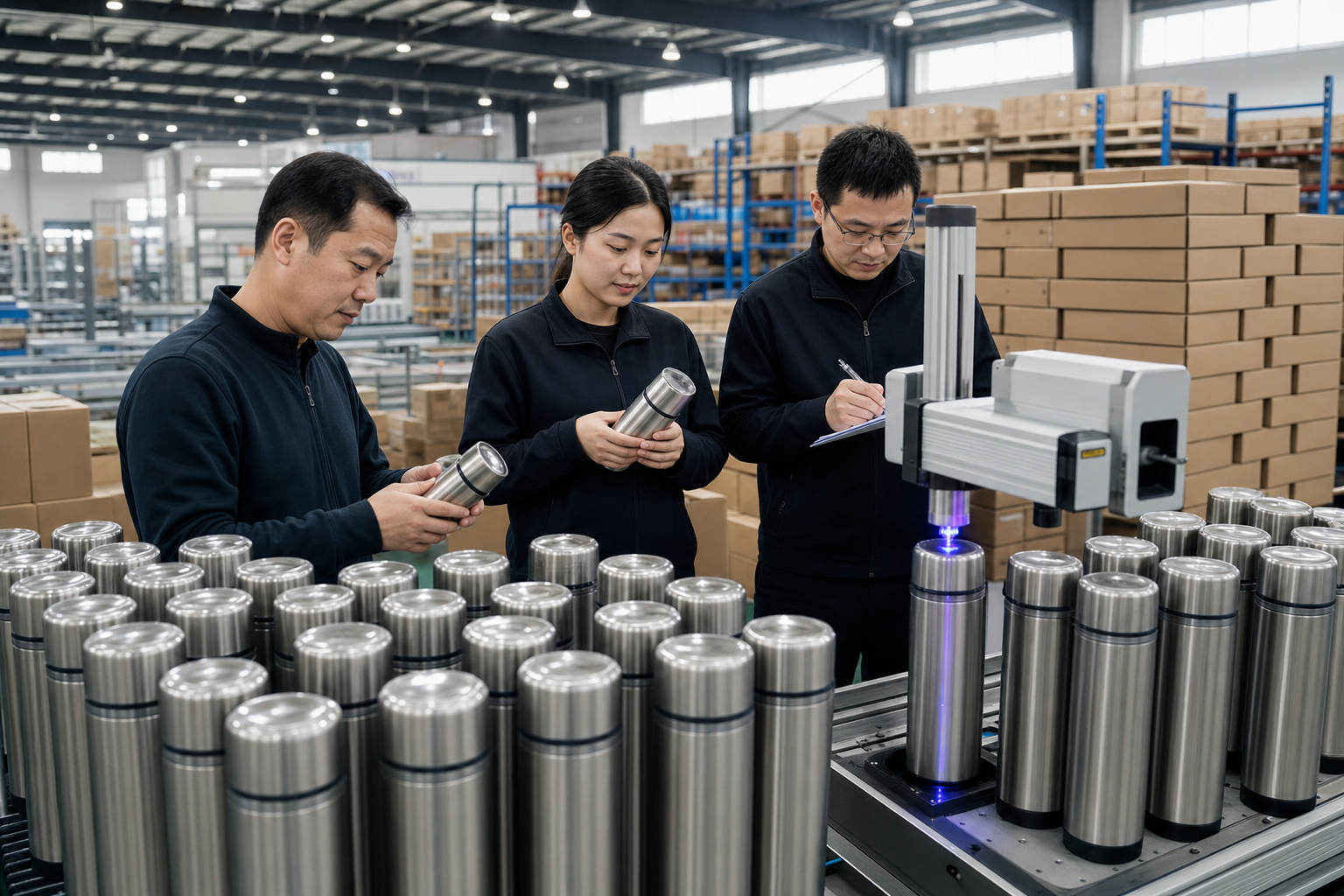
Key Takeaways
- A good promotional thermos should hold 65 C or higher after 6 hours, with a real-world target of 12 hours hot and 24 hours cold for 500 ml models.
- For food-contact parts, 304 stainless steel is the baseline; 316 is worth paying for when acidic drinks, salt exposure, or premium positioning matter.
- A typical factory MOQ is 500 pcs for stock bodies and 1000 pcs for fully customized colors or packaging, with 25-35 days lead time after sample approval.
- Use AQL 2.5 for critical defects, request REACH or LFGB paperwork where needed, and confirm logo durability before you place a bulk thermos order.
A promotional thermos looks simple until you buy 5,000 or 50,000 units. On the line, the vacuum weld has to hold, the lid must stay tight after 3,000 openings, and the print cannot scuff in transit. We have seen buyers push back on a cheap sample after QC pulled it for a 1.2 mm lid gap, then the return rate showed up later.
The right way to source is to treat the thermos as a factory job, not a giveaway item. In Zhejiang, China, a serious manufacturer can produce around 180000 units per month, but only when the logo file, carton spec, and test request are locked before the line starts. We ship these jobs every week, and a PO typo on the packing count can turn a 12-day schedule into 18.
What Makes A Good Promotional Thermos
For a promotional thermos, retention is the first test. If the vacuum wall is weak, the logo is dead on arrival. We have seen buyers approve a clean sample, then the first 200 units come back with lid sweat and scuffed powder coat after a week in a truck cab. A good promo bottle needs to feel firm in hand, close the same way every time, and survive backpack rub without looking tired. One sample is easy. Repeatable 5,000-piece output is the real job.
Start with the basics: double-wall vacuum construction, a food-contact inner wall in 304 stainless steel, and a lid with a tested seal. For a 500 ml custom thermos, a solid target is 12 hours hot and 24 hours cold in normal use, not lab theater. Wall thickness matters too. A 0.40 mm inner wall is common; go much thinner and the body dents fast, which is why the buyer flags the sample as "cheap" even before QC pulls it.
Good factory thermos suppliers also look at the parts buyers skip: the silicone gasket, powder coat adhesion, and carton drop test. We run those checks because a 1.2 m drop test on the outer carton will expose a loose lid ring long before shipment. In Zhejiang, the better lines build for repeat orders, not one-off showroom samples. That is the wrong question to ask: not "does it look nice," but "will it ship 3,000 units without a surprise return rate?"
- Check the lid: one-hand lids, screw lids, and straw lids have different leak risk profiles.
- Check the finish: matte powder coat hides scratches better than glossy paint.
- Check the weight: a 500 ml bottle that is too heavy is expensive to ship; too light is usually compromised somewhere.
Stainless Steel Grades That Matter
Most buyer mistakes start with the steel spec. For a custom stainless thermos, 304 is the standard baseline because it handles salty air, coffee, and repeated deep drawing without causing scrap on the line. On a 0.35 mm inner wall, it gives us a workable mix of corrosion resistance, cost, and shape stability. For outdoor retail, we usually run 304 on the inner wall and often on the lid insert too. It is the grade we ship most, and the export paperwork stays clean when the PO says 304.
When the drink is harsher, 316 deserves a look. Sports recovery drinks, acidic juice, and bottles left in a 40 C truck cab for 12 days put more stress on the metal than plain water or coffee. We have seen buyers push for 304 on those runs to save a small amount per unit, but the math does not work if the product comes back with stains or complaints. 316 costs more, though for a premium customized thermos line it can be the right call when the buyer wants fewer returns and a stronger quality story.
Do not cut corners on food-contact parts. If a thermos supplier wins on price with thin metal and vague steel grades, you may save a few cents and lose the account later. This is the wrong place to gamble. A practical export spec usually pairs a 304 inner wall with a 201 or 304 outer shell, depending on the target price, plus a printed or stamped material declaration. Ask for the mill certificate, not a brochure claim. We have seen a PO typo turn 304 into 304L on paper, and that sort of mismatch slows customs and QC.
On a real production run, the steel grade affects more than corrosion. It changes drawability, welding behavior, dent resistance, and how stable the vacuum seam stays when QC pulls samples from the line.
For China sourcing, serious manufacturers in Zhejiang should show material traceability, REACH paperwork for Europe, and a clear incoming inspection flow. If they cannot explain the grade in plain numbers, keep moving. A factory that knows its 304 from its 316 will say so fast, and the 24-hour trace file should match the coil tag.
Logo Methods And Decoration
Decoration is not just branding. It decides abrasion resistance, resale feel, and whether your promotional thermos still looks clean after 30 washes. The logo method has to match the use case. For a trade show or a retail giveaway that needs bold color fast, printing is the cleaner choice. For outdoor retail or a long-service gift, laser engraving or a plain one-color screen print usually holds up better. The wrong question is which option looks best on a render. The line cares about what survives the first 90 days.
Choose the method for wear, not hype
Silkscreen fits simple logos and keeps the unit price in line. On a 1,000 pcs thermos run, our one-color pad print is usually the cheapest clean option, especially at 500 to 2000 pcs. Laser engraving leaves a permanent mark on stainless steel, so it is the better call when the buyer wants the logo to survive scuffs, hand washing, and repeat handling. UV printing or full-wrap transfer can look sharp, but the finish needs tighter control on the line and scratches easier. We have seen that go sideways after carton friction in transit.
- Silkscreen: best for 1-2 colors and lower unit cost.
- Laser engraving: best for permanence and a technical look.
- Heat transfer or UV print: useful for complex art, but check scratch resistance.
Ask for a proof on the actual body curve, not a flat mockup. A logo that looks centered on a drawing can drift on a tapered bottle. For thermos custom projects, keep the artwork simple and the clear space generous. A 0.5 mm stroke that looks fine on screen may vanish after coating or blasting. QC pulled one sample on a 30 mm shoulder and the mark shifted 4 mm, which is enough to get the buyer flagged in the first round. If you need a deeper comparison, see the factory guidance on silkscreen vs laser engraving for drinkware and choose before you approve samples.
MOQ, Lead Time, And Packaging
I’m rewriting the section directly in HTML, keeping the tag structure intact and tightening the language so it reads like factory-side sales copy instead of generic web text.I’ve got the rewrite shape. Next step is to swap in the new copy while preserving every tag and the link exactly as-is.Most buyer pain starts when they order 2000 pcs before the spec is frozen. The better move is to split what is truly custom from what can stay standard. Keep the body shape, inner liner, and cap structure standard, and only change logo, color, or carton. That keeps MOQ down. Push for a special lid, custom powder coat, or a new insert, and the quote moves up fast. On our line, QC pulled a sample once and found a 1.5 mm lid gap; that is the kind of miss that turns into rework.
A practical factory thermos offer from Zhejiang, China usually looks like this: 500 pcs MOQ for stock models with logo, 1000 pcs for customized color or packaging, 5-7 days for samples, and 25-35 days for mass production after sample approval. A factory running 180000 units per month can handle distributor thermos programs, but only if you lock the run size early. We had a PO with a wrong carton count once, and the print plate had to be held back for 3 days. Late artwork changes do the same damage.
Packaging deserves attention because retail and e-commerce channels do different jobs. Outdoor retailers usually want a tough color box, barcode, and carton count that fits shelf planning. If you are shipping into Amazon or a similar channel, FNSKU labels, carton marks, and drop-test tolerance matter more than a glossy sleeve. The wrong question is whether the box looks premium; the real check is whether it survives the warehouse and the truck. We run a carton drop test at 76 cm for that reason.
- Lower MOQ: stick to stock colors, standard lids, and a carton we already run on the folding machine.
- Lower cost: keep print to 1 or 2 colors and skip new tooling unless the lid or handle really needs it.
- Lower risk: sign off the pre-production sample, check the 304 stainless callout, and clear the PO before the main run.
If you need a working estimate, read how MOQ affects custom drinkware pricing before you ask for final numbers. It keeps the quote honest and cuts the back-and-forth. We have seen one typo on a PO turn 500 pcs into 5000 pcs on paper.
Compliance And Testing
If you are importing into Europe or North America, compliance is not optional. A promotional thermos can look like a cheap giveaway, but the line still needs material control, food-contact files, and repeatable test data. Ask the manufacturer thermos partner what they test in-house and what goes to a third-party lab. A missing carton mark or a PO typo on the shade code is enough to slow a shipment.
For Europe, REACH-related material declarations, LFGB-focused food-contact testing where applicable, and a clear statement on BPA-free plastics are standard conversation points. For the US, buyers usually ask for FDA-related food-contact suitability and basic safety files. QC pulled the sample on the packing table last week and found a 0.3 mm logo shift; that is the kind of miss that gets a buyer to push back hard. A good factory should also understand AQL inspection. For critical defects like leakage, wrong logo placement, or damaged vacuum seams, AQL 2.5 is a reasonable starting point. For minor cosmetic issues, many buyers accept AQL 4.0 on promotional orders, but only if the box presentation is controlled.
Testing should cover more than a single hot-water check. We run these checks with a torque gauge, a sink tank, and a drop jig, then compare the numbers against the same spec sheet every time. Ask for:
- Leak test: 24 hours inverted at room temperature.
- Thermal retention: measured at defined fill temperature and ambient conditions.
- Drop test: carton and retail pack performance from 76 cm or the agreed standard.
- Coating adhesion: cross-hatch or equivalent method on painted bodies.
China factories in Zhejiang that ship seriously into export channels usually have these routines built in. If they cannot explain test data clearly, the math does not work and you are dealing with a trading layer, not a real thermos factory. That matters when you are ordering at scale and need repeatability, not stories.
How To Brief A Factory
The cleanest RFQ strips out guesswork. If you want a usable custom thermos quote, send a short technical brief, not a “nice bottle” note. We run into the same problem on the line: the buyer writes “premium feel,” QC pulls three different samples, and the quote drifts because nobody knows the target.
Your brief should cover capacity, lid style, end use, logo method, packaging, destination market, and annual forecast. If you buy for a distributor program, say it. If this is for a retailer chain, say the channel and the shelf-life expectation. The math does not work if you hide the volume: 500 pcs trial and 5,000 pcs repeat are priced differently, and a 12-day sample plan is not the same as an 18-day rework cycle.
Use this structure:
- Product: 500 ml stainless vacuum thermos, matte powder coat.
- Material: 304 inner wall, 304 or 201 outer wall, BPA-free lid parts.
- Logo: 1-color silkscreen, 40 mm wide, front center.
- Packaging: color box, master carton, barcode, or FNSKU if needed.
- Market: EU or North America, with required compliance docs.
- Order plan: 500 pcs trial, 5000 pcs repeat if sell-through is strong.
Send a tight brief to a thermos supplier or thermos vendor and the quote gets cleaner, with fewer sample rounds. A PO typo on carton count can still slow the line, so this is the wrong question to ask if you only want the cheapest number on page one. If you want a factory partner in China that can handle the engineering detail, start with the product range on custom stainless thermos options and move to contact the factory once your spec is fixed.
Build your promotional thermos spec today
Send your logo, target market, and quantity. We will quote the right custom thermos, confirm MOQ, and match the finish to your channel.
Frequently asked questions
What is a normal MOQ for a promotional thermos?
For a stock stainless thermos with one-color logo, 500 pcs is a common MOQ. If you want a custom color, special lid, or dedicated packaging, expect 1000 pcs or more. On repeat distributor thermos programs, factories in Zhejiang, China can often hold the price better once you commit to 3000-5000 pcs. Ask whether the MOQ applies per color, per logo, or per carton style, because those are not the same thing.
How long should a custom thermos keep drinks hot?
For a 500 ml promotional thermos, a realistic target is 12 hours hot and 24 hours cold under normal conditions. That is a useful commercial benchmark, not a lab guarantee. If the supplier claims much more, ask for the exact test setup: starting temperature, fill volume, ambient temperature, and lid type. A factory that understands performance will give you numbers, not just marketing language.
Which logo method lasts longest on stainless steel?
Laser engraving is usually the most durable because the mark is mechanical and does not depend on ink or coating adhesion. Silkscreen is still fine for simple logos if you keep the design clean and avoid heavy abrasion zones. For a thermos promotional run, many buyers use laser on premium retail models and silkscreen on bulk thermos giveaways. The right choice depends on budget, artwork complexity, and how rough the product will be used.
What compliance documents should I ask a thermos supplier for?
At minimum, ask for material declarations, a food-contact statement, and test reports relevant to your market. For Europe, REACH-related documentation and LFGB-oriented testing are common asks. For the US, buyers often want FDA-related food-contact suitability. Also ask for AQL inspection terms and a leak-test record. A serious manufacturer thermos partner in China or Zhejiang should be able to show these without hesitation.
What should I budget for packaging and samples?
A plain sample on a stock model is often free or low-cost, but customized samples with logo and color matching usually cost more. Expect 5-7 days for samples and 25-35 days for production after approval. For packaging, a standard color box may add a small amount per unit, while custom inserts, barcodes, and FNSKU labels can add more depending on your channel. If you are building a retail program, packaging is part of the product, not an afterthought.