Key Takeaways
- Typical MOQ for a custom kids thermos is 3,000 units per SKU, with 35-45 days lead time after sample approval.
- A compliant build usually uses 304 stainless inner and outer walls, 0.4-0.5 mm gauge, and BPA-free PP or Tritan lids.
- Prop 65 risk is managed by testing for lead, cadmium, and phthalates in coatings, inks, gaskets, and printed components.
- For schools, hotels, and restaurants, the same vacuum bottle platform can be adjusted to 12 oz, 16 oz, or 18 oz with different lid and packing options.
If you are sourcing a prop 65 vacuum insulated bottle for kids, do not treat it like a basic stainless bottle order. It is not. You are buying into California compliance, child use, and buyer scrutiny that starts with paperwork. We ship these requests every week, and the first question is usually the wrong one: “Can you print my logo?” Before art, the bottle has to clear a practical compliance screen.
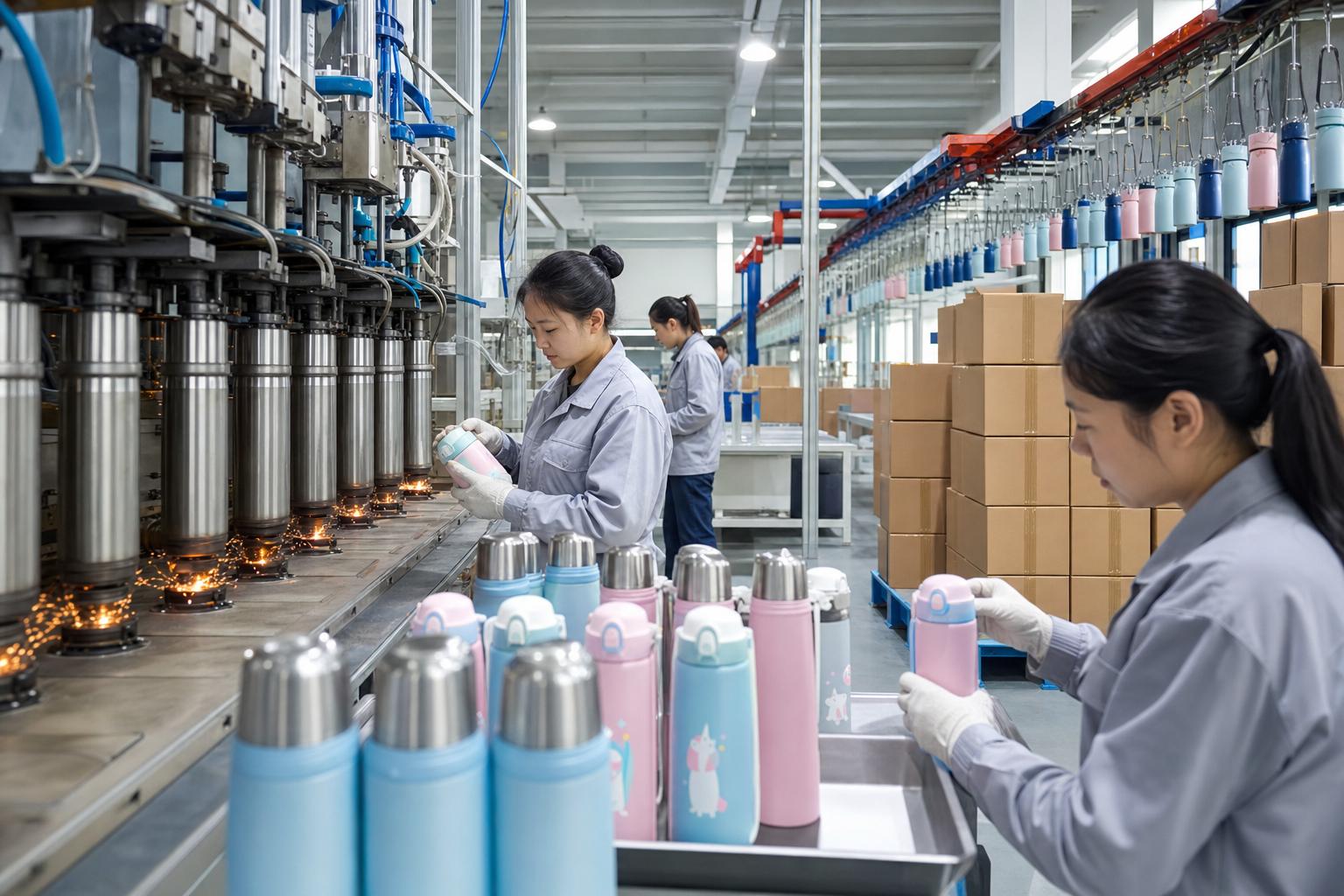
From our factory in Hangzhou, Zhejiang, we see the same pattern on the line: a buyer wants a 12 oz or 14 oz kids bottle, powder coated, leakproof, with a soft-touch carry handle, then asks for a low MOQ and a 25-day lead time. The math does not work unless the spec is clean. QC pulled a sample last week and flagged a lid fit issue at the 0.3 mm gap, which is the kind of thing that kills a shipment later. If you are building a prop 65 vacuum bottle for kids, or using the same platform for schools, hotels, or restaurants, the materials, testing, and carton pack need to be set before sampling starts.
What Prop 65 means in practice
California Proposition 65 is not a design style or a marketing label. It is a warning rule for products sold into California when listed chemicals can be present above defined thresholds. For a prop 65 vacuum insulated bottle for kids, the issue is not stainless steel alone; we look at the full build: coatings, inks, decals, lid parts, silicone seals, adhesives, and any decorative metal trim. On the line, a 10 ml ink pad can cause more trouble than the 304 shell.
What buyers want is simple: no customs drama, no retailer chargebacks, no surprise test failure. The math does not work if the BOM changes after approval. We ask for supplier declarations, test reports, and a locked BOM. A bottle for domestic sales and a bottle for California are not handled the same way in our Hangzhou shop. If your customer asks for a prop 65 vacuum bottle for schools, you need to say whether the school district wants warning labels, lab testing, or both. The buyer flagged it on a PO once; the label line had the wrong state format.
Practical note: Prop 65 is about exposure and documentation, not just a “safe” or “unsafe” claim. Buyers should require component-level testing, not only a finished-product certificate.
For kids, we keep it conservative: stainless body, food-grade coating, low-migration print, and a lid with tested polypropylene or Tritan. If counsel wants a warning, we build the artwork around that early. QC pulled the sample last week and checked the lid gasket at 1.2 mm; that is where cheap substitutions show up. We have seen this go sideways when the lid supplier swaps resin without telling anyone.
Build specs that actually pass
If you want a prop 65 vacuum flask for kids that ships clean, start with the build, not the decoration. We run 304 stainless steel inner and outer walls most of the time, with 0.4 mm to 0.5 mm wall thickness. For a tougher shell, some buyers go 0.5 mm outer wall and 0.4 mm inner wall; that keeps dent rate down without blowing up cost. The vacuum gap usually sits at 0.8 mm to 1.2 mm, and QC checks it against the forming tool before we release the line.
For lids, specify BPA-free PP or Tritan, a food-grade silicone gasket, and a screw or flip-top closure with cycle testing on paper and in the lab. A kids bottle should hold up through at least 3,000 open-close cycles without seal failure. We had one buyer flag a lid that passed the photo sample but failed after 2,400 cycles; the math does not work if the cap is weak. For school and outdoor orders, leak test belongs in the spec, not in a sales promise. We normally run a 24-hour inverted leak test at room temperature and a drop test from 1.2 meters on packed units. That tells you more than a glossy brochure ever will.
- Common capacity: 12 oz, 16 oz, 18 oz
- Standard insulation target: 6-12 hours cold, 8-10 hours warm depending on lid design
- MOQ: 3,000 pcs per color per SKU in Zhejiang factory runs
- Lead time: 35-45 days after sample sign-off
Do not over-spec the body and under-spec the cap. That is the wrong question to ask. Most returns start at the lid, the gasket, or the print layer, not the steel tube. On one PO, the buyer typed the cap color wrong by one code, and we caught it only after QC pulled the sample at packing.
Testing and documents you should request
When you source a prop 65 vacuum insulated bottle for kids, ask for the paperwork before you approve mass production. We run this on every new order: material declarations, test reports, and line photos before the first 500 pcs move. A factory in China should send a clean pack, not a half-finished PDF dump. If the supplier stalls, slow down. You are not buying a generic tumbler; you are buying a bottle that may land on a retailer’s desk, a school buyer’s desk, or a distributor’s desk in North America.
For Prop 65 sourcing, the usual tests are lead and cadmium on coating and decoration, phthalates on plastic parts, and total heavy metals when the build calls for it. REACH and food-contact declarations come up a lot too, especially if the bottle may be sold in the EU later. For a U.S. account, buyers often ask for ASTM-style physical testing, plus migration and endurance checks where the structure needs it. If the bottle ships with a straw or gift set, test the straw. If the straw cap has colorant, test that part too. We’ve seen a buyer flag a PO because the decoration was missed on the sample report, and the math didn’t work for anyone.
Documents worth keeping in one folder
- Material Safety Data or composition declaration for stainless, plastic, and silicone parts
- Third-party test report for coating and decoration
- Factory audit items such as BSCI or ISO 9001 if your retailer requests them
- Carton drop test and transit packaging spec
- Final inspection record based on AQL 2.5 for major defects and 4.0 for minor defects
For a prop 65 vacuum bottle for schools, the purchasing team may also ask for child-safe lid details and traceable batch coding. That is standard. We had one PO with a typo on the batch code, and QC pulled the sample back before ship. Build the file early, while the line is still running, and you save weeks later.
School, hotel, and restaurant use cases
The same stainless thermos platform can cover school, hotel, and restaurant orders, but one SKU for all three will cause trouble. A prop 65 vacuum insulated bottle for schools needs a different spec from a hotel amenity bottle or a restaurant merch item. Schools ask for drop resistance, a carry loop that holds up, and a cap shape that does not trigger choking or breakage concerns. Hotels care about shelf look, clean printing, and fewer returns. Restaurants want logo visibility and stable repeat orders. We saw a buyer try to use one drawing for all three, and the math did not work.
For schools, we usually push a 12 oz bottle with a wide-mouth opening for cleaning, a matte powder coat, and a one-piece silicone gasket. QC pulled the sample and checked the mouth at 44 mm, because a tight opening slows washing and gets flagged fast by buyers. For hotels, a 14 oz or 16 oz version with gift-box packaging works better, especially for a boutique shop or guest amenity program. For restaurants, a 16 oz or 18 oz thermos with laser logo or one-color silkscreen is more practical than full-wrap printing; reorder consistency matters more than decoration tricks. If you are building a prop 65 vacuum bottle for hotels, the carton has to survive shelf display and storage, not just a photo shoot.
The same rule applies to a prop 65 vacuum flask for restaurants: fewer special parts, easier cleaning, lower unit cost. We keep the platform stable and change only the parts the channel actually needs. That is how we run the line without tool cost creep in China manufacturing. One buyer once sent a PO with “18oz” typed as “180z”; we caught it before production, and that saved a messy reprint.
Pricing, MOQ, and lead times from China
Buyers ask for a price before they send the spec sheet. That slows the line. For a custom 12 oz stainless kids thermos, FOB China usually starts at USD 2.20 to 3.40 at 3,000 pcs for one-color print, then moves to USD 3.60 to 5.20 once you add a double-wall premium finish, laser engraving, special lid tooling, or a retail box. One buyer flagged a PO typo on the color code, and we had to stop the ink room for half a day. In Zhejiang, labor is clean and tooling is efficient, but every extra decoration step adds real cost.
We run 80,000 units per month across several thermos lines, so the spec needs to be fixed early if you want a production slot. For a first order, MOQ is usually 3,000 pcs per design and color. Need three colors? Each one usually counts separately unless the same coating line can run a mixed batch without changing the setup. Sample lead time is often 7-10 days for existing molds and 15-20 days if you need a new cap or handle tool. Mass production is normally 35-45 days after sample approval, plus freight. QC pulled the sample and measured the lid thread at 38.2 mm; that kind of small miss is what kills time.
Packaging changes the math. A plain egg-crate insert costs less than a full retail box, and the gap is not small. If you want Amazon-ready FNSKU labeling, individual polybagging, and carton barcode placement, say it up front. We’ve seen this go sideways when the buyer adds barcode rules after production starts. Rework always costs more than planning.
How to qualify the factory properly
If you buy from China, factory qualification matters as much as price. Ask where the vacuum welding, polishing, and coating are done. We have seen suppliers assemble in one plant and push the key steps out to three outside shops. That can work, but only if they control it tightly. On a real audit in Zhejiang, the better factories showed us the vacuum leak tester, the spray booth, and the packing bench without dodging the questions. Ask for line photos or a live video. If they stall, that tells you plenty.
Request a pre-production sample, then a golden sample sealed and signed. That sample should lock the lid color, logo position, coating gloss, and carton art. We once found a PO typo on the carton spec—“matte” was typed as “metallic”—and the buyer flagged it before the run started. During production, insist on checks at first article, mid-line, and final inspection. AQL 2.5 is standard for major defects, but kids bottles need tighter control on lid function and print alignment. For school orders, batch traceability matters if a recall ever happens. This is basic export discipline, not extra service.
Good questions to ask a factory:
- Can you provide component-level Prop 65-related test reports?
- What is your standard vacuum insulation failure rate target?
- Do you run 100% leak testing or sampling by lot?
- Can you support custom packaging for schools, hotels, and restaurants?
- What is your reorder lead time on the same mold and decoration?
A factory that answers clearly will save you money. A factory that answers vaguely will cost you orders later. We run into this all the time: the math does not work when a supplier hides a 12-day lead time behind a 18-day promise and then blames the line.
Get a compliant kids thermos quote today
Send your target capacity, artwork, and market list. We will build the spec, test plan, and FOB price for your next China order.
Frequently asked questions
Do I need a Prop 65 warning on a kids thermos sold in California?
Sometimes yes, sometimes no, depending on the chemicals present and the exposure pathway. For a stainless kids thermos, the main risk is usually not the steel body but the coating, print, lid plastic, silicone, or accessories. If a warning is required, it should be decided using current legal guidance and test data, not guesswork. Ask for component testing first. We recommend keeping a documented BOM, third-party lab reports, and a signed compliance declaration for each SKU. That way your prop 65 vacuum insulated bottle for kids is ready for retailer review and California distribution.
What is a realistic MOQ for a custom vacuum bottle for schools?
For most factory runs in Zhejiang, a realistic MOQ is 3,000 pcs per SKU and color. If you want a prop 65 vacuum bottle for schools with custom lid tooling, the first order may need 5,000 pcs to justify the mold and packaging setup. Standard lead time is 35-45 days after sample approval. If you need printed retail boxes, barcodes, and FNSKU labels, add 5-7 days for packing coordination. Smaller MOQs are possible, but unit cost usually climbs fast because setup and decoration are spread over fewer bottles.
Which materials are safest for a kids stainless thermos lid?
Use BPA-free PP or Tritan for the hard lid body, with food-grade silicone for the gasket and any drinking spout seal. For a prop 65 vacuum flask for kids, avoid mystery plastic blends and ask for material declarations by component. If there is a straw, carry handle insert, or decorative ring, those parts should be tested too. A good lid should survive at least 3,000 cycle tests and a 1.2-meter drop when the bottle is packed. The lid is where most failures happen, so do not save USD 0.08 and create a return problem later.
Can the same bottle platform work for hotels and restaurants?
Yes, but you should adjust the packaging and decoration. A prop 65 vacuum insulated bottle for hotels usually needs premium gift boxing, a cleaner logo layout, and better shelf presentation. A prop 65 vacuum bottle for restaurants is often better with a simple one-color logo or laser mark, because reorders and cleaning matter more than complex graphics. Capacity often shifts to 14 oz, 16 oz, or 18 oz. The core stainless vacuum body can stay the same, which keeps tooling costs under control and helps you manage inventory across channels.
What should I pay FOB China for a custom kids thermos?
At 3,000 pcs MOQ, a basic custom 12 oz stainless kids thermos usually lands around USD 2.20 to 3.40 FOB China. If you add premium powder coating, special lid tooling, or gift-box packaging, budget USD 3.60 to 5.20. Freight, duties, and compliance testing are extra. If a supplier quotes far below that, check what is missing: sometimes it is the coating quality, sometimes the print durability, and sometimes the testing. In China, especially Zhejiang, the real cost is not the steel; it is the process control and the documentation.