Key Takeaways
- Most silicone stainless steel bottle wholesale orders start at 3,000 units, with 35-45 days lead time after sample approval.
- A 304 inner liner with 201 outer shell is cheaper than full 304 construction by about 12-18%, but only if your market allows it.
- Silicone sleeve or overmold options usually add USD 0.35-1.20 per piece depending on thickness, finish, and mold complexity.
- For US/EU retail, ask for REACH, LFGB, FDA, and AQL 2.5 inspection before you confirm silicone stainless steel bottle bulk production.
If you are sourcing silicone stainless steel bottle wholesale for a brand, outdoor chain, or distributor program, the first mistake is treating every “supplier” as if they can do the same job. They cannot. A real silicone stainless steel bottle manufacturer in Zhejiang will quote different tooling, coating, and packing costs than a trading company, and that shows up fast when you ask for 5,000 units, 2 logos, and REACH paperwork. We had a buyer flag a PO once because they wrote “silicon bottle” on the form; QC pulled the sample and the whole spec sheet had to be fixed before we could run the line.
You also need to separate marketing language from build reality. A silicone stainless steel water bottle can mean a 304 inner wall with a silicone sleeve, a full silicone-wrapped body, or a stainless steel thermos with a soft-touch overmold. Those are not the same product, and they do not run the same on the line. If you want silicone stainless steel bottle custom work that ships on time from China, you need to know MOQ, lead time, and which specs move cost. The wrong question is asking for the cheapest quote first; the math does not work when one version needs a 2.0 mm sleeve mold and another uses a standard wrap.
What you are really buying
Buyers searching silicone stainless steel bottle wholesale usually mean three build types. One is a silicone stainless steel water bottle with a stainless inner liner and a removable silicone sleeve. Another is a silicone stainless steel tumbler with a silicone base or mid-band for grip. The third is a silicone stainless steel flask where the silicone is doing grip, drop protection, or color blocking. These are not cosmetic choices. They change tooling, vacuum yield, decoration, and pack-out. We’ve had a buyer flag a PO because the drawing showed a sleeve, but the sample was overmolded. Same SKU name, different line setup.
From the factory side, the stainless core drives most of the cost. In Zhejiang, a standard 500 ml 304/201 vacuum bottle with powder coating often starts around USD 2.10-2.80 FOB. Add a custom-fit silicone sleeve and it can move to USD 2.55-3.90 FOB, depending on mold size and Shore hardness. Ask one clean question: is the silicone a separate part or molded onto the body? A sleeve can be swapped. An overmold cannot. The math doesn’t work if you treat them the same. That choice affects defect handling, rework, and how much stock you can safely hold.
Key specs to pin down early:
- Inner steel: 304 or 316
- Outer steel: 201 or 304
- Silicone hardness: usually 40A-70A
- Wall thickness: 0.4 mm, 0.5 mm, or 0.6 mm
- Vacuum performance: 6-12 hours hot, 12-24 hours cold depending on structure
Choose the right factory type
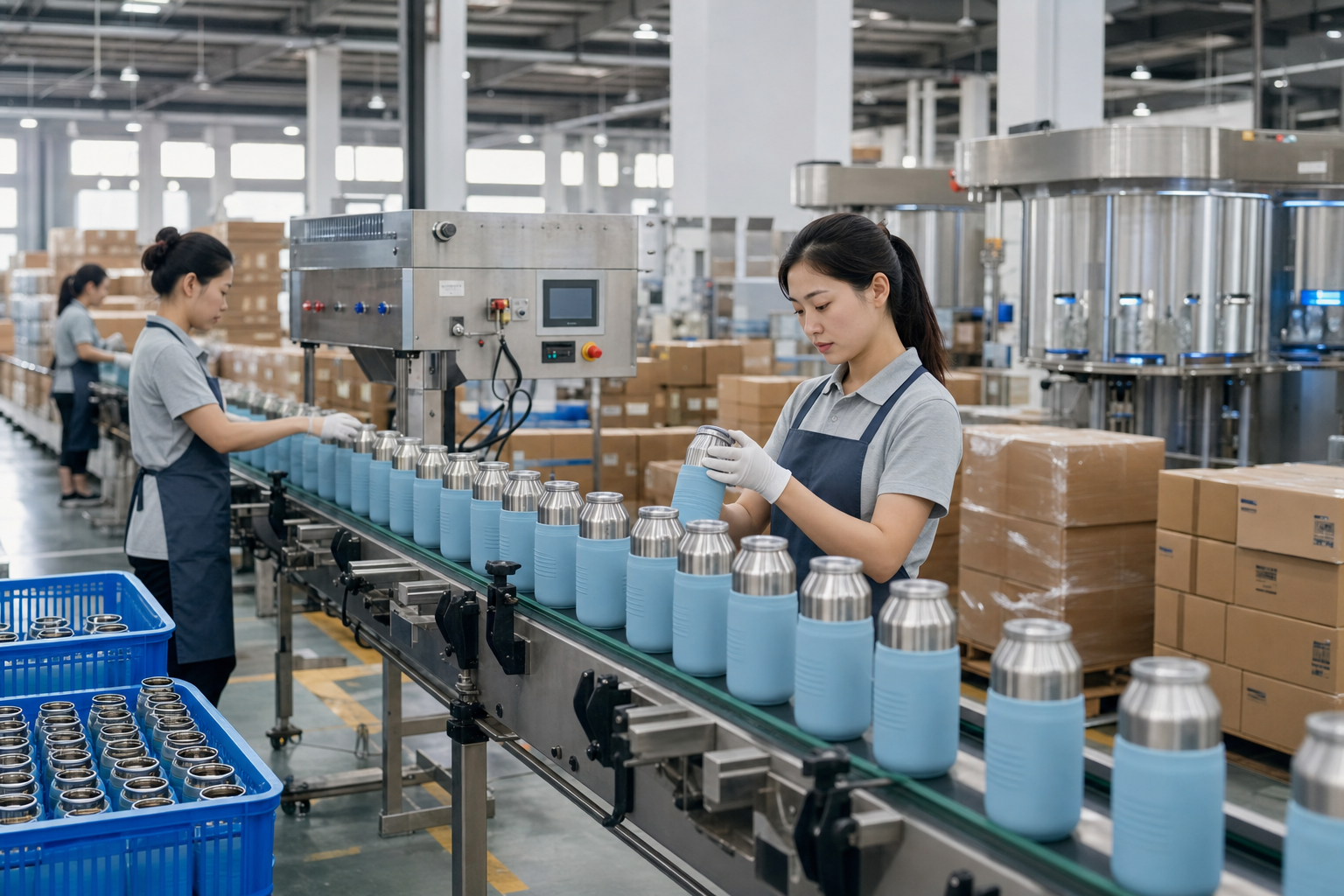
A silicone stainless steel bottle supplier can be a factory, a trading company, or a hybrid export office. If you need repeat orders, custom molds, and QC that stays on the line, choose the factory. A silicone stainless steel bottle factory in Zhejiang usually runs vacuum lines, vacuum sealing machines, powder coating booths, and silicone injection or compression equipment in one plant. That matters when the metal body and the sleeve have to match within a tight tolerance stack, not after three handoffs.
The real difference is control. A true silicone stainless steel water bottle manufacturer can hold sleeve dimensions to within ±0.3 mm on fit areas, keep logo placement aligned, and change packing specs without waiting for another shop. We’ve seen a buyer flag a 2 mm sleeve gap on a 500 ml sample, and that small miss would have become a warehouse headache. If your program includes silicone stainless steel water bottle OEM or silicone stainless steel water bottle ODM, ask for monthly output in black and white. A mid-sized factory in China or Zhejiang should be able to ship 80,000-150,000 units per month on standard bottle lines, with 3,000 pcs MOQ per color and 15-20 days for sampling depending on decoration.
If a seller cannot tell you the steel grade, silicone durometer, and monthly output in one conversation, you are not talking to the right source.
Ask for BSCI, ISO 9001, and past audit reports. A good silicone stainless steel bottle supplier does not hide them. If you are buying for EU retail, REACH and LFGB are part of the PO, not extra paperwork. We run into buyers who want to “check it later” on compliance; that math does not work, and the line will stop once QC pulls the sample.
MOQ, pricing, and sample math
Buyers often miss the first run cost. The steel and silicone are not the main driver. On a silicone stainless steel bottle bulk order, we usually see MOQ at 3,000-5,000 units per SKU when the bottle body is standard and the silicone part uses an existing mold. If you ask for a new silicone shape, a new cap, or a full silicone stainless steel bottle custom shell, MOQ can climb to 6,000 units because we have to cover mold cost and line setup. On the line, that means one extra fixture and a separate color-change cleanout.
Sample cost is not where the pain sits. The time and rework are. A plain pre-production sample may cost USD 30-80, but a custom-colored silicone stainless steel water bottle private label sample with logo, box, and Pantone match can reach USD 120-250. We usually quote 7-12 days for a standard sample and 15-25 days for a fully custom sample. Mass production then runs 35-45 days, plus sea freight. QC pulled a sample once because the lid print was 1.5 mm off-center, and the buyer flagged it before we shipped the final set.
Typical FOB bands you can expect:
- Standard stainless bottle with silicone base: USD 2.10-2.80
- Silicone sleeve or wrap: add USD 0.35-1.20
- Laser logo: add USD 0.08-0.20
- One-color silkscreen logo: add USD 0.05-0.18
- Color box: add USD 0.25-0.60
Do not compare a silicone stainless steel bottle wholesale quote without checking steel thickness, vacuum method, and inner coating. The math does not work. A cheaper offer with 0.4 mm walls and weak vacuum can cost you more in returns than a better-built bottle from a Zhejiang factory. We have seen a PO typo turn “304 stainless” into “30#4 stainless,” and that one line item took two days to fix before the order could move.
Compliance for EU and North America
If your bottles touch food and drink, compliance is not a “nice to have.” For a silicone stainless steel water bottle wholesale program sold into the EU and North America, ask for REACH declarations, LFGB test reports for silicone contact parts, FDA food-contact statements where they apply, and migration reports for both the stainless and silicone components. Hot-fill orders need thermal testing and lid seal pressure checks. For Amazon, we also check packaging, barcode placement, and carton strength before the line releases the goods. QC pulled a carton at 18 kg compression, and the buyer flagged a loose barcode once, so we stopped guessing years ago.
The steel itself is usually tested under food-contact standards and corrosion checks. Silicone parts get odor, extractables, and color-transfer testing. A decent silicone stainless steel bottle factory will run leak tests on 100% of units or follow a defined sampling plan, often AQL 2.5 major and 4.0 minor for retail cartons. Some buyers ask for AQL 1.0 on leakage. Fair ask. The math works only if your margin can take the extra inspection time, and we’ve seen that line slow down fast when the lid tool was 0.3 mm off.
Ask for documentation before you approve colors. Dark pigments, metallic finishes, and soft-touch coatings can behave differently in migration tests. A silicone stainless steel bottle branded for Europe should leave with paperwork, not promises. One PO came in with the color code right and the compliance line wrong, and that typo cost two days. In Zhejiang, experienced factories know this drill; put the test reports and declaration list in the PO, and you avoid a mess at loading.
OEM, ODM, and private label paths
There are three ways we source silicone stainless steel bottle custom work. OEM means you own the artwork, specs, and usually the packaging too. ODM means you pick an existing bottle structure and change the color, logo, lid, and carton. Private label sits in the middle: standard body, your brand, your color, your barcode, your retail box. For most B2B buyers, private label is the fastest route and easier on tooling. We run this split on the line every week.
If you need silicone stainless steel bottle oem or silicone stainless steel water bottle oem, tooling is a real line item. A new cap mold can cost USD 3,000-8,000. A custom silicone sleeve mold may cost USD 1,500-5,000, depending on cavity count and detail. ODM ships faster because the engineering is already locked. The buyer flagged it on one PO last month: they wanted OEM pricing, then asked for ODM lead time. That math doesn't work. Most distributors start with silicone stainless steel bottle private label, then move to full OEM after the first reorder.
For brand owners, the useful question is not “Can you customize it?” It is “How much of the product is standard, and how much is truly mine?” If 80% is standard and 20% is customized, you move faster and keep landed cost closer to target. If you want a full silicone stainless steel bottle branded program with special Pantone, engraved logo, and custom retail inserts, build 6-8 weeks into the plan. QC pulled the sample, checked the lid gap at 0.8 mm, and caught a carton typo before shipment. We've seen this go sideways when buyers wait until the last week to ask for changes.
Quality control that actually matters
Most quality problems on silicone stainless steel bottle wholesale orders are small, then they get repeated 10,000 times. Cap misfit, silicone odor, print rub-off, dust under coating, weak vacuum retention. We see this on the line when QC pulls the sample at 9 a.m. and the cap feels fine, then the same cap starts sticking after 500 open-close cycles. This is why a factory-side inspection plan matters more than a final random check. The buyer who skips that is asking the wrong question.
A practical QC system for a silicone stainless steel water bottle manufacturer starts with incoming inspection for steel sheets, silicone raw material verification, in-process leak testing, and final carton audit. If your order has branding, ask for adhesion tests on silkscreen and laser mark contrast checks. We also run a 1-meter drop test onto plywood for retail jobs and concrete for outdoor SKUs, because the math changes once the bottle leaves the carton. On one run, a 0.3 mm print shift looked minor until the buyer flagged it on a 24-piece sample. This is where a caliper, a vacuum gauge, and AQL 2.5 earn their keep.
Here is the part many buyers skip: confirm the inner finish. A smoother inner wall cleans better and cuts taste retention, especially for coffee and tea. If the factory offers electropolished or improved inner passivation, ask what that does to cost and lead time, because 12 days versus 18 days can change your launch. A reliable silicone stainless steel bottle supplier will not promise perfection; it will tell you which defects are controlled and which are tracked by sample lot. We ship faster when the buyer understands that distinction. That is the difference between a real factory and a sales office in China with no line visibility.
How to source without overpaying
If you want a good deal, do not ask for the lowest unit price first. Ask for a quote split: bottle body, silicone part, logo, packaging, test reports, and freight-ready carton dimensions. That shows where the margin sits. In Zhejiang and across China, the price changes fast depending on whether the silicone is an in-stock sleeve or a new mold with a Pantone match. We had one buyer flag a PO typo on carton size, 52 x 35 x 28 cm instead of 58 x 38 x 30 cm, and the freight number changed overnight. A silicone stainless steel bottle supplier that throws out one lump sum with no breakdown is usually burying setup cost somewhere.
For silicone stainless steel bottle bulk purchasing, the cleanest path is a standard bottle platform, one custom silicone component, one decoration method, one retail box. Keep the first order simple. If you need 3 SKUs, share the body and change only the color, logo, or cap insert. That keeps inventory down and cuts re-order headaches. We run this way on the line all the time. It also matters when you move from 3,000 units to 30,000 units, because the same filling and packing line can keep moving without a 12-day reset.
Good sourcing questions to ask:
- What is the exact steel grade on inner and outer walls?
- Is the silicone molded, sleeved, or overmolded?
- What is the monthly output for this model?
- Which tests are included in the FOB price?
- What happens if the leak rate exceeds 0.5%?
If the factory answers straight, you are probably dealing with a real silicone stainless steel bottle manufacturer. If they dodge the steel grade or blur the test list, walk away. QC pulled the sample on one lot we shipped last quarter, and the leak rate was 0.8% at the cap joint; we fixed the gasket, but that batch taught us the wrong question is always the lowest price. China has plenty of sellers. The hard part is finding the ones who can repeat the same quality at scale.
Request factory pricing for your bottle program
Send your specs, target MOQ, and market. We’ll quote a silicone stainless steel bottle wholesale program with clear FOB, lead time, and compliance docs.
Frequently asked questions
What MOQ should I expect for silicone stainless steel bottle wholesale?
For a standard silicone stainless steel bottle wholesale order, MOQ usually starts at 3,000 units per color or per SKU. If you use an existing body and only change logo, lid color, or a silicone sleeve, some Zhejiang factories can accept 1,500-2,000 units, but pricing rises 8-15%. Once you require a new silicone mold or custom cap, 5,000-6,000 units is more realistic. For private label programs, ask whether MOQ is based on bottle body, decoration, or packaging. That detail changes your landed cost more than most buyers expect.
How much does a custom silicone stainless steel water bottle cost FOB?
A standard silicone stainless steel water bottle FOB price often falls between USD 2.10 and 3.90 per piece depending on steel grade, finish, and silicone complexity. A simple silicone base may add USD 0.10-0.25, while a full sleeve or overmold can add USD 0.35-1.20. Laser engraving is usually cheaper than color silkscreen, especially on smaller runs. If your quote is far below USD 2.00 FOB for a vacuum bottle with silicone parts, check wall thickness, vacuum retention, and packaging. Low price often means thinner steel or weaker QC.
What compliance documents do I need for EU and US sales?
For EU sales, ask for REACH compliance, LFGB testing for food-contact silicone, and migration reports for the bottle and lid. For North America, request FDA food-contact declarations and any relevant material test reports. If you sell on retail or e-commerce channels, also keep AQL inspection records, carton drop-test data, and barcode verification. A silicone stainless steel bottle factory should provide these before mass production, not after shipment. If you are using Amazon FBA, keep carton size, FNSKU placement, and master carton labeling aligned with the inbound plan.
Should I choose OEM, ODM, or private label?
Choose ODM if speed matters and you want to launch with a proven bottle shape. Choose private label if you want your logo, your colors, and your packaging without paying for new tooling. Choose OEM only when the product structure must be unique, because tooling can add USD 3,000-8,000 for caps and USD 1,500-5,000 for silicone parts. For most B2B brands, private label is the safest first step. You can move to full OEM after the first reorder once you know sell-through, return rate, and customer feedback.
How long does production take in China or Zhejiang?
For a standard silicone stainless steel bottle custom order, sampling usually takes 7-12 days if the factory already has the base mold. A fully custom sample with new color, logo, and packaging can take 15-25 days. Mass production is commonly 35-45 days after sample approval, assuming raw materials are in stock and the order volume is under 20,000 units. If you need a new mold, add 20-30 days. A strong silicone stainless steel bottle supplier in Zhejiang should be able to state monthly capacity, often 80,000-150,000 units, without guessing.