Key Takeaways
- 304 stainless steel inner liners are the practical baseline; 201 is cheaper but usually weaker for premium retail
- A typical stainless steel bottle wholesale MOQ for custom print starts at 3,000 pcs, with 25-35 day lead times
- Expect FOB China pricing to vary by 12% to 30% depending on vacuum structure, coating, and lid type
- For Europe and North America, ask for REACH, LFGB where relevant, and AQL 2.5/4.0 inspection data
If you are sourcing stainless steel bottle wholesale for a brand, retailer, or outdoor channel, the first trap is thinking all bottles are the same. They are not. A 304 inner liner, a 201 outer shell, 0.35 mm wall thickness, and a vacuum level that holds 24 hours are different from a cheap spec sheet with no test data. We’ve watched buyers lose margin because they compare only unit price and ignore coating loss, cap failures, or a late carton mark-up that sends the shipment back for reprint.
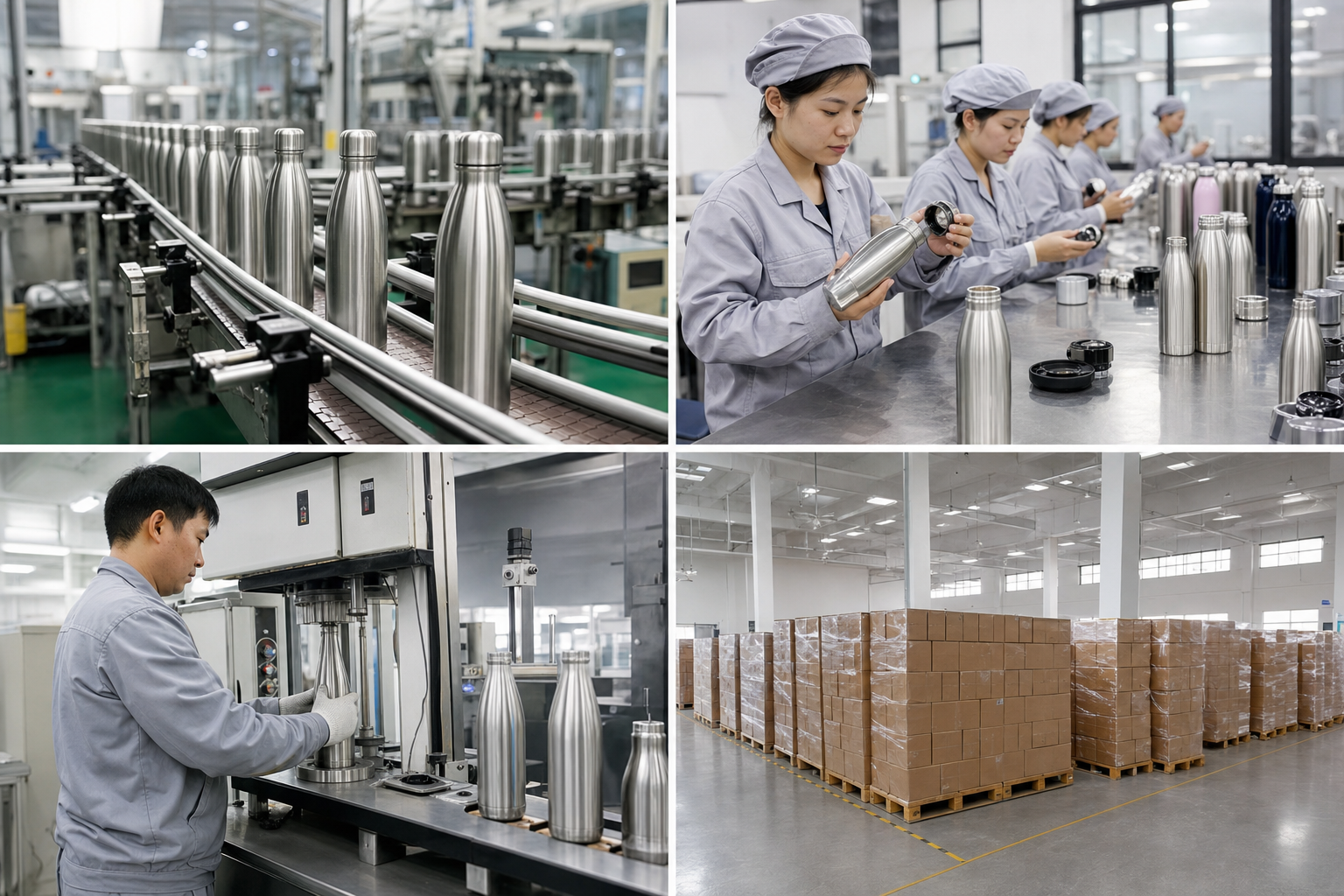
The smarter move is to buy from a stainless steel bottle manufacturer that can show tooling, test standards, and real production capacity. At BottleForge in Hangzhou, Zhejiang, our stainless steel bottle factory runs 120,000 units per month, with standard MOQ starting at 3,000 pcs for custom logo orders and 25 to 35 days lead time after sample approval. QC pulled the sample on the line last week and caught a 0.2 mm gap on a lid insert before mass production. That is the level of detail you need before you place a stainless steel bottle in bulk order from China.
What wholesale really means
Buyers who search stainless steel bottle wholesale usually want three things: factory price, logo work, and steady repeat supply. Those are not the same as ordering from a stainless steel bottle vendor or stainless steel bottle distributor that only moves stock. Wholesale should lock the spec, set the MOQ, and keep the line on one production plan. We have seen it go sideways when a buyer treated “wholesale” like a loose retail quote.
For most B2B programs, wholesale starts making sense at 3,000 pcs or more per SKU. At that volume, we can fix the body shape, lid system, finish, and carton pack. A real stainless steel bottle supplier in China should quote by material grade, not by “vacuum bottle.” Ask for the build in plain terms: 18/8 or 304 inner wall, 201 outer shell if used, 0.4 mm base reinforcement, and powder coating at 60 to 80 microns if scratch resistance matters. QC pulled a sample with only 48 microns once, and the buyer flagged it fast.
What to ask before you shortlist any supplier:
- Is this stainless steel bottle factory direct, or is there a trading layer on top?
- What is the confirmed MOQ per color and per logo method?
- Can they support stainless steel bottle private label work with packaging inserts?
- Do they have OEM and ODM files for a stainless steel bottle custom made program?
In Zhejiang, a lot of factories look the same online. The difference is process control. If a supplier cannot tell you loss rate, test method, or monthly output, you are not dealing with a serious stainless steel bottle manufacturer. One PO typo on a 500 ml bottle can turn into a carton label mess, and that is the wrong question to ignore.
304 steel and real product specs
For search traffic around 304, the buyer intent is usually clear: you want a food-contact safe bottle that can survive carton drops, shelf stacking, and repeated washing. 304 stainless steel is the starting point for a premium stainless steel bottle wholesale program because it gives solid corrosion resistance and better value than low-grade steel. It is not magic. We still check welds, passivation, and a lid that stays dry after 500 open-close cycles.
We normally quote stainless steel bottle custom builds with these numbers: inner liner 304, outer shell 304 or 201 depending on target price, vacuum insulation gap under 0.01 mbar, and body thickness from 0.35 mm to 0.5 mm. On our line, a 500 ml thermos usually lands at 260 g to 380 g. If a quote comes in lighter than that, the math does not work. A buyer once flagged a PO typo on “0.03 mm” wall thickness, and QC pulled the sample before tooling started.
For Europe and North America, ask for compliance documents at the sample stage. REACH is common for coatings and silicone parts; LFGB is often needed for German retail channels; FDA-related supplier declarations are often requested in the U.S. We ship to buyers who want paperwork first, and this saves time. A 12-day sample run beats an 18-day rework cycle when the carton label or steel declaration is wrong.
Rule of thumb: if the supplier cannot state the steel grade, wall thickness, and test standard in one sentence, treat the quote as unfinished.
MOQ, price, and lead time
Price is where buyers get distracted. A stainless steel bottle wholesale quote can swing 15% to 40% from one factory to the next, and the gap usually sits in the lid tooling, coating method, gift box, and export carton. We break it into product, decoration, packaging, and freight. That is the right way to read it.
For a 500 ml vacuum bottle, Zhejiang factory-direct pricing usually starts around USD 2.10 to 3.20 per piece at 3,000 pcs for basic custom print, then moves to USD 3.40 to 5.80 for powder coating, laser logo, or an upgraded lid. Double-wall builds or a straw cap can push it up again. If a quote lands far below that range, the math does not work. Ask what was cut. We have seen buyers get a low number, then find out the carton was 3-ply instead of 5-ply, or the stainless grade was never stated on the PO.
Lead time matters just as much. Standard custom logo production runs 25 to 35 days after sample confirmation. New mold work adds 15 to 25 days. If you want a seasonal launch, send samples 60 days before the ship date, not 30. A factory that promises one-week custom production is usually pulling stock off the line, not making your spec. QC pulled the sample on one rush order last month and found a 2 mm lid gap; the buyer flagged it before we shipped.
Good sourcing practice: split the order into sample, pilot run, and volume run. A 300 pcs pilot tells you if the cap fits, the print holds after rub testing, and the retail carton survives transit before you commit to 10,000 pcs. We ship this way for a reason.
Customization that sells retail
Most buyers think stainless steel bottle custom work is just logo printing. That is the cheapest part. The money is in channel fit. A gift brand may ask for matte powder coating, a two-color rigid box, and a printed insert; an outdoor buyer may push for an impact-resistant lid, a carabiner loop, and a harder-wearing finish. A stainless steel bottle custom made program should match how the customer drinks, packs, and carries the bottle, not just how it looks on a shelf.
We usually quote three decoration routes. Silkscreen is the low-cost option for one or two colors. Laser engraving gives a cleaner premium look and holds up after abrasion testing on the line. Heat transfer or full-wrap printing works when the artwork carries more detail, but it can lift cost and reject rate. For a stainless steel bottle with custom logo, ask for print adhesion tests, rub testing, and dishwasher exposure results if the item is going into retail.
If you plan stainless steel bottle private labeling, lock the packaging spec first. Carton size, UPC placement, FNSKU if you sell through Amazon, and country-of-origin marking all need to be set before mass production. We had a buyer flag a PO typo on carton count once, and the rework cost more than the bottle run because the 3PL had to relabel every case. In our Zhejiang plant, QC pulled the sample, found a barcode that scanned at 92% instead of 100%, and the shipment stopped right there.
- For premium retail: laser logo + matte coating + rigid box
- For promotional use: single-color print + standard carton
- For e-commerce: scannable barcode + drop-tested shipper carton
How to audit a real factory
A real stainless steel bottle factory should not hide behind photos. Ask for video of the welding line, vacuum sealing area, coating booth, and packing line. If the supplier is a trader, they may still ship decent product, but they should say it straight. You need to know whether you are dealing with a stainless steel bottle manufacturer, a stainless steel bottle supplier, or a stainless steel bottle vendor that only coordinates orders. The structure changes your risk. We had one buyer flag a PO typo on “vacuum” as “vacuum” and still catch the gap before we loaded the container.
At the factory level, look for process controls. Do they use AQL 2.5 for major defects and 4.0 for minor defects? Do they maintain incoming material records? Can they provide batch traceability for 304 steel coils and silicone lids? A supplier directory can list hundreds of names, but only a few run with the discipline needed for repeat retail supply in North America and Europe. QC pulled the sample, checked the weld seam at 0.3 mm, and that is the kind of detail that tells you whether the line is real.
Another sign of seriousness is capacity. A plant that outputs 120,000 units per month can usually support a stable launch if your forecast is honest. Smaller workshops may work for very small orders, but if you need seasonal replenishment, a stainless steel bottle oem manufacturer with real tooling and QC is safer. In Zhejiang, the best plants operate like systems, not like catalog resellers. We run into this every season: the math does not work if your reorder window is 12 days and the workshop needs 18 days just to clear coating and packing.
Ask these three questions:
- What is your monthly output by SKU?
- What defect rate do you accept before rework?
- Which tests are in-house and which are outsourced?
Common buying mistakes to avoid
The biggest mistake is treating stainless steel bottle wholesale as a simple sourcing job. It is a quality, packaging, compliance, and logistics job. Buyers ask for a stainless steel bottle supplier list or stainless steel bottle supplier directory, then grab the lowest quote without checking whether that factory can hold the same spec six months later. We have seen this go sideways on a 500 ml thermos with a 304 inner wall: the first run passed, the second run came with a different lid torque and the brand got burned.
Another mistake is ignoring shipping performance. A bottle can look clean on the sample table and still fail in transit if the carton is too weak or the paint rubs under friction. For a stainless steel bottle promotional order, this matters even more because the end customer handles the bottle loosely. Ask for carton drop-test data, 1.0 m to 1.2 m depending on box size. QC pulled the sample in our workshop last month and the corner crush showed up after the third drop.
Do not skip sample sign-off. Lock down the exact logo placement, cap color, body finish, and box artwork. If you want stainless steel bottle wholesale bulk supply with no surprises, write the spec like a contract. Put the tolerances in black and white: logo shift within 2 mm, capacity tolerance within ±5%, and leakage test under 0.5 bar for 30 seconds. A buyer once sent us a PO with the logo spelled two ways on the same file. That is the wrong question to ask; the real issue is whether the line can repeat the approved sample.
Finally, a cheap stainless steel bottle buy in bulk order is not cheap if the return rate hits 3% to 5%. One container of bad product can erase the savings fast. We run a 24-hour closure test on key SKUs, and that catches loose lids before shipment. In China, especially in Zhejiang, the suppliers who keep repeat business are the ones who document every carton count, every inspection sheet, every PO correction.
Request a factory-direct thermos quote today
Send your target capacity, logo method, MOQ, and destination market. We will quote stainless steel bottle wholesale pricing with clear specs from Zhejiang, China.
Frequently asked questions
What is the usual MOQ for stainless steel bottle wholesale orders?
For custom logo production, a practical MOQ is 3,000 pcs per SKU and per color at most Chinese factories. Some stainless steel bottle suppliers will accept 1,000 pcs, but you usually pay 10% to 25% more. If you need multiple lid colors or retail box versions, treat each variant as a separate line item. For stock shapes with simple print, a stainless steel bottle factory in Zhejiang may also offer 500 pcs trial orders, but that is best for testing, not scaling.
How much does a 500 ml custom thermos cost FOB China?
For a standard 500 ml vacuum bottle with 304 inner liner and one-color logo, FOB China pricing often lands around USD 2.10 to 3.20 at 3,000 pcs. With powder coating, upgraded lid, or premium packaging, expect USD 3.40 to 5.80. Laser engraving and gift boxes add more. Shipping, duties, and carton protection can add another 12% to 35% depending on your destination and order size.
Is 304 stainless steel enough for Europe and North America?
Yes, 304 stainless steel is the common baseline for premium drinkware, especially for the inner liner. But 304 alone does not make the product market-ready. You still need silicone parts that meet REACH expectations, coating that passes abrasion checks, and a food-contact declaration from the stainless steel bottle manufacturer. For some German retail channels, LFGB-related testing may also be requested. Ask for batch traceability and test reports before mass production.
How do I check if a supplier is factory direct?
Ask for a live factory video, production line footage, and monthly output by SKU. A true stainless steel bottle factory should show welding, vacuum sealing, coating, and packing areas, not only sample shelves. Also ask for business license details, export records, and whether they offer OEM tooling. If the answer is vague or they keep changing the contact person, you are probably dealing with a trading layer rather than a factory direct source.
What tests should I request before ordering in bulk?
At minimum, request leakage testing, thermal retention testing, coating adhesion, carton drop tests, and AQL inspection reports. For retail programs, ask for capacity tolerance within ±5%, leak test under 0.5 bar for 30 seconds, and 500-cycle lid durability data if available. For stainless steel bottle wholesale bulk orders, these tests protect you better than a lower unit price. If you sell on Amazon, also confirm packaging dimensions and FNSKU placement before production.