Key Takeaways
- Typical MOQ for stainless steel insulated water bottle wholesale starts at 3,000 units per SKU, with 35–45 days lead time after sample approval.
- 18/8 stainless steel, 0.4–0.5 mm inner wall thickness, and a full vacuum seal matter more than surface polish.
- FOB China pricing for basic 500–750 ml bottles often lands at USD 3.20–6.80 depending on lid, coating, and decoration.
- REACH, LFGB, FDA, and AQL 2.5 inspection are standard checkpoints for export to Europe and North America.
If you are buying stainless steel insulated water bottle wholesale, the real question is not which bottle looks good in a catalog. It is whether the factory holds temperature, clears compliance, and ships on time without eating your margin. A thermos program lives or dies on steel grade, vacuum quality, lid fit, and whether the line can keep MOQ and lead time under control. We have seen a 5000 pcs order slip by 12 days because the cap gasket spec was loose by 0.3 mm.
We make drinkware in Zhejiang, China, and buyers usually show up after a failed sample round or a missed peak-season delivery. Normal stuff. What matters is how a stainless steel insulated water bottle manufacturer quotes, tests, and builds for stainless steel insulated water bottle custom orders. If you are a brand owner or outdoor retailer, you need factory logic, not brochure language. QC pulled the sample, checked the 304 stainless wall thickness, and the buyer flagged a typo on the PO the same afternoon.
What wholesale buyers should check first
When you source stainless steel insulated water bottle wholesale, start with the structure, not the artwork. Ask for the steel grade, wall thickness, vacuum retention, and monthly output. A real stainless steel insulated water bottle factory in Zhejiang should answer without checking with three different people. We run a lot of these jobs, and the first PO mistake is usually a spec typo, not the print file.
For export programs, the common base spec is 18/8 stainless steel for the inner and outer shell, with 0.4 mm to 0.5 mm wall thickness on mainstream bottles and 0.5 mm to 0.6 mm on heavy-duty outdoor models. A decent 500 ml bottle should hold hot drinks for 8 to 12 hours and cold drinks for 18 to 24 hours if the cap seal is clean and the weld line is stable. If a supplier cannot explain why the bottle drops temperature early, the math does not work. QC pulled the sample last week and found a tiny dent near the neck ring; that kind of defect kills insulation faster than buyers expect.
Check capacity split too. A Zhejiang plant may show 12 to 20 production lines and monthly output above 500,000 units, but a straight-wall stainless steel insulated tumblers line is not the same as a narrow-mouth flask line. Tooling changes, capping speed, and leak-test fixtures all shift the bottleneck. That changes lead time fast, especially if you need stainless steel insulated water bottle bulk delivery before Q4. One buyer once pushed for a 15-day ship date on a mixed SKU order; the line could do it only after we split the order by mold set.
- Request steel certificates for 304/18/8 material
- Ask for the vacuum leak test method and pass rate
- Confirm monthly capacity by SKU, not factory-wide
- Check carton drop-test requirements for your route
Materials and insulation that matter
The phrase stainless steel insulated water bottle gets used too loosely. Separate the sales copy from the build spec. For most programs we run, the inner liner is 304 stainless steel, with 316 reserved for salty air or other corrosion-heavy use. The outer shell is usually 201 or 304. On one 6,000-unit PO, the buyer had “304 body” typed in the note but the sample showed 201 outside, and QC pulled the sample before packing. 304/304 is the cleaner call for retail. It adds cost, but it cuts rust complaints.
Vacuum insulation is the product. The paint is just finish. A proper bottle uses a double-wall body with a vacuum gap that blocks conduction and convection; if the vacuum draw is weak, you end up with a shiny metal cup and a lid. That is why stainless steel insulated water bottle manufacturer quotes can swing by USD 0.40 to 1.20 per unit even when the shell looks the same. We’ve seen this go sideways on a batch where the vacuum gauge at the line read off by 12 kPa, and the heat-retention test failed before carton sealing.
Cap design changes thermal performance too. A single-walled PP lid is cheap, and it bleeds heat fast. A stainless cap or a lid with an internal silicone sealing ring holds temperature better. For outdoor retail, a straw lid or push-button lid works, but both add parts, more assembly time, and more failure points. If you want stainless steel insulated water bottle custom branding, lock the finish early: powder coating, spray painting, electro-polished metal, or printed graphics. This is the wrong question to ask late in the schedule. We’ve had buyers flag a PO typo on “matte black” versus “matte blac k,” and that one small miss forced a 3-day hold because the curing spec changed.
“A bottle that looks premium but fails a 24-hour leak or temperature test is not premium. It is a return waiting to happen.”
OEM, ODM, and private label choices
Buyers ask this every week: do you need stainless steel insulated water bottle oem, stainless steel insulated water bottle odm, or plain private label? The answer depends on your channel and how much difference you need on the shelf. If you want to ship fast, private label is the cleanest route. Pick an existing mold, print the logo, lock one Pantone color, and run the line. We’ve had buyers send a PO with the cap code typed wrong by one digit; that kind of slip turns into a week of back-and-forth, so speed only works if the spec is tight.
ODM fits when we already have a tested body that matches your market, but you still want control over lid shape, finish, and carton art. In Zhejiang, a lot of factories keep 20 to 80 bottle bodies and lid sets on the shelf. That cuts launch time hard compared with full custom. But if your target is stainless steel insulated water bottle branded retail, a generic sample with a logo on the side will not carry the order. QC pulled a sample once and found the cap torque was 1.8 N·m instead of the buyer’s 2.2 N·m target; the buyer flagged it immediately. The math is simple: shelf appeal comes from shape, hand feel, and packaging, not just artwork.
New tooling for a body or cap usually runs USD 2,000 to 12,000, depending on the drawing and cavity count. That cost makes sense if you plan 10,000 to 50,000 units a year. Below that, private label usually wins on cash flow. A good stainless steel insulated water bottle supplier will say this plainly, because we’ve seen custom requests go sideways when the buyer wanted a 0.5 mm wall change and still expected the same lead time. If the order volume is low, the mold cost sits on your books while stock moves slowly.
- Private label: fastest launch, lower risk, less unique
- ODM: tested design with controlled changes
- OEM: custom structure, higher tooling cost, stronger differentiation
Pricing and MOQ realities
Wholesale pricing looks clean on a quote sheet until you pin down the spec. A plain 500 ml bottle with powder coat, one-color logo, and a standard gift box usually sits around USD 3.20 to 4.50 FOB China at 3,000 units. Move to laser engraving on the stainless body, a better lid, and a premium carton, and the number lands more like USD 4.80 to 6.80. We run this every week, and the jump is usually from lid parts and print setup, not the bottle shell.
For stainless steel insulated water bottle bulk buying, MOQ usually starts at 3,000 units per color or 5,000 units per model if you want more than one decoration option. We have done 1,000-unit runs, but the math gets ugly fast because mold charge, printing setup, and QC time get spread too thin. One buyer pushed back on a 1,000-piece PO last month, then the carton master file had the wrong lid code, and the line had to stop for a half day. Freight is the part people miss. A bottle that looks cheap at FOB can climb once you add carton volume, pallet count, and ocean freight.
Lead time is another line item, not a side note. In a normal season, sample approval plus production takes 35 to 45 days. In Q4, 50 to 60 days is safer. A serious stainless steel insulated water bottle factory in China should tell you whether your deadline fits the current line load. If they promise 15 days for a custom printed insulated bottle, they are either short on orders or not telling you the full story. QC pulled a sample with a 0.8 mm lid gap once, and that job still needed a rework day.
Use this range as a quick check:
- MOQ: 3,000 units standard, 1,000 units possible with higher unit cost
- FOB China price: USD 3.20 to 6.80 depending on build
- Lead time: 35 to 45 days, or 50 to 60 days in peak season
- Sample lead time: 7 to 12 days for existing molds, 20+ days for OEM
Testing, compliance, and export risk
Europe and North America do not care how nice your renderings look. They care whether the bottle is safe and whether the claims are accurate. For a stainless steel insulated water bottle supplier, the export file usually starts with material declarations, REACH papers for coatings and inks, LFGB or FDA food-contact support where needed, and nickel release data for markets that ask for it. We shipped a 24,000-piece order last quarter, and the buyer stopped the booking until the carton test report was in hand. Fair enough.
Temperature claims should be tested, not copied. Ask for the method: starting water temperature, ambient temperature, whether the bottle was preheated or precooled, and whether the lid was tightened to torque spec. A claim like “12 hours hot” means nothing without those details. QC pulled the sample on our line once and found a 2 mm lid gap between the pilot run and mass production, so the buyer flagged it before the carton was printed. This is the wrong question to ask: “Can you print the claim?” Ask whether the claim survives real production.
Quality control should cover incoming material inspection, in-process vacuum checks, coating adhesion testing, and final AQL sampling. For export batches, AQL 2.5 for major defects and 4.0 for minor defects is a common starting point, though some brands tighten that to 1.5 on critical dimensions. If you are importing stainless steel insulated water bottle custom goods into a regulated retail channel, ask for batch traceability by lot number. We run 100% vacuum checks on key orders, and the math does not work if a supplier says traceability is “optional.”
What to ask before you place the PO
- Can you provide REACH, LFGB, or FDA-related documentation?
- What is your AQL standard and defect classification?
- How do you test vacuum integrity and leakage?
- Can you trace each carton to a production lot?
How to brief a factory properly
A clear brief saves time and cuts sample back-and-forth. When you contact a stainless steel insulated water bottle manufacturer, send one file with capacity, target market, target price, lid type, finish, logo method, box style, certification needs, and expected annual volume. If you want stainless steel insulated water bottle private label sourcing, say it straight. If you want a new shape, say that too. Vague inputs turn into vague quotes, and the buyer usually flags the price later.
We prefer a simple buyer spec sheet. Put body material, wall thickness, capacity tolerance, temperature target, color reference, packaging size, and carton master data in one table. If the bottle must fit retail shelves or Amazon FNSKU labeling, give carton dimensions and barcode placement before we cut tooling. We once saw a PO with the barcode note missing; QC pulled the sample, and the carton came out 15 mm too tall. That kind of miss costs time on the line.
Ask for two quotes. One should match your target spec. The second should be a value-engineered version. In one project, trimming wall thickness by 0.05 mm and changing the lid insert cut USD 0.25 to 0.60 per unit, and the insulation test still held. The math works only when you know which specs affect performance. This is the wrong question to ask if you only chase the lowest number; we ship for brands that care about repeat orders, not just the first deal.
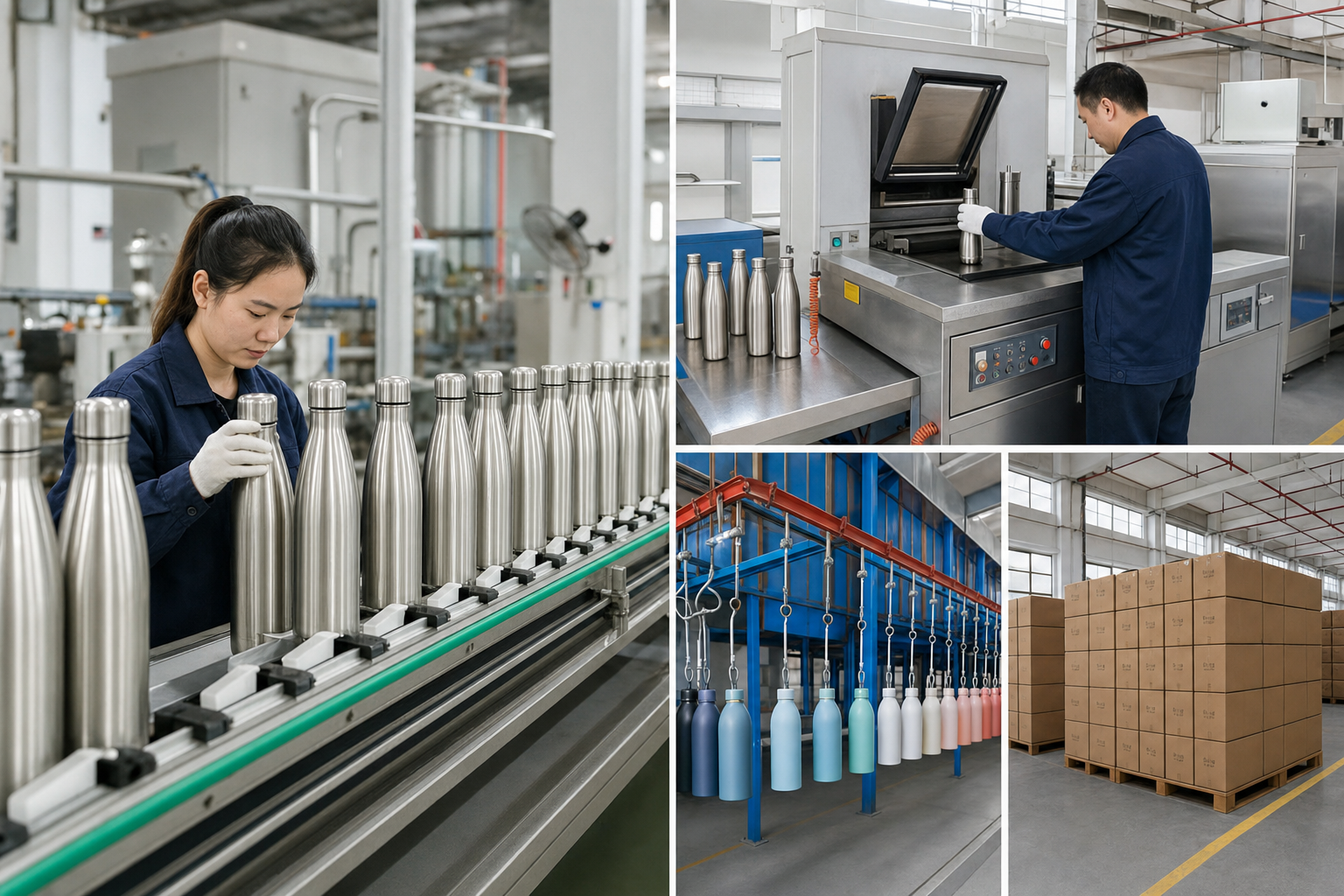
If you want a supplier who can handle stainless steel insulated water bottle branded programs, ask for sample photos from prior export jobs, not studio renders. Real production shots show coating uniformity, print alignment, and packaging condition. We keep a 12-head pad printer on the floor for logo checks, and that tells you more than a polished brochure ever will.
Get a factory quote with real specs
Send your capacity, target price, and branding needs. We’ll map the right bottle, test path, and production plan for your market.
Frequently asked questions
What is a normal MOQ for stainless steel insulated water bottle wholesale?
A practical MOQ is 3,000 units per SKU or per color for most wholesale programs. Some Zhejiang factories will accept 1,000 units if they already have the mold and you keep decoration simple, but the unit price may rise by USD 0.30 to 0.80. If you need OEM tooling, the MOQ often moves to 5,000 units or more because the factory needs to amortize mold and setup costs. For mixed lids or mixed colors, clarify whether the MOQ is per model, per color, or per print method before you approve the sample.
How much should I budget per unit FOB China?
For a standard 500 ml insulated bottle, budget about USD 3.20 to 4.50 FOB China with powder coat and one-color logo. If you want laser engraving, a premium lid, or gift packaging, the range usually moves to USD 4.80 to 6.80. Larger sizes, thicker 304 steel, or custom lids increase cost further. Freight, duties, and local warehousing are separate. For Europe and North America, landed cost can be 20% to 45% above FOB depending on carton volume and shipping mode.
What testing should a stainless steel insulated water bottle supplier provide?
At minimum, ask for material declarations, vacuum leak testing, temperature retention data, and coating or print adhesion checks. For export to Europe or North America, you usually want REACH support and food-contact documentation such as LFGB or FDA-related paperwork, depending on the market. AQL inspection should be defined in writing; AQL 2.5 for major defects and 4.0 for minor defects is a common starting point. If the supplier cannot explain the test method, treat the claim cautiously.
How long is production lead time for custom orders?
For existing molds and straightforward branding, expect 35 to 45 days after sample approval and deposit. During peak season, especially Q4, 50 to 60 days is safer. If you request OEM tooling, new lid development, or special packaging, add 20 to 30 days for tooling and sample iterations. Zhejiang factories with monthly output above 500,000 units can still run late if your order arrives after the production calendar is full, so book early.
Should I choose OEM, ODM, or private label?
Choose private label if you want speed and low risk. Choose ODM if you want a tested design with controlled changes to lid, color, or packaging. Choose OEM if you need a new shape or a brand-specific product that justifies tooling costs. OEM usually makes sense when your annual volume is 10,000 to 50,000 units or more. If your first order is smaller, private label or ODM is usually the smarter margin decision.