Key Takeaways
- MOQ for a custom stainless steel stainless steel bottle is usually 1,000-3,000 pcs, with 45-60 day lead times from approved sample.
- A 500 ml double-wall bottle typically lands at USD 2.40-4.80 FOB China depending on lid, finish, and decoration.
- Look for 304 inner steel, 201 outer steel for budget lines, or full 304/304 and 316 for higher-end stainless steel stainless steel water bottle wholesale programs.
- For export, ask for LFGB, REACH, FDA-related compliance docs, vacuum retention data, and AQL 2.5 inspection terms before you pay deposit.
If you are sourcing stainless steel stainless steel bottle wholesale for a brand, outdoor chain, or distributor, the hard part is not finding a supplier. The hard part is telling a real factory from a trading layer, then making sure the bottle you approve is the bottle that ships 45 days later. We see this all the time. In Zhejiang and across China, plenty of factories can quote in 24 hours. Fewer can keep wall thickness, coating adhesion, and vacuum performance steady across 5,000 or 50,000 units. QC pulled a sample last week at 0.45 mm and the buyer flagged the mismatch right away.
For B2B buyers, the commercial questions matter more than the product page: what is the MOQ, what grade of 304 or 316 stainless do you actually get, what is the FOB price at 1,000 vs. 10,000 units, and how much decoration can you add before the lead time slips. At BottleForge in Hangzhou, Zhejiang, we run stainless thermos programs at 300,000 units per month, so we see the same mistakes every week: unclear artwork, target costs that do not match the mold cost, and buyers who ask for private label but forget the test standard. One PO even came in with “stainless still bottle” typed three times. The math does not work.
What wholesale buyers really need
Buyers searching for stainless steel stainless steel bottle wholesale usually want three things: factory price that holds, compliance that clears, and branding that keeps margin alive. Simple on paper. Then the lid list grows. A 500 ml straight-body bottle with powder coating and a screw lid is not the same job as a 750 ml tumbler with a flip lid and silicone base, and the gap can be USD 1.20-2.00 per unit.
Start with the use case. If you sell outdoor gear, we run a wide-mouth stainless steel stainless steel tumbler with 6-8 hour hot retention and a dishwasher-safe finish. For corporate gifts, the buyer usually asks for a stainless steel stainless steel flask with laser logo and tight color control; one PO we saw had “loaser” on the artwork file, and the line caught it before engraving. If you are building retail, you need shelf appeal, carton fit, and private label packaging that survives ecommerce drops. This is the wrong question to ask if you treat it like a generic item. The spec sheet decides the margin.
What sourcing teams should check is the boring stuff: 0.4-0.5 mm body thickness, 18/8 stainless on the inner wall, cap fit within tolerance, and decoration that matches lot to lot. QC pulled the sample with a caliper at 72.3 mm because the buyer flagged a loose lid on the first round. A stainless steel stainless steel bottle supplier that sends one clean sample and then changes the wall structure on mass production is not a partner for the second order.
Factory or supplier: know the difference
Buyers often say they want a stainless steel stainless steel bottle manufacturer, then they send us a company card that belongs to a trading office with two sales staff and no line. That is not a bad thing by default. A solid supplier can still run the order if they own the factory slot, but you need to know who makes the bottle, who prints the logo, and who keeps the QC records. In China, especially in Zhejiang and the nearby factory belt, the difference gets blurred fast unless you ask for audit photos, machine lists, and the actual production flow. We’ve seen buyers miss this and get burned on a simple typo in the PO.
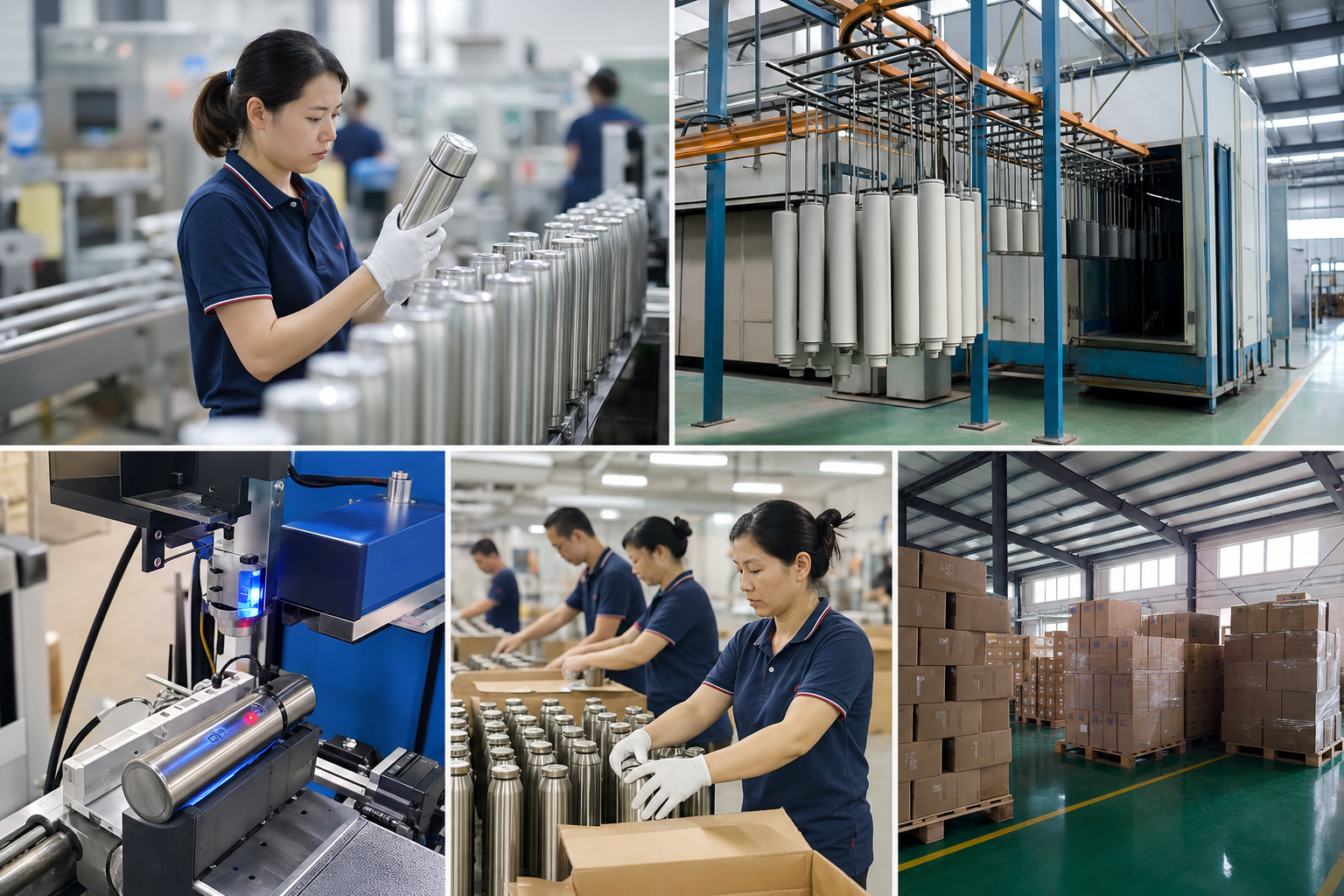
A real stainless steel stainless steel bottle factory should answer production questions without reading from a brochure. Ask how many forming lines they run, how many vacuum chambers are on the floor, and whether polishing and coating stay in-house. A true stainless steel stainless steel water bottle factory has numbers, not “large scale” talk. At our Hangzhou plant, monthly output is 300,000 units, sample turnaround is 7-10 days, and bulk lead time is 35-45 days after sample approval for standard builds. If they cannot name the bottleneck process, the line is being outsourced. The math does not work.
What you should verify
- Inner steel grade: 304 is the baseline; 316 is better for salty or acidic use cases.
- Vacuum seal performance: ask for hot/cold retention data on the actual model, not a generic claim.
- Inspection plan: AQL 2.5 is common for major defects; agree on cosmetic limits separately.
- Compliance: REACH for Europe, FDA-style food contact declarations for US buyers, plus LFGB if your retail channels demand it.
If you are buying stainless steel stainless steel bottle bulk for a chain or distributor, factory transparency matters more than a polished catalog. We ship a lot of repeat orders this way, and the difference between factory and supplier shows up on the first round of QC. A direct factory relationship usually saves 8-15% versus layered sourcing, but only if the factory can hold your spec and keep the records straight. One buyer flagged a 2 mm lid gap on a sample, and that saved a full rework later.
Materials and construction details
Buyers often chase volume and skip the build. Bad call. A stainless steel stainless steel bottle custom program lives or dies on wall structure, lid design, and weld consistency; on our line, QC checks the seam under a 10x loupe before we release sample packs. The usual build is double-wall vacuum insulated construction, with 304 inner and 201 outer steel for lower-cost retail SKUs. If you want a premium stainless steel stainless steel water bottle custom order, write 304/304 on the PO or move the inner wall to 316 when the use case really needs it. The price gap is real, and so is the durability gain.
Wall thickness is one of the easiest places to control cost and quality. Many export bottles sit at 0.35-0.45 mm. Drop below that and the bottle feels flimsy; go thicker and unit cost climbs, the bottle gets heavier, and forming defects show up on the neck ring. For a 500 ml insulated bottle, a finished weight of 260-340 g is normal, depending on shape and lid. We had one buyer push for 220 g, then the carton compression test started failing at 12 drops. If your product manager wants a rugged outdoor feel, a heavier bottle helps, but freight goes up fast for ecommerce.
The lid is where complaints start. A standard screw lid may cost USD 0.25-0.55, while a push-button or flip lid can add USD 0.40-0.90. A silicone gasket, PP cap body, or stainless cap insert all change leak resistance and how the bottle feels in hand. For stainless steel stainless steel flask programs, the stopper design often matters more than the bottle body, because leakage complaints usually come from the lid. Ask the stainless steel stainless steel bottle ODM team for exploded drawings before sign-off; we once caught a PO typo that said 50 mm gasket instead of 5.0 mm, and that saved a useless sample run.
Practical rule: if a supplier will not state the exact steel grade, wall thickness, and lid material in writing, do not move to mass production.
Wholesale pricing and MOQ logic
Buyers ask for one price. Wholesale never works like that. For stainless steel stainless steel water bottle wholesale, the unit price moves with order size, decoration, packaging, and whether you want OEM, ODM, or stock goods. A plain 500 ml vacuum bottle usually sits around USD 2.40-3.10 FOB China at 3,000 pcs. Add powder coating, laser logo, a color box, and a custom lid, and the same item can move to USD 3.40-4.80. We ran this exact quote last month on the line. If you want a gift set with an insert tray and retail carton, the math goes up again.
MOQ is not a magic number; it is a production efficiency threshold. For stainless steel stainless steel water bottle bulk programs, MOQ often starts at 1,000 pcs for stock shapes with a simple logo, and 3,000 pcs for new colors or custom tooling. True stainless steel stainless steel bottle OEM development usually needs 5,000 pcs per SKU if you want a custom lid or body mold. QC pulled the sample after a 2 mm lid gap showed up on the first pre-production run. If your buyer only needs 500 pieces, the wrong question is, "Can you match the low price?" The real issue is cost per unit and how much packaging flexibility you still have.
Do not compare offers by bottle price alone. Check the full landed cost: carton size, inner pack, outer carton strength, drop-test risk, and whether the product is set up for sea freight or air shipment. A stainless steel stainless steel bottle branded program can look cheap at FOB level and still get expensive once you add labeling, warning cards, and barcode application. We once found a PO typo on FNSKU placement, and the buyer flagged it before shipment. For Amazon or DTC, that label位置 matters because rework burns cash fast. This is where a stainless steel stainless steel bottle manufacturer with export experience saves real money, not just time.
Private label, OEM, and ODM choices
If you want a stainless steel stainless steel bottle private label line, do not mix up branding with product development. Private label means you pick an existing body shape and lid platform, then add your logo, color, and packaging. Faster, cheaper, fewer moving parts. OEM is a different job: you define more of the structure, and you may pay for molds, tooling, or a custom spray jig. ODM means the factory brings the design and you adapt it for your market. We see outdoor buyers choose ODM when they need a shelf line in 6-8 weeks, not a 6-month sketching loop.
A stainless steel stainless steel water bottle private label program is the usual entry point for North American and European buyers. You can often start at 1,000-2,000 pcs per color if the lid stays standard and the carton stays plain. We run 18 mm and 21 mm neck finishes on the line all day, and the buyer flagged it fast when they asked for a custom sleeve plus matte coating on the first order. That combo adds touch-up work and more reject checks. Approval has to be on the actual sample, not a rendering from a sales deck.
For Amazon sellers and chain retailers, the call is speed or uniqueness. Private label can move in 45 days. OEM usually runs 60-90 days if the mold or lid needs testing on a drop rig. ODM cuts design risk because the factory already knows what sells in China and export channels. A good stainless steel stainless steel water bottle supplier should tell you which route fits your margin, not push the highest-ticket option. We’ve seen this go sideways when a buyer asked for “custom” and the PO still had a typo on the lid color code.
Testing, compliance, and inspection
Compliance is not paperwork for legal teams. It is what keeps cartons from getting held, marketplace listings from getting flagged, and buyers from sending back a full container. For stainless steel stainless steel water bottle manufacturer sourcing, we ask for documents before the line starts: material declaration, coating safety statement, and third-party reports for REACH, LFGB, or food-contact claims when the market asks for them. Europe is simple on this point. LFGB and REACH need real files, not promises. For North America, buyers want food-contact support and low-odor materials, and we have seen a PO typo on “food grade” turn into a week of back-and-forth.
Inspection needs to be agreed before the PO, or the math does not work. Most export buyers use AQL 2.5 for major defects and AQL 4.0 for minor defects; for a premium SKU, we sometimes tighten that. The inspection list should cover leak test, vacuum retention, logo placement, lid torque, drop condition, and carton integrity. For a stainless steel stainless steel water bottle OEM order, we keep the golden sample and the pre-production sample on the shelf, then QC pulled the sample and checked first output against them one by one. It is basic work. It still saves arguments.
Ask for rust resistance and salt spray if the bottle is going to coastal stores or outdoor use. A good stainless steel stainless steel tumbler or flask does more than look clean on day one; it has to survive monthly use, dishwashing if that claim is on the spec, and the vibration in a truck linehaul. If the supplier says “no issue” but cannot show test data, we do not chase it. We stop there. We have seen that one go sideways too many times.
How to work with a China factory
Working with a stainless steel stainless steel bottle factory in China is straightforward if you treat it like an engineering buy, not a cart checkout. Start with a tight RFQ: 500 ml or 750 ml, target unit cost, insulation target, logo method, carton spec, destination market, and the papers you need. Leave out the lid style or packing standard and the first quote will look clean, then climb after sampling. We see that all the time. A buyer once sent a PO with “matte black bottle” and no cap code; QC pulled the sample, and the line stopped for 2 days while we clarified the lid.
In Zhejiang, a lot of factories run mature supply chains for lids, powder coating, cartons, and silicone parts. That helps speed. It also means QC has to be strict. Ask for production photos at three points: blank body forming, vacuum sealing, finished packing. For a stainless steel stainless steel bottle odm project, confirm who holds the design files and whether the mold fee is built into the unit price or billed separately. If you skip that, the math does not work on the second order. We usually see mold charges quoted at USD 1,200 to 3,500, and a 0.3 mm dent on the shell can still pass visual inspection if nobody sets the standard upfront.
Good factory communication is plain and direct. You want a stainless steel stainless steel bottle supplier who can say, “We can hit 35 days for 3,000 pcs, but not with a custom lid and embossed logo.” That answer is worth more than a cheap number. If you need sourcing support, work with a supplier that knows export labeling, compliance, and packing before production starts. We ship this way every week. A seasoned factory will catch a PO typo like “304 steinless” before it reaches the line, and that saves a week of back-and-forth.
Request your stainless thermos quote today
Send your target capacity, logo method, and market requirements. We will quote FOB China pricing, MOQ, and lead time within 24 hours.
Frequently asked questions
What is a normal MOQ for stainless steel stainless steel bottle wholesale?
For stock shapes with logo printing, MOQ is often 1,000 pcs. For new colors, custom packaging, or private label cartons, 3,000 pcs is more realistic. If you want OEM tooling or a custom lid, expect 5,000 pcs per SKU. A factory in China may accept smaller trial runs, but unit price usually rises 15-30%.
How much does a custom 500 ml stainless steel bottle cost?
A standard 500 ml double-wall bottle usually costs USD 2.40-3.10 FOB China at 3,000 pcs. Add powder coating, laser logo, and retail packaging, and it can reach USD 3.40-4.80. If you choose a premium lid, 316 inner steel, or gift packaging, the cost can go above USD 5.00. The exact price depends on the steel grade and decoration method.
What compliance documents should I ask for?
For Europe, ask for REACH and, when relevant, LFGB testing. For North America, request material declarations and food-contact support. You should also ask for AQL inspection terms, leak test data, and vacuum retention performance. If the bottle is sold as a premium insulated product, keep the test reports tied to the exact model and production batch.
What lead time should I plan for from a stainless steel stainless steel bottle factory?
For standard wholesale orders, plan 35-45 days after sample approval. Sampling usually takes 7-10 days. If you need custom tooling, a new lid, or a special finish, total lead time may extend to 60-90 days. In busy seasons, Chinese factories can add 1-2 weeks, so lock the spec early.
Should I choose OEM, ODM, or private label?
Choose private label if you want the fastest launch and a proven shape. Choose OEM if you need unique structure, size, or lid design and can accept higher MOQ and longer lead time. Choose ODM if you want a market-tested design with some differentiation. For most outdoor retailers, ODM gives the best balance of speed, margin, and shelf appeal.