Key Takeaways
- A workable supplier canteen quote starts with capacity, lid type, decoration method, and target order volume, not just a unit price.
- For most programs, 500 to 3,000 pcs is the practical MOQ range for a customized canteen, depending on tooling and print.
- Ask for compliance proof such as REACH, food-contact declarations, and AQL inspection terms before you confirm.
- A Zhejiang canteen factory with 300,000+ units/month can usually support tighter replenishment schedules than a small workshop.
If you are sourcing a supplier canteen for retail, corporate gifting, or distributor programs, price is only one line on the sheet. We look at material safety, print wear after 3,000 rubs, carton fit, and whether the line can keep a ship date when your forecast jumps from 5,000 pcs to 8,000 pcs. A lot of first-time buyers lose margin because they treat the canteen supplier like a commodity shop, then QC pulls the sample and finds a leaking lid, a loose gasket, or a carton that adds 12% to freight. We have seen a PO with the lid code typed wrong by one digit, and that small typo turned into a week of back-and-forth.
A practical canteen manufacturer should narrow the spec before quoting. For most buyers, that means confirming capacity, wall thickness, lid system, test standard, and whether you need a custom canteen or a stock body with custom decoration. On our side, we run the 48-cavity injection line and track MOQ, lead time, and monthly output before artwork lands. The wrong question is asking only for the cheapest unit price. The math does not work if the factory cannot hold 30-day replenishment or if the logo fails the tape test after inspection.
Start With The Actual Use Case
Before you compare canteen suppliers, pin down where the bottle will be used. A school-program distributor wants easy replacement and low breakage; a trade-show giveaway wants low unit cost and a lid that does not leak in a tote bag; an Amazon retail line needs cleaner packaging and fewer return spikes. Skip this step and you pay for a rubber base or vacuum wall nobody asked for, then QC is stuck handling claims later. On one line, QC pulled a 600 ml sample after a 1.2 m drop test cracked the cap hinge.
Start with daily use, drop risk, target price, and whether the buyer wants a custom growler-style shape or a traditional military-style canteen body. Then lock the size. Common capacities are 400 ml, 600 ml, 750 ml, and 1,000 ml. For a canteen distributor, a 600 ml or 750 ml format usually gives the best balance of perceived value and freight efficiency. For a canteen promotional campaign, a lighter body and simpler lid usually beat a premium double-wall build. The math does not work if the carton weight jumps by 18%.
You should also define the buyer profile. A canteen vendor selling to a brand owner needs tighter packaging control and barcode accuracy than a canteen distributor reordering blank stock. If you are building a canteen customized SKU for Europe or North America, ask whether the product needs a REACH declaration, LFGB-style food contact support, or carton testing for long transit. On one PO, the buyer flagged a "6000 ml" typo before we ran the line, and that saved a week of rework. The right answer depends on market, channel, and price point, not on what is easiest for the factory to run.
Do not ask for a generic quote. Ask for a quote tied to use case, target market, and expected monthly repeat volume. If the seller cannot map that back to lid type, carton count, and test method, the quote is noise.
Choose Material And Structure First
Material choice sets the rest of the job. A stainless steel canteen is still the cleanest starting point for most B2B runs because it takes abuse, keeps odor complaints down, and gives you a clear food-contact compliance path. On our side, the incoming QC table starts with the grade stamp and a quick check against the mill cert; if a PO says 304 but the sample tells a different story, the buyer flags it fast. For mainstream retail, 304 stainless is the normal call. Use 316 when corrosion is part of the brief, not as a marketing add-on. For a low-cost giveaway, single-wall plastic can work, but the wear life and perceived value are what they are.
Wall thickness matters more than most buyers expect. A thin shell looks fine in photos, then dents on the first carton drop and your distributor margin starts leaking out. We see this on the line all the time: a 0.4 mm body can pass a visual check, but the 1.2 m drop test tells the truth, and 0.6 mm buys you a lot more margin. Double-wall vacuum adds cost. That is the wrong question to avoid; if the buyer wants thermal retention and a stronger shelf story, the structure has to be set for that from day one. For a custom canteen, the forming depth, embossing, and target price all have to line up.
Caps and seals are where orders fail. A screw lid with a silicone gasket is usually the safer export spec than a loose-fit cap, and we have seen the line stop over a 1 mm thread mismatch that looked harmless in CAD. For sports or outdoor retail, ask for a leak test after assembly, not just before packing. We run a 50 kPa check on finished units, because a canteen customized design can look clean in renderings and still fail once the gasket compression is off. That is the kind of mistake that turns into a chargeback.
- 304 stainless: practical default for most canteen supplier programs
- 316 stainless: better for harsher use or higher-end positioning
- Single-wall: lower cost, lighter weight, simpler logistics
- Double-wall vacuum: better retail value and temperature performance
Decoration Must Survive Transit
Decoration is where a lot of canteen custom orders fail. A clean sample means nothing if the print scuffs in a 1.2-meter drop test, rubs in the carton, or washes off after 20 cycles. We ran a batch last month where the buyer flagged a faint logo edge after the line packed 800 units in a day. Silk screen fits one to three solid colors and keeps cost down. Laser engraving stays on stainless for good. UV print handles complex logos, but QC pulled the sample and checked adhesion on the curved shoulder before we approved it.
When you quote a canteen promotional run, ask the supplier for the print area in millimeters, not a marketing sketch. A logo can look fine on a mockup and still crash into the shoulder radius on the real bottle. We had a PO typo once, 35 mm became 53 mm, and the artwork had to be reset. For a canteen customizable program with multiple SKUs, lock one master file and confirm Pantone values before sampling starts. That is the right move, because re-orders get messy fast if you keep changing artwork.
Packaging is part of decoration durability. Individual polybags, egg-crate dividers, and export cartons cut surface rub, but they also change carton count and freight cost. A canteen vendor should give you carton dimensions, gross weight, and units per carton before you sign off on artwork. If the carton is 58 x 58 x 42 cm and weighs 18 kg, you need that number before the freight quote goes out. For retail or FBA, the spec should already cover scuff resistance, barcode placement, and outer box readability. We ship enough to know the math does not work if packaging is treated as an afterthought.
If your customer wants a custom growler or customized growler, test the finish on the exact base material. A dark powder coat on a textured bottle behaves differently from a polished shell, and that difference shows up fast at the line. Ask for an abrasion test, or at least a real rub test, before mass production. A canteen manufacturer that refuses to promise every method on every surface is usually the safer supplier. We see that as discipline, not a limitation.
Know MOQ, Price, And Lead Time
MOQ is not a bargaining trick. It comes from setup time, tooling, and the way we run the line. A serious supplier canteen quote should show whether the MOQ comes from body forming, cap tooling, print screens, or carton allocation. On a stock-bodied customized canteen, 500 to 1,000 pcs is normal. For a fully custom shape, 3,000 pcs or more is the real number because the mold cost has to be spread out. If a canteen factory offers 200 pcs on a complex design, the math does not work. We have seen that go sideways the moment QC pulls the first sample off the jig.
Pricing needs a clean breakdown. Ask for unit price, logo setup fee, sample fee, carton fee, and mold cost if the project needs it. On a standard 304 stainless custom drinkware item, the quote can move fast with color, lid type, and packaging. A FOB China price can swing by 10% to 25% depending on silk screen, laser engraving, or full-color print. At 300 pcs, that gap shows up immediately. The buyer flagged it on a PO once because the carton spec was typed as 24 pcs instead of 24 pcs per master carton, and that small typo changed the landed math.
Lead time has to be written down in steps. A factory in Zhejiang with 300,000 units/month capacity may still need 25 to 35 days for production if your artwork is final, and add 7 to 10 days if new tooling or packaging changes are involved. For export programs, budget another 20 to 40 days for ocean freight depending on destination. If your canteen suppliers only say “3 to 4 weeks,” push for a real schedule: sample approval, raw material buy, mass production, inspection, booking date. We run to that schedule on the line, not to a vague promise. A missed booking on the 40HQ can cost a week.
For repeat orders, ask the canteen manufacturer what can stay in semi-finished inventory. That is often the line between a stable distributor drinkware program and constant firefighting. A good supplier canteen partner will tell you what stays ready, what is seasonal, and what changes when stainless prices move in China. The wrong question is asking only for the lowest unit price. We have seen a 15-day reorder slip to 28 days because the lid insert was not stocked, and the buyer had to wait for a fresh run.
Inspect Quality Before You Ship
Quality control has to rest on measurable defects, not gut feel. We run AQL 2.5 for major defects and AQL 4.0 for minor defects unless your channel asks for tighter limits, and that gives both sides one clear yardstick. On the line, the inspector should check leakage, lid torque, finish consistency, print alignment, carton strength, and accessory count. For a canteen manufacturer shipping into Europe or North America, food-contact files and batch traceability belong in the QC pack from day one.
Leak testing is the first fight. A bottle that leaks at the cap thread or gasket will kill repeat orders fast, and we have seen buyers reject a full lot over one wet carton. Ask for a hot-fill or pressure test when the use case calls for it. For vacuum items, verify thermal retention with a real test method, not just a polished claim sheet. If the canteen is customized with a special coating, add rub testing and adhesion checks. QC pulled a sample with a loose gasket at 0.3 mm, and that kind of miss is the wrong question to ignore.
You also need packaging inspection. A weak carton can survive a truck run inside China and fail after 12 days on ocean freight, so this is where the math gets ugly. Carton compression, drop testing, and label accuracy are basic export discipline. If the canteen vendor ships mixed lots or barcode errors, your warehouse team will spend hours fixing what the factory should have caught, and a PO typo on the FNSKU turns into chargebacks. For Amazon and similar fulfillment channels, that means FNSKU confusion and avoidable fees.
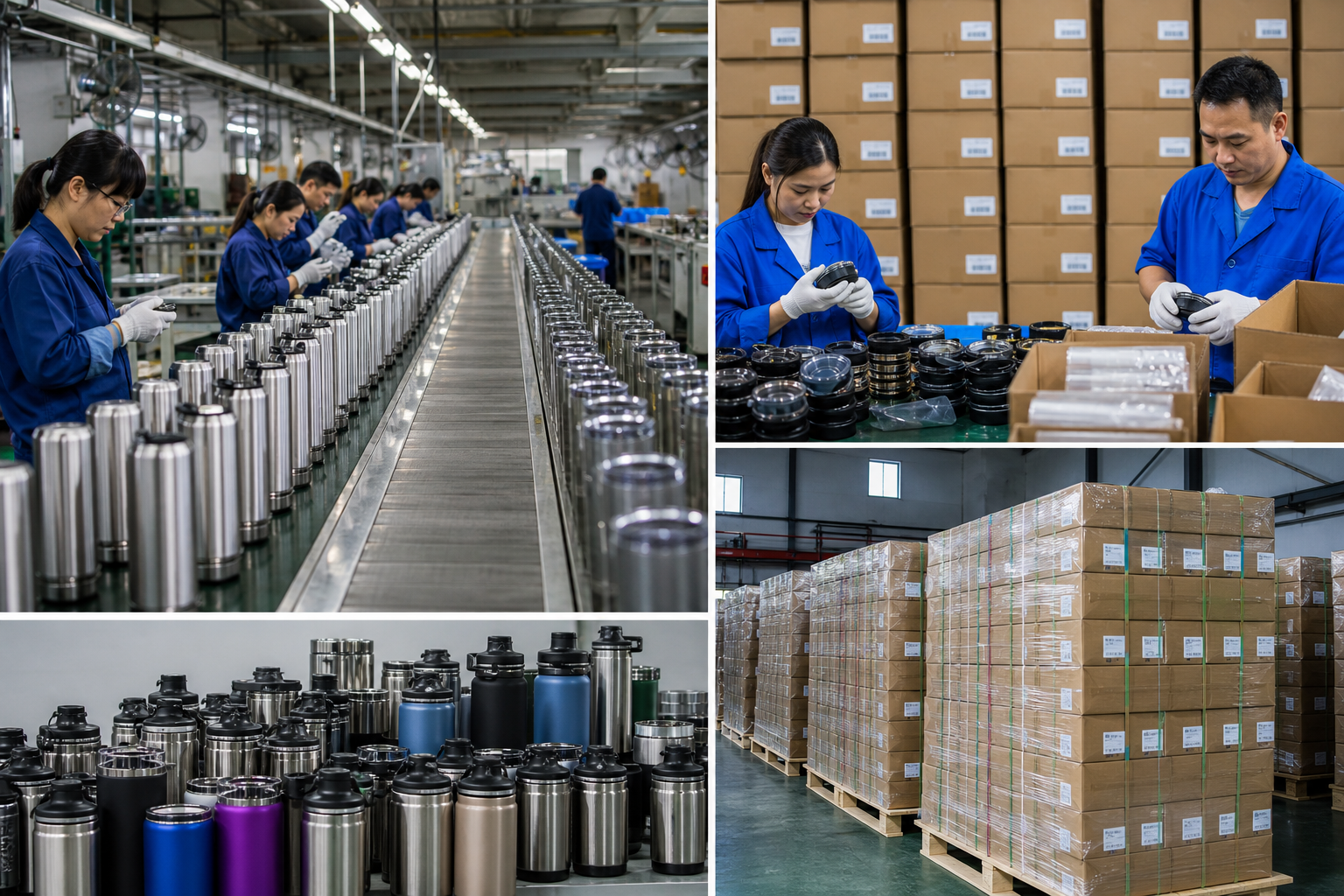
Work with canteen manufacturers that show process photos, QC records, and inspection reports. In Zhejiang and other parts of China, the factories that handle repeat B2B drinkware well are usually the ones that document everything. We ship that way because the line changes fast, and a missing photo or failed torque note tells you more than a sales promise ever will. This is not paperwork for its own sake. It is the cheapest way to stop one bad shipment from becoming your problem.
Work With A Zhejiang Factory
There is a clear gap between a trading middleman and a canteen factory that runs its own line. When you source from China, ask who controls raw material purchase, forming, welding, polishing, decoration, and final packing. A real canteen manufacturer can tell you why a 0.8 mm wall holds speed at 6,000 units a day while a 1.0 mm spec slows the press line. Move from one lid style to another, and the changeover time is usually the first thing that breaks the schedule. Zhejiang factories answer that because the region sits on a dense drinkware supply chain, with cartons, caps, and surface-treatment shops within easy reach.
Ask for proof, not promises. Request recent QC reports, compliance declarations, and a sample schedule before you release the first order. QC pulled the sample on one job and found a 0.3 mm print offset before packing, which saved a bad batch from leaving the floor. That is the kind of detail you want. If a canteen customizable body needs a new embossing line, expect extra polishing, a longer lead time, and a higher scrap rate. The wrong question is whether it is possible. The right question is where the risk sits.
For repeat business, you want a factory that can support both customized drinkware and distributor drinkware. The first needs branding flexibility. The second needs stable reorders, carton consistency, and fewer surprises on the pallet count. We ship some programs on a 1,000 MOQ and others on 20,000-piece cartons, and the line has to hold both without confusion. If the same supplier also handles custom growler or customized growler orders, that only matters if QC keeps the same standard across formats. Variety does not equal competence. We have seen that go sideways on a PO with a wrong lid code and one extra zero in the quantity.
China is still the practical base for this category because the supply chain is complete: stainless, caps, silicone, print shops, and export cartons are all close enough to keep lead time under control. On one export run, the buyer flagged a typo in the carton mark before loading, and that saved a 12-day delay at the port. But the difference between a smooth order and a painful one is not geography alone. It is whether the canteen supplier can turn your spec into a repeatable production plan, then keep the line honest when the next reorder lands.
Source your next canteen program with less risk
Send the spec, target price, and market. We will quote the right structure, decoration, and lead time from Zhejiang.
Frequently asked questions
What MOQ should I expect for a supplier canteen order?
For a stock-based customized canteen, MOQ is often 500 to 1,000 pcs. If you need a new mold, special lid, or non-standard shape, 3,000 pcs is more realistic. A small order may be possible, but the unit price usually rises 15% to 30% because setup cost is spread across fewer pieces. A good canteen factory will separate body cost, decoration cost, and packaging cost so you can see exactly what drives the total. If a canteen supplier quotes 200 pcs on a complex spec, ask whether the price includes tooling and test samples.
Which material is better for custom canteen programs?
For most B2B drinkware buyers, 304 stainless is the best default. It balances cost, corrosion resistance, and food-contact acceptance. Use 316 only when the customer wants a stronger corrosion margin or you are targeting a premium line. Single-wall aluminum or plastic can work for canteen promotional projects, but the perceived value is lower and durability is usually weaker. If you want a customized growler or premium custom drinkware piece, double-wall vacuum 304 stainless is the safer commercial choice. Always ask for material certificates and confirm the wall thickness, usually 0.4 mm to 0.6 mm for mainstream stainless programs.
How do I avoid leaking or print failure?
Treat leak performance and decoration as separate tests. Ask the canteen manufacturer to run cap torque checks, gasket inspection, and leak testing on every production lot. For decoration, confirm the exact print method, ink type, curing time, and surface finish. Laser engraving is permanent on stainless, while silk screen and UV print need adhesion checks. If you are ordering from a canteen vendor in China, request pre-production samples and a photo report before mass production. For export orders, add carton drop testing and scuff checks so the product survives transport from Zhejiang to your warehouse.
How long does production usually take in China?
A typical supplier canteen order takes 25 to 35 days after sample approval if the body and lid are already existing tooling. Add 7 to 10 days if you need new packaging, special coating, or new tooling adjustments. Ocean freight adds another 20 to 40 days depending on destination and season. A capable Zhejiang canteen factory with 300,000 units/month output can still miss your date if artwork is late or approvals drag. The most reliable projects start with a locked spec, approved sample, and a clear inspection date before the production order is released.
What documents should I ask for before paying?
At minimum, ask for a commercial invoice, packing list, product specification sheet, and compliance documents for food contact or REACH where relevant. If you need branded retail or FBA fulfillment, request carton dimensions, gross weight, barcode placement, and whether the product supports FNSKU labeling. For a canteen distributor program, it is also smart to ask for AQL terms and an inspection checklist. A serious canteen supplier should be able to show batch traceability, material declarations, and sample photos without hesitation. If they cannot, the risk is usually higher than the price savings.