Key Takeaways
- A serious supplier drinkware factory should quote MOQ, lead time, and test standards up front; for many custom canteen orders, 500 to 1,000 pcs is the practical starting point.
- 304 stainless, 316 stainless, Tritan, and borosilicate each solve a different use case; the wrong material adds cost without improving performance.
- Decoration method changes both price and durability; laser engraving, silkscreen, and UV print are not interchangeable for distributor drinkware.
- For Europe and North America, ask for REACH, LFGB, FDA, ISO 9001, BSCI, and AQL-based inspection records before you place a repeat order.
When you source supplier drinkware, the question is not which bottle looks best in a catalog. It is whether the factory can hold a cap torque spec at 0.8 to 1.2 N·m, keep coating adhesion after 50 dishwasher cycles, and still ship before a fixed launch week. On one 20,000-piece run, QC pulled the sample because the lid thread was off by 0.3 mm. That is where most programs break.
Good custom drinkware sourcing comes down to material choice, decoration method, compliance, and line discipline. We run factories in Zhejiang that can quote MOQ, lead time, and test reports without a song and dance, but the math has to work. If a buyer pushes for FDA and LFGB on a $1.10 bottle with a 15-day turnaround, the answer is usually no. A clean PO and a clear spec sheet save everyone from rework.
What Supplier Drinkware Really Means
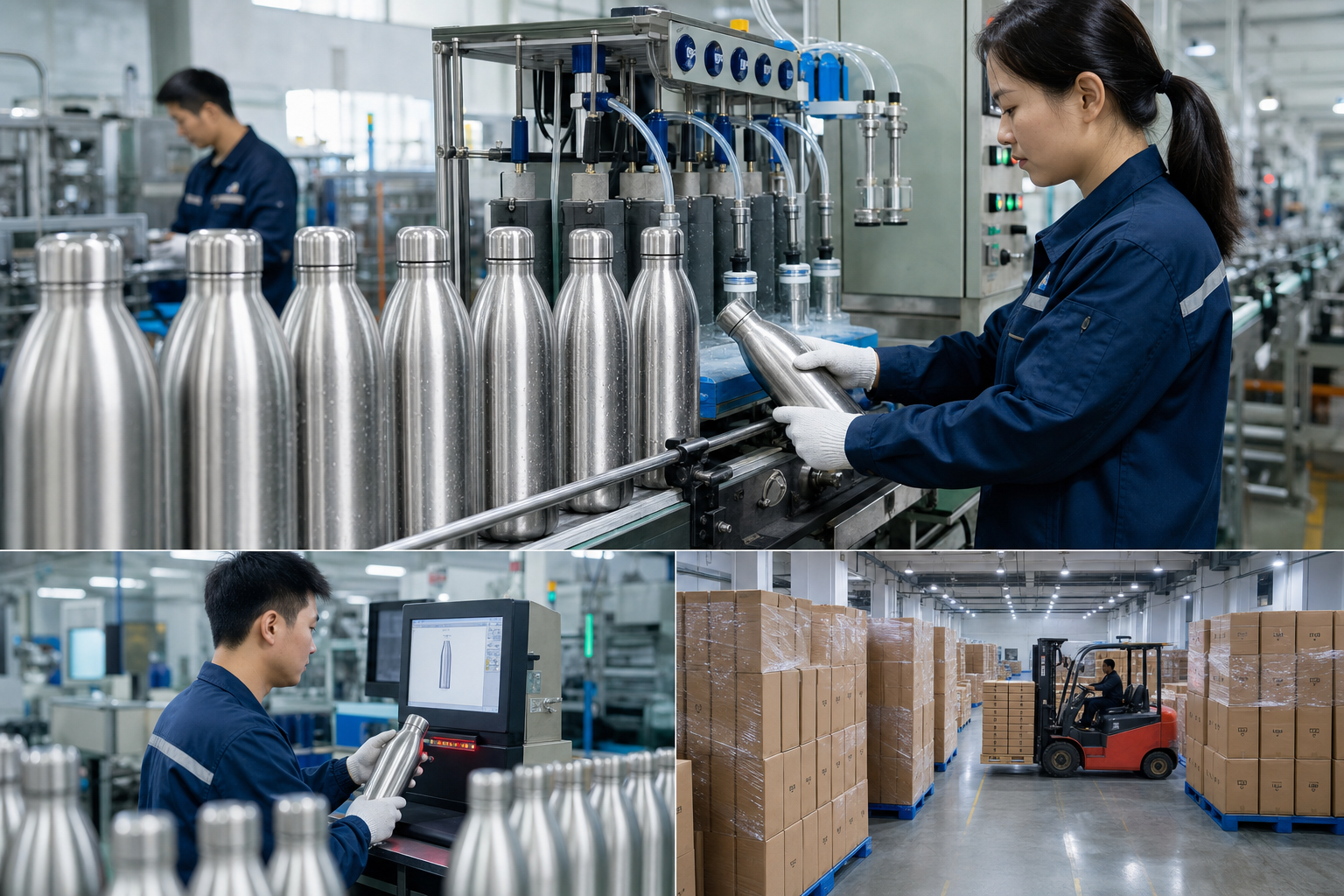
Supplier drinkware is a broad label, but in practice you are choosing between a factory, a trading company, and a vendor that only resells what it can source. That difference matters. A true canteen factory runs molding, welding, vacuum sealing, coating, and packing under one roof, and you can walk the line and see the TIG weld beads at 0.2 mm instead of guessing from photos. A canteen vendor may still be useful for a fast quote, but if you need a custom canteen with exact logo placement or a customized growler for retail, the chain of responsibility has to be clear.
For B2B buyers in Europe and North America, the first filter is not price. It is whether the supplier can answer basic process questions. Ask how they control weld strength, how they test lids, and whether they can send recent production photos from China, not a showroom shot with a polished sample table. In Zhejiang, a lot of canteen manufacturers do have real tooling and metalwork capacity, but we still see buyers get stuck with a middleman who cannot explain why the cap failed a 24-hour leak test.
If a canteen supplier cannot show you leak-test data, they are selling assumptions.
Before you request samples, check whether the supplier can support repeat orders, consistent color matching, and export paperwork. A canteen distributor needs inventory reliability; a brand owner needs the same Pantone from batch 1,000 to batch 10,000; a promotional buyer needs cost control on MOQ 3,000. Those are different jobs, so the supplier has to act like a manufacturing partner, not just a catalog sender. We have seen this go sideways over a one-digit typo on a PO.
Choose Materials By Use Case
Material choice sets price, weight, hand feel, and failure rate. On insulated custom drinkware, 18/8 stainless steel, usually 304, is our default. We run a 0.5 mm inner and outer wall on a standard vacuum canteen all the time. It holds up on the line, and it keeps the scrap rate under control. If the drink will carry citrus, vinegar, or see harsher cleaning, 316 is the safer call, but the unit price moves up. Ask only for the cheapest quote and the math does not work.
Tritan works well for lightweight, clear customized drinkware when the buyer wants a premium look without glass breakage. QC pulled one sample last month with a lid scuff after the drop test, and that is the sort of problem we expect to catch before shipment. Borosilicate fits laboratory-style or tea-focused glass bottle projects, but it is not the right answer for every distributor drinkware program. For a custom growler, lid torque and body thickness matter more than brochure copy. A 0.6 mm to 0.7 mm stainless body is usually a safer commercial choice than a thin shell that looks good in photos and dents on the first drop.
- 304 stainless: best all-rounder for canteen custom programs.
- 316 stainless: use when corrosion resistance matters more than cost.
- Tritan: useful for light, clear, customizable drinkware.
- Borosilicate: better for glass bottle projects and tea applications.
Do not let the marketing term customizable canteen hide the real specification. Ask for steel grade, wall thickness, coating type, and lid gasket material. We had one PO with a typo on the gasket material, and the buyer flagged it only after the carton labels were printed. Those four details tell you more than a glossy render.
MOQ, Lead Time, and Price
Most buyers ask for the lowest price first, but MOQ and lead time decide whether the order can ship at all. For a standard custom canteen, MOQ usually starts at 500 to 1,000 pcs per color and logo setup. If you want full packaging customization or a new mold, the minimum can jump to 2,000 pcs fast. That is normal. The line still needs a screen frame, a jig, and setup time, and those costs do not vanish because the order is small.
In our Zhejiang factory, monthly output is about 300,000 units, so we run mixed orders without stopping the line for every PO. QC pulled the sample on a Tuesday morning, checked the neck finish, and sent it back when the logo sat 2 mm off center. For stock models with a simple logo, lead time is often 20 to 35 days after sample approval. For new tooling or complex surface treatment, plan on 45 to 60 days. If a supplier says 7 days for a fully customized canteen, the buyer is being shown existing stock and the math does not work.
Price is a stack of decisions. Sample fees are often USD 30 to 80. Printing plates may add USD 40 to 120. New molds can run USD 800 to 3,000 depending on complexity. FOB terms are cleaner for experienced importers because they separate product cost from freight and duty. We have seen POs stall over a typo on the carton count, so ask for tiered pricing at 1,000, 3,000, and 5,000 pcs and check where the breakpoints really are.
Branding That Survives Use
Decoration is where supplier drinkware programs often cut cost in the wrong place. A logo that looks clean on day one and starts flaking after six weeks is a warranty problem, not a design win. For stainless steel canteens, silkscreen is still the lowest-cost route for one or two colors. Laser engraving costs more, but the mark is cut into the surface and holds up. UV print works for complex artwork, but the line needs tighter control, and it is not the right call for a hard-use custom canteen. On our side, we usually run a 50-piece abrasion check before we release a new print setup.
For a canteen customized for retail or a canteen promotional giveaway, match the decoration method to the channel. If the bottle sits on office desks, silkscreen is usually enough. If it will be carried by field teams, outdoor users, or distributor drinkware accounts, laser or a durable powder coat with engraving is the safer call. For a custom growler, check lid branding and sidewall branding separately; wear is different, and the buyer flagged that point on a 2024 PO because the lid logo rubbed first. That is the wrong place to guess.
Ask the canteen manufacturer for real samples from previous runs, not digital mockups. Check edge sharpness, color registration, and how the logo holds after abrasion. QC pulled a sample last week with a 0.3 mm registration shift, and the base finish had ring marks around the logo. A good custom-logo process keeps the coating intact, because finish damage is usually the first sign the process is drifting.
Quality Checks You Should Demand
Quality control is not a slogan. It is a checklist with numbers on it. For export orders, ask whether the factory works to ISO 9001 and BSCI, then ask which inspection level goes on the lot. AQL 2.5 for major defects and 4.0 for minor defects is a normal starting point for consumer drinkware, but the paper means nothing if QC does not pull the sample. We ask for batch traceability on every order; once a buyer found a PO typo on a 5,000-piece run, the cartons had to be relabeled before the truck left.
For Europe, REACH and LFGB are the documents buyers ask for first. For North America, FDA food-contact compliance is common, but the exact resin and coating still need to match the claim. Leak testing should be 100 percent on critical models, not random only. A real canteen factory runs vacuum retention checks, drop tests, and thermal cycling on the line. Our baseline is 12 to 24 hours of thermal retention verification and 5 to 10 drop cycles on agreed test samples. The math does not work any other way.
- Ask for material certificates before mass production.
- Require pre-shipment photos of packaging and carton markings.
- Confirm gasket material and lid torque on every lid style.
- Request retained samples from the production lot.
For canteen suppliers that claim broad export experience, the test reports should be easy to share. If they are not, we have seen this go sideways, and the buyer usually ends up paying for a second round of testing at the port.
Pick The Right Factory Partner
The cheapest supplier drinkware partner is usually the wrong bet. What you want is the factory that keeps repeat orders steady and catches trouble before it turns into a claim. We run into this all the time: QC pulled a sample off the line and found a 1.5 mm cap gap, and that one small miss would have become a leak case in transit. So compare canteen suppliers on three things only: process control, export experience, and response speed. A canteen manufacturer with real engineering support can explain why a cap leaks, why a coating chips, or why one carton spec fails a freight test. A canteen vendor who only forwards messages cannot.
Use a hard checklist. Can they run standard models and custom canteen projects on the same production line? Can they handle canteen distributors who need mixed SKUs and different logos in one shipment? Can they take sample revisions without turning every change into a new project? We had one buyer flag a PO typo that switched 500 pieces to the wrong lid color, and the factory that handled it well fixed the file, rechecked the barcode labels, and kept the schedule. If the answer to those questions is yes, you are dealing with a factory that understands commercial buying, not product flipping.
For long-term distributor drinkware programs, ask for after-sales rules before the first order lands. Spell out replacement terms for leaks, print defects, and carton damage. A serious supplier should give you a written response window, a defect handling process, and a repeat-production plan. We have seen this go sideways when a buyer waited until after shipment to ask, then spent 12 days arguing over a cracked lid and 18 days waiting for a reprint. If you are buying customized drinkware for several regions, a Zhejiang factory with stable QC and clean export paperwork saves real time. The wrong question is whether the unit price is 3 cents lower.
Compare every option against the same standard: material, MOQ, lead time, testing, decoration, and service. Keep it commercial. That is where supplier drinkware decisions belong, and that is where weak factories get exposed fast. We ship off one sheet, one sample, one carton test, and the numbers tell the story.
Request a custom drinkware quote today
Send your logo, target MOQ, and market standard, and we will quote the right canteen custom option for China or Zhejiang production.
Frequently asked questions
What MOQ should I expect for custom drinkware?
For most supplier drinkware projects, a practical MOQ starts at 500 to 1,000 pcs per style and per logo setup. If you want a full custom canteen with a new mold, the minimum can move to 2,000 pcs or more because tooling and setup are fixed costs. For canteen promotional orders with one-color printing, some factories will accept 300 pcs, but the unit price is usually too high to support distributor margins. Ask for tier pricing at 1,000, 3,000, and 5,000 pcs so you can see the real breakpoints. If the supplier cannot explain why the MOQ exists, they may not be a real canteen factory.
How long does a custom canteen order take?
A standard custom canteen order usually takes 20 to 35 days after sample approval if the supplier is using an existing mold and a simple logo. New tooling, special coatings, or custom packaging often extend the timeline to 45 to 60 days. If you are buying from China, shipping time is separate from production time, so build in another 7 to 35 days depending on destination and lane. For a canteen distributor with a launch date, the safer move is to approve artwork early and freeze the spec before production starts. Late changes are the fastest way to lose a week or more.
Which logo method lasts longest on drinkware?
Laser engraving usually lasts the longest on stainless supplier drinkware because the mark is physically removed or altered, not just printed on top. Silkscreen is cheaper and works well for simple one- or two-color branding, but it can wear faster under abrasion or aggressive washing. UV print gives strong visual impact for detailed artwork, though it needs better process control and is more sensitive to surface prep. For a custom growler or a canteen customized for field use, I would usually choose laser engraving or a durable powder coat plus engraving. If the product is a canteen promotional giveaway, silkscreen may be the better cost tradeoff.
Can you support Europe and North America compliance?
Yes, but you should verify the exact documents for the specific model, not just the factory. For Europe, REACH and LFGB are the common requests for food-contact drinkware. For North America, buyers often ask for FDA food-contact support, plus material data and coating details. A capable canteen manufacturer in Zhejiang or elsewhere in China should also be able to show ISO 9001 or BSCI, depending on your audit needs. For custom drinkware programs, I would also ask for leak-test records, retained samples, and AQL inspection notes. Compliance is not a single certificate. It is a set of controls tied to the exact material and decoration method.
What files and samples do you need before production?
Start with a vector logo file in AI, EPS, or PDF format, plus the Pantone color if you need a strict match. If the artwork includes gradients or fine lines, tell the supplier early because some canteen suppliers cannot hold those details at production size. You should also confirm bottle capacity, lid type, coating finish, and carton requirements before sample approval. A serious factory will usually send a blank sample first, then a decorated sample, then a pre-production sample if the project is complex. For distributor drinkware orders, that extra step saves expensive mistakes later. If the sample already leaks or the logo is off-center, do not rush the order.