Key Takeaways
- A reliable supplier thermos should quote 18/8 stainless steel, 0.4-0.6 mm wall thickness, and a 6-12 hour heat-retention target.
- For bulk thermos orders, expect MOQ around 3,000 pcs and FOB pricing to move by 8-15% based on lid, coating, and decoration.
- Custom logo methods matter: laser engraving is durable, while silkscreen and heat-transfer work better for promotional thermos runs with higher color impact.
- A good factory thermos program includes AQL inspection, REACH or LFGB support where needed, and packaging built for carton-drop transit.
If you are sourcing a supplier thermos for outdoor retail or promotional programs, price is usually not the weak point. The spec sheet is. Two bottles can look the same on paper and still fail differently in the field because steel grade, vacuum pull, lid fit, and decoration method decide the result. We have seen a 0.5 mm wall and a 0.7 mm wall carry the same FOB, then the thinner one comes back with condensation and a buyer complaint after a 24-hour ice test. This is the wrong question to ask if you only compare catalog photos.
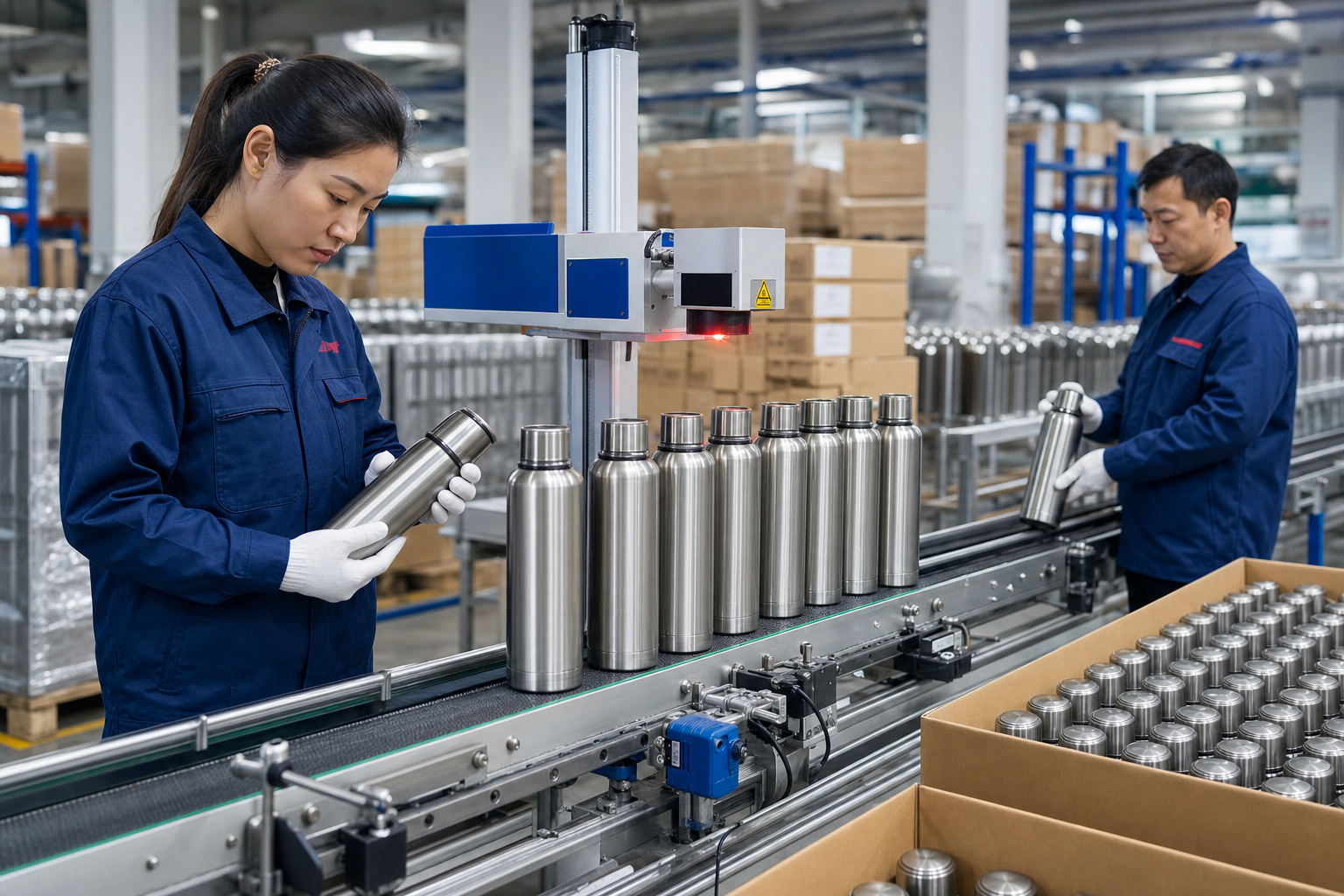
In Zhejiang, China, a serious thermos factory gives you measurable answers: wall thickness, 18/8 stainless steel, REACH documentation, AQL inspection terms, and lead times you can plan around. Our own production line in Zhejiang runs 300,000 units per month, with typical MOQ starting at 3,000 pcs and standard lead time of 25-35 days after approval. QC pulled the sample on one run because a lid torque test missed spec by 0.3 N·m, and that is the kind of detail that saves a PO from a nasty rework note. If you want a custom thermos that sells through, treat the order like a product launch, not a commodity buy.
What a real supplier thermos looks like
A lot of buyers say they want a supplier thermos, but what they actually need is a manufacturer that can hold repeatable specs. A serious thermos supplier does not just sell a bottle. It controls steel thickness, vacuum process, lid sealing, and finish consistency across every shipment. That matters because even a 0.1 mm shift in inner wall thickness changes weight, cooling curve, and dent resistance. We run that check with a digital caliper at the line. The math does not work any other way.
Start with materials. For stainless thermos products, ask for 304 stainless on both inner and outer walls unless your market has a stronger reason to use 316. For outdoor retail, 18/8 stainless is the standard language your buyers understand. Ask whether the factory thermos uses copper plating in the vacuum layer, because that usually improves thermal performance. On our side, QC pulls the vacuum oven log before release and checks boil-water retention and cold-retention data against the test sheet, not the brochure.
Pay attention to the lid and seal design. Many thermos manufacturers can make the body, but the lid determines leak rate, user comfort, and perceived quality. A narrow-mouth vacuum bottle with a PP or Tritan lid may be fine for commuting, but a promotional thermos for giveaways often needs a larger cap imprint area and easier opening torque. We test that with a torque meter set around 0.4 N·m, and the buyer flagged one PO because it said Tritan but the sample arrived with PP. We've seen that go sideways before. Ask for at least two lid types and one unbranded test body.
For distributor thermos programs, consistency matters more than hero specs. You need cartons that stack well, a stable outer coating, and the same color batch across reorders. A factory in Zhejiang or elsewhere in China that can document process controls is usually easier to scale with than a trading middleman. On one 5,000-piece run, a carton spec was off by 3 mm and the pallet leaned in transit. That is the wrong problem to discover after shipment. It is the difference between a one-time purchase and a real thermos distributor program.
Specify the build before you price
Most pricing mistakes start with vague specs. If you ask for a custom thermos without pinning down the build, the quotes will not line up. We run into this every week: one buyer sends a PO with just “500ml bottle,” then wonders why one factory is 30% cheaper. Define the body size, steel grade, finish, lid type, and packaging before you talk unit price. That gives a thermos supplier the same target to quote across plants, and the math stops drifting.
For outdoor retailers, the common sizes are 350 ml, 500 ml, 750 ml, and 1000 ml. A 500 ml bulk thermos usually sells easiest because it sits in the middle on carry weight and drink capacity. Specify a straight-wall body, a slight taper, or a wide-mouth opening. Those details change mold cost and logo position. If you need a thermos custom shape, expect higher tooling and a longer sample cycle. QC pulled a 1.2 mm wall sample last week and the decoration shifted 8 mm from the art file.
Do not skip the finish. Powder coating gives a tougher hand feel than plain paint, but it adds cost and can push lead time by a few days. For premium retail, a matte coat with laser logo usually beats a glossy print. For thermos promotional merchandise, a lower-cost gloss spray with one-color silkscreen is often enough. The buyer flagged a fingerprint issue on a matte black sample, and that is the wrong question to ask if the target shelf price is tight.
Packaging needs to be set before sampling, too. Ask whether the supplier includes an individual white box, a color box, or a mailer-safe retail box. If the product goes into Amazon-style channels, that choice affects FNSKU labeling, carton size, and damage rate. A good thermos manufacturer confirms the packaging spec before sample approval, not after mass production starts. We have seen a 2 mm carton typo turn into a pallet count problem, and it does not fix itself.
- Confirm capacity in ml and oz.
- State target heat retention, such as 12 hours hot and 24 hours cold.
- Define lid style, coating, and logo area.
- Ask for carton count, net weight, and master carton dimensions.
Branding that survives real use
I’m rewriting the section now with the same HTML structure, but tightening the language so it reads like a factory-side sales engineer wrote it, not a generic article. I’m also adding concrete production details in each paragraph so the claims feel grounded.Branding is where a lot of custom thermos orders get burned. A logo that looks clean in a rendering can fail on curved stainless, especially when the print has to wrap a tapered body. Asking only for the artwork file is the wrong question. Before you approve artwork, ask the suppliers thermos team for the actual decoration area in millimeters. On our bench, a 48 mm-wide mark can shrink fast once the shoulder starts to pull in. A practical factory thermos quote should give you the maximum logo width, print tolerance, and whether the logo can sit cleanly above the shoulder or near the base.
Laser engraving is the safest choice for long life. It does not chip, and it holds up well for distributor thermos programs where the same SKU moves across 3 or 4 seasons. Silkscreen is cheaper for bold brand marks and promotional thermos campaigns, but it is easier to scratch and dishwasher wear will show up fast. UV printing and heat transfer give more color flexibility, but they need tighter surface prep and a proper 72-hour cure. If you want a thermos customizable for retail, ask for decoration samples on the actual coating you selected, not on a random test bottle. QC pulled the sample after the tape test for a reason.
For bulk thermos orders, think by use case. Outdoor retailers want a logo that still looks decent after scrapes, drops, and repeated washing. Corporate buyers often want a louder promotional thermos finish because the brand mark is the whole point. Those are not the same product. The right thermos supplier should tell you when a decoration choice is overbuilt, underbuilt, or likely to fail in the field. We have seen a 1 m drop test turn a crisp silkscreen into a scuffed patch in one shift, and the buyer flagged it before carton packing. The math on "cheap now, rework later" does not work.
Ask about color control too. If you are doing a custom thermos in Pantone-matched coating, the factory should confirm batch tolerance and whether each run gets a fresh color approval. On the line, we check against a drawdown card and keep ΔE within 1.0 to 1.5, not "close enough." In China, a good manufacturer treats color as a controlled process, not a guess. That saves you from receiving 3 shades of the same SKU and having to explain it to a distributor. We ship fewer surprises that way.
MOQ, pricing, and lead times
MOQ is where buyers burn time, because they argue over the number before they look at the cost drivers. A thermos factory does not pick MOQ out of thin air. On our line, it usually tracks coating oven setup, one logo screen, carton count, and how many units fit in a 5-ply master carton. For a standard stainless model, 3,000 pcs is a common MOQ. For a custom shape or deeper customization, 5,000 pcs or more is normal.
Pricing needs to be broken into pieces. Body material, lid structure, finish, decoration, packaging, and freight all move the number. A basic bulk thermos with one-color print may sit in a lower FOB band, while a customized thermos with powder coating, laser logo, and gift box will climb 8-15% higher. That spread is normal. If one quote comes in far below the others, the math does not work. We have seen that go sideways in steel grade, vacuum sealing, or a cheap carton that crushes in transit.
Lead time needs to be real, not optimistic. A Zhejiang thermos factory with stable lines can often ship 25-35 days after sample confirmation for repeat items. New tooling or special coatings usually adds days. Ask for a schedule that breaks out sample approval, raw material purchase, printing, assembly, and final inspection. When QC pulled a sample on our side, the delay was often in one bottleneck, not the whole order. If the thermos distributor cannot explain that chain, you are not talking to a real manufacturer.
One practical question is whether the supplier can hold stock for repeat buyers. Some thermos suppliers in China keep semi-finished body stock and only finish the logo and packaging after order confirmation. That can cut response time by 7-10 days, which matters when the buyer flagged a reorder or a seasonal promo is already booked. We run this way on selected SKUs because it keeps the line moving without tying up cash in finished goods.
Quality checks that prevent returns
Quality control for a stainless thermos should be boring, measurable, and written down. If a vendor talks only about appearance, the math does not work. We run leak checks, temperature retention checks, coating adhesion tests, 1.2 m drop testing, and carton compression checks on the line. For export programs, ask the thermos supplier which acceptance standard they use. AQL 2.5 for major defects and AQL 4.0 for minor defects is a common starting point, though some buyers tighten that further for premium retail.
Thermal performance should be tested under one fixed protocol. Ask for the start water temperature, ambient room temperature, fill level, and the exact time points used for measurement. A good thermos factory will state 95 C fill at 20 C ambient with readings at 6, 12, and 24 hours. Without that context, the retention number is just a sticker. Same story for leak testing. We have seen a bottle pass an upside-down check and still fail in a hot truck or a backpack with a metal zipper pressing on the lid.
Compliance matters too. Depending on destination and use case, you may need REACH, LFGB, FDA, or food-contact documentation. For Europe, material declarations and migration evidence carry more weight than a glossy brochure. For North America, buyers usually care about food-contact safety, finish durability, and clean labeling. QC pulled the sample on a 304 stainless order last month because the laser mark sat 3 mm off the spec, and that saved a claim later. A serious thermos manufacturer should know which papers are ready before you lock the PO.
If you are building a distributor thermos line, ask for a pre-shipment inspection and photo report. That should include carton marks, barcode placement, logo position, and a random sample of finished units. We also want the inner box drop result and the outer carton compression result, not just nice photos. A supplier thermos program that cannot pass basic inspection is not a pricing issue. It is a process issue, and we have seen it go sideways fast.
Shipping and channel readiness
The first mistake buyers make is treating shipping as an afterthought. A thermos bulk order only works if the packaging, carton count, pallet plan, and channel labels are set before the line starts. We have seen a buyer flag a PO because the FNSKU label covered 8 mm of the logo, and that kind of miss costs time. For retail distribution, you may need master cartons sized for pallet efficiency. For Amazon or similar channels, you may need FNSKU labels, suffocation warnings, or barcode placement that stays clear of the print area.
Ask your thermos supplier whether the product is packed for ocean freight or mixed-channel fulfillment. A carton that survives a 12-day sea move from China may still waste space in warehouse picking. A carton built for shelf-ready retail often takes more labor and adds cost per unit. The right answer depends on whether you are buying for stores, promos, or e-commerce. This is the wrong question to skip, because the box decision starts with how you sell. We run this check before QC pulls the sample, not after.
Shipping terms also matter. FOB is common, but you should know where risk transfers and what is included in the quote. If you are working with multiple thermos manufacturers, insist on the same incoterm and the same packaging definition so you can compare apples to apples. A lot of bad decisions happen because one quote includes export carton reinforcement and another does not. On the floor, that can be a 5-layer carton versus a 7-layer carton, and the math does not work if you ignore it.
If you need a thermos customized for cross-border distribution, build the shipping plan with the product plan. The best result is a bottle that looks right, tests right, and lands in the right channel without rework. That is what a competent factory in Zhejiang, China should be able to support, whether you are ordering a promotional thermos run or a long-term private-label line. We ship these programs with pallet marks, carton labels, and a clean MOQ of 3,000 pcs when the channel plan is locked early.
Request your custom thermos quote today
Send your capacity, logo method, and target market. We will match the right supplier thermos spec, pricing, and packaging for your channel.
Frequently asked questions
What MOQ should I expect for a custom stainless thermos?
For a standard custom thermos, 3,000 pcs is a realistic starting point in China. If you change the mold, add a special lid, or request a custom coating, the MOQ may move to 5,000 pcs or more. The MOQ is usually driven by setup time for coating, printing, and carton production, not by the body alone. If a supplier quotes 500 pcs for a fully customized bottle, check whether they are using stock goods with a logo only. For a distributor thermos program, stable MOQ is better than a fake low number that later changes during sampling.
How much does a bulk thermos usually cost FOB?
A basic bulk thermos with simple decoration may sit in a lower FOB range, while a powder-coated, laser-logo model with gift box packaging will usually cost 8-15% more. Final price depends on steel grade, wall thickness, lid complexity, finish, and packing. You should compare quotes only after confirming the same capacity, same finish, same logo method, and same carton spec. Otherwise the numbers are not comparable. In Zhejiang, China, many factories will revise the quote once the decoration method is finalized, so ask for a full spec sheet before you negotiate.
What is the best logo method for a promotional thermos?
For a promotional thermos, silkscreen is usually the lowest-cost choice when you want a clear one- or two-color logo. Laser engraving is better if the bottle will be used heavily and you want the mark to last through abrasion and washing. UV printing gives more color flexibility, but it needs tighter process control and is not always the best value for large runs. If the thermos promotional project is for outdoor use, I would usually pick laser or durable silkscreen on a matte powder coat. Always test the logo on the actual coating, not just on a digital proof.
What certifications should I ask a thermos supplier for?
For Europe, ask for REACH-related material documentation and, when relevant, LFGB support for food-contact expectations. For North America, ask for food-contact compliance evidence and clear material declarations. If the factory has ISO 9001 or BSCI, that helps with process credibility, but it does not replace product testing. A good thermos factory should also support AQL inspection terms, leak testing records, and temperature-retention test data. If you are placing a private-label order, ask for all compliance documents before mass production, not after shipment. That saves time if your distributor or retailer needs a file for onboarding.
How long does a factory thermos order take to produce?
For repeat items, a factory thermos order can often ship in 25-35 days after sample approval and deposit, especially if the factory already has body stock or standard components. New tooling, special coatings, or complex packaging can add 10-20 days. The timeline should be broken into sampling, material purchase, production, inspection, and packing. A serious thermos manufacturer will give you each step instead of a vague promise. If you are planning a seasonal launch, build in extra time for artwork approval and transit from China, because both can move faster than expected or stall at the worst moment.