Key Takeaways
- A serious canteen factory should quote MOQ, lead time, and packaging details up front; 3,000 pcs and 25-35 days is common for custom orders.
- For export, ask for REACH, LFGB or FDA where relevant, plus AQL 2.5 sampling and documented leak testing.
- 18/8 stainless steel with 0.4-0.6 mm wall thickness is a safer default than thin, low-grade metal for customized drinkware.
- The best canteen suppliers can show in-house decoration, assembly, and capacity of 500,000 units per month without overpromising.
If you are comparing suppliers canteen options, the real question is not who gives the lowest unit price. It is who holds thickness within 0.2 mm, passes your drop test, and still ships on time when the distributor asks for a second order. We have seen a canteen custom program go sideways because the factory guessed on material gauge, closure fit, or print wear after 500 cycles.
In Zhejiang, you can find plenty of canteen suppliers. The split between a workable canteen manufacturer and a risky canteen vendor shows up in the first sample: weld marks, lid seal, coating evenness, and whether the factory can explain its AQL plan without looking at a cheat sheet. QC pulled the sample on a caliper at 2.8 mm, and that is the level of detail buyers should ask for. If you buy custom drinkware for retail, promotion, or a distributor program, this is the wrong question to ask: do they sound cheap, or can they ship the same spec twice?
Start With Factory Reality
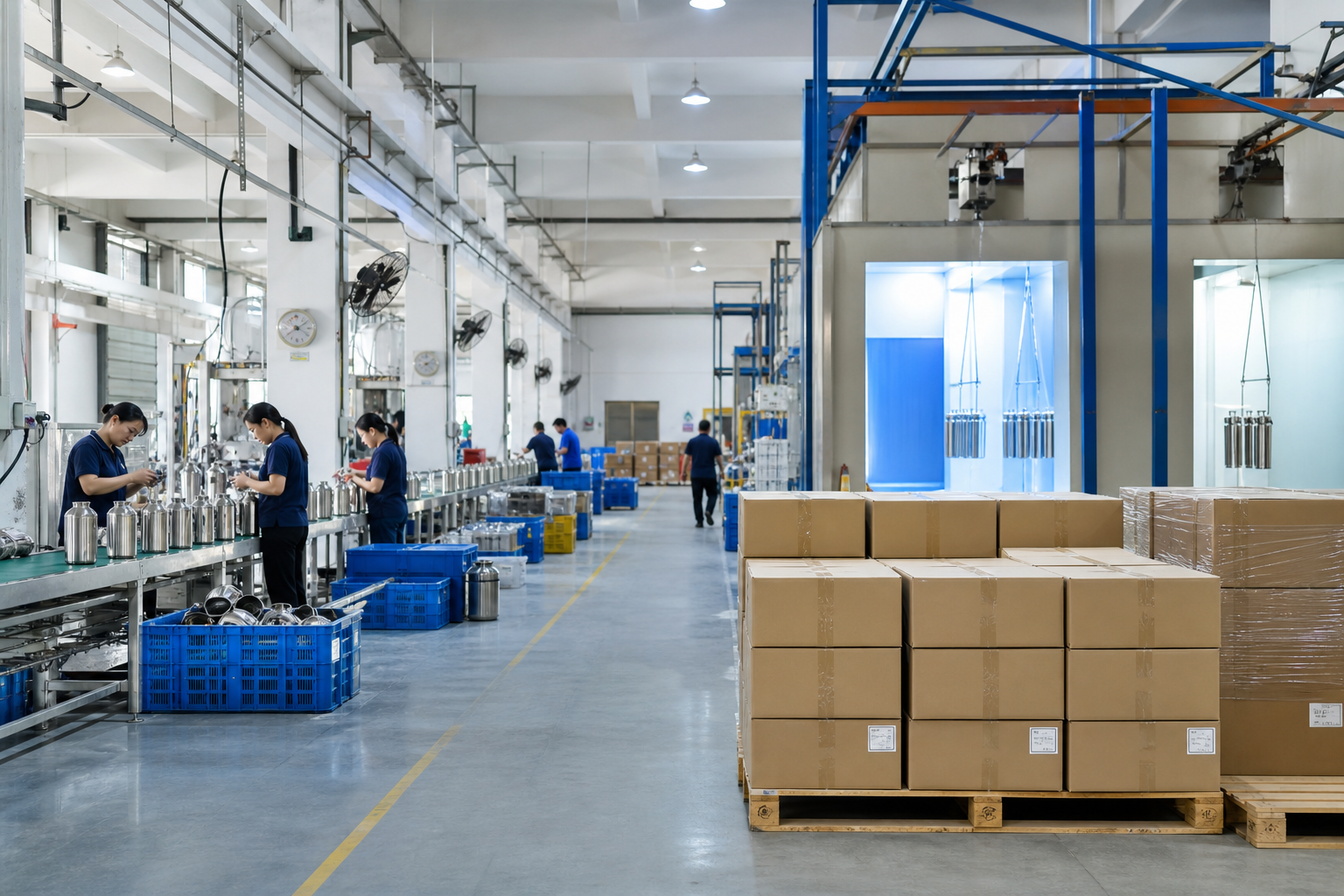
When you evaluate suppliers canteen candidates, start with factory reality, not catalog copy. Ask where the canteen is made, who owns the tooling, and whether the plant is a real canteen factory or a trading layer pushing work to someone else. In Zhejiang, we run into both. The good plants answer in numbers: 500,000 units per month, 18-minute changeover, 1.8% defect rate, and what happens when the buyer flags an artwork typo after sample approval.
A serious canteen supplier should talk through the line, not just the brochure. If a factory says 500,000 units per month, ask how that splits across body forming, welding, coating, and packing. We had one buyer push back on a claimed lead time after QC pulled the sample from packing with a 0.6 mm print shift; the math did not work. If you need canteen customized for a distributor canteen program, check whether the plant can lock capacity for repeat orders instead of treating you like a one-off. For China sourcing, that beats a polished sales deck every time.
- Ask for MOQ by model, finish, and packaging.
- Confirm sample lead time, normally 5-10 days for existing tooling.
- Verify whether the plant offers OEM, ODM, or both.
- Request a production flow chart, not just product photos.
If a canteen vendor cannot explain how it controls batch consistency, assume rework, delay, and customer complaints after launch. We have seen this go sideways on a 304 stainless order where the weld bead looked fine on photos but failed the gauge check at 2.2 mm.
Choose The Right Material
Material choice decides whether your custom canteen ships as a solid retail item or looks like a throwaway promo piece. On our line, 18/8 stainless steel is still the safest base because it holds up against corrosion, stays food-contact friendly, and forms cleanly without ugly stretch marks. For wall thickness, we usually start at 0.4 mm to 0.6 mm, then pick the end of that range based on size and shape. A flat canteen, an insulated bottle, and a custom growler body do not behave the same in a drop test. Go thinner only after you have checked dent rate and carton damage on a real freight run.
A canteen customized for Europe needs a REACH check. For direct food-contact orders, ask the canteen supplier for material declarations, migration test reports where they apply, and the supporting files tied to FDA or LFGB if your market needs them. We have seen buyers try to save 3 cents on the shell and then eat the cost later when QC pulled the sample for coating pinholes. That is the wrong question to ask. On a 100,000-unit distributor drinkware order, a 2% coating failure rate means 2,000 bad units, and the math does not work.
What to specify in the RFQ
- Steel grade: 304 or 316 if corrosion resistance matters.
- Wall thickness: 0.4-0.6 mm, with a tolerance band.
- Finish: matte powder coat, glossy paint, or bare metal.
- Lid material: PP, Tritan, or stainless depending on use.
Opinionated rule: if the supplier will not state thickness tolerance and coating spec in writing, the quote is too loose for serious procurement. We had a PO last month with "0.5mm" typed as "0.05mm" on the buyer side, and the line caught it before tool-up. That kind of typo turns into scrap fast.
Decoration Should Survive Use
Decoration is where a lot of canteen suppliers overpromise. A custom canteen can look clean in sample photos and still come back scuffed after 2 weeks in a gym bag or on a warehouse shelf. We run screen print for simple logos with solid coverage, laser engraving when the mark has to stay put, and heat transfer when the artwork has 3 or 4 colors and the buyer accepts tighter process control. On the line, QC checks logo edge bleed at 0.2 mm, because that is where cheap jobs start to slip.
For canteen customizable projects, ask the canteen manufacturer how it tests decoration durability. The right question is not “Can you print this?” It is “What does the print look like after 50 or 100 rub cycles, and what happens after repeated washing?” That is the question that matters. If your buyer sells through distributor drinkware channels, returns eat margin fast. A decorated custom drinkware item that survives field use costs less than a cheaper unit that triggers warranty claims. We have seen this go sideways when a buyer approved a sample with a 12 mm logo, then sent a PO with a typo that moved the mark 8 mm too low. For retail, ask for side-by-side samples with the exact logo size and placement before you release the order.
For a canteen vendor in China, the best sign of discipline is a clear decoration matrix: logo type, color count, minimum line width, and whether the plant recommends one-process or two-process finishing. If the table is vague, the decoration will be vague too. We ship better results when the spec says 1-color silk screen, 2-color transfer, or laser on the same drawing. That is how you avoid empty promises and get a product that still looks decent after freight, shelf handling, and rough end-user use.
Test Quality Before You Scale
Quality control belongs in the sourcing decision, not after the first complaint lands in your inbox. On a proper canteen line, QC pulls incoming material with calipers, checks weld seams in-process, and closes the lot with AQL sampling. For most programs, AQL 2.5 for major defects and AQL 4.0 for minor defects is a fair starting point, but put the acceptance standard in the purchase order. The buyer flagged it once on a 1,200-piece run: one carton had coating pinholes and a lid gap of 0.8 mm, and the argument was simple because the PO already had the limit.
Leak testing is not optional. Ask for a documented pressure test or inversion test on every batch, especially for insulated bodies or screw-cap canteens. We run that check with a torque gauge and a 24-hour water hold, then we log the result by lot. If your buyer is in Europe or North America, ask for carton drop testing, salt spray data when the finish matters, and a clear food-contact compliance statement. “QC passed” is too vague. You want the test sheet, retained samples, and batch traceability, or the math does not work.
Watch how the factory handles nonconforming goods. A supplier worth your time will tell you whether they rework, scrap, or quarantine the lot, and how much gets rechecked after that. On one line, QC pulled a 50-piece holdback after a valve mismatch, and that saved a distributor program from a return wave. This is the wrong question to ask if you only want a cheap unit price. For distributor canteen and distributor growler orders, one hidden defect can wipe out a seasonal order.
- Set AQL levels in the contract.
- Require batch photos before shipment.
- Keep one golden sample signed by both sides.
- Confirm replacement lead time before you place the order.
Match Packaging To Your Channel
Packaging changes the cost of a custom drinkware program more than most buyers expect. A canteen promo run for a trade show can ship in a plain polybag with an insert card, but retail and e-commerce need a tougher carton, barcode placement that scans first time, and enough crush protection for the line. We had a buyer flag a 1 mm fit issue on a sample tray and the whole pack-out changed. If you work with a canteen distributor, ask straight whether the pack needs shelf display, direct-to-consumer fulfillment, or palletized wholesale. Those are different jobs.
A practical canteen supplier should quote inner boxes, master cartons, and carton dimensions in the first round. If you sell on Amazon or another marketplace, the pack also has to work with FNSKU labels and shipment prep. For a custom canteen going into North American retail, ask for ISTA-style transit assumptions, even if the factory does not run full lab certification in-house. QC pulled the sample on a 600 mm drop because the corners were soft, and that saved us a claim later. This is the wrong question to ask if you wait until after production starts. Design for the shipping environment now, or pay for 3% damage later.
China-based canteen suppliers often chase unit price and ignore what weak packaging does downstream. Do not let that slide. A heavier box, a tighter insert, and a clean barcode label can cut damage claims faster than a minor material upgrade. We ship with 3 mm insert clearance for a reason. In Zhejiang, the better factories treat packaging as part of the product, not an add-on, and the ones that miss this usually send a PO with a barcode typo and call it “close enough.”
Packaging checkpoints
- Master carton strength and drop risk.
- Retail barcode and FNSKU placement.
- Gift-box or display-box requirement.
- Pallet pattern and export mark rules.
Negotiate Like A Buyer
Good procurement is not about grinding the supplier on price until the welds fail. We run better programs when the commercial terms match the real volume. If you expect repeat orders, set a price ladder at 1,000, 3,000, and 5,000 pieces, then write down what happens if the forecast moves 20% or 30%. A Zhejiang factory prices tighter when the buyer shows a PO trail, a carton spec, and a shipping month, not a loose inquiry.
Ask for a written quote that separates tooling, sample charges, unit price, packaging, and shipping terms. For custom growler or customized drinkware variants, tooling is often the real project cost, especially if you need a new lid, a special handle, or a unique body shape. We once saw QC pull a sample and the lid thread was off by 0.4 mm; that kind of miss gets expensive fast. If the canteen vendor hides tooling inside the unit price, the math does not work. For FOB China quotes, confirm the port, the validity period, and whether the price assumes one artwork version or multiple SKUs.
Use a simple rule: if two canteen suppliers differ by less than 8% on unit price, choose the one with better documentation, stronger sample control, and a clearer replenishment plan. The cheapest offer usually turns into the messiest order once delays, defects, and relabeling hit the line. We've seen a buyer flag a one-digit typo on the PO and the cartons had to be reprinted; that cost more than the price gap they fought over.
Request a canteen quote with real specs
Send your target MOQ, logo method, and market standards. We will map the right custom drinkware setup for your channel.
Frequently asked questions
What MOQ should I expect for a custom canteen order?
For most canteen custom projects, a realistic MOQ is 3,000 pcs per color or per SKU, though simple shapes can sometimes start lower if the factory already has tooling. If you need a new mold, expect separate tooling charges and a longer sample cycle. In Zhejiang, many canteen manufacturers can turn samples in 5-10 days and mass production in 25-35 days after approval, provided artwork is final. For distributor drinkware programs, I would not judge the supplier only by MOQ. Check whether they can repeat the same color, coating, and logo placement on the second order without drift. That matters more than shaving 500 units off the first run.
Which material is best for a customized canteen?
For most buyers, 18/8 stainless steel is the practical default for a customized canteen. It gives you decent corrosion resistance, acceptable forming, and broad food-contact acceptance in China, Europe, and North America. A wall thickness of 0.4 mm to 0.6 mm is a normal working range, depending on whether the product is lightweight promotional or heavier retail-grade. If the item will see aggressive use, choose a powder-coated exterior and a lid with a tested seal. I would only move to 316 stainless when your use case justifies the extra cost. For a canteen supplier, the key is not the alloy name alone; it is whether they can keep thickness tolerance stable across batches.
How do I check if a canteen supplier is reliable?
Start with documentation. A reliable canteen supplier should provide factory profile, audit reports if available, material declarations, sample lead times, and a clear QC plan. Ask whether they operate under ISO 9001 or BSCI, and how they handle AQL inspection. Then look at the sample: lid fit, weld consistency, coating finish, and leak performance. If the factory claims 500,000 units per month, ask how much of that is actually your category and how much is unrelated drinkware. A real canteen factory in China will answer without hiding behind generic sales language. If the answers stay vague, treat that as a risk signal.
What certifications matter for Europe and North America?
For Europe, REACH is a baseline concern, and LFGB-style food-contact expectations may be requested by your customer depending on the channel. For North America, FDA-related food-contact compliance is commonly asked for, along with traceable materials and testing records. You should also ask about BSCI or similar social audit coverage if your retailer requires it. Certification alone is not enough. You still need batch control, AQL sampling, and documented leak testing. On a canteen customized program, the factory should be able to provide reports tied to the exact material and decoration method you ordered. Generic certificates not linked to your product are weak evidence.
Can I use the same factory for canteen and custom growler orders?
Sometimes, yes, but only if the factory has the right forming, welding, and decoration equipment. A canteen manufacturer that handles custom growler work usually has stronger metal forming capability and better lid sourcing. Still, do not assume every canteen factory can move between a flat canteen, a insulated bottle, and a custom growler without a cost and timing penalty. Ask for a process map and confirm whether the tooling is shared or separate. If you are buying as a canteen distributor, shared capacity can be useful, but it also creates scheduling conflict if the supplier overcommits. Keep each SKU's lead time and packaging separate in the PO.